The Rape of Ganymede – attitudes to rape in Ancient Literature
The right wing press (the dailies Mail, and Telegraph) and GB News, and only they, are doing their best to continue the attitude of culture war and making news stories about ‘woke’ attitudes and their effect on freedom of speech. Their latest target is related to content-based ‘trigger warnings’ issued by The University of Exeter to students on their course module Women in Homer. Top of the list of antiwoke warriors is Boris Johnson, armed with his reputation as a defender of the literature of the classical Western world and a contested ability [the level of ability is contested by Mary Beard and Edith Hall] to recite from memory numerous lines from the opening of Homer’s The Iliad.
I imagine Boris, in his own imagination as he reads of ‘arms and the man’, rising from his bed in the camp of Achilles, like Patroclus fresh from healthy imaginations of intercrural sex delivered by Achilles, for that is what Aeschylus imagined worthy of the sexual life of his heroes in a fragment of his lost play The Myrmidons, and wondering what the fuss is about that Homer’s attitude to women is being queried. The Daily Mail reported Johnson as saying that the warnings were “absurd”.
MSN with no false shock describes those anodyne warnings as advising learners ‘that they may encounter “uncomfortable and challenging” material, particularly concerning infant mortality, rape, and sexual violence in texts like the Iliad and the Odyssey‘. Boris wonders whether ‘students are now considered too “feeble-minded” to engage with classic literature, and is reported to continue:
‘Are they really the most quivering and pathetic students in 28 centuries of Homeric studies?’
But as Edith Hall and Mary Beard warn us, Johnson’s claim to understand the reception of Homeric or other classical is thinly evidenced, to say the least. He is reported as believing that in the centuries during which the works were discussed ‘never once has there been a suggestion that they might be in some way psychologically damaging to the reader’ and that Exeter University should withdraw its absurd warnings.
‘Are they really saying that their students are so wet, so feeble-minded and so generally namby-pamby that they can’t enjoy Homer?’, he muses.
Johnson is, of course, quite wrong. Even at the height of Classical reception of Homer in the fifth and fourth centuries BCE, the origin of the Academy in the schools of Plato and Aristotle respectively were discussing psychologically unhealthy content in the Homeric myths or versions of them, since for them Homer was merely a 8th century BCE version of the myths, if tbe most authoritative of them.
Hence , when the great artist, soldier, and citizen, Aeschylus, imagined the relationship between Achilles and Patroclus, he imagined the former as the lover of the latter, since mutual love was a concept forbidden to him to posit given the fact that both were grown men and that mutual love between adult men was considered degrading. Patroclus’ death is mourned by Aeschylus’ Achilles as that of a beloved one having rejected the ‘awesome ritual of our thighs’ and the lover’s kisses. The former phrase about thighs is a reference to intercrural sex according to Eva C. Keuls, in her book of 1985, The Reign of the Phallus.
If Aeschylus thought the idea of mutual love between these heroes was anathema and required context revision for his play The Myrmidons (Μυρμιδόνες, Myrmidónes),from the lost Achilleis (/ˌækɪˈliːɪs/; Ancient Greek Ἀχιλληΐς, Achillēís trilogy now only in fragments), then Plato, in his version of an Academy, thought Aeschuylus had created an even more shocking version of the story by making Achilles represent the role of the active ‘lover’ and Patroclus that of the passive ‘beloved’. Keuls cites The Symposium. Note that the text she translates makes it quite clear that Plato, at least (and he is no inconsiderable example – although rarely invoked by Johnson) thought Aeschylus’s content revision of the story as in Homer was in ‘some way psychologically damaging to the reader’.
Aeschylus talks nonsense when he says that Achilles was in love with Patroclus, because he was not only more beautiful than Patroclus, but also the most beautiful of all the other heroes. He was, moreover, still beardless and younger by far, as Homer says.
Symposium as cited by E.C. Keuls (1985: 289) ‘The Reign of the Phallus: Sexual Politics in Ancient Athens‘ Berkeley, The University of California Press. I give the full title here because a reader made the mistake from my earlier reference of believing that ‘The Reign of the Phallus’ was the subtitle of Boris Johnson’s dire autobiography ‘Unleashed’, or his description of his premiership in that book. Boris has no such insight into his comic reputation.
Far then from failing to see dangerous content about which vulnerable minds need warning, the Greeks of the High Classical period saw many dangers in wanton representations, such as Plato saw in Aeschylus’s representations of Patroclus and Achilles. It matters who does what erotically and romantically with whom. This made certain depictions of appearance matter immensely. Look at the reproduction of a Sosias red-figure ceramic painting below. This 5th century BCE representation carefully follows Plato’s description of the pair, with the younger beloved tending to his role-model male lover.
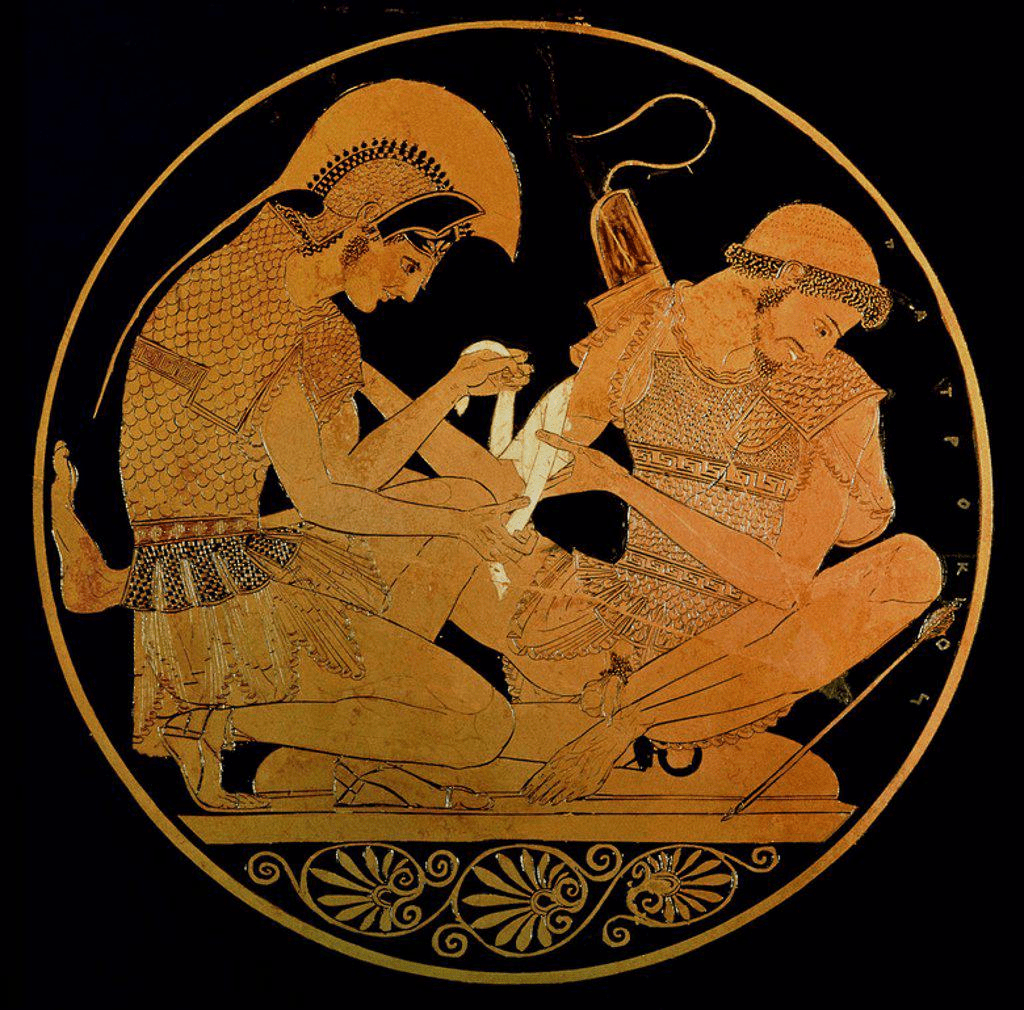
SOSIAS (VASE PAINTER). From a vase at CHARLOTTENBURG. BERLIN. GERMANY, depicting Achilles as beardless and tending his man PATROKLOS.
To draw the scene above otherwise would be psychologically damaging for, as Keuls shows, only despised men (such as the democratic politician Cleisthenes whom the aristocratic-leaning Aristophanes describes as “with gaping ass-hole”) or barbarians submitting to Greek superior masculinity would accept male sexual attention to which they were passive.
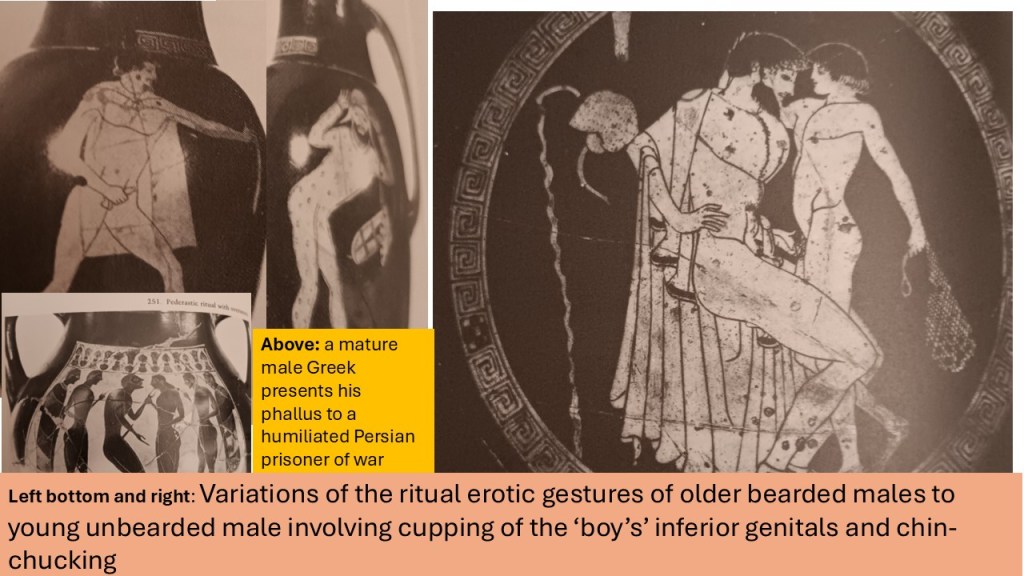
Our view of what is psychosexually healthy is almost, especially in relation to eroticism between males, almost the inverse of the Greek view. Unhealthy desire in men for Classical Greece is that which submits to another male’s power as a man. Such submission might be acceptable in a young beardless male who can be thought to be receiving healthy attention from a male who admires his face and gropes his genitals but is not so in a mature man accepting the sexual attention of another mature man.
Aristophanes satirised men he didn’t like, like the arch-Democrat Cleisthenes, as men still accepting passive sex after maturity. See that below in the excerpt from his The Frogs, with its plays upon genital size and purpose.
Dionysus
And while I was on board, reading
the Andromeda, suddenly a craving
smote my heart, you'll never guess how strong.
Heracles
A craving? How big?
Dionysus
Small, like Molon.
Heracles
For a woman?
Dionysus
Oh no.
Heracles
A boy?
Dionysus
Not at all!
Heracles
A man?
Dionysus
Argh!
Heracles
You did it with Cleisthenes?
Dionysus
Don't make fun, brother, I've really got it bad,
Such passionate desire torments me so.
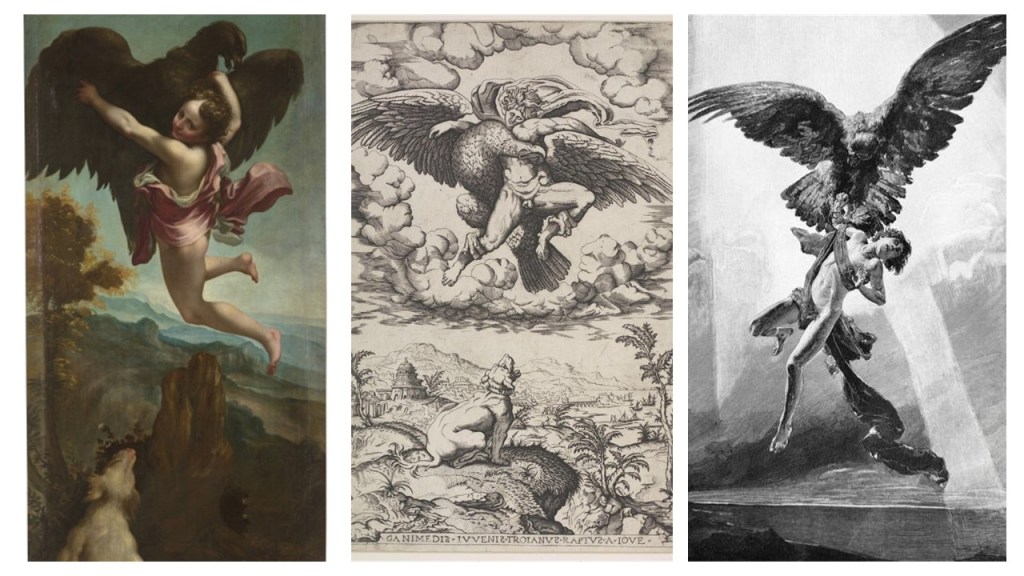
It is unlikely that we will hear Plato or Aristophanes called ‘woke’ because they thought some things should not be represented or represented only under certain conditions, but it is certainly true that attitudes to rape in Greek society were not those of our contemporary society. It was condemned, as in the rape of the young man Chryssipus by King Laius, the father of Oedipus, but it could also be celebrated as in the case of the myth of Zeus abducting the young man Ganymede – a ritual very like some of those shown above, where the right of power to take over the beauty of another is exonerated.

In the historical reception of the myth attitudes to male rape and pederasty have played over the trope of Zeus and Ganymede as in examples in my first collage above, Rembrandt’s view being the most obscure. In a course on ‘Women in Homer’, it feels appropriate to look at the attitude implied by rape in the conquest of Troy and in the story of Briseis. A strong feminist take like Pat Barker’s does not see these raped women as solely ‘victims’ for she endows them with strength – see my blog on the last of these at https://livesteven.com/2024/09/07/real-unreal-inner-outer-always-debatable-land-to-her-he-sees-his-dead-daughter-whats-that-if-not-a-disputed-boundary-this-is-a-blog-about-pat-bark/. But even Pat Barker, no simple ‘woke’ figure’, puts content warning into her representations – a warning that not all that Homer invoked is easy to digest in the light of female experience, or indeed of boys and girls raped by fathers and father figures.
Boris Johnson is an ‘ass’ if not a Cleisthenian ‘ASS-HOLE’. One reason that Boris Johnson refuses to see as problematic the validation of male power in patriarchy in sexual situations with the less powerful is that his own history does sometimes require a content-warning, especially if, as is possibly not the case in Unleashed, if the truth were told.

With love
Well perhaps let’s exempt Boris
Steven xxxxxxxxx
 Steve_Bamlett_blog