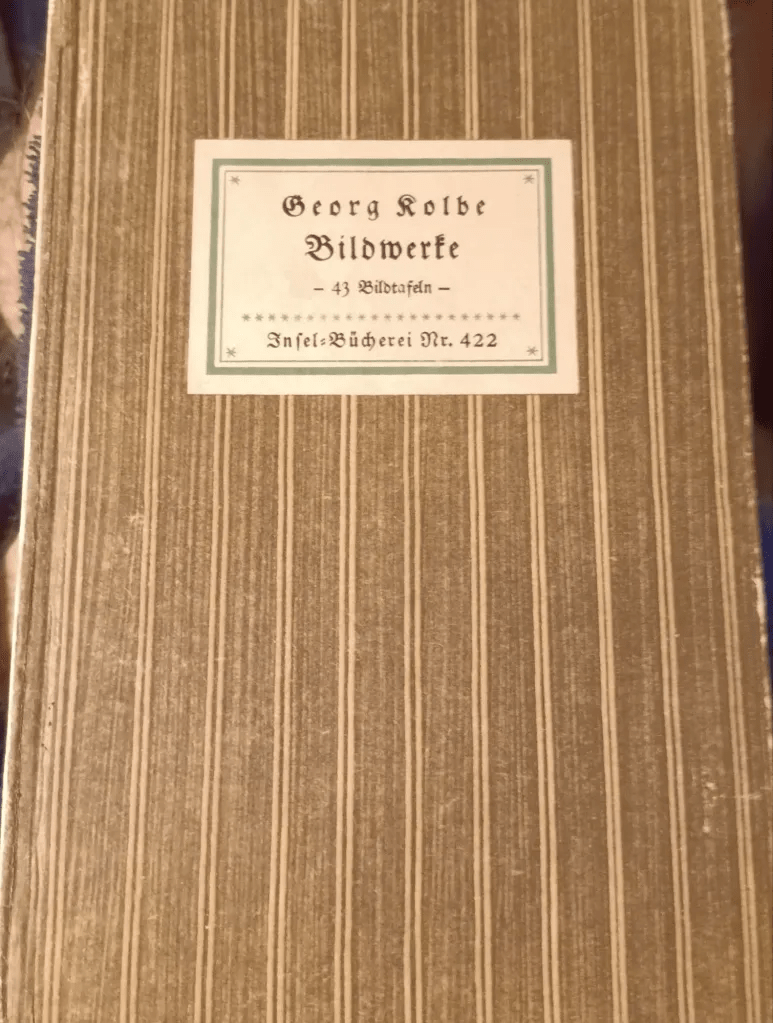
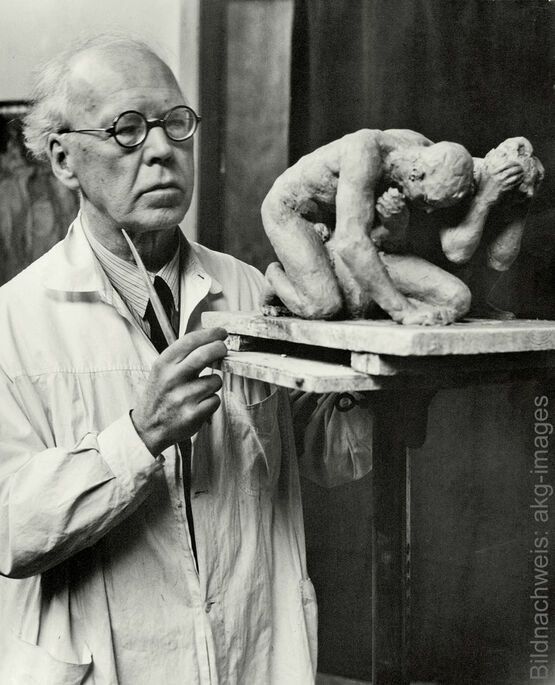
Geoff works in a charity bookshop as a volunteer and often buys me little books that don’t sell but he thinks might interest me. Yesterday he brought this little book first published in Leipzig, Germany, but undated, with a written brief life of Kolbe by Richard Grant (whom I have failed to trace) in German, which I can’t read.
What struck me gazing through it was a change in Kolbe’s figurative sculptures between the 1920s and 1930s. Kolbe died in 1947. I looked Kolbe and the Berlin Secession up, for reasons that will become clear, in Wikipedia of course, and these reflection are based only on these superficial sources, just to help me think about what my first impressions of the book might mean. According to Wikipedia, Kolbe’s best piece, created in 1912, is a statue known as Die Tanzerin [The (female) Dancer‘] here below seen in a recent photograph from the Georg Kolbe Museum in Berlin.
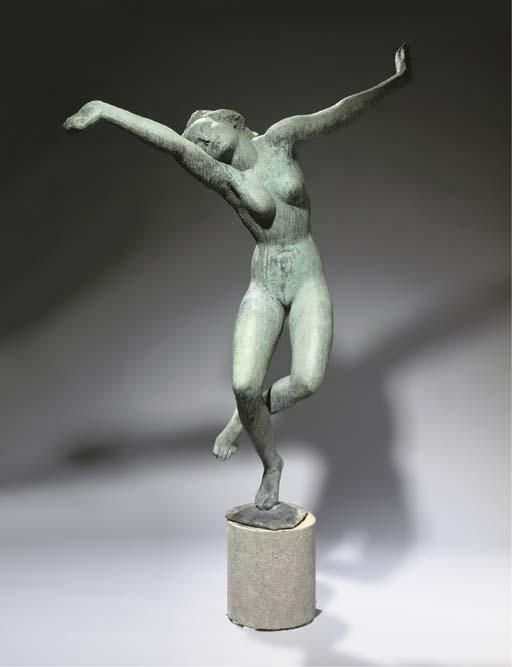
In 1912 Kolbe was a member of the Berlin Secession, but must already have been aware that he was losing touch with some of the more constrained rules of that movement. He broke from it in 1913 to be part of the Free Secession movement, to be followed by the vast bulk of well known German artists of course. We could conclude that this aligned him with the radical and innovative in the art of his time, even if his figures retained classical proportions. Certainly, Wikipedia notes his support,as time moved on, for those artists increasingly called ‘degenerate, and soon to be deliberately marginalised and put at real risk by National Socialism.It took me some time reflecting on how on how this beautiful piece, with the freedom of cut-out Matisse dancers, related to the effect created on me by my little book.

The book gives two different perspectives of the statue of The Dancer. They are the second and third illustrations in it but they attests to the power of photography that the posture of the figure seems so different from that in the Kolbe Museum photograph above. The actual displacements of the dancer’s arms are harder to see – her arms seem frame and regulate her body in stasis (tame it somewhat I think from the effects of unbalance that create a sense of wilder motion in tne Museum capture of the figure). It was the ‘wildness’ that made me compare it above to the motion in Matisse, however different the art. I would not have done so from the photographs in the book. In brief, I felt the person and identity of the figure had lost its obvious link to that acculturated by diverse motion into something conventional – a young pre-sexual girl.
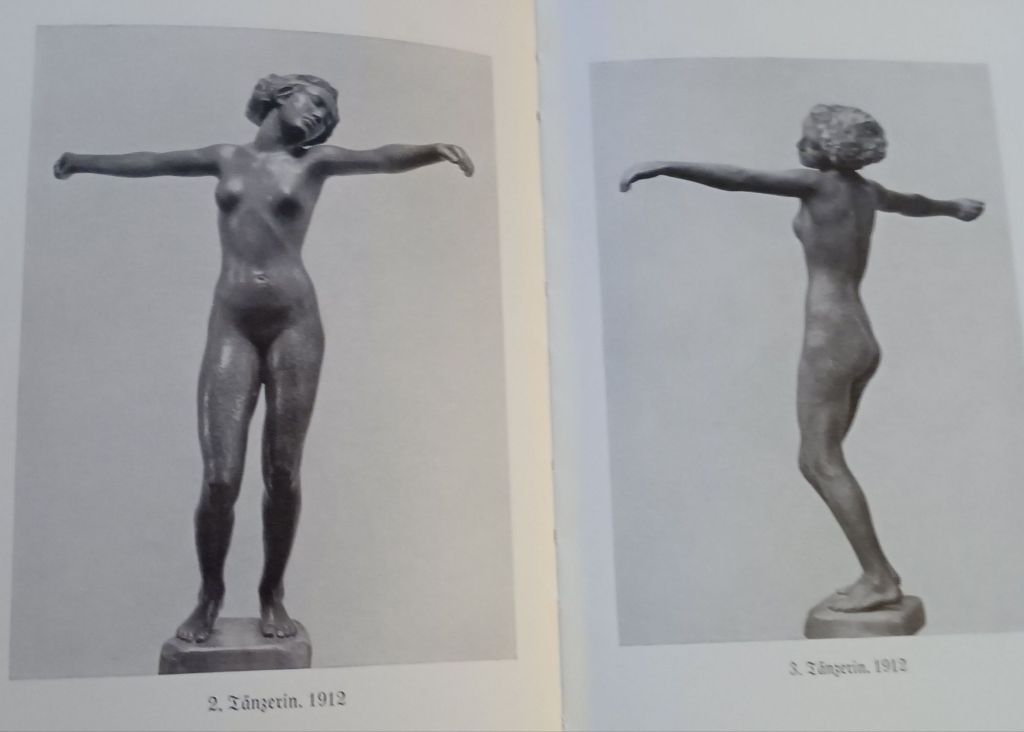
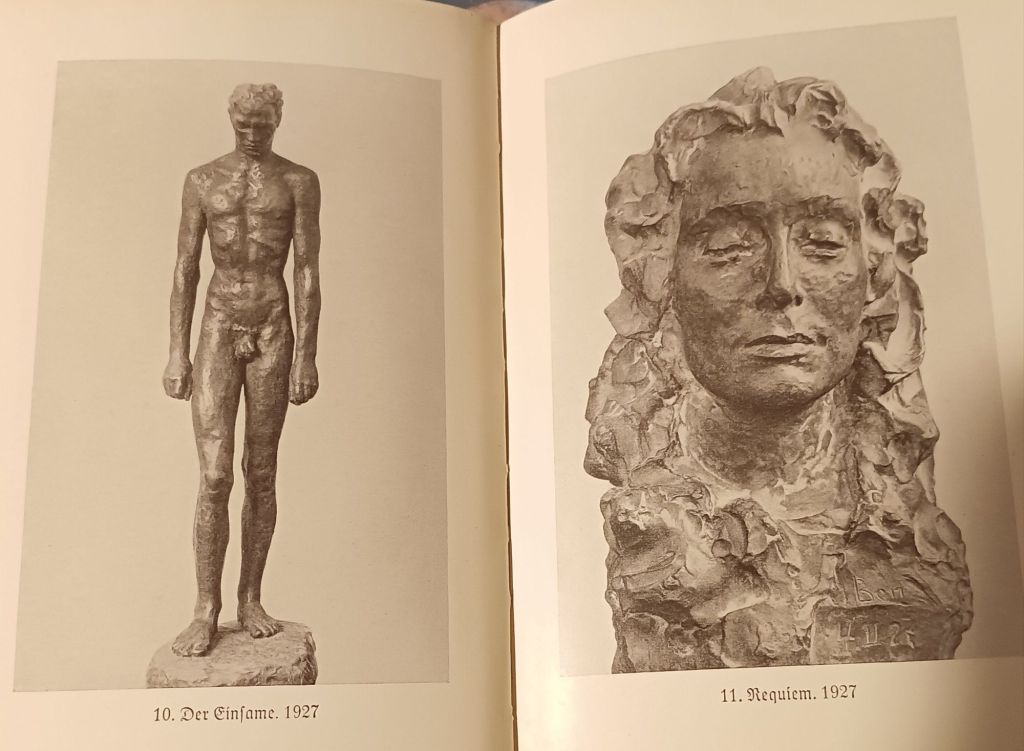
The photographic method in this book entirely flattens the artwork and removes any suggestion of freedom, flamboyance, or ‘bohemian’, or other kind of, wilder ‘degeneracy’ or idiosyncrasy. Hence this work did not stand out as much from other art in the book as it does to me now. However, to be fair, you only have to look closely to see large differences in style, freedom and honesty as in the two earlier pieces below. The bust of the musician seems to extend into some redemptive life in the carving of the hair as if the latter represented the life of his music over a face presented in the form of a male death-mask , the male standing figure almost to look like like the emaciated nude male forms in Schiele The man is beautiful but not idealised, his arms hanging limply like his head towards something ‘grounded’ in its appearance. Nothing in either lends itself to ideological versions of sex/gender.
However, by the 1930s there is a severe change in the figures. According to Wikipedia, the young Kolbe was fascinated by Asiatic faces and body forms, siuch as wonderful 1911 Japanese Crouching Woman amongst the Wikipedia examples. The thin evidence I see in the book suggests that the human form was admired for its diversities of being and acculturated expression, that as it were, transformed simple and conventional notions of being. However, this is not so in the figure below, who deviates not all from idealised Aryan type that the Nazis encouraged as the form of patriarchal Germanic nationhood and imperial dominance. Hitler became Chancellor in 1933. His grip on the art establishment changed the nature of commissions, and though some say Kolbe refused to sculpt Hitler himself he dis produce a figure of Mussolini which Hitler accepted as a gift.
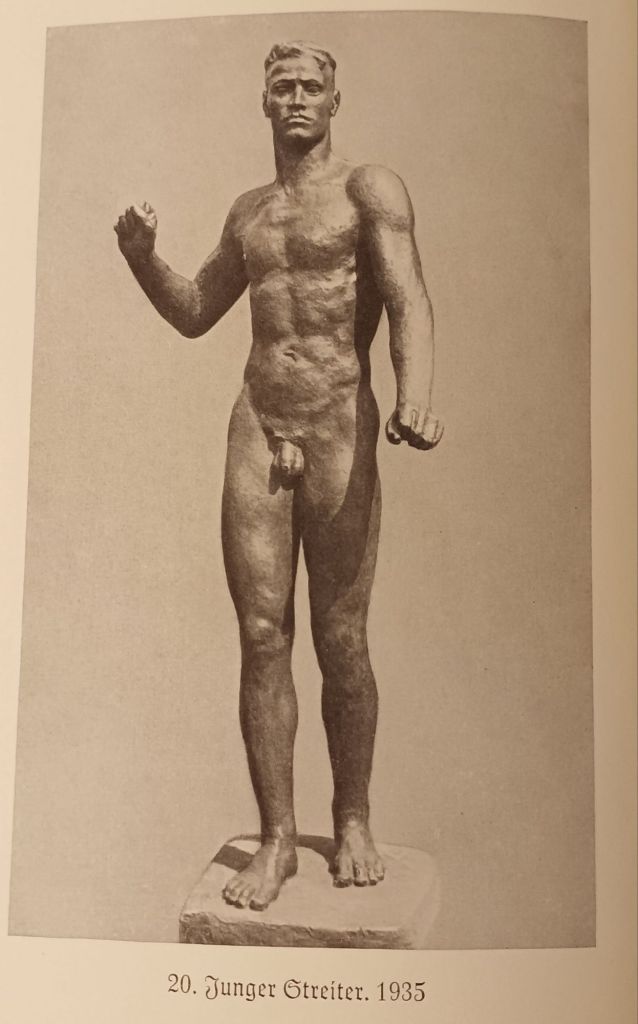
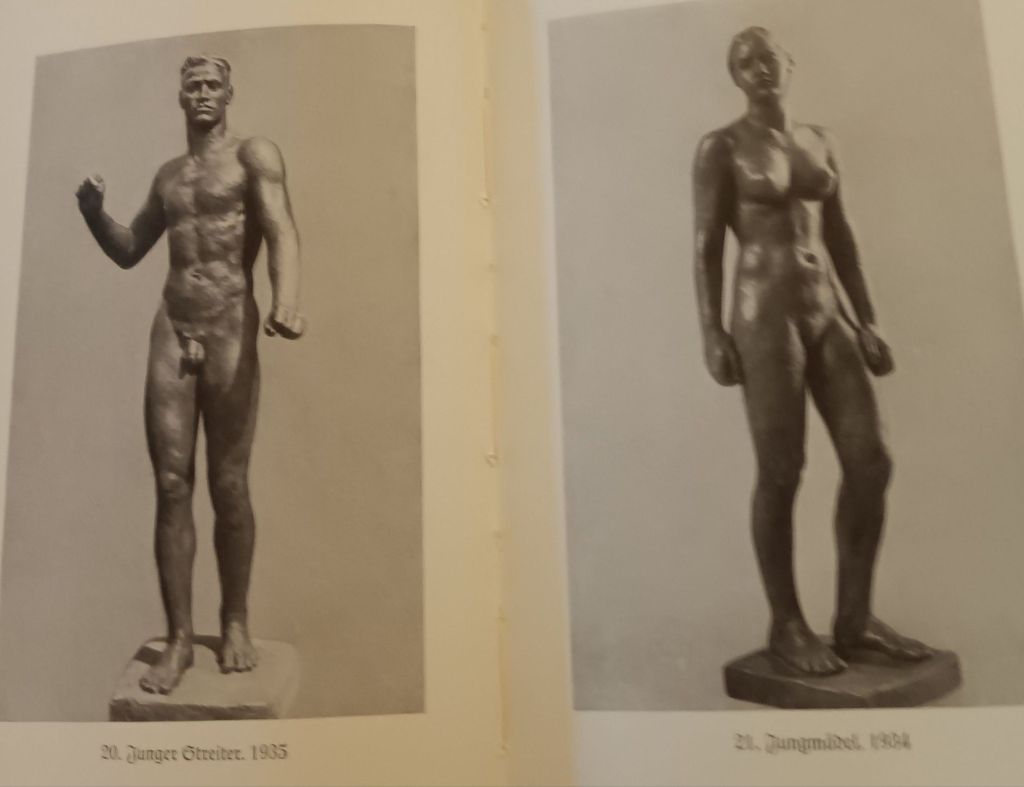
It is not just that this young male figure has his fist clenched in the defiant certainty of his physical prowess and the driving power of his musculature, but that the body is a kind of militant biological ideal in itself. The contrapposto pose is defiantly Classical in the Graeco-Roman model as promoted by Leni Riefenstahl in her film of the 1936 Olympics, but the effect is an idealisation of biology is made ideological in intent more than aesthetic. No classical statue would use its contrapposto stance to emphasise the well-developed penis (in size and form) as this figure for penis size was associated with the coarse and the non-aristocratic and subhuman ideal – the satyr in its extreme as in the Doryphoros example below.
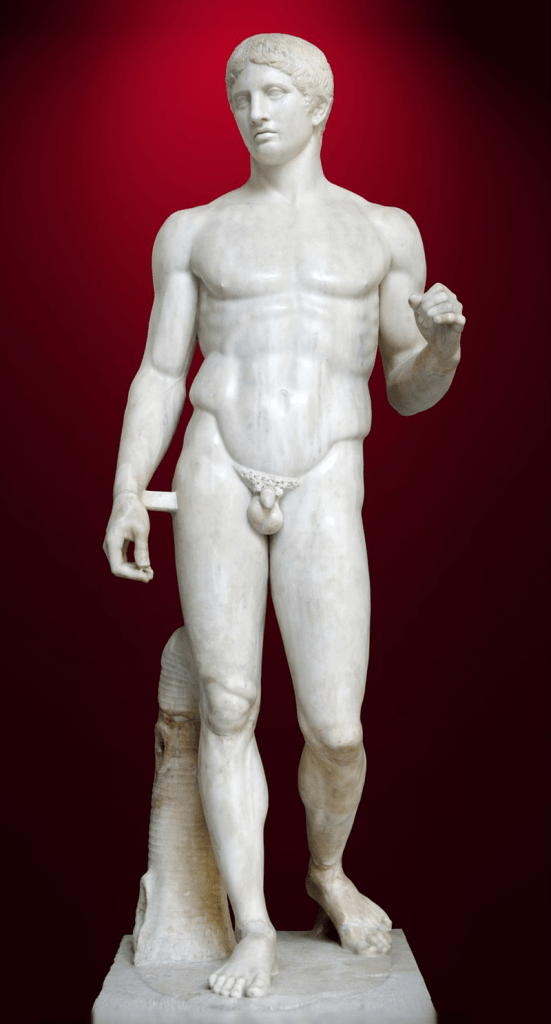
By derivative work: tetraktys (talk) – Doryphoros_MAN_Napoli_Inv6011.jpg: Marie-Lan Nguyen (2011), CC BY 2.5, https://commons.wikimedia.org/w/index.php?curid=18366140
An emphasis on the size of the penis as Kolbe’s 1935 Junger Greiter both makes that single body feature focal and the rationale of the posture. The musculature is not seen armed but it is militant. The fight though appears to be tne inalienable right of a superior race to propagate its biological birthright, and with it an appropriate masculinity as its emblem. The whole postures emphasises the erect, even the arm gesture and the back foot is not arched as if in mid-movement as in the Doryphoros example. ,This man advances on you asserting his right to do so as if nature and biology commanded it. Such ideologies were not confined to Fascism in the period but represented widespread belief about eugenics amongst the European intelligentsia and were happily passed on to the masses (see my blog at this link) And armory could be shown and male bonding, of a supposedly non-sexual form, thart emphasised even more this masculinity-bound and naked imperial ideology based on the power of the phallus.
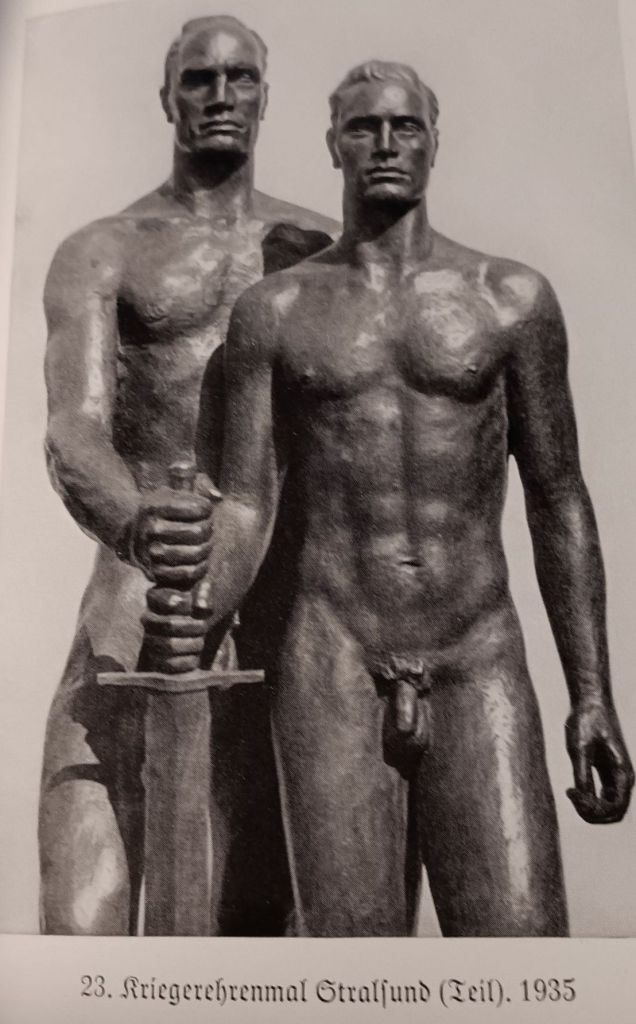
These men are not only ideal types but also ones, as in the 1935 example below, where the larger unit of masculinity (perhaps a father, perhaps patriarchy itself) supports the shorter and not yet into full maturity version of himself, like patriarch and offspring, their bond cohering in the joint hold of a medieval sword hilt. And there too, that much more realistic but emphasised phallus of flesh – the weapon of propagation of the ideal.
Such ideals can appear homoerotic and would be reproduced in heterosexual figures of young couple, man and woman. She shorter than he and held down as it were in a gesture of supposed support, His body is all musculature and penis, hers emphasizing pre-motherhood virtues, wider hips and clear connection of of the lower body to the breasts to feed heroes.
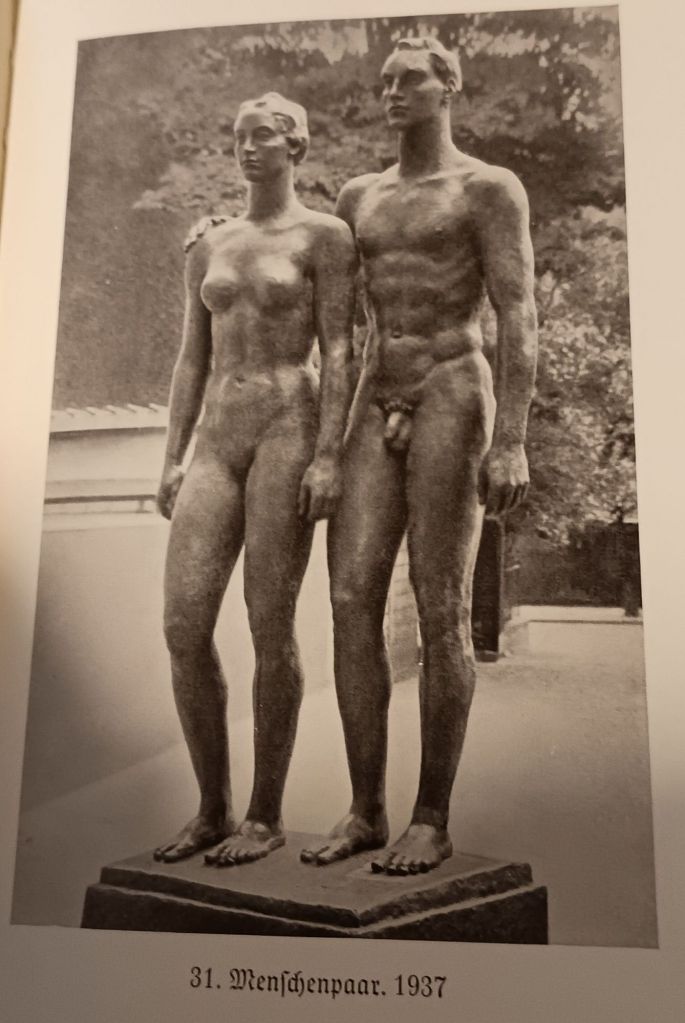
Male and females created alone had clearly contra-distinguished postures as if this too were a fact of biology.The man below is armed with medieval weapon and the posture leans him forward in active advance on the viewer, overwhelming them. Everything is tight, from the muscled casing of the body to the clench on the bow and in the fist. Beatrix (1938)has her arms forced back by muscles at her shoulders, is as open in gesture – open palms, outspread arms as he is tightly closed. Whilst he projects outwards, she invites in. She is not submissive but she does know that her biological role is to give way, accept her destiny as a woman – as a mother, already equipped to feed the patriarch’s sons.
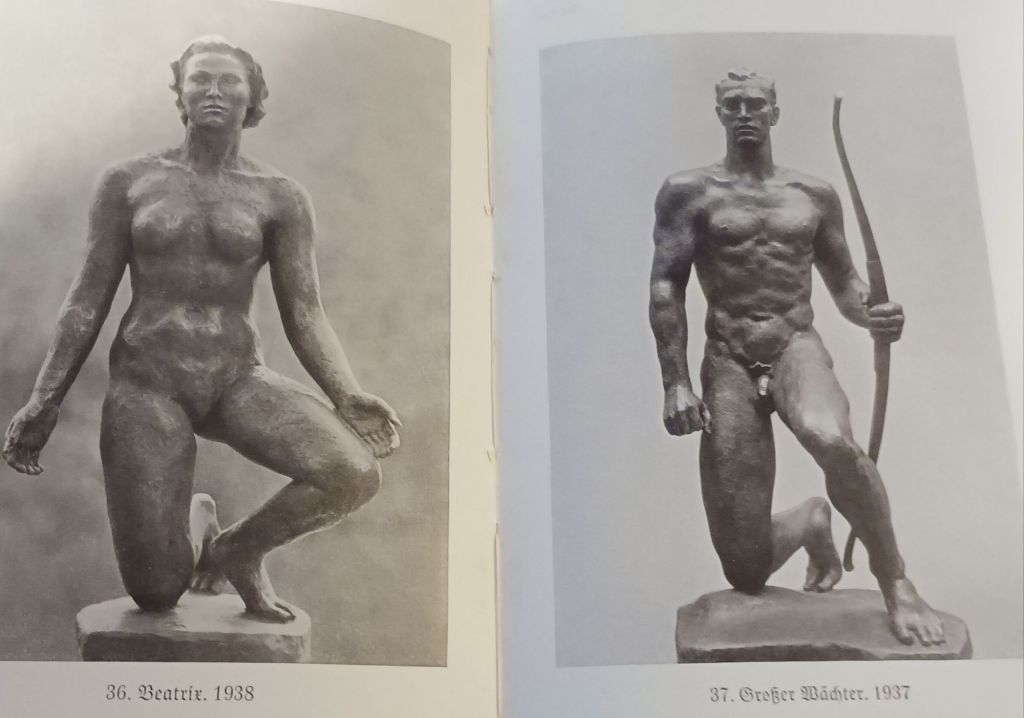
In the second example below, the active body and passive body alone proclaim difference.
Pink News, perhaps the only paper other than The Daily Mail and The Daily Telegraph in England, for purely political reasons, revealed that J’K.Rowling twice in the Scottish census protested against the right of people to self-identify sex / gender by claiming her ‘belief in biology’ in two sections of the census as part of a concerted campaign (use link to read the article). Here are the most significant facts:
A number of people who entered the “believer in biology” response did so as part of action led by gender-critical organisation For Women Scotland, which called on citizens to write the answer as a protest against the inclusion of trans-inclusive sex and gender questions in the census that allowed for self-ID.
A judge ruled in February 2020, one month before the group called for action, that people should be able to record their sex based on “biological sex, sex recognised by law, or self-identified (“lived”) sex as at the date of the census”.
The defiance is continually justified because the organisations for whom Rowling speaks thinks that he only reason a person registered as male at birth would identify as other than a male is because they are naturally, by biology, predators, wanting to force themselves and their phallus onto a woman even if they have to waear a frock for two years to do so. They use outlying cases to ‘prove’ that. It is the same ideology that drove Fascism and which drives patriarchy based on a predestined binary difference. It is pernicious.
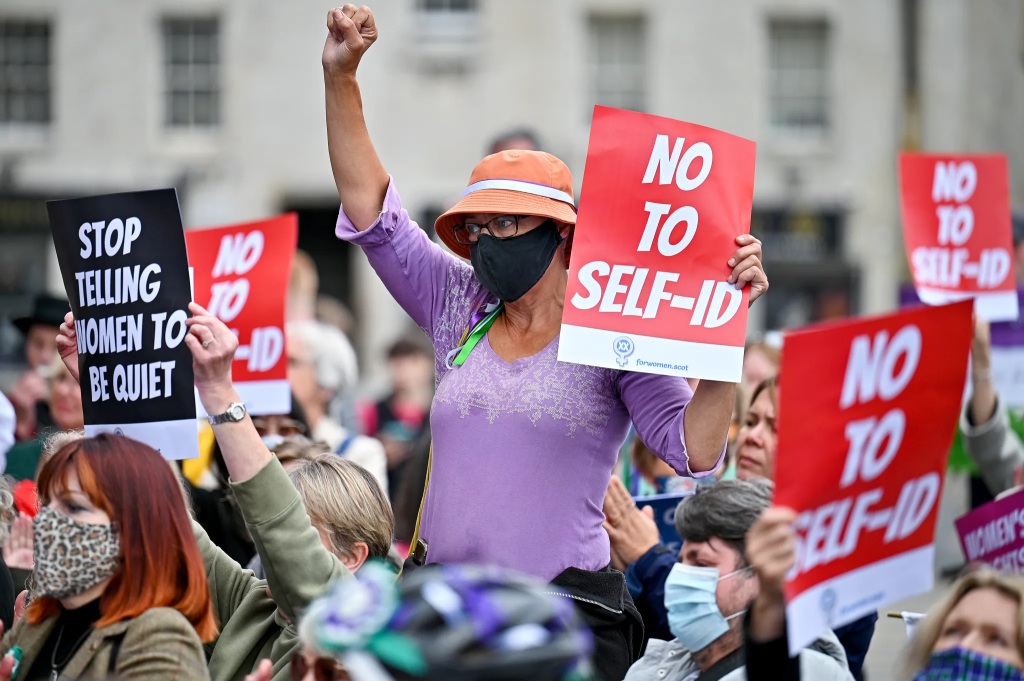
Anti-trans protestors took to the streets of Scotland where just 20,000 transgender people live. (Jeff J Mitchell/Getty Images) From: https://www.thepinknews.com/2024/10/04/jk-rowling-believer-in-biology-scotland-census-trans/
To ‘believe in biology’ is a nonsense. Biology is a human construct naming a mode of research and inquiry in which many questions, from which hypotheses can be built, remain open in the animal , including human, and plant world. The relationship between nurture and nature cannot be solved by belief but by openness to discovery and asking relevant questions. Believers shut all that down and substitute ideology. We need values of course and these are not the stuff of science per se (though science without them would be chaos), but they need to be non-exclusive – not there to weed out the unworthy in the views of current established norms,, even the adherents of those norms think that their beliefs are based on science. When I was young, science declared we are told there could be neuroplasticity – now the facts that it is key to linking culture and genetics is changing the world, Similarly science said that there was no evidence of climate change. In both cases belief took precedence over the means advanced science gives us. In each case belief served retrograde goals which may kill humanity in the end, or parts of it that cannot defend themselves from the aggression of the Many who wish to impose their beliefs on everyone.
 Steve_Bamlett_blog
LikeLike