…; through the centuries, artistic creation has been meshed into complex networks of patronage and expectation. Drawing has always offered more creative latitude’. (1) Has there always been an ‘alternative history of art’ waiting to emerge into visibility as Susan Owens tells us in The Story of Drawing: An Alternative History of Art (2024).
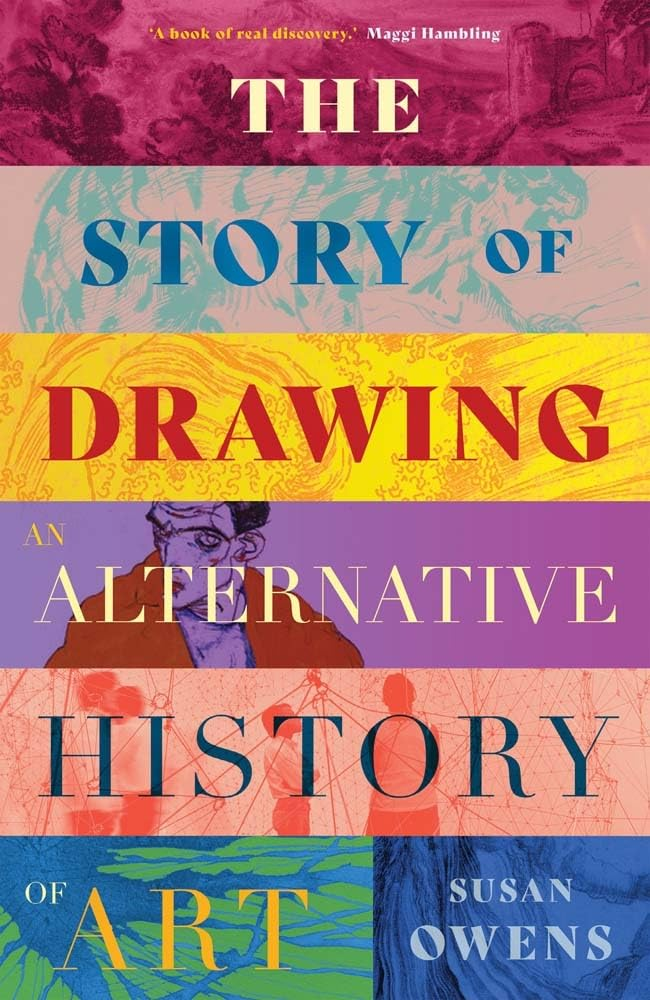
There is a school of the telling of history that relates history entirely to the rediscovery by the historian and teller of historical stories of pre-existent sequences of persons, events, and outcomes that only they have noticed. Susan Owens belongs to this school, As a result her ‘alternative history of art’ can really be characterised with two alternative perspectives. First it inserts a few women, but largely women who are considered in traditional histories of art like Sofonisba Anguissola and Angelica Kauffman, into it the course of its relation as a story. Second, it implies, in parallel but not in connection to the insertion of female artists into the flow of the history (rather than as a sideline), a ‘shadow side of art, a private arena for expressing ideas and emotions that are rarely explored in other media in quite the same way’.(1)
I bought this book then with high expectations of revelations of a deeply interesting view of history that in the the name of the private and the excluded would challenge historiography as a discipline and the powerful interests that sustain it in its present form. However, there is nothing of this nature in this book and I have rarely felt so disappointed by a reading experience. The clue is in the introduction and the sentences I cited had I looked more carefully. The combination of the experience of a private arena and a shadow side, respectively, of art do not on their own challenge the notion of a public institution that stands in the full sun, casting shadows behind it, but rather presupposes it as a reality to which this alternative is necessary phenomenon.
And Susan Owens is no less, as an ex-V&A curator and academic, part of networks of power than Yale publishing which produce this book. For Owens it is all a matter of choice anyway, for after invoking alternative and dark sides of history, she insists in her introduction that drawing cannot be ‘entirely’ defined and hence includes anything out of a rather narrowly defined norm. hence she can include painted miniatures by Imran Qureshi and even established paintings by Egon Schiele. The writing on Michelangelo could have been cribbed, not that I say it is, from the catalogue on the exhibition of Michelangelo drawings at the British museum (see my blog on that at this link) and the explanation of drawing as the basis of the artistic foundation of imaginative design of either a figure or a whole work from Giorgio Vasari makes Owens’ argument collapse like a pile of cards for so much of the art history establishment has been established on the concept of disegno in Vasari as a guiding principle of the whole endeavour of the art of painting and sculpture as a process.
To pretend that history is just a conventional story, makes the creation of alternatives to that history a mere game. It will not understand, for instance how power, ideologies of status and the role of commodification and capital in and its processes are challenged by counter-cultural or even subaltern voices within it. Instead it draws alternative lines that borrow nearly most of their structure and direction from that to which they are said to be an alternative. In the end, Owens’ argument isn’t easily challenged itself. She, for instance, insists that though Louise Bourgeois turned ‘private and spontaneous drawings’ into painting or sculpture, the ones that weren’t were ‘put away by the artist’ but remain ‘visual thoughts pulsing quietly with potential’. (2)
of course I cannot argue with this, It is true but it DOES NOT support the view of an alternative history sniffing away in Bourgeois’ private drawers. That is to occlude that Bourgeois’ public art was itself often a study of how invisible the visible can be and vice-versa and how much the public discourse of art both hides and exposes the shadows of history and might in time challenge the whited sepulchre it has become (see my blog her semi-private work with Gary Indiana on the last Bourgeois exhibition I saw here of public art at the links here, for my views on this).Her argument is the same with Yayoi Kusama (almost an institution herself) now, which offers nothing new to its analysis of the Infinity Nets (1951) drawings that is not implied, perhaps more by her public art (again see my blog on her at this link).
There is nothing about the ‘shadow-side’ of art nor of the role of women that the history of art can not absorb and still stay the bastion of privilege and the status quo it is, even against the will of some artists supposed to represent it. The point is that its true shadow-side lies not in unseen patterns that add up to ‘alternative’ histories but that it is a system of appropriation that makes safe and relatively comfortable inside of it all of that that might have challenged it. There are exceptions. John Berger was one but he looked not to drawing but to tools used by French peasants as the focus of an alternative that truly challenges orthodoxies. That challenge failed and Berger is partially absorbed in the margins of the history of art and regularly put back in his place.
There are times when you read Susan Owens, on the work of Agnes Martin for instance, where she seems entirely to have forgotten that her thesis is to explore alternatives to, rather than alternatives within, the history of art.
…: the eye is not detained by the lines but hovers between grid and background. As a result, her works gradually absorb the viewer in a feeling, whether the sensation of a certain time of day or the experience of being in a particular landscape.
Read this and then consider how Victoria Chang puts Agnes Martin’s work in a context of a true dialectic where established ways of thinking are challenged (try my blog on this at this link). There is no call for this book. It adds nothing and merely capitalises on what Yale must consider a market for populist books that appear soundly academic. All such books do is feed the vanity of a world that thinks it can generate altetnatives without seeing these alternatives as viable challenges to the status quo. The History of Art remains the zone of entitlement it was and the world goes on valuing things through the mediation of patronage, power and vested interests. Give us a break, Susan, for:
8 Vanity of vanities, saith the preacher; all is vanity.
...
12 And further, by these ... be admonished: of making many books there is no end; ... .
13 Let us hear the conclusion of the whole matter: ...: for this is the whole duty of man. (3)
And there we might come to a ‘conclusion’ of the matter. For words and books matter. I long to write on Garth Greenwell’s Small Rain, for it is wise on this matter. It will show when I get round to struggling with my blog that the knowledge of what is good in life, love and art cannot be stated by a set of propositions as philosophers used to think till Wittgenstein subverted the form but in the lived experience of a series of sentient sentences that only proffer meaning when we truly read them, for reading is not vanity.
All my love
Steven xxxxxxxxxx
____________________________________________________________________________________
(1) Susan Owens (2024: 4) The Story of Drawing: An Alternative History of Art New Haven & London, Yale University Press.
(2) ibid: 173
(3) Ecclesiastes Chapter 12, verses 8 – 13 (King James Version). Available: https://www.biblegateway.com/passage/?search=Ecclesiastes%2012&version=KJV
 Steve_Bamlett_blog