
Geoff, my husband, and I both read the manuscript of this show during the time when our dear friend, was, for a moment without any confidence in themselves, composing it. We loved it then and love it now. We only hope that Mike did not interpret the fact that we suggested no emendations as a sign of a lack of interest or even objective disinterest, for we valued everything that Mike helped us to see about their life and ours.

Now the book is out with its public dedication to Mike’s husband, Kenneth, who together with Harry & Saffy the couple”s pet personalities embodied in cat fo
rm, whom are all credited as having each saved Mike ‘in one way or another’. It is a lovely thing this slim book: its poems bolder than those in Mike’s last volume, Through These Words: A journey of poetry about which I blogged when it appeared in 2023. See that blog at this link.
When I wrote that blog I wondered whether Mike deliberately chose not to write in free verse and did so because the discipline of rhyme and basic metrics helped Mike to show us that we are rarely entirely free in our life choices, as they were not and still are not, though much progressed along a path to self-knowledge. That message, after all, is the very heartbeat of their poetry. Mike never answered the implied query, and I do not now wish them so to do. That is because poets should be the very last persons to turn the products of their feelings, passing (and enduring) thoughts and senses into a mere exercise in formal technique. Yet I feel more sure in myself that I am right about that in this brief volume.
The very simplest poem in here is Shine A Light but one of the strengths of its assertions lie in a form known as syllabics: the first three lines are three syllables with a stress on the first syllable of each, so are lines five to eight, although the first and third syllables are to my ear equally stressed in those lines. In each case however these three syllables lines are followed by one in four syllables: the first of these being ‘that nobody knows’, reiterating the volumes title and putting uncertainty at the heart of the process of self-knowledge. What matters then is that the main stresses of the first three lines are all on active verbs, showing that doing something visible is the way path Mike recommends to their readers – trans or cis, queer or not (READ, STRIKE, TAKE). How does this have an affect on the poems meaning? The activity recommended is performative but the definition of the ‘path’ these actions reveal to the one taking it is unknown, at least in its final destination.. The last three lines are also tri-syllabic, where first and third syllable are both strongly stressed but joined by a weak stress on their conjunction. The lesson:
Make the change
Take the chance (1)
In fact Mike says this in simpler but no less challenging (in a good way) prose later: ‘
I have embraced all my gender queerness and neurofabulousness. … Just the freedom to not be confined by society’s binary system of gender. … It really is like a “Choose your own adventure” book every single day. … Because I want to change things up however I want. (2)
To ‘change things up’ is a splendid idea that can only be understood by considering its difference from ‘Change things down’: not because I want to invoke a binary but to illustrate that the movement up or down the proximity to being what you can be each day, is all the better when we move up that scale of self-knowledge.
And there is considerable new subtlety in this verse: Take this poem and its prose continuum (the latter of which I have just quoted);
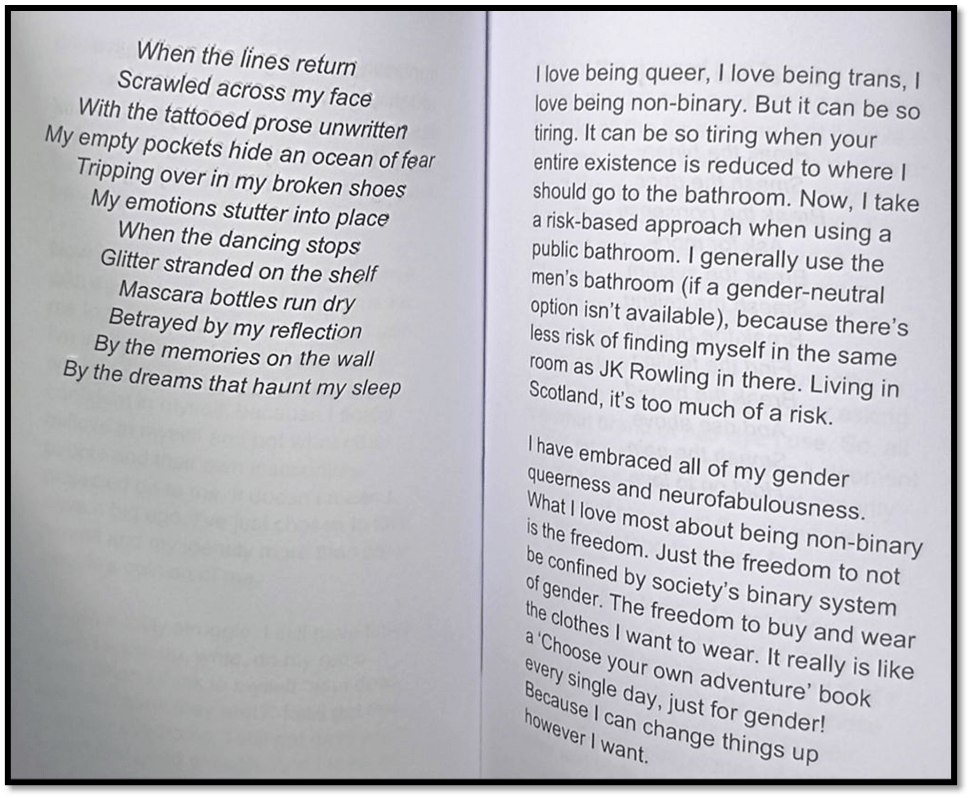
This is a very self-conscious poetry, employing ambiguity around words that apply to writing (and different forms of it) of queer life-experience. Are the ‘lines’ on their face those of worry or of physical maturity; whatever they are they are also a ‘return’ of poetry too (which is invariably lined poetry) in a book of sequential poems and prose. Prose is not handwritten (‘scrawled’) lines but scored in the skin like a tattoo, like those Mike bears on their skin (and visible in the lovely cover photograph): each has its role to play as inner and outer life of Mike as person come to know themselves inside and outside, male and female, inner self-knowledge and what shows in the mirror or the walls. There is so much that moves me in the images of rejection here that use the markers of a gendered sign painted upon the self (glitter and mascara) or activity that cannot last forever and must leave an endpoint in our self-exploration (a trip, an end to dancing, a time when action gives way to reflection on the walls that hold us in and dreams that act like ghosts).
Mike’s sensitivity is shown in that they have felt exposed to some who have called themselves friends and who reacted to their self-assertions with accusations that here was a ‘big ego, that I am self-obsessed’. Mike reacts as they tell us in the longest prose piece in this book with a knowledge that what people call ‘ego’ and ‘self-obsession’ is actually the achievement of a little ‘self-confidence, years in the searching and trying on as an experiment. If we don’t see the journey to that tiny facet of self-confidence we are unlikely to like these poems and prose combined, for they depend on our ability to stop and to inhibit our desire to judge and evaluate others or even, at least for a time, ourselves until we know the direction in which we are travelling. Part of the journey, like the dancing, is knowing that when it stops the grey walls can still reflect our achievement, revisit the journey and learn about it. ‘If we just stopped for a second and remembered that each individual knows themselves as much as you know yourself, then we’d stop putting so much pressure on ourselves‘, they say. The truth comes when they know: ‘they can never know’ the other’, and this being the case will struggle to know themselves except as a false image, a prescription from family or society.
I am in danger of giving away why I love this book and why I love Mike (and Kenneth – and Harry and Saffy). My favourite poem is ‘Stomp and Strut‘, one of the Madonna haunting poems that in truth reverse the usual convention of confessional writing established by Goethe in the eighteenth century. That traditional is suicidal in every sense of the word and called Sturm und Drang, translated into English as ‘storm and stress’ and once used as a synonym for adolescence. How much more I prefer Mike’s Stomp and Strut to that.
The verse is freer in Stomp and Strut but still syllabic, varying between a base 5 syllable line, normally to seven but starting with nine – to give ‘euphoria’ the long ride its syllabic measure requires. This poem identifies a ‘You’ who wants to ‘take me down’, to reverse the process whereby I and others ‘change things up’. ‘You’ might be ‘track suited youth’ on a Glasgow street, but it equally is not just them. It is any aspect of the self or other that refuses the right to a moment of self-belief in that emergent self that does not need to be specified or DEFINED so that it is ‘known’: for ‘Nobody knows me’.
And that, believe it or not, is a good thing. Now Young Werther’s sorrows generate a lot of ‘storm and stress’. Below are the images inspired by the 1774 text: Lotte visits his grave (right of collage) and Werther lies killed by his own hand (left), like so many young queer people in the past and still now, truth be told, but not all – far from even the most – in our reclaimed history of diverse queer experiences. It is why Mike also dedicates their book to ‘all queer people just trying to survive’.

Wouldn’t you rather ‘Stomp and Strut‘ than storm and stress with Werther:
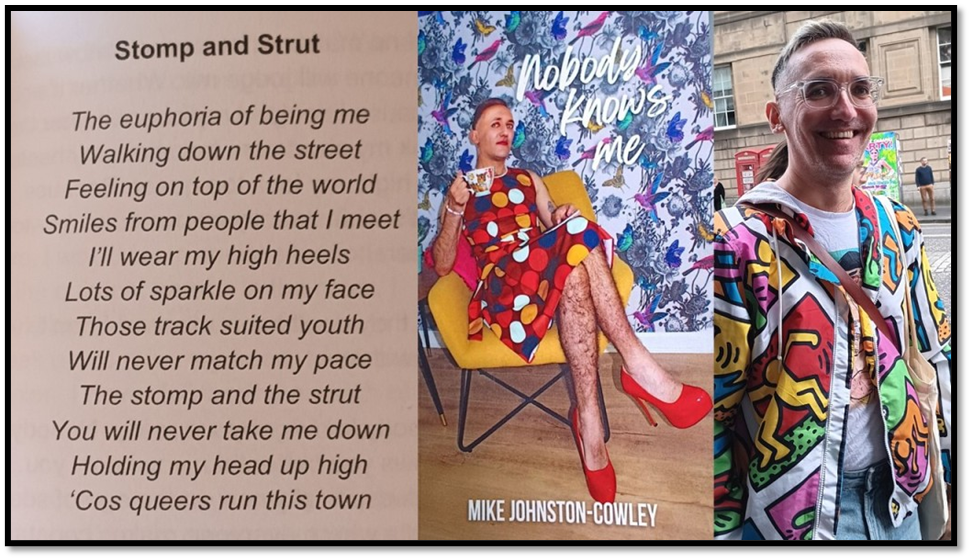
Above in a collage, I include a picture of when I met Mike at Edinburgh (right) to share a little of the Festival with them over a brief half-day. Last year at the Festival when they visited Geoff and me there, they literally held my hand when I collapsed quite often (very weak I know) after the end of a friendship with both Geoff and me, ended by someone who had become a big part of my life. When that person died I know not how some months after, I had been through counselling and a lot of Sturm and Drang. Mike saw me through that too at the end of a WhatsApp connection. He is our friend. This morning they sent us a copy of their book and so I share their handwritten dedication with lots of pride.

Capture the video at: https://mxmike.co.uk/nobody-knows-me/ and order the little book on Amazon. It is out in hard copy next week I believe but can be ordered for £3.49 on Kindle now (use the link).
All my love, Mike, and all of you
Steven xxxxxxxx
____________________________________________________________________
(1) Mike Johnston-Cowley (2024: 19) ‘Nobody Knows Me’, Amazon Publishing.
(2) ibid: 23
 Steve_Bamlett_blog