The second of 2 days at the Edinburgh Festival: A blog covering events on 23rd August 2024.

This diary blog covers the things I did at Edinburgh on the 23rd August after staying over from the 22nd August at Novotel Central Edinburgh. There is a record of other times at Edinburgh at these links: 14th August day trip; Two Day trip, day 1 22nd August; A play The Outrun on the evening of the 22nd August.
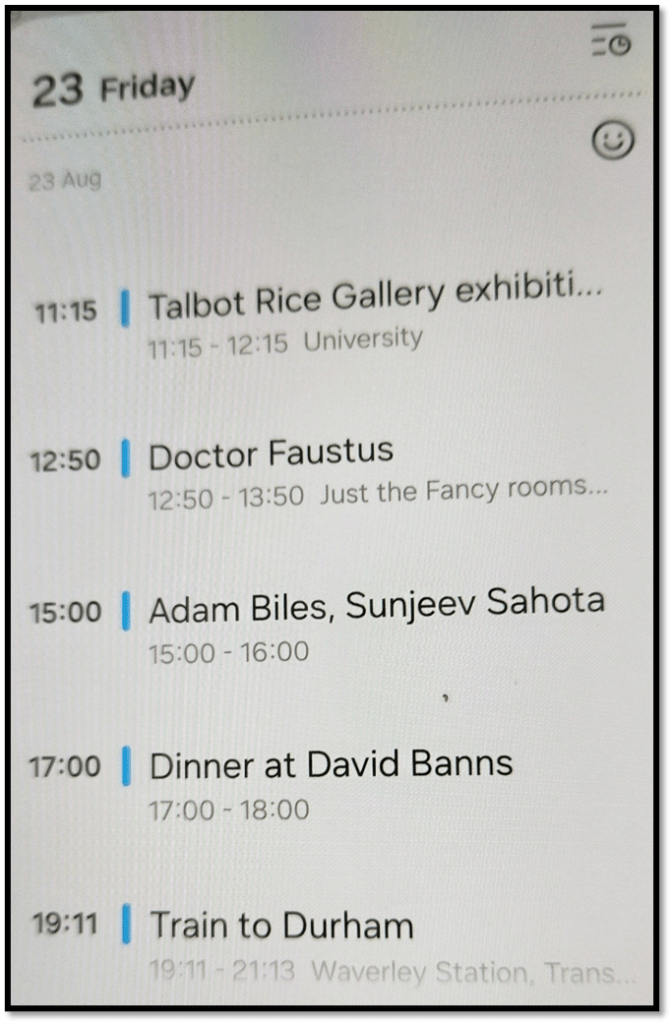
A resumé of the day is in my phone calendar below. This account picks up on each event briefly or otherwise but in the case of the exhibition of the work of El Anatsui exhibited at the Talbot Rice is as brief as a token requires, for I want to write on the artist separately, having now acquired Susan Mullin Vogel’s (2020) book El Anatsui: Art and Life, London & New York, Prestel Verlag.
Shattered from the day before I rose late, had a leisurely veggie breakfast at the Alba Restaurant in Grassmarket before strolling to the Old College of Edinburgh University to the Talbot Rice Gallery. The quadrangle of the Old College is my introductory photograph but I took this on coming out of the exhibition so I could leave the last exhibit of the exhibition to the last, a huge self- unfurling relief sculpture. If you want to do the same approach the university quadrangle from the alleyway linking Lauriston Road to the street on which the Scottish National Museum stands.
This back door actually confronts the entrance to the gallery, up a few flights of inauspicious stairs. It is an inauspicious staircase because, apart from the poster below there is nothing to lead you to expect the beauty of the Gallery above, which was once one used for University Natural history exhibits. The Talbot Rice of the Gallery’s name is the iconic professor David Talbot Rice, perhaps the best portal still to the early days of the discovery of Byzantine and Islamic culture and Art in Great Britain, although the Gallery was set up by his successor in his honour. I have never been disappointed by the curators of this Gallery and have never been to the Festival without visiting. Is it because, unusually, it is free that it has never seemed crowded?
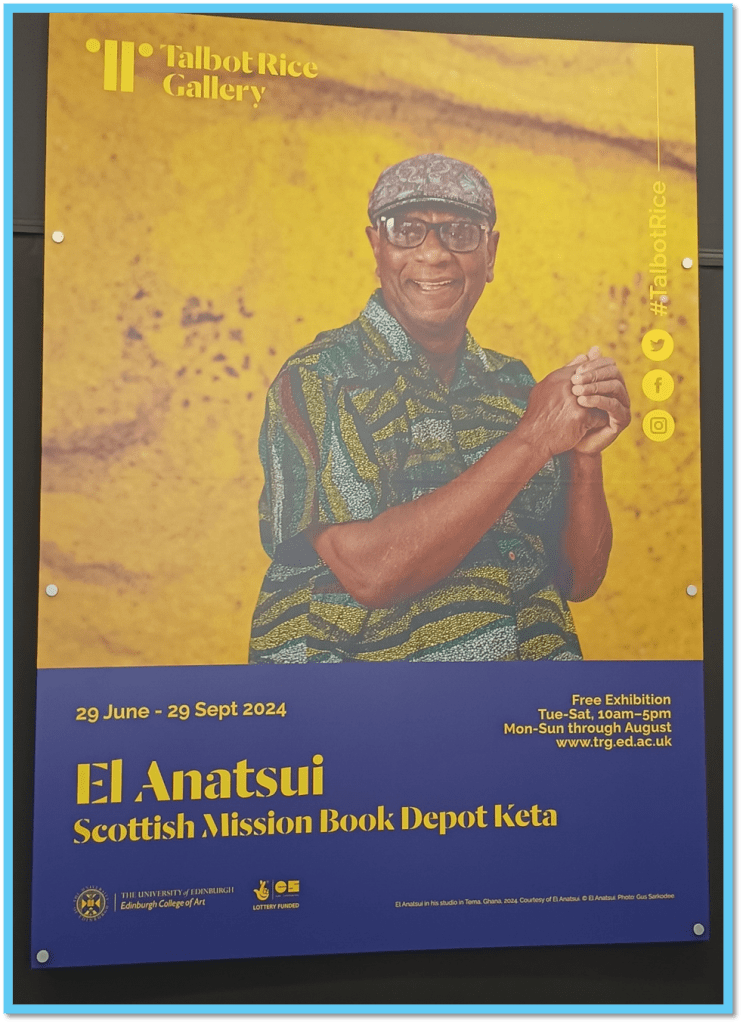
The staircase is daunting to the gallery because it is very institutionally bare to the eye, so I was pleased to see the poster for the event guiding the way, for El Anatsui has a brilliant welcoming smile on it. The exhibition is named after the stunning exhibit you first see as you enter and was commissioned for this exhibition, because it recalled the Scottish role (a heavily ambivalent one but like all colonial ones mainly negative) in El Anatsui’s family and personal past. Called The Scottish Mission Book Depot Keta, it is based on a depot run by the Presbyterian Church on behalf of the Empire in Keta which distributed books and “art materials’, from which he fed his interests as a child.
Anaysuo’s uncle who cared for him on his mother’s death was a Presbyterian minister.
This work is ‘like’ a tapestry but made of squashed metal bottle tops sewn together and shaped into fabulously varied contours such that it resembles a relief landscape. It is also marked by coloured tops made to resemble the marks the young ‘artist’ made on paper, marks he calls ‘squiggly lines of colour on the lower right’ that speak of ‘my childhood experience of using crayons provided by the Scottish Mission as my earliest medium of self-expression’.[1]
You see this work as you enter the Gallery, but a photograph cannot really tell of its beauty and impact. I will write about it in a later blog:

,And rather than write here about what else I saw I will reserve that for the later blog entirely on what I learn about El Anatsui from Mullin Vogel [one thing already being that the ‘EL’ in his chosen name is not Ghanaian but rather more an addition, perhaps modelled on El Greco]. Here I will just give a collage of highlights below, and then before I leave this topic, the star of the show; a huge self-unfurling work hanging in the quadrangle courtyard of the Old Colleges against the wall of the Talbot Rice itself.
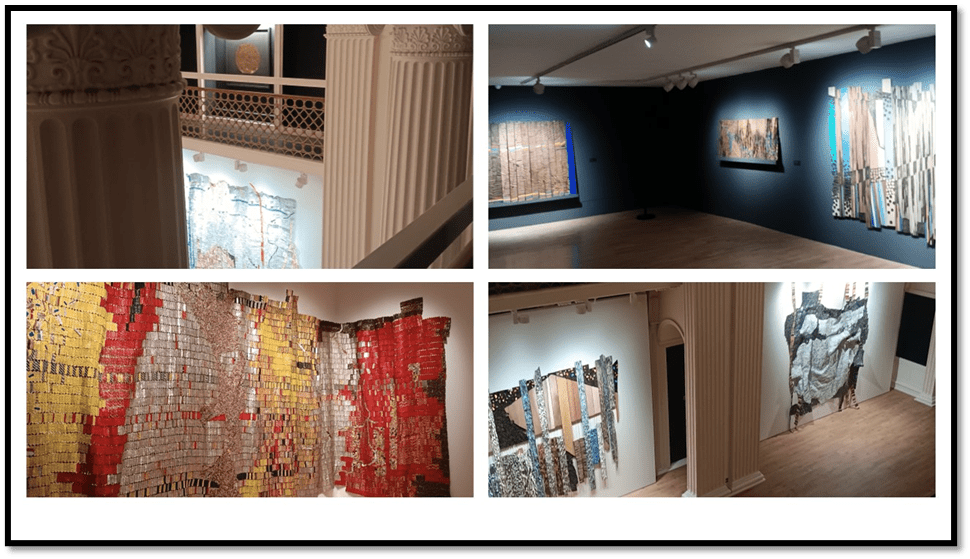
I don’t then intend to talk about these works here, but to show above their appearance in situ in the Adam interior that is the main room with its upper viewing gallery of smaller but magical works in circles of metal form. I can’t show the range, although above you see the wood relief sculptures that gave way to the use of industrial and retail waste. It uses specially some from the ‘trade’ alcohol exchange implicated even in slavery as well as enslavement of masses of people through substances that are addictive (the Empire knew how to do this in other places than china after all and with other substances than opium).
As you leave you have to see the huge 2013 work TSAATSIA – searching for connection, which mimes both cartography and landscape and yet references colonialism throughout – but, I need this new blog to learn how to understand it better.

I left the exhibition quite sadly, without hope or achievement to find a book on the artist at Waterstones across the road at South Bridge and went on to see Doctor Faustus by the Canadian group Apothecary Theatre, playing in the Just the Tonic venue under South Bridge. The underground venue was well chosen. The production team is called Apothecary Theatre directed by Max Ackerman and is from Canada. They describe their show thus:
This Canadian adaptation pairs Marlowe’s tragedy down to a personal interplay between Doctor Faustus and Mephistopheles, the conjured demon, played by drag king Coyote Ugly. Once the deal is struck and Faustus has surrendered heaven for worldly pleasures, the two become everything to each other: servants, lovers, enemies, trapped in an eternal dance.
The adaptation centres magic and queerness as modes to explore the themes of transformation and damnation. Offering unique and accessible interaction, the audience is invited to participate in Faustus’ downfall by donning devil horns if they wish to join in, or a masquerade mask if they would rather remain unseen.[2]
Although billed as a queering of the play by Christopher Marlowe, Doctor Faustus’ might be difficult not to see as queer, when asked about the beauty of Helen of Greece, Mephistopheles calls her as beautiful as ‘Lucifer before his Fall’. The cast of this play are tied together queerly, though Faustus could not look more ready to play some of his most heteronormative lines. He is played by the attractive James Llewellyn Evans, who is on the stage writhing in expectation of damnation as if the rest of the play could be a flashback. He reads Marlovian verse, so much more fluid than Shakespeare, to perfection. Mephistopheles is played by Augusta “Gus” Monet as their drag persona Coyote Ugly and rightly for such a superlative performance as not only Mephistopheles but a campish Helen and the brilliant dual roles of the Good and Bad Angels showing the balance of Faustus’s spirit. They won the ‘My Entertainment World’s Outstanding Performance (Supporting)’ for their national premier in Toronto.
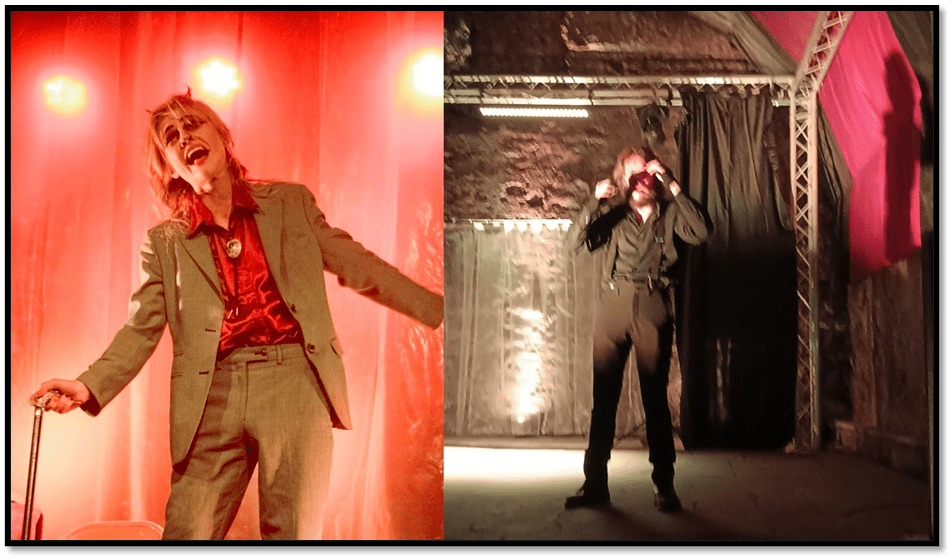
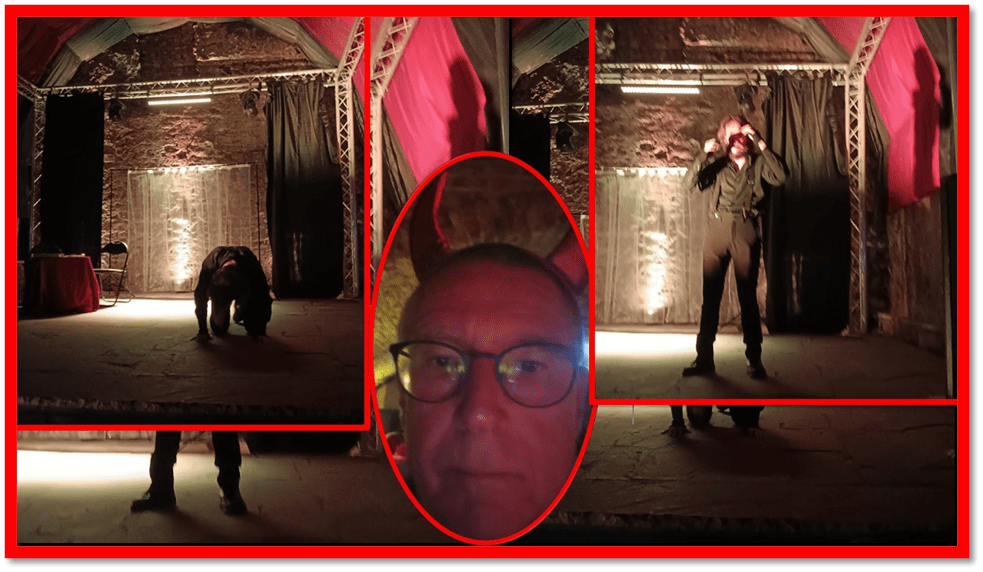
Only the photograph of Faustus shows the Edinburgh venue and its fitness for the play, taken during the period at which the audience was assembling, Faustus suffering in mime, quite brilliantly.
The audience here, as well as in Canada could wear ‘party’ devil-horns if they wished to show willingness to be called upon the stage. Of course, to my later chagrin, I did.
Faustus is in my book a queer play anyway. The object of desire is a matter of metamorphosis in it. When Faustus successfully conjures Mephistopheles, he doesn’t like the look of the devil he conjures (ever had that experience?) and says:
I charge thee to return, and change thy shape;
Thou art too ugly to attend on me:
The production cuts the next two lines: ‘Go, and return an old Franciscan friar; / That holy shape becomes a devil best’. That may be a School of Night joke for practical atheists but it spoils the reason the two lines, without that joke amongst atheists, got a laugh from this audience of a LGBTQ+ boasting show.
There is deliberately anormative excess in Faustus that surely cannot stop short of boundary-crossing when, at last Mephistopheles cures him of wanting a wife and seeking instead a different personage each night. Nevertheless, there is little of Marlowe’s Piers Gaveston (the favourite toy of the King in Edward II and also like Faustus from a lowly class background). Faustus is raised by hard academic work not dressing up wantonly anz perhaps the academic does dry one out somewhat in a way Gaveston is never dry.
How am I glutted with conceit of this!
Shall I make spirits fetch me what I please,
Resolve me of all ambiguities,
Perform what desperate enterprise I will?
I’ll have them fly to India for gold,
Ransack the ocean for orient pearl,
And search all corners of the new-found world
For pleasant fruits and princely delicates;
I’ll have them read me strange philosophy,
And tell the secrets of all foreign kings;
I’ll have them wall all Germany with brass,
And make swift Rhine circle fair Wertenberg;
I’ll have them fill the public schools with silk,
Wherewith the students shall be bravely clad;
Verse like this is Evans natural metier. Rarely have I found done so brilliantly the way the play dramatically rhymes the failure of Faustus’ blood to ‘stream’, when he is called upon to sign a legal contract deed using his own blood, admitting Satan’s claim to his soul, with the beautiful line at the end where Faustus looks for more time to call on Christ’s clemency (so hammed up by Richard Burton in the old film as we see scarlet smoke drifting through the empyrean):
O, I’ll leap up to my God!—Who pulls me down?—
See, see, where Christ’s blood streams in the firmament!
One drop would save my soul, half a drop:
I have never heard it read so well and it is hard to stand clear in the gleam of Monet’s performance in varied tones of soto voce. Unfortunately, and ever a curse on that thin streak of acting greatness, they the actor playing Mephistopheles read behind me the lines of the Mortal Sin, Gluttony:
Who I, sir? I am Gluttony. My parents are all dead, and the devil a penny they have left me, but a bare pension, and that is thirty meals a-day and ten bevers,—a small trifle to suffice nature. O, I come of a royal parentage! my grandfather was a Gammon of Bacon, my grandmother a Hogshead of Claret-wine; my godfathers were these, Peter Pickle-herring and Martin Martlemas-beef; O, but my godmother, she was a jolly gentlewoman, and well-beloved in every good town and city; her name was Mistress Margery March-beer. Now, Faustus, thou hast heard all my progeny; wilt thou bid me to supper?
Still it gave me the right to stare at Faustus and lick my lips in an atrociously lascivious way. LOL. Now for the diet!
The performance ends with Faustus’ death, but not dying straight away Mephistopheles is seen with backs turned to us to tear at his throat, turning round to show his mouth bloodied like a vampire. To leave a production so fine needs that there be time to rest, so I strolled through Grassmarket to the second-hand bookshops beyond them before going to The Edinburgh Futures Institute Courtyard Theatre for more literature input and see a novelist I love, Sunjeev Sahota.
He spoke with Adam Biles, whose work I don’t know, his latest is a well-like modernisation of Orwell’s Animal Farm, and that alone makes me NOT want to read it, though from his readings it sounds absolutely wonderful. I have written on Sahota’s book The Spoiled Heart (see my blog at this link) but I was so keen to have my book signed, so here I was. The discussion was good. Both novelists spoke of the meaning of the term ‘truth’ in novels, admitting the masquerading and nuances that each get called lies but are not the same, in political discourse of course.
But my interest is in the use of the desire to be believed that strikes us as an attachment, and when addressed to many, or at least more than one person, to the building of community. I asked how that resonated in the novel with calls to racial communities, even ones of oppressed races, or class solidarity and community.
I quote that call to Brandon by Nayan Olak, the book’s protagonist and a trade union stalwart of the old-fashioned kind who calls for communities to have ‘solidarity’, be ‘solid’. Brandon doesn’t understand:
Let’s Stay solid?” Brandon said.
“Solid as in solidarity. Sticking together to make real change happen.”
“Right.”
“Why? What’s the matter?” The boy was looking doubtful.
“Nothing. I just think – solid to me, means, you know, solids. Like – poo.”
…
“So you’re reading it as ‘Let’s Stay shit’?”
“No! just … Well, yeah, I guess I am. Sorry.”[3]

Are calls to community capable not only being understood as ‘shit’ as actually being that as so many calls of spoiled hearts to community are in this novel? Sunjeev thinks that, unlike the French, the English reader is less open to be being left in a negative state by a novel. I think Sunjeev though does leave us like that, but with some sense that we are only looking at the worst. The rest is not literature but learning how to live differently.
There was time to mosey to David Bann’s vegetarian restaurant, half way to Waverley where I would catch the 19.11 to Durham. David Bann’s’ blue-cheese and spinach pudding did not let me down and it was relaxing there:

The restaurant was empty then (I got there at 18.15) but very full by the time I left to catch the train. The silence and restfulness seemed golden in retrospect for many trains had been cancelled and the train was hot and full, with many standing. Sitting across the train aisle were three ladies from Dundee and one they met at their table from Newcastle. Starting with loud jokes, as the wine and spirits got consumed the noise from the table hurt my ears, interfered with writing my blog on a play about alcoholism (the one I put online as a bog this morning) but I tried very hard to avoid my ex-alcoholic’s intolerance showing. But my, what a long journey home that seemed till 19.13 at Durham.
I will take a break from Edinburgh blogs before I come back on El Anatsui, but I will be back, There are tears in my eyes as I realised how hard I found it to say why I found this work so beautiful and moving.
With love
Steven xxxxxxxxx
[1] Cited By Tessa Giblin (2024: 6) in Tessa Giblin et. al. in the free catalogue, El Anatsui: The Scottish Mission Book Depot Keta, Edinburgh, Talbot Rice Gallery
[2] Doctor Faustus Pitch – Culture Canada (https://culturecanada.co.uk/events/doctor-faustus-pitch/)
[3] Sunjeev Sahota (2024: 103) The Spoiled Heart, Dublin, Harvill Secker.
 Steve_Bamlett_blog
2 thoughts on “The second of 2 days at the Edinburgh Festival: A blog covering events on 23rd August 2024.”