A day at the Edinburgh Festival: A blog 14th August 2024
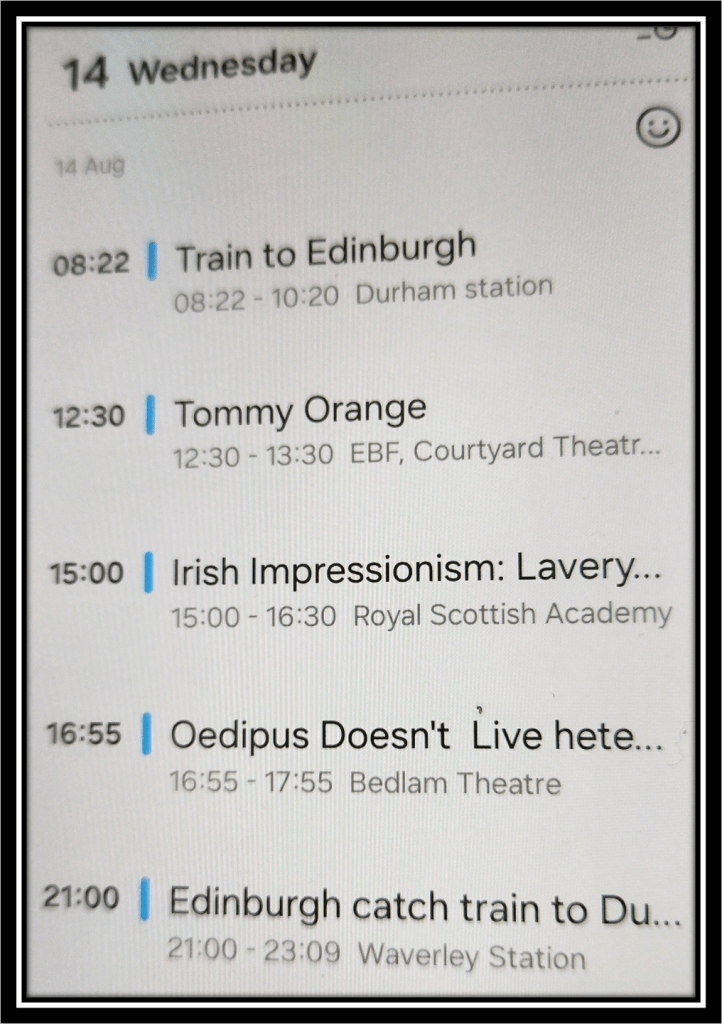
Maybe I over-prepare for my days out. Certainly, I overfill them – but it saves the longueurs of loneliness in a city. Here at least is the programme as already recorded on my phone on the 13th August.
The day has arrived. I am.on Durham Stafion awaiting the delayed train.
But here we go:
Arriving at Waverley at 10.30, I made my way to the Fruitmarket Art Gallery for coffee. But the exhibition there was too enticing. Taking advantage of the setting above Waverley station, this exhibition is called Songs about Roses, the first ever solo exhibition in Scotland of Ghanaian artist Ibrahim Mahama, pictured below from the show’s explanatory video.

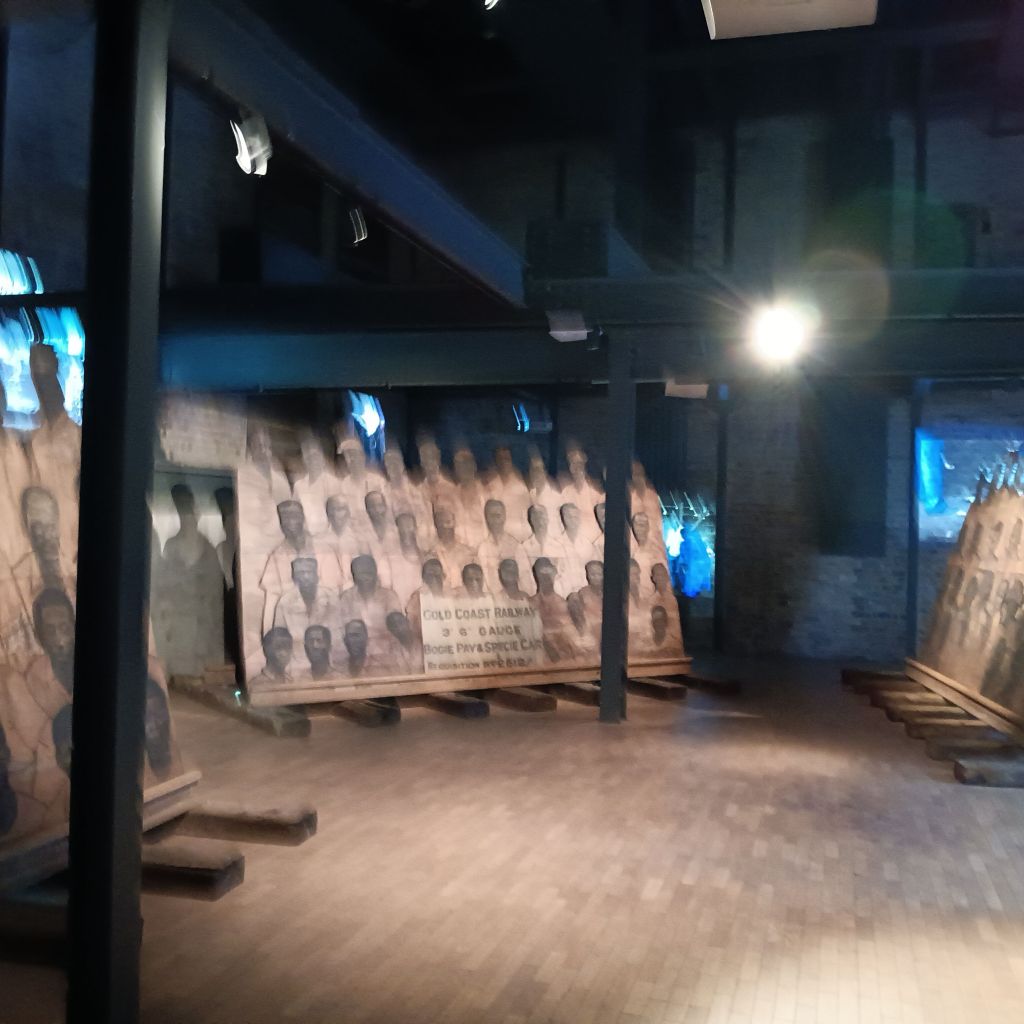
I was struggling with the meaning of the title of the exhibition for an exhibition filled with the lavour in particular of hefty men involved in the construction of the British commissioned railway developing the economy of the Gold Coast, an initiative that failed. Heavy with reference to slavery histories associated with the castles of no return on the coast, it was about colonialism and the very materials of his art that once serviced the commodification of ‘things’, even the jute sacks sown by female labour for storing peoduce, charcoals used in branding slaves or marking non-human goods including the leather skins rescued from the railway carriage wrecks, they decorated in their life.
And then I read that he took the name from Scottish Band, Owl John: their line ‘we don’t need songs about roses/Please sing me something new … All that we ask for is truth.’
There are stunning truths here, even if you confined yourself to the brilliantly curated Warehouse in which you wander around the heavy sculptural flats mounted on railway sleepers showing the faces of labouring men and women from the past and the shadows they cast on walls, interrupted by video loops of modern manual work in modern day. Ghana. Visually, it is such an exciting exploration; perspectives on it changing as you turn each corner, sometimes into dark alleys or backtrack on yourselves.
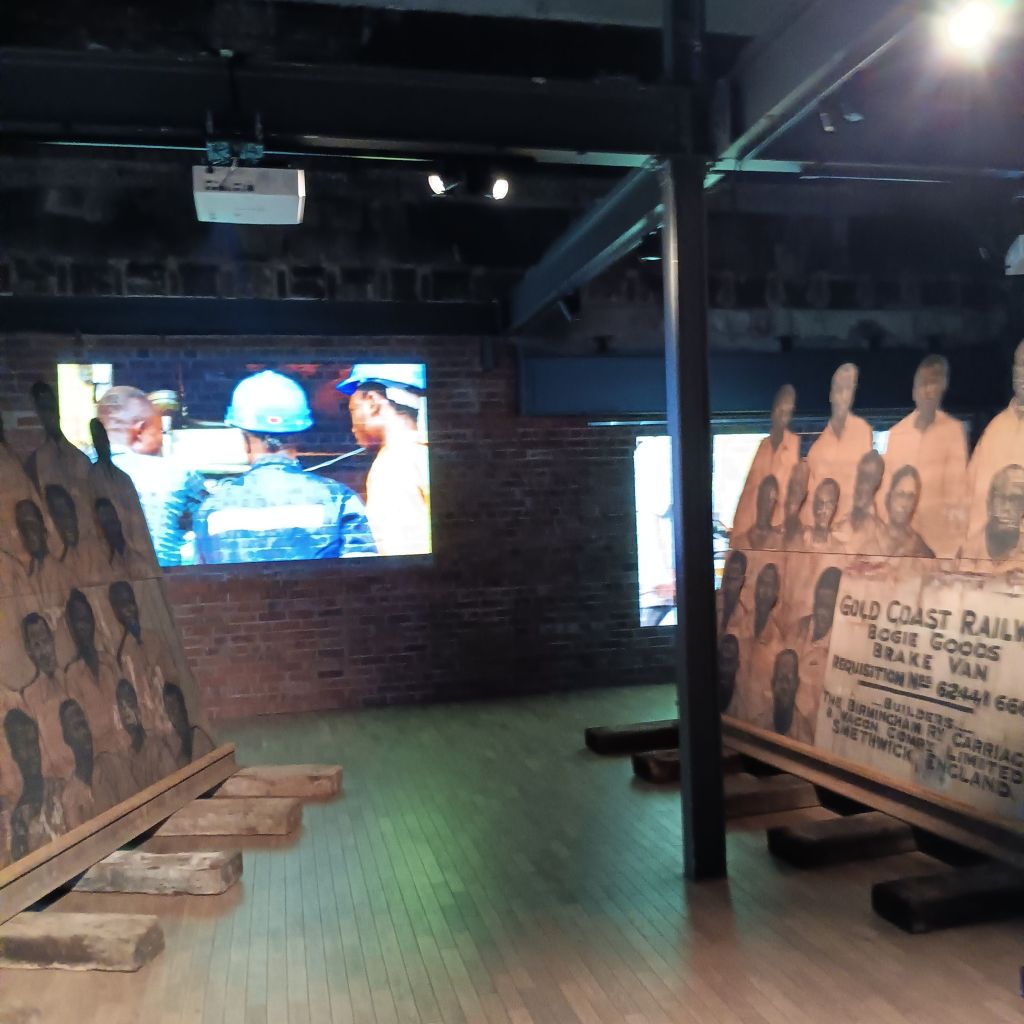
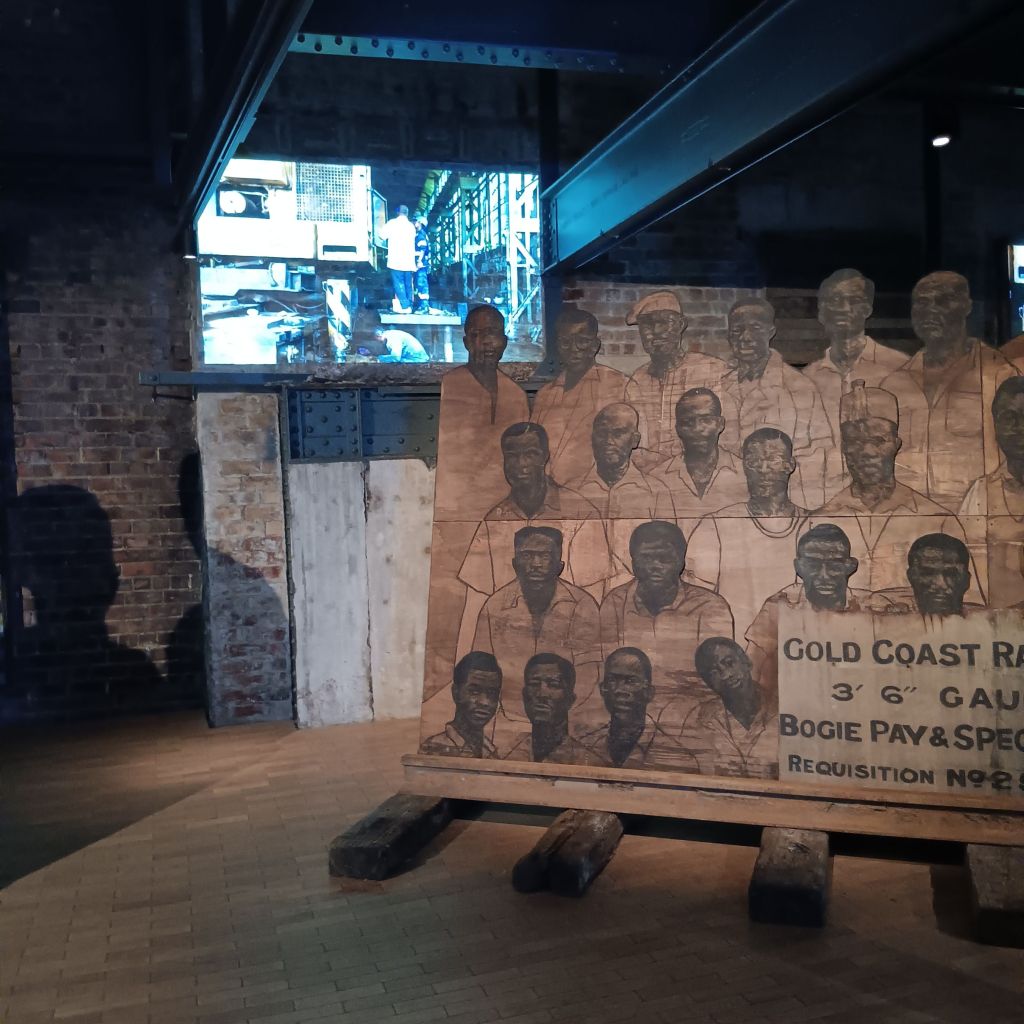
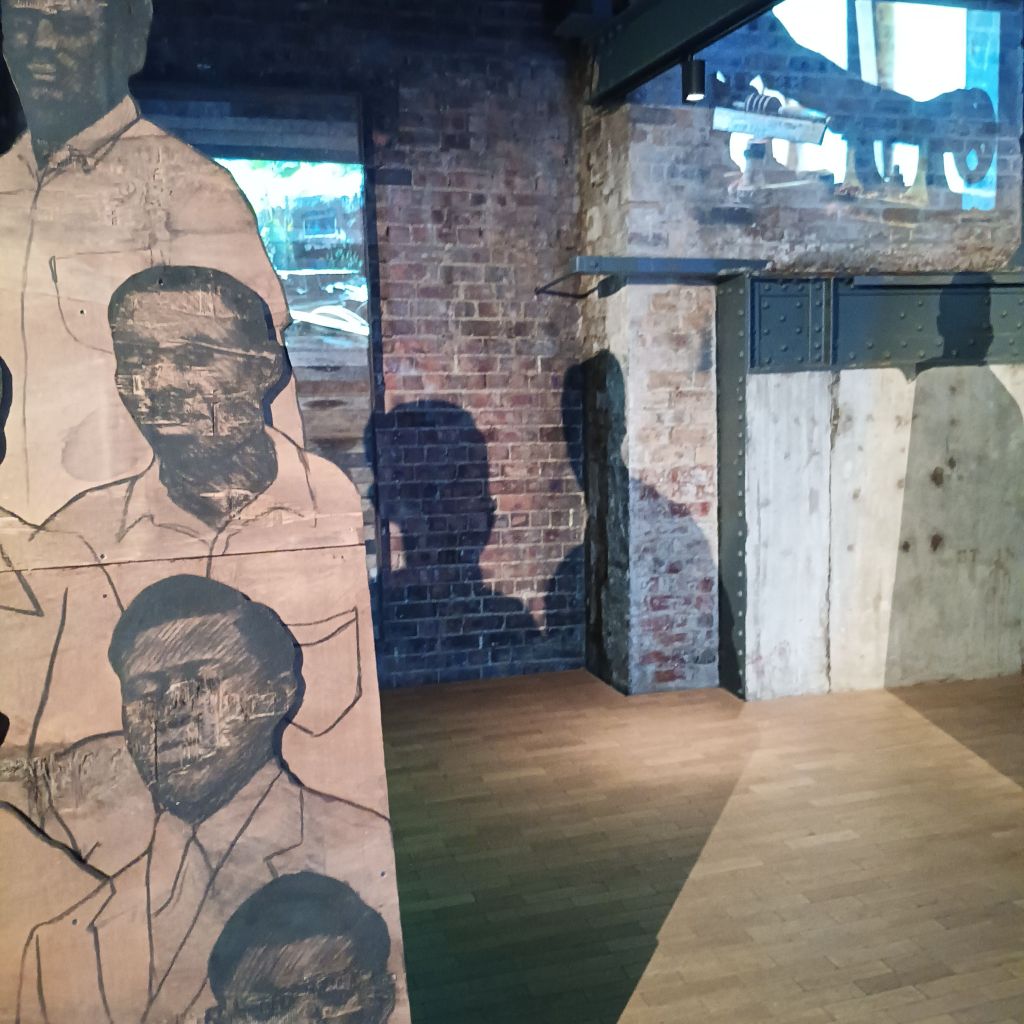
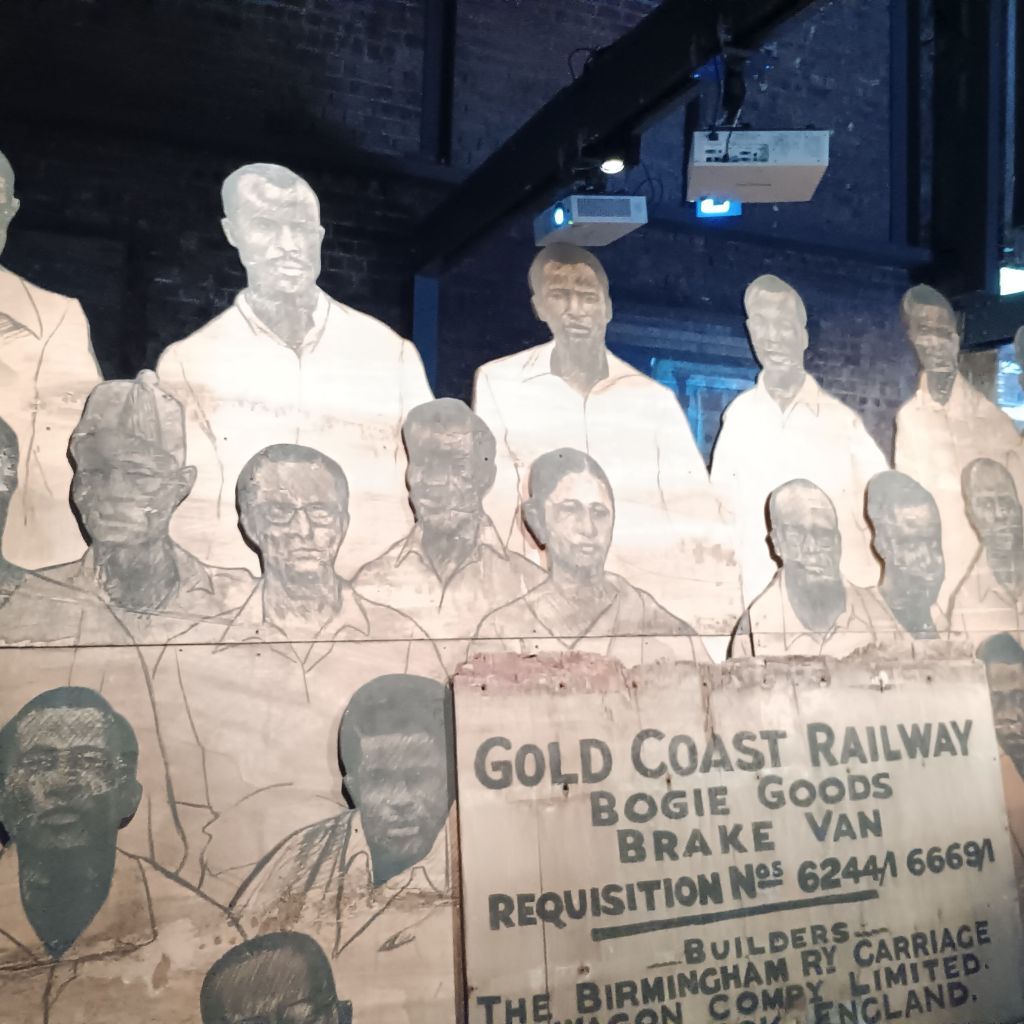
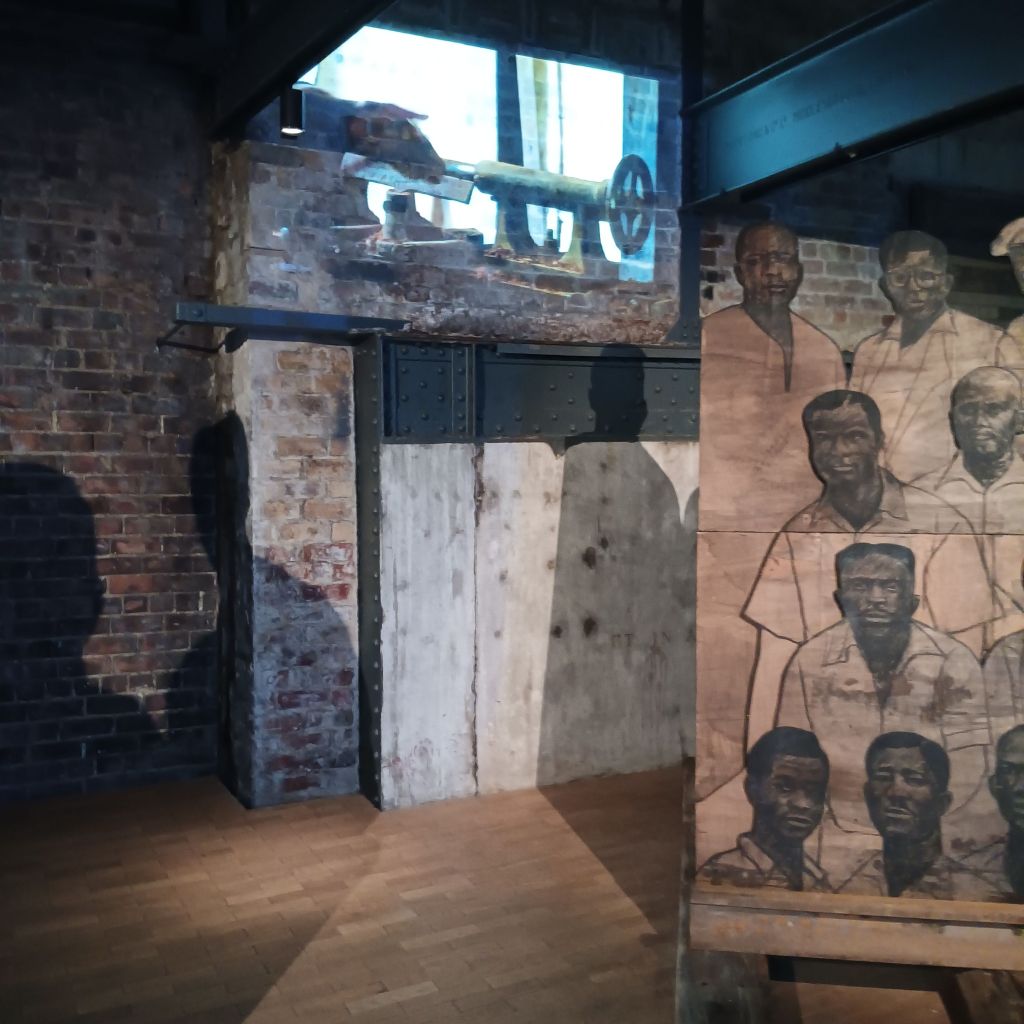
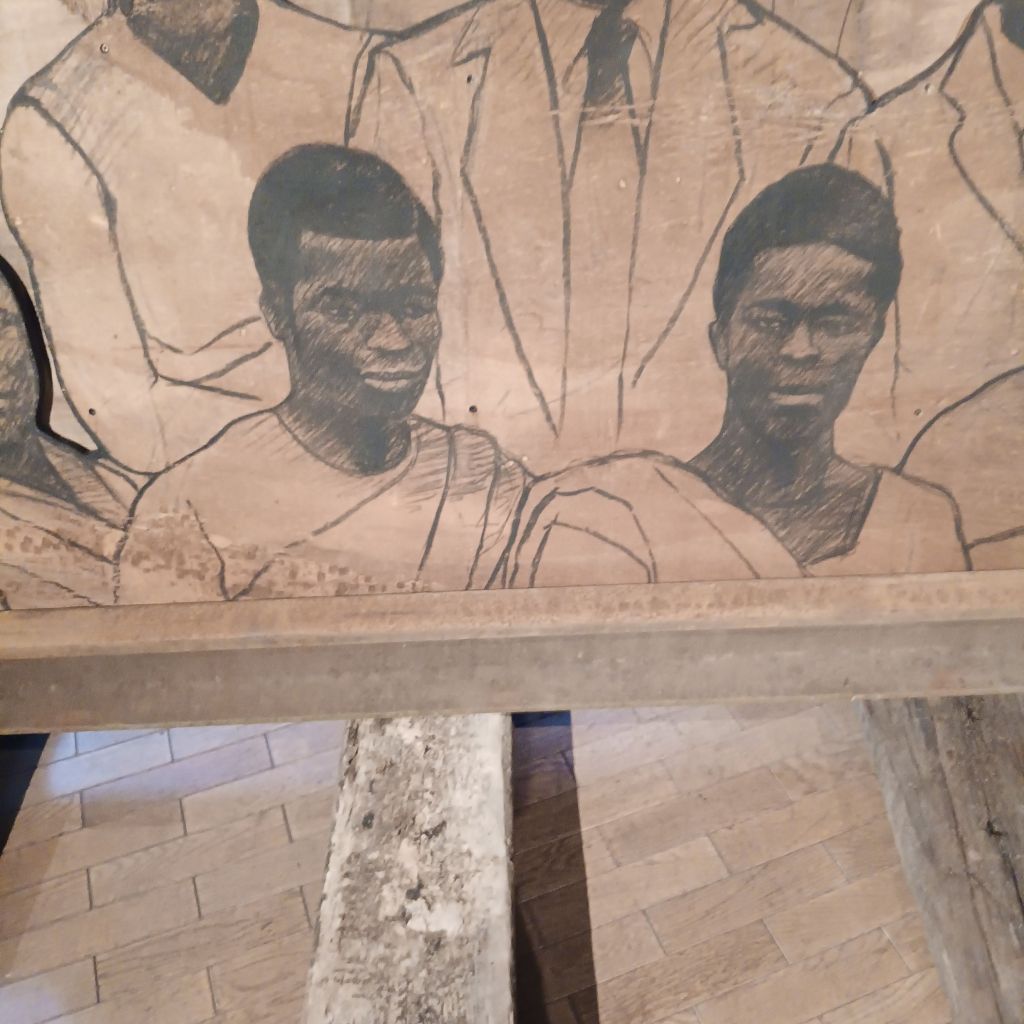
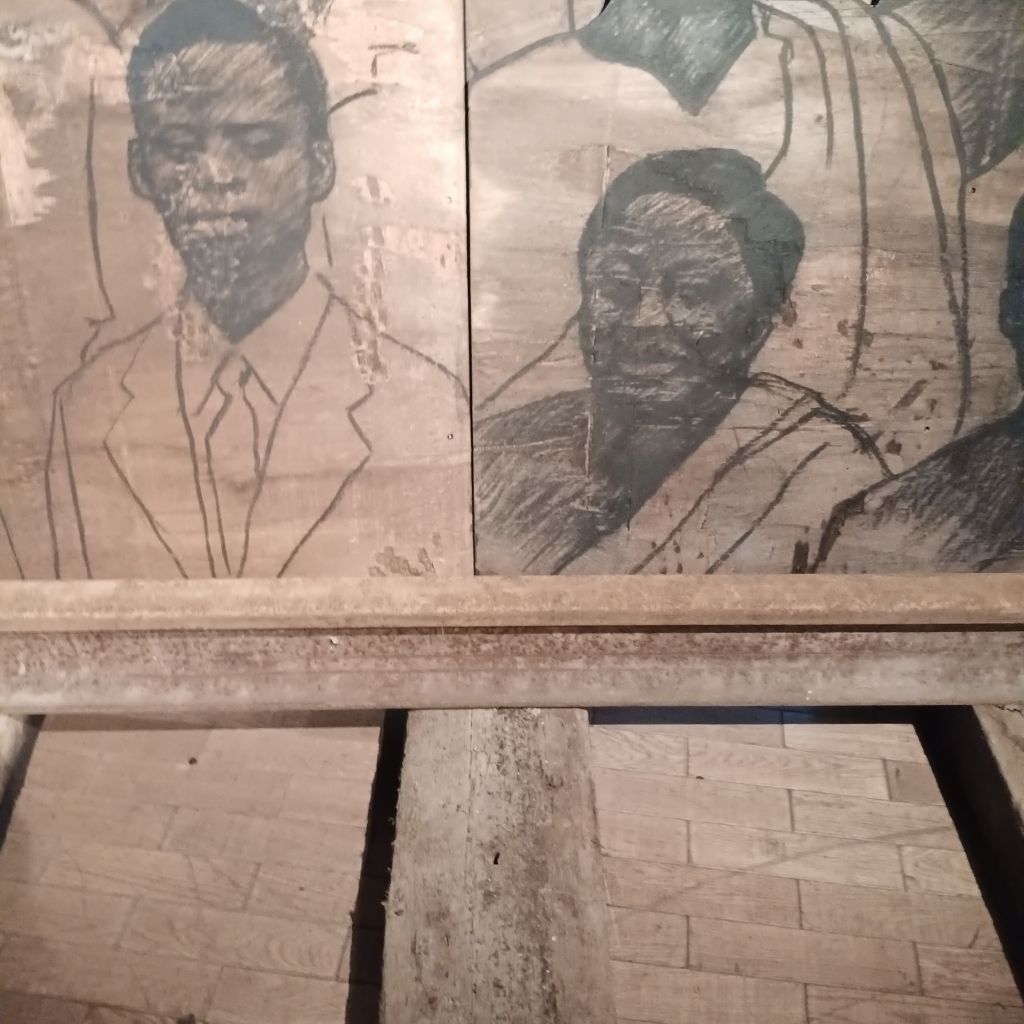
Independent works hang on the walls of other gallery spaces. The cattle skins marked in charcoal like that used to ‘heal’ and set in, the owner ripped from old coating carriages are moving, I think even if you did not know all their associations, for they marked by thevtouch and use of mant hands of the past.
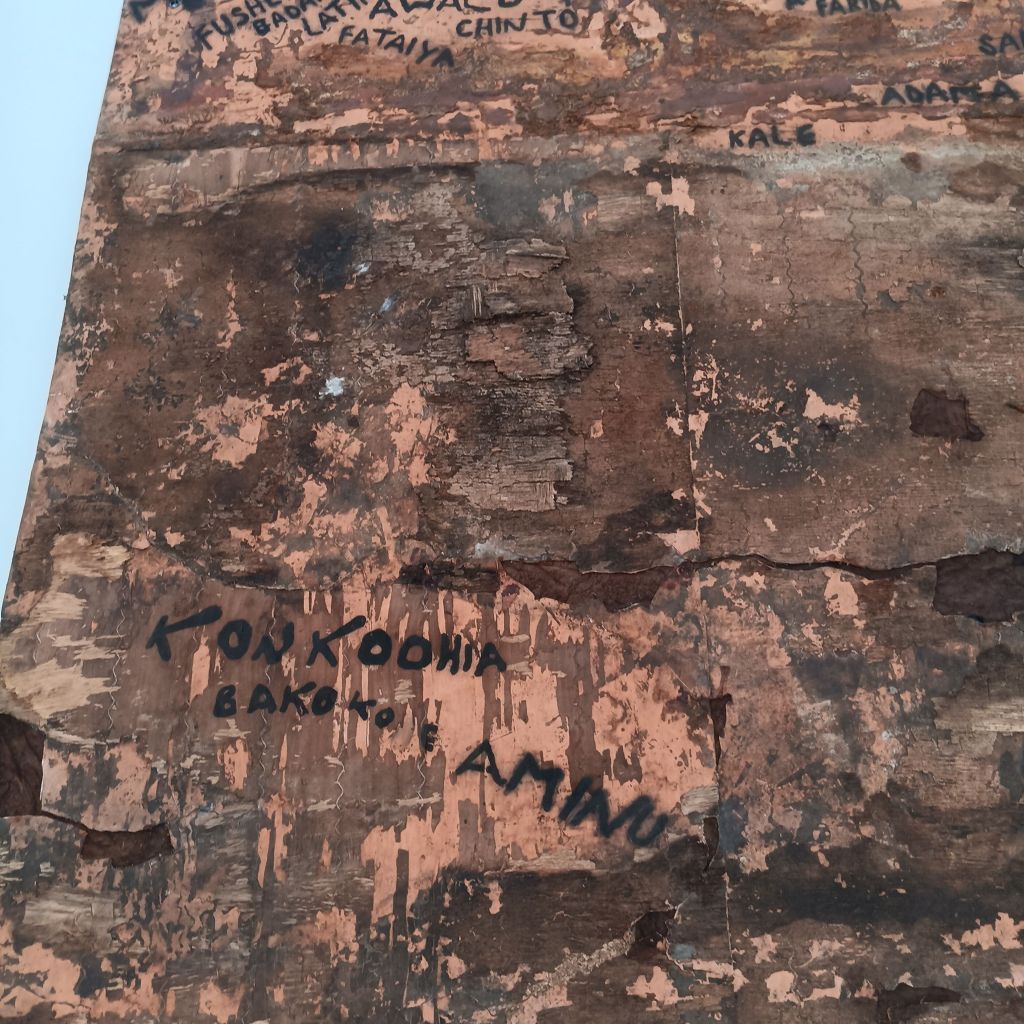
Other art is created by collaged bills and administrative paperwork salvaged from a manufacturer of paints for industrial purposes.
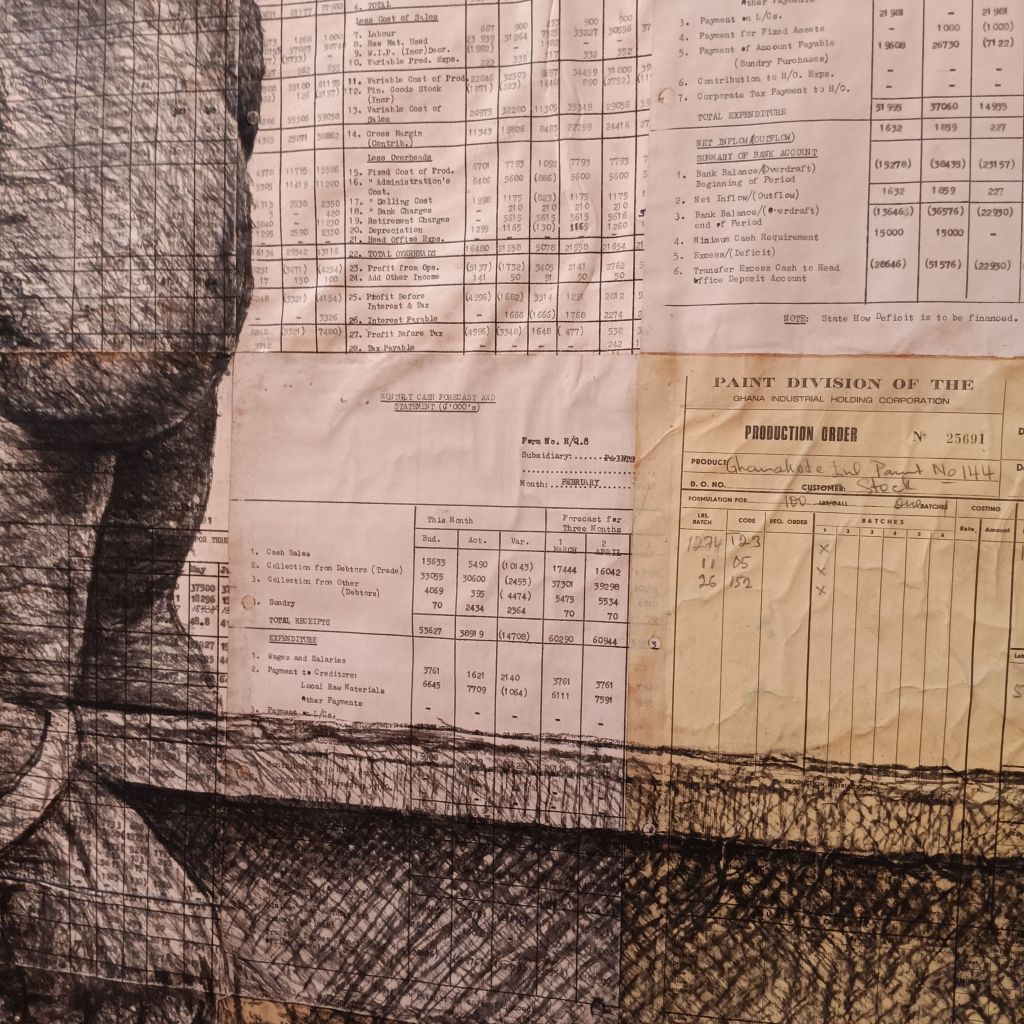
Created into huge surfaces whose text and / or calculations on bills of sale become visible only as marks, they are marked upon or branded again with figures somewhere between realistic labourers and idealised bodies or a mix of both and other symbols or patterns of marks. The variety is amazing.
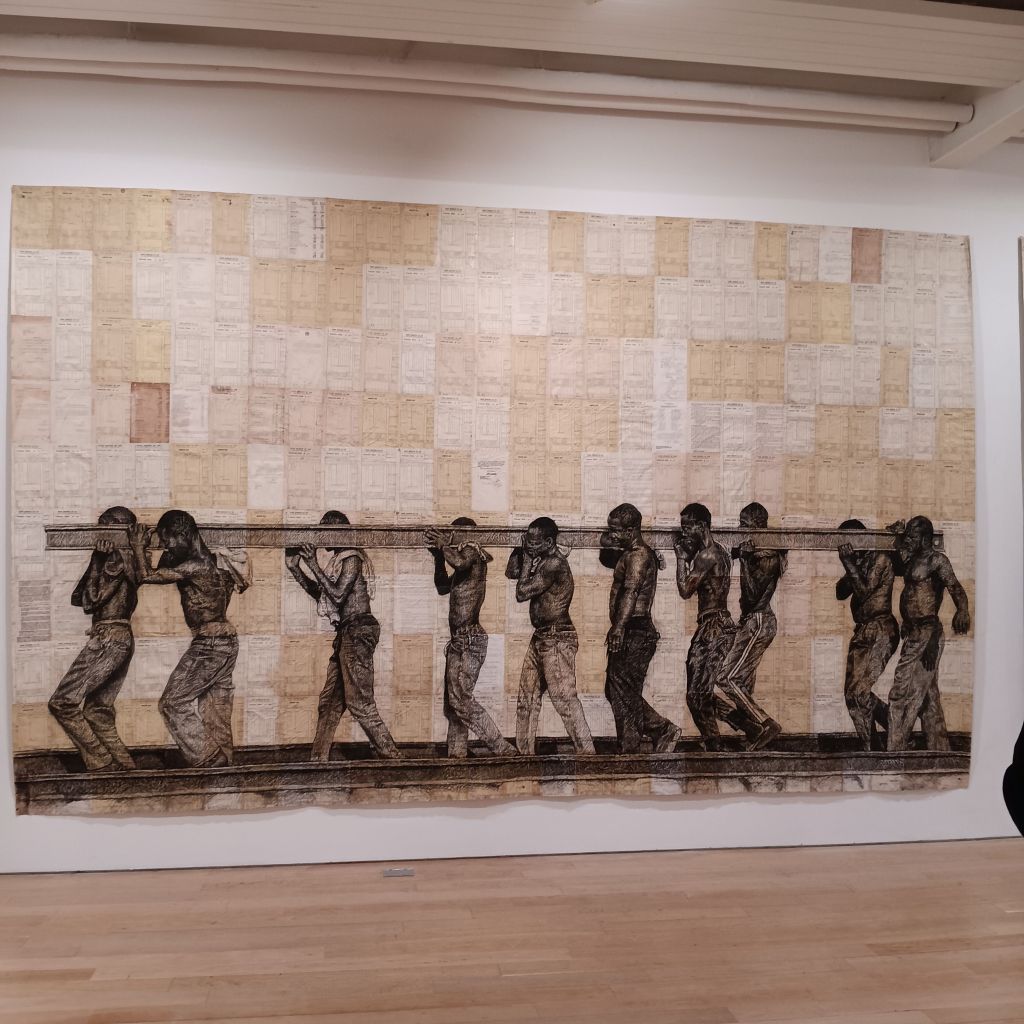

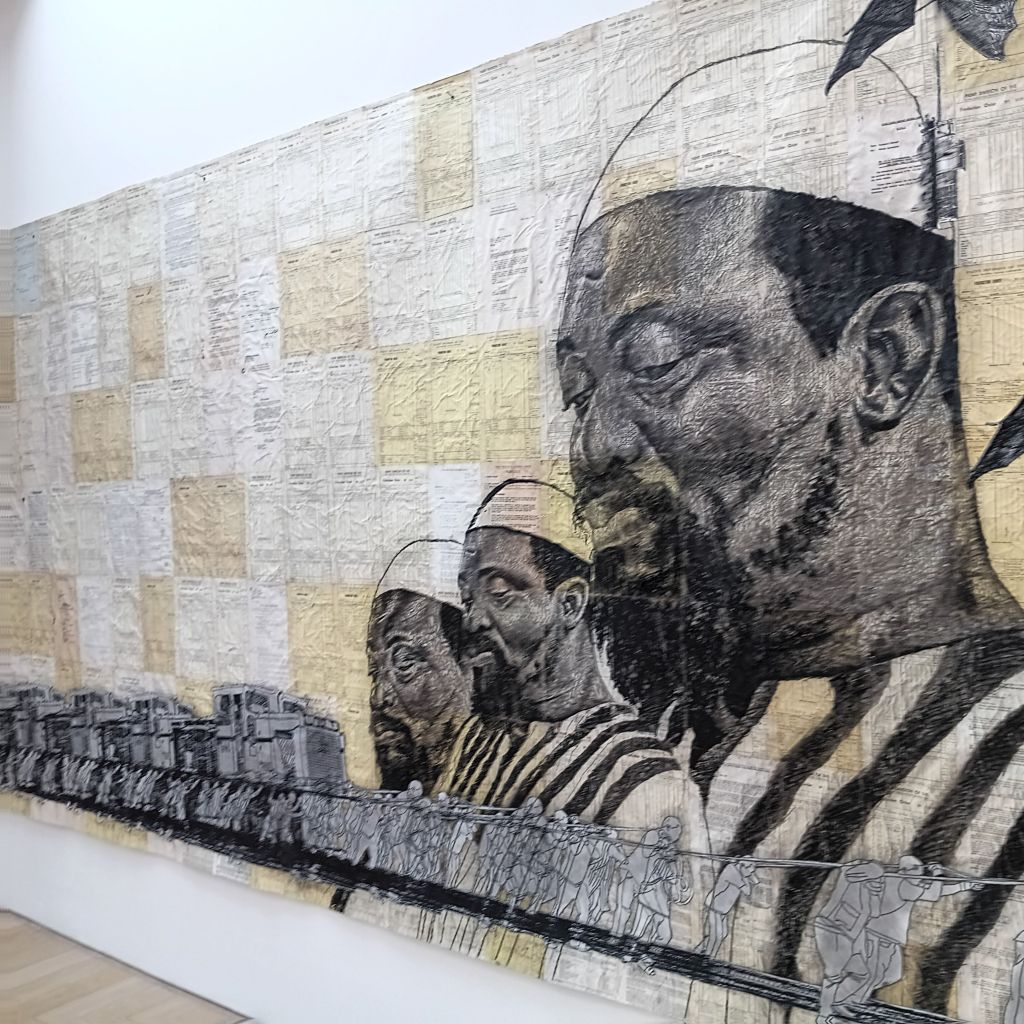
You need to get up and close to realise another depth in the art.

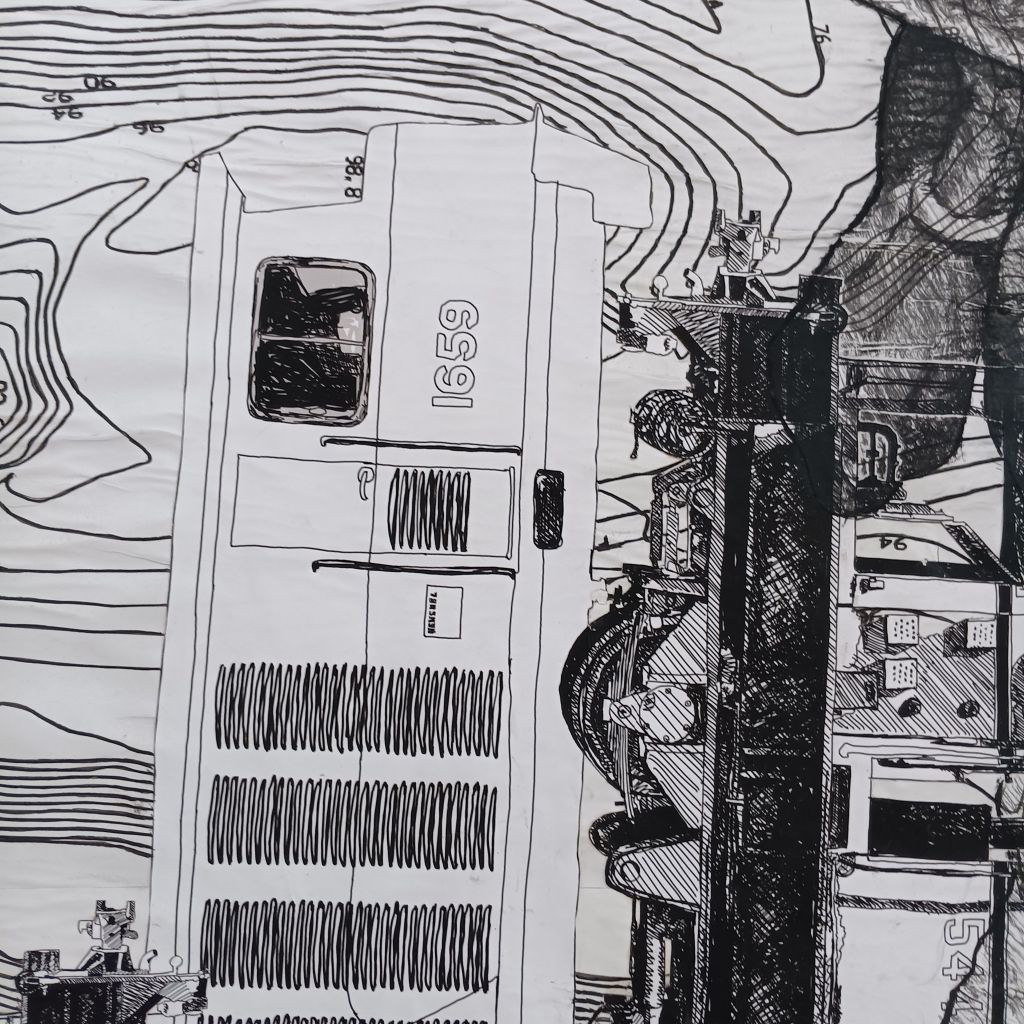
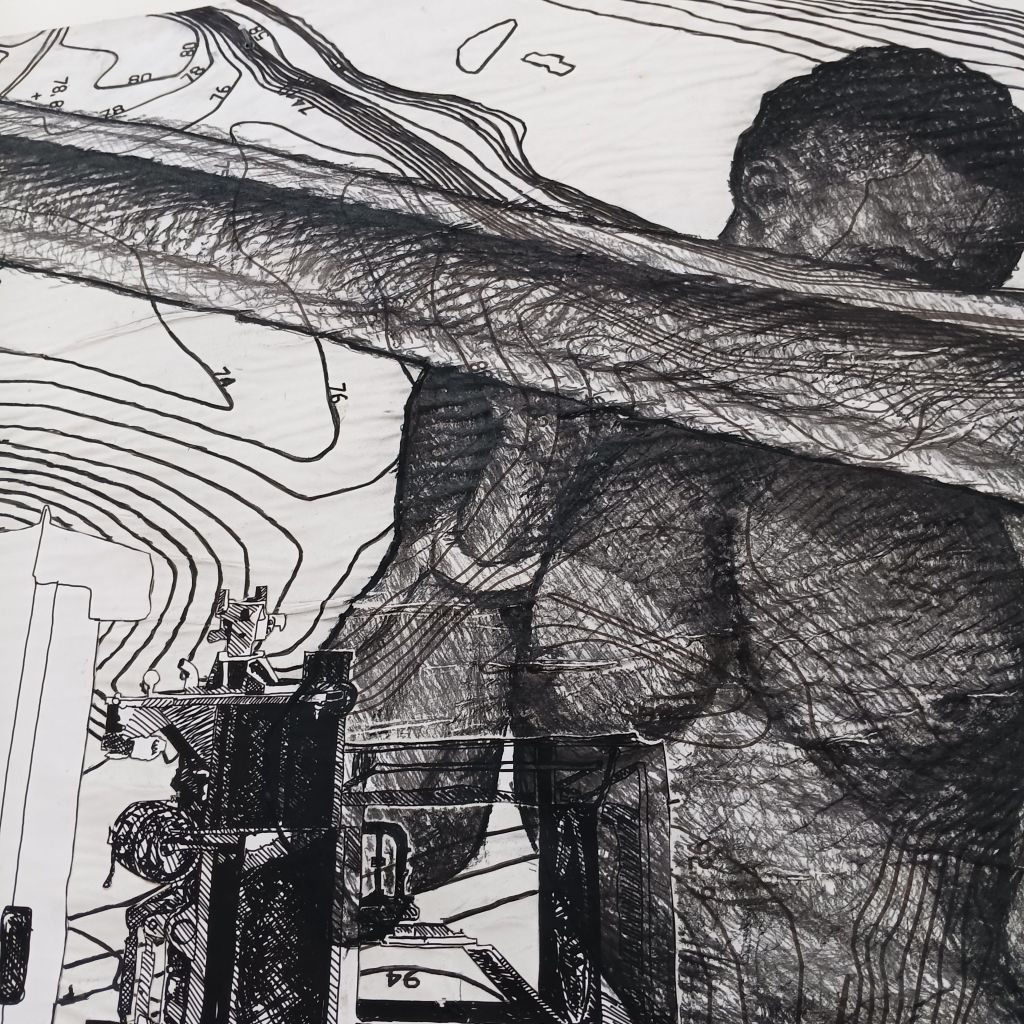
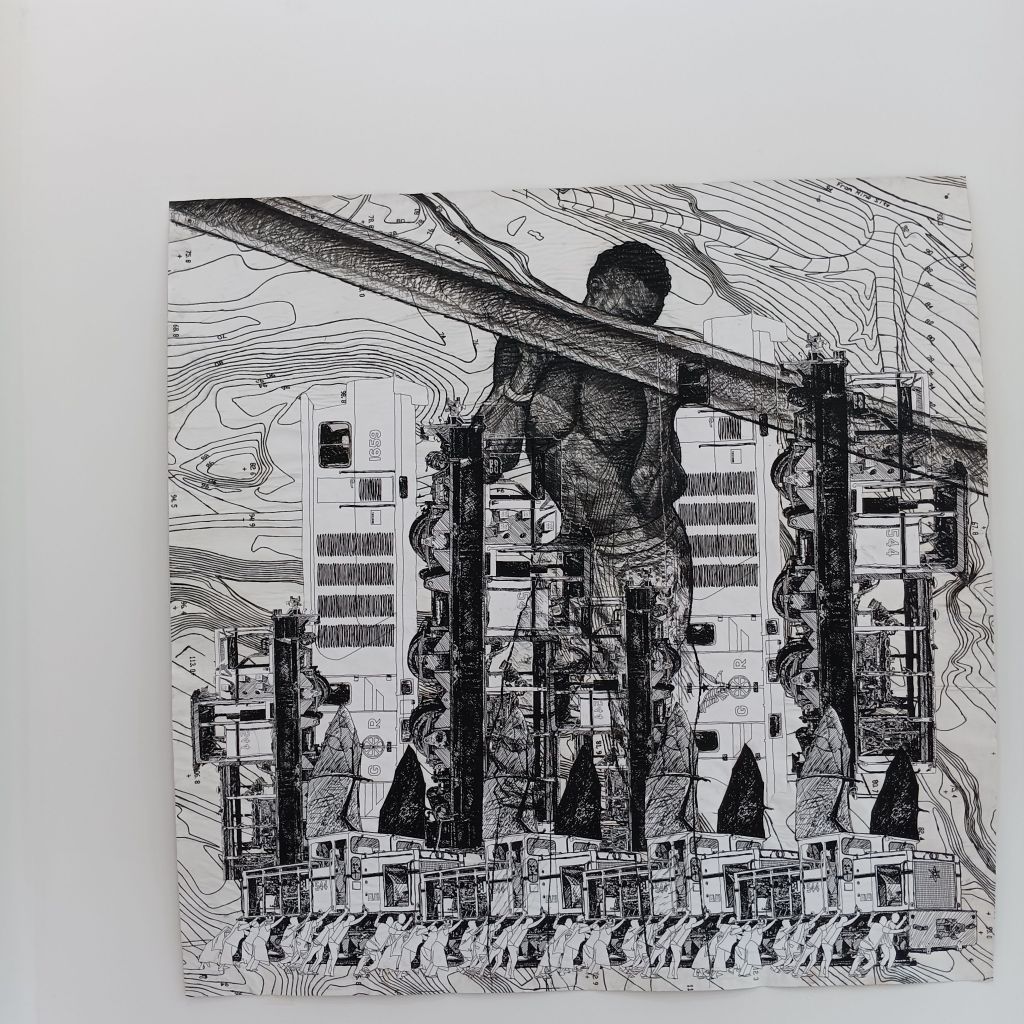
The markings are those of cartography showing contour lines next to created volumes of an artist’s figural representation of a body in its volumes, densities and inward and outward curves; curves that are created to deceive the eye. Likewise, iconic two dimensional.pictures of train stock created another level .of the representation of the ‘real’.
What an exhibition to stumble upon. But this is Edinburgh in the Festival. I walk up The Scotsman Steps, themselves an artwork of contrasting marbles and join the High Street on my way to the Book Festival.
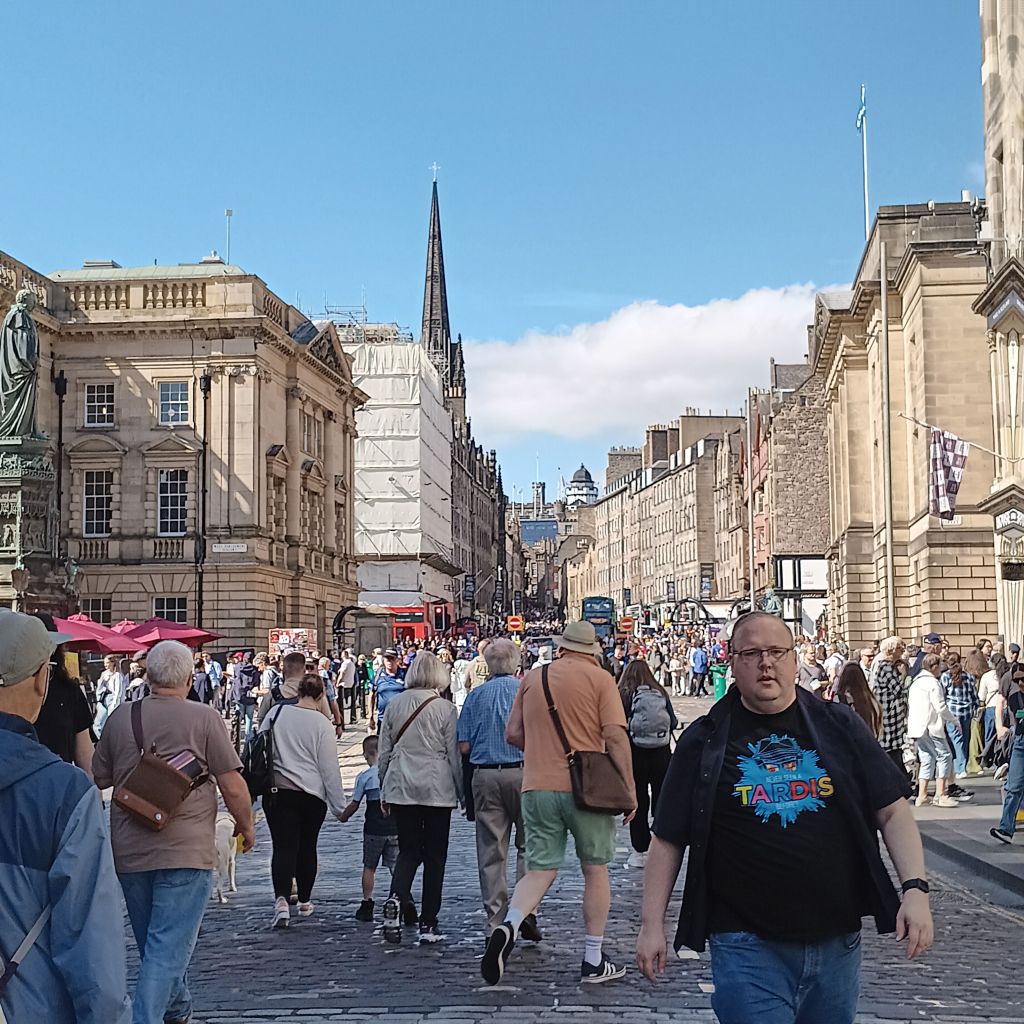
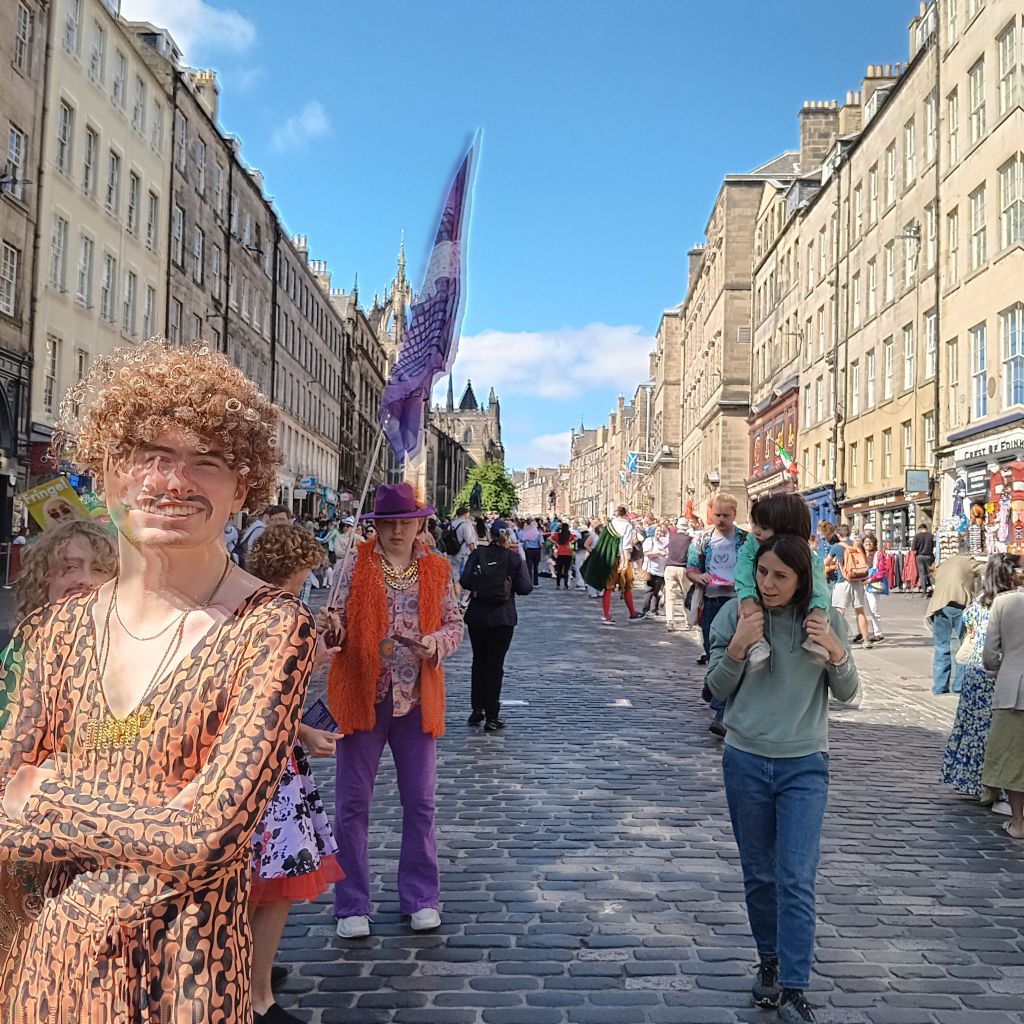
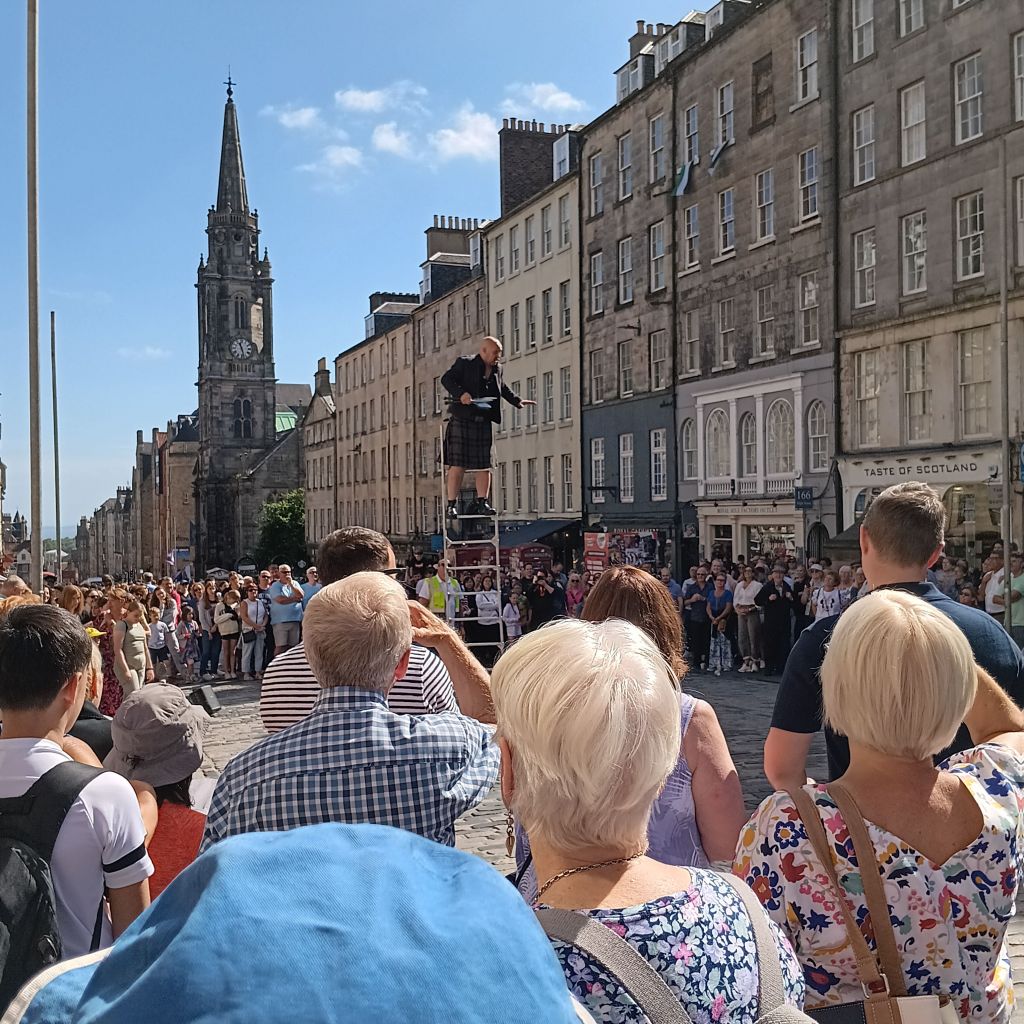
I bypass the theatre I will return to 4.55, the Iniversity of Durham Students Union, Bedlam Theatre as I turn into the main University Campus area.
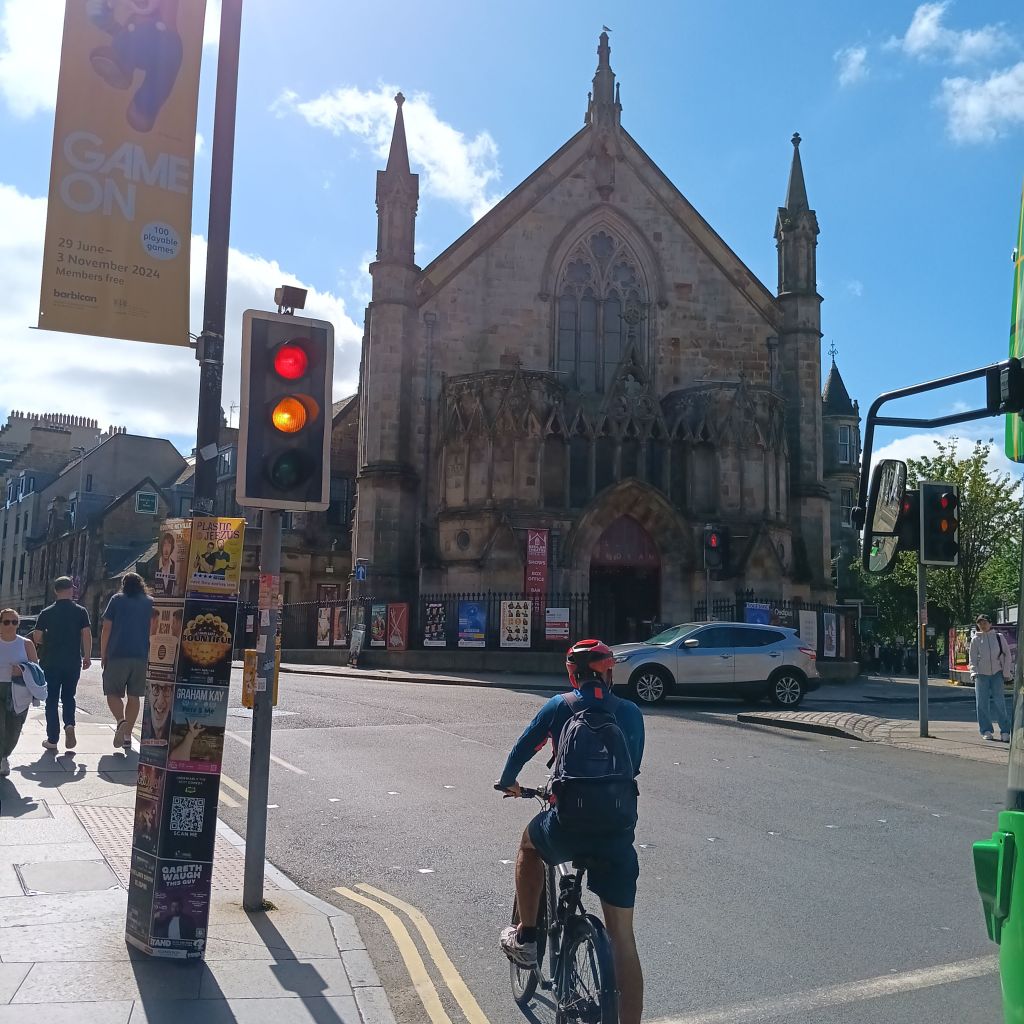
And then the new home of the Book Festival.
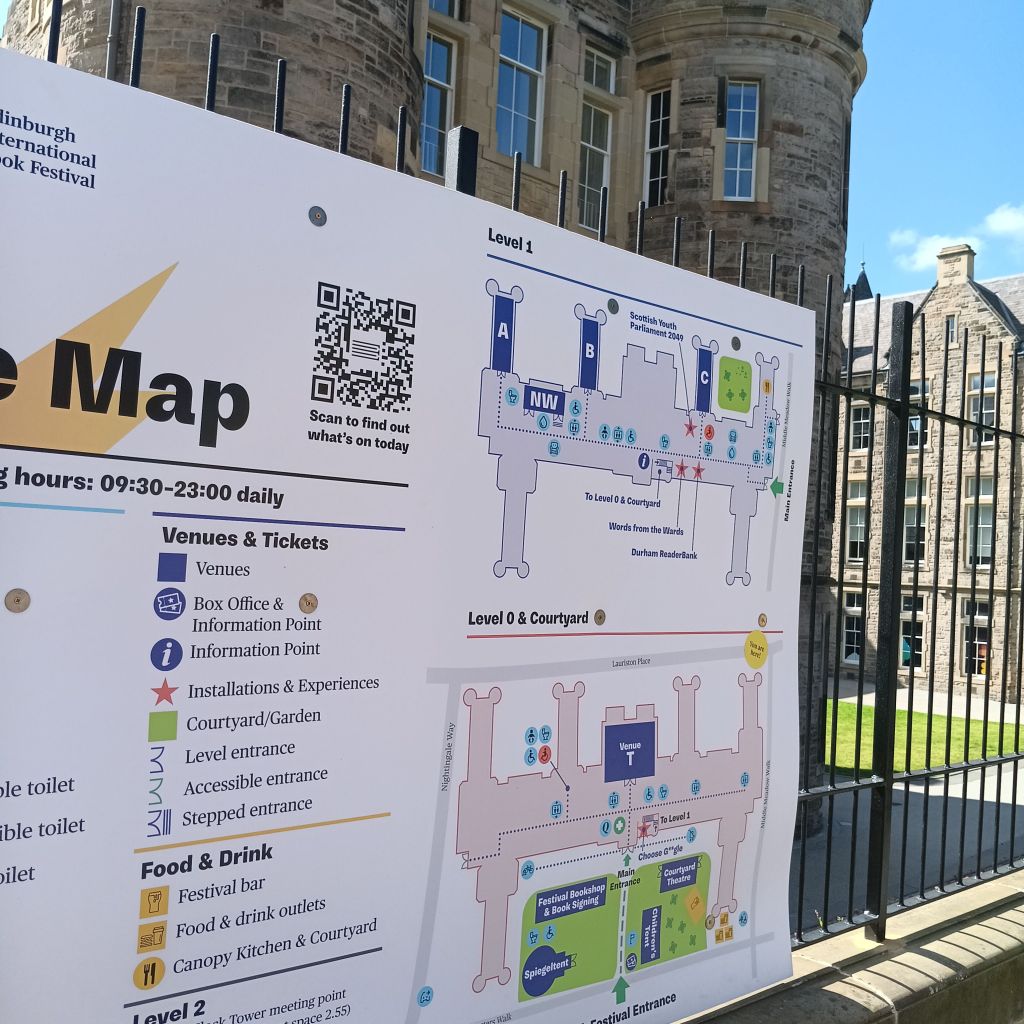
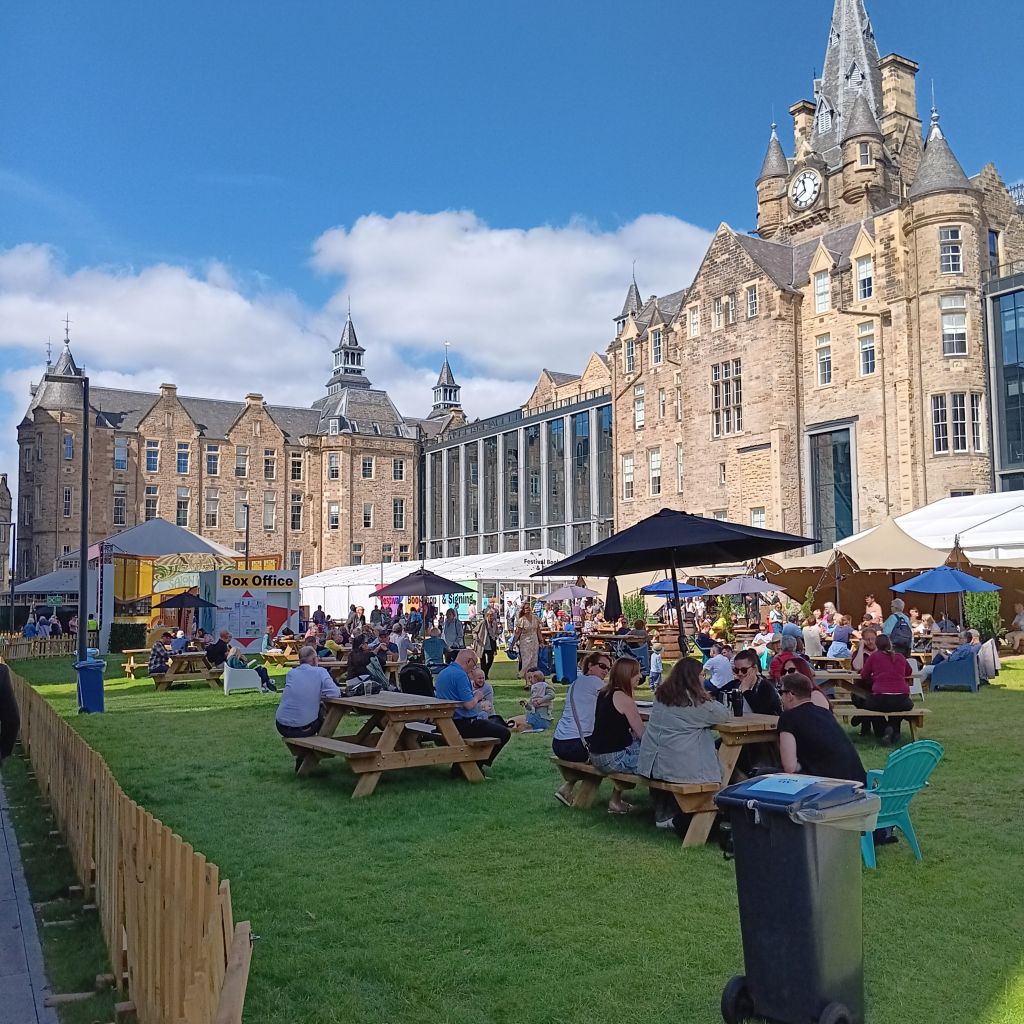
Once there, it was possible to go into the Courtyard Theatre immediately where Tommy Orange was interviewed, reading two short passages of the interviewers choice. I didn’t cat h the novelist-interviewer’s name, but she was excellent, in line with how Tommy Orange worked. You can never capture the moment.
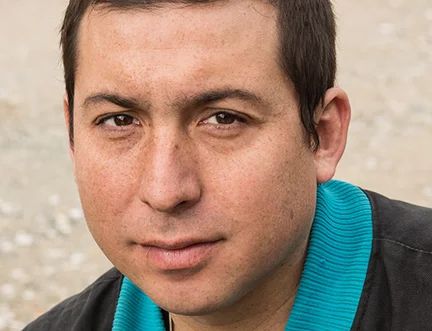
Orange spoke of clarifying the complexities of the identity issues in this novel and the importance of prose technique and the manipulation of point of view in the novel in order to achieve this. I loved all this. I got the chance to ask my question about the special relationship between Orange and Kaveh Akbar and the assumptions regarding the processes and assumptions of survivor identities and recovery and lapse paradigms in ‘addict’ experience and work. This seemed to make a basis of commonality between writers of very different backgrounds and identity positions.
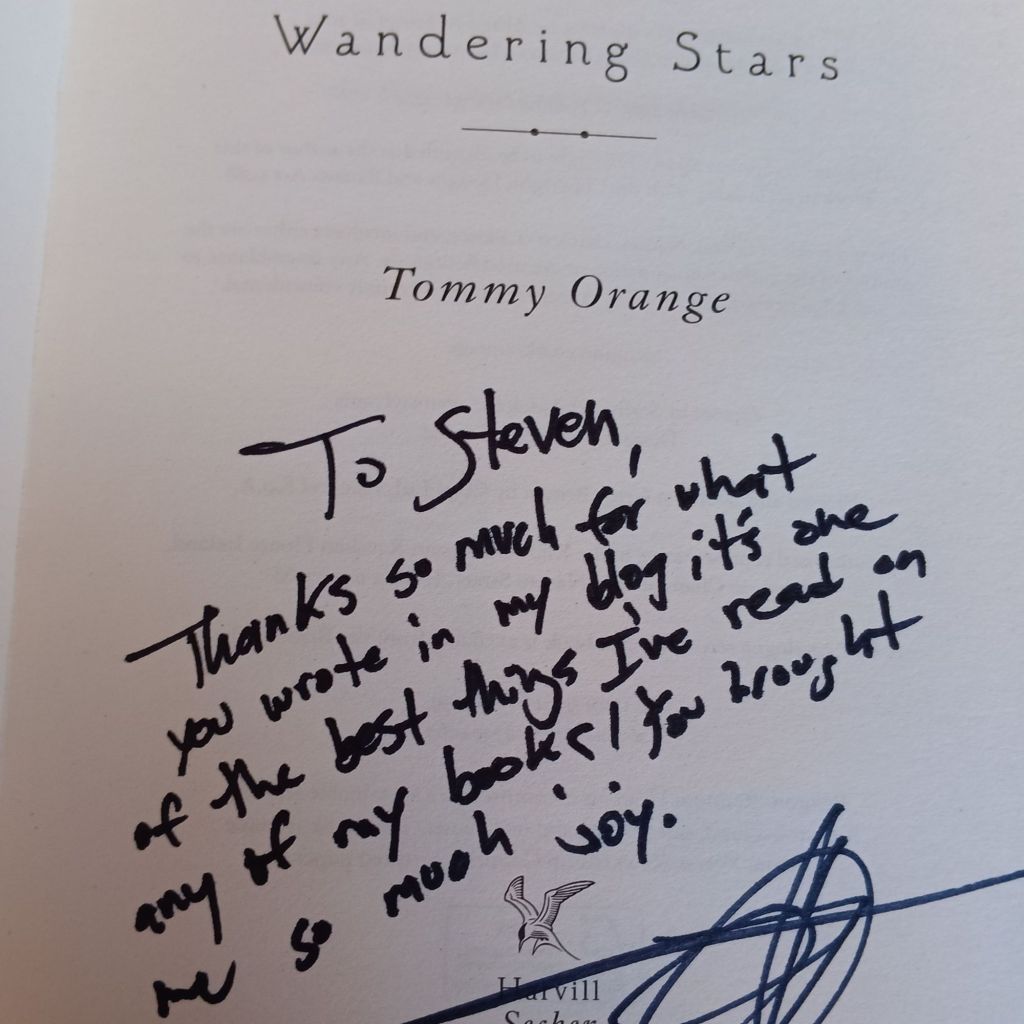
Tommy Orange answered beautifully. I felt that so much could have been uncovered, yet this was the most satisfying author talk I have ever attended. I was so buzzing when I attended the author tent that I forgot to ask for a live photograph. I asked if Tommy would accept a hard copy of my blog on him, and he did, and that made me happy (access this blog with this link). When he saw it, he told me with an obvious sense of surprise at the coincidence, he said it had already been sent to him by Kaveh Akbar. Thank you, Kaveh, for I do not know you except in your fine work either.
And he wrote me a fine dedication. Forgive me for sharing it. I feel so proud. Here it is:
No wonder I fell over on the street as I walked to the Mound and on to the Royal Academy. Given the rushing by, I think people thought I was drunk. Lol. I have not had a drop for thirty years.
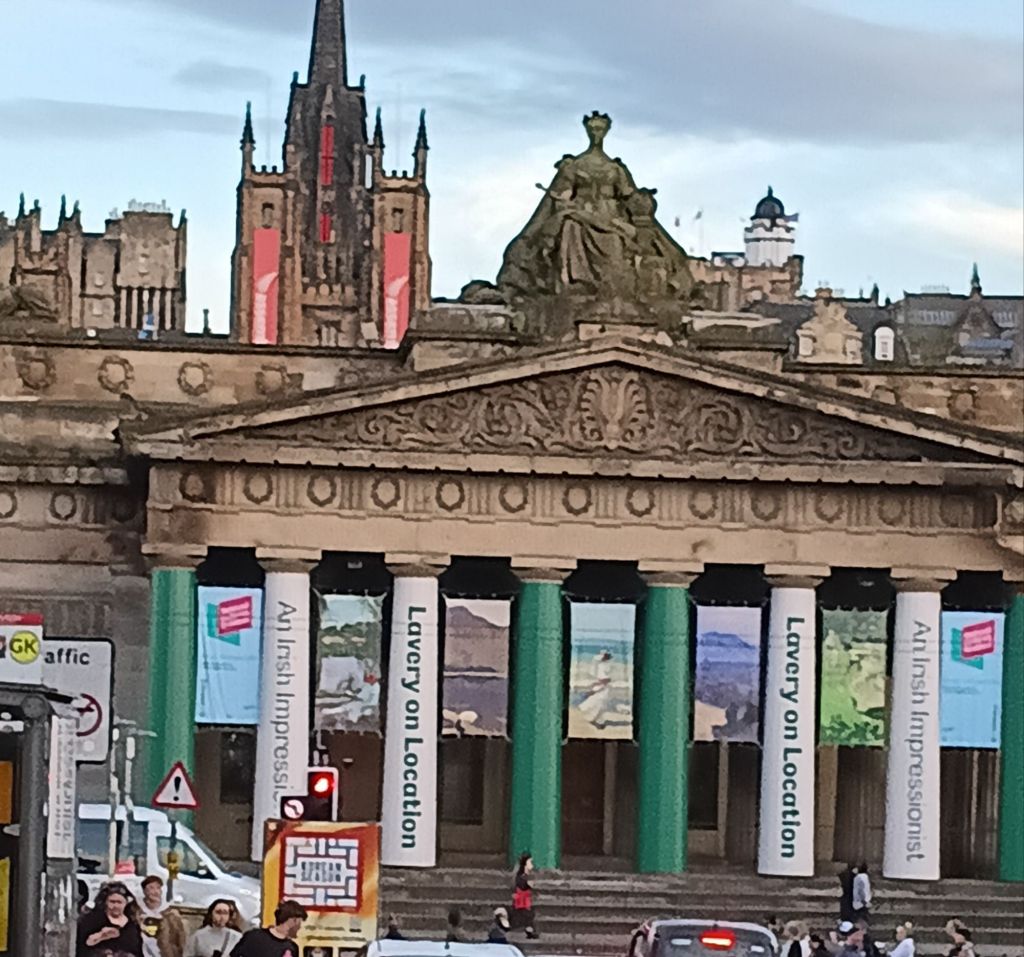
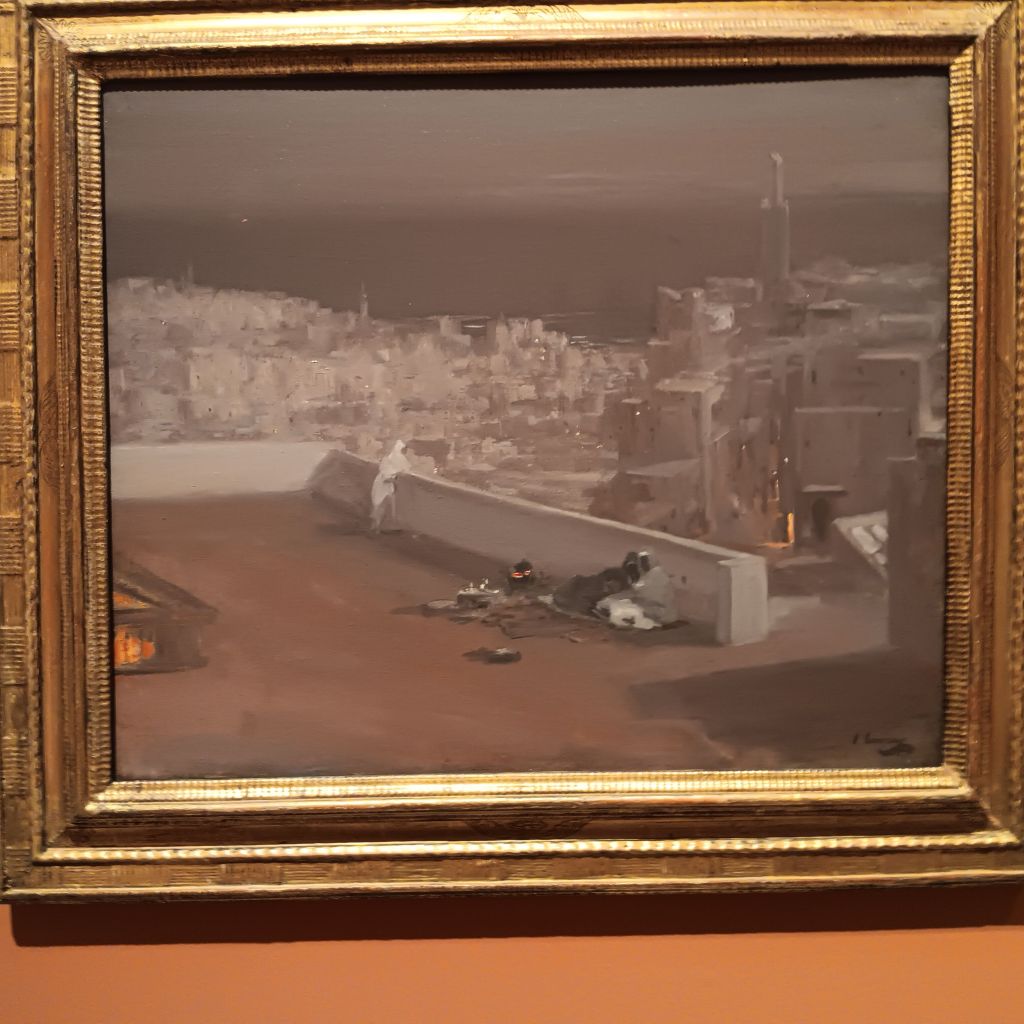
Then on to the John Lavery exhibition which I relished too much not to do a separate blog when I have read the catalogue I bought afterwards, but her is a wonderful and intriguing Morrocan picture to be going on with.
After a break, I had just time to get to Bedlam. Thatre and have a zero Guinness in its yard.
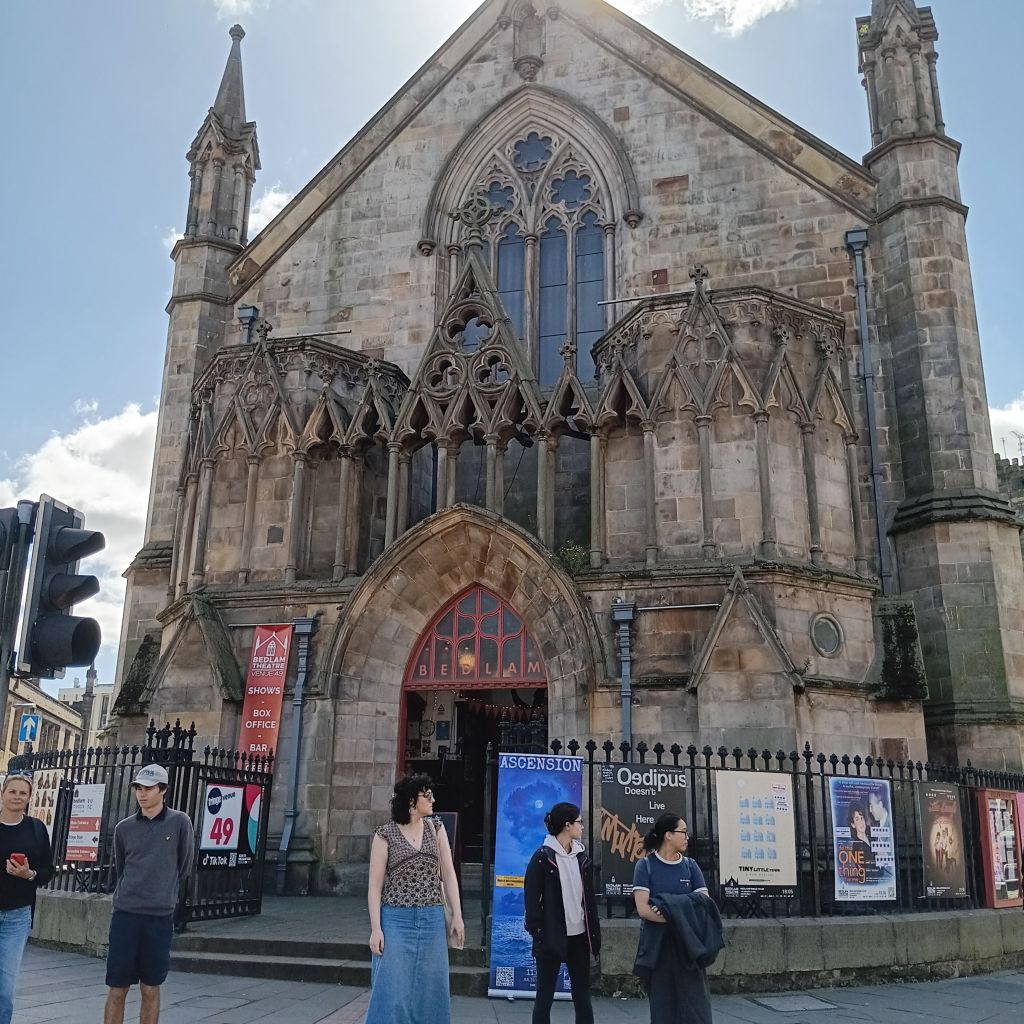
Guiness gone, the playbserved was performed by Edinburgh students, a four person piece called Oedipus Doesn’t Live Her Anymore, a play by Danuel Evans, of which the basic plot is a semi-modernised version of ghe fate of thd Housd of the Lbdacids of Thebes from the rape and murder of the young boy, Chrysippus by Laius, to the death of all the children of Oedipus. The rape of the boy was in a motel shower, the murder of Laius done as a televised sporting adventure watched by a modern family, and although Creon still consulted the Oracle at Delphi he flew there after giving his son a fatherlyvtelling modified somewhat by his pleasure that his sex play had been with a girl.
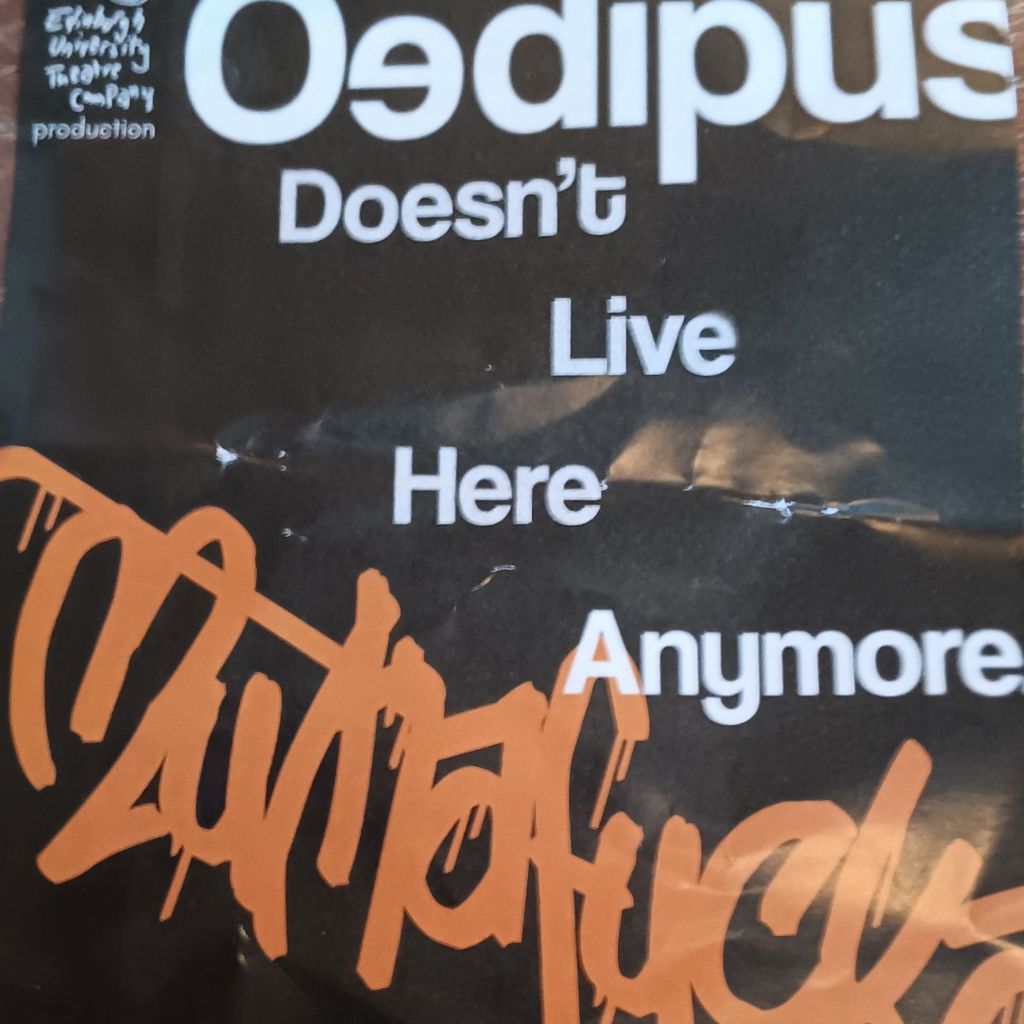
As you might suspect the word ‘MUTHAFUCKA is written on Oedipus’s garage door after his mistake is discovered by some funny neighbours but the representation of all this has to be done by some rather impromptu sets:
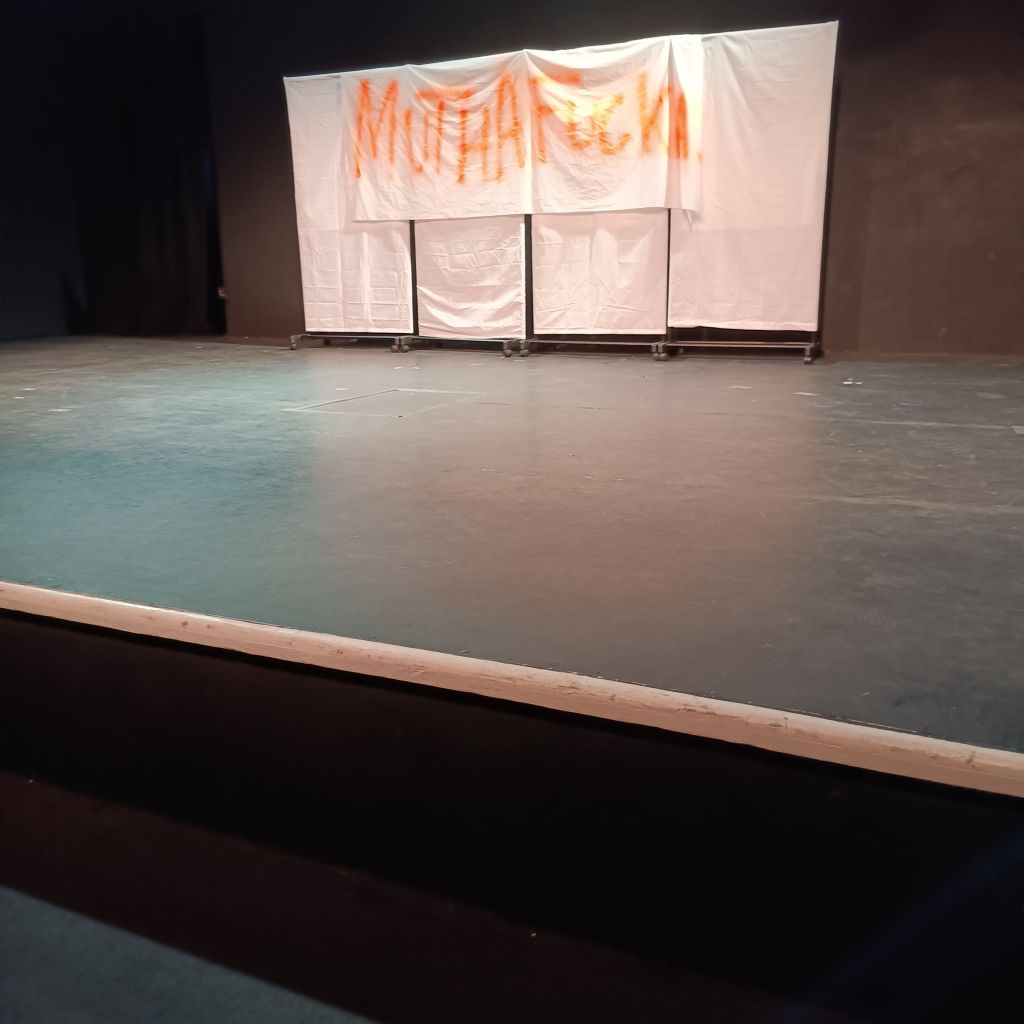
The burden of meaning gnof the play is that it seems we all perform horrific disdain for things we find ‘abnormal’ but lust to hear them nevertheless, and for that, we as audience were mocked.
It was all great fun, but the strength of such performances involving character shifts and comic play depend on easy transition between roles, times, and places, and that demands highly developed skills. These are not thee yet, but this play is enjoyable, although the version of the war between Polyneices and Eteoclez lost me – becoming a series of skits of modern miscommunication.
My train is nine o’ clock so I am in a rather nice restaurant eating grilled paneer writing this on my phone.
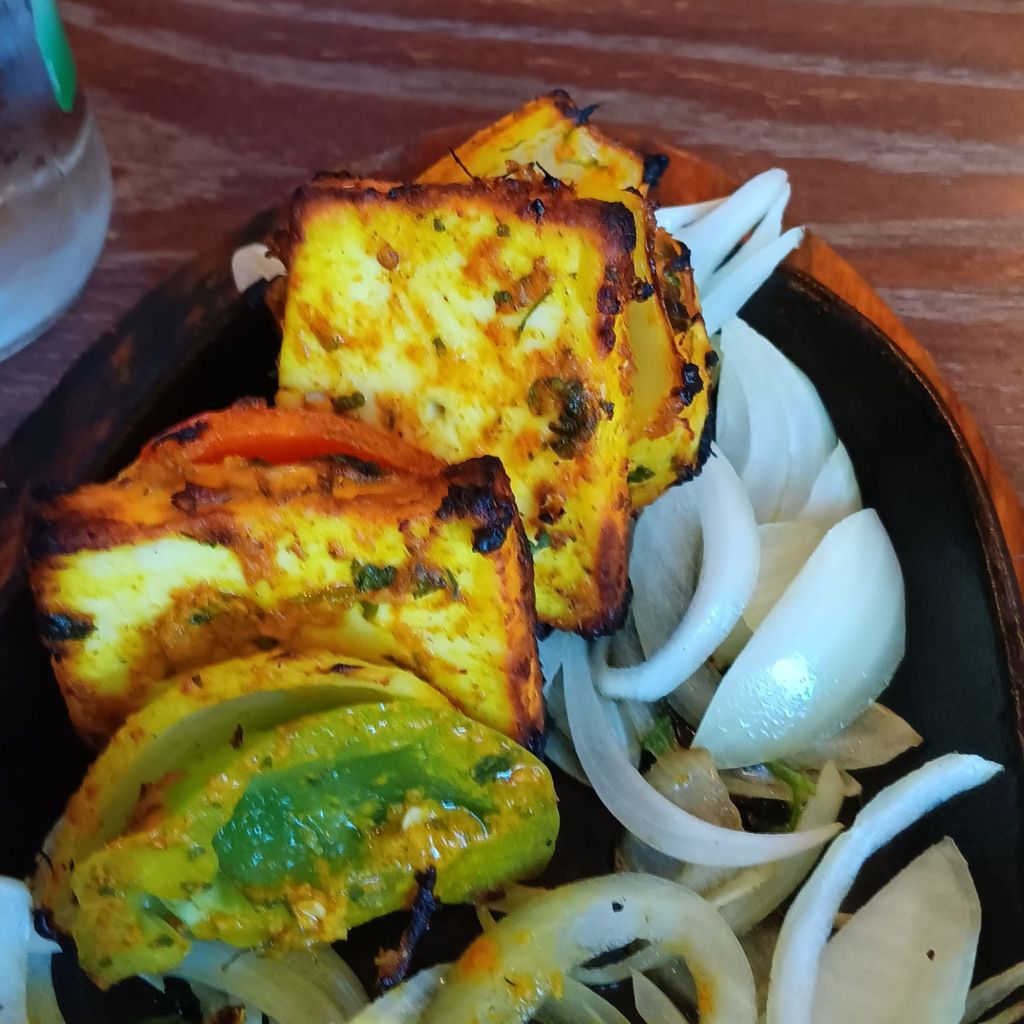
Back to sum up the journey before this becomes tomorrow’s blog. I will work on ‘Glasgow Boy, John Lavery, for another day.
It is now 10.45, and in just over 30 mins or so, I will be picked up at the station. I doubt I can sum up now. Just sign off tattered – but yes, the day was worth it.
All my love
Steven xxxxxxx
 Steve_Bamlett_blog
3 thoughts on “14th August 2024: Steven’s day at the Edinburgh Festival, a blog.”