Rita Bullwinkel seeks for something in the progression of women’s competitive sport which does not involve a ‘feeling of whittling, of a group of many reduced to a single champion, but’ rather ‘the feeling of accumulation’.[1] This is a blog on Rita Bullwinkel (2024) Headshot London, Daunt Press.

This is a superbly written book with an infuriating plot structure. That is unfair because the plot structure and its nuances of treatment and play with expectations are those of a potentially great novelist – it reminds me of Virginia Woolf’s Between The Acts, though that might be a fanciful comparison. It is, however, as equally and skillfully mastered if without (for me at least) the historical and emotional range of Woolf. It is a book that deserves its current favour and its place on the Longlist, although it feels to me to be a debut novel that needs more to get to deserving the shortlist.
So, first of all the plot, which is based upon a tournament that starts with eight young women in Round I of ‘The daughters of America cup’ (Women’s Under 18 & Under) at Bob’s Boxing Palace, Reno, NV. It is a plot meant to be spoiled, for it can be and is summarised in a schedule of the elimination rounds, each game leading to a supposedly unpredictable winner. There is some role then for the reader in guessing the winner of each match between two people, where the whittling away of the contestants is achieved, or in other words the ‘group of many’ is ‘reduced to a single champion’. This is in fact the plot in one very linear sense but, as my title quotation suggests this is not the larger meaning of the plot and its handling. My title refers to this statement, which is handled as if giving the point of view of a local male reporter (for the Reno Gazette-Journal), Sam. In full the significant passage reads :
The girls all look different, and the way each of them boxes is different, but there is something collective about their energy. Sitting in a white folding-chair, waiting for the championship match to begin, Sam thinks about how something about the Daughters of America tournament feels like a game played in reverse. Usually, as a tournament progresses, there is a feeling of whittling, of a group of many reduced to a single champion, but here in Bob’s Boxing Palace, at the daughters of America tournament, as each bout has been fought, there has been a feeling of accumulation.[2]
That use of the reputation of the name of the tournament in Sam’s point of view of it may tell us something about Sam himself, as a reporter, and even specifically as a male reporter, stuffed with a sense that somehow the patriarchal traditions of America matter, wherein all men are potentially Fathers but all women are primarily daughters, even when they marry another man. Yet it is important Sam, a man, sees this rather than a woman from a female point of view because it registers what Bullwinkel wants the readers understanding of the plot to mean – that this novel is not one of reductive diminished (‘whittling’), which is one way of looking at the meaning of competitive tournament but a collective solidarity and growth of a female consciousness from the coming together of very different women. Not that the women necessarily see it as a coming together from each of their individual points of view in the telling of the story – the point is I think it is collective nature of women, over and above individual differences, is what accumulates, and that this, by implication, is not the case with the majority versions of competitive sports that are played solely by men. The presence of male administrators of the sport throughout is emphasised as is their failure to understand, as the women do, that which they promote.
So there is a sleight of hand in the way the prefatory charts of the events of each stage of the tournament play a male game – a competitive and ‘whittling’ one, whilst the process of prose treatment of these episodes allow for a reverse dynamic – moving from the individualised or atomised to the collective and emergent whole made up of many atoms. The charts are below (my photographs – note the flimsy paper of my paperback copy (it was a paperback original) shows through the typing on the verso of the page.
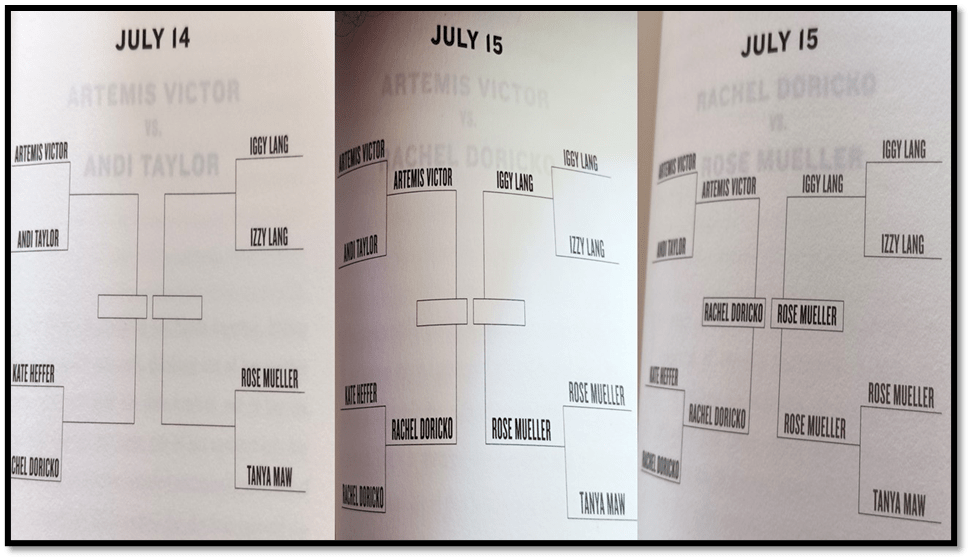
The schedules of the tournament held on July 14th and 15th 20XX of ‘The daughters of America cup’ (Women’s Under 18 & Under) at Bob’s Boxing Palace, Reno, NV as used to preface the Sections of this Novel based on the effects of the elimination rounds of the Tournament and culminating in the Final. BUT THERE IS MORE TO THE PLOT than that.
There is a tension of suspense created around the first four ‘chapters’ (named after the combatants, starting of course with ‘Artemis Victor vs. Andi Taylor’ about who will win these contests. All of these chapters are aligned with the four ‘elimination round’ matches that determine which woman will win and how at their conclusion, However there is ambivalence to this tension and it becomes less in later rounds. There are causes for this reduction of stress. First the ‘losing combatant’ you discover, as you read, is usually given a more elaborate treatment : their future life will becomes projected for them in ways it is not for the combatant that will win the match. The aim seems to be to refuse any simple binary of winners and losers in favour of more equal contributors of a kind of subjective life and will to survive between all the female contenders. After the first four matches, the tournaments are less similar in structure and increasingly include characters who lost their matches and ought to belong to the past but don’t.

For instance s Artemis Victor and Rachel Doricko fight on in a kind of blending of diverse styles of motion, posture, gesture and proxemics that reflect their past lives, the ‘other girl fighters enter the gym’ and contribute to the understanding of the fight, Iggy Lang seeing it as less contest than a ‘fight about aesthetics’, and consequently with its blend of such features.. even the girls who ‘are not present’ are evoked as ‘their successes and failures haunt this march’. We see here the mechanisms of solidarity and accumulation of experience both garnered from the past and projected into futures.[3] In the next match too girls who have lost also contribute by spectating. For Tanya Maw that is because she ‘would never leave a play before it is finished’. Indeed it more active than spectating alone, they ‘haunt this match’, focusing its developments learned from their participation.[4] As we learn more about the girls and their subjective fantasies, we see the fight in terms of a kind of work utilising the imagery of these fantasies, of water that either drips or floods, caves, animals (especially dogs), marked or decorated skin or body features. In the last chapter moving between rounds in a match is often like other kinds of liminal experiences, ‘like she is crossing the border from sandy beach to water’.[5]
In the final championship match Artemis Victor, the memories the reporter Sam has of the caves of her home town, redding, mix his imagery of ‘sixty-foot icicle spikes’ with hers of delivering victory to herself by a process of the slow violence of dripping water, but a complex image so mixed: ‘The drip formations reaching for each other looked like rocks in the process of kissing’. If this match between women is more cumulative than reductive, it comes so because it is created in a way that respects these women as a community of interest, and embodied metaphors for feeling. How much individual girls are conscious of these cumulative processes it is difficult to tell. The processes are surely a function of aggregation of the narrative from different shifting viewpoints and sub-stories of each woman. These sub-stories get bound together by metaphors that criss-cross their boundaries so that there is a communal female subjectivity that is still not purely gender-nor-sex stereotypical. These women’s relationships change, and will change more in a projected futures that an opmniscient narrator knows will be the case for them. in changing members of the group will be brought both nearer to some and further from others in different ways but will remain a group bound in some way or another. Even the Lang family relational bonds shift – become less intrusive on each side – but not quite reduced just to their meetings at their family home of origin at Christmas.
But though this book achieves all that mastery of handling of its material, I find it, to my mind, still lacking in the feelings it ought to use and convince us about in describing women’s communal being. They are these meta-connections between the characters too much in the ownership of a brilliant author with a brilliant plan for her novel. There are suspicious links between the characters and archetypes – for instance the Greek Goddess Artemis is associated with caves and victory in the hunt whose name is invoked by the character Artemis, from the Victor boxing family, but I do not stress that link, for it may or it may not be there.
But oh, what mastery! Here is a novelist to watch.
With love
Steven xxxxxxxxx
[1] Rita Bullwinkel (2024: 234) Headshot London, Daunt Press
[2] Ibid: 233 – 234
[3] Ibid: 197f.
[4] Ibid: 212
[5] Ibid: 225
 Steve_Bamlett_blog
2 thoughts on “Not a ‘feeling of whittling, of a group of many reduced to a single champion, but’ rather ‘the feeling of accumulation’. This is a blog on Rita Bullwinkel (2024) ‘Headshot’.”