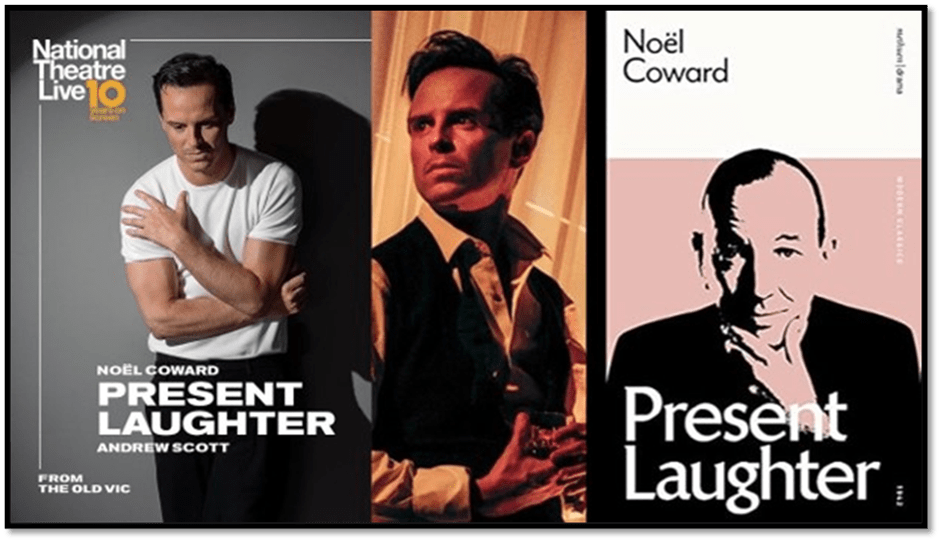
This is a blog on the National Theatre Live revision of Noël Coward’s ‘Present Laughter’.
If follows a blog preparatory to seeing the play from July 21, 2024 in stevendouglasblog (use this link to read it in full)
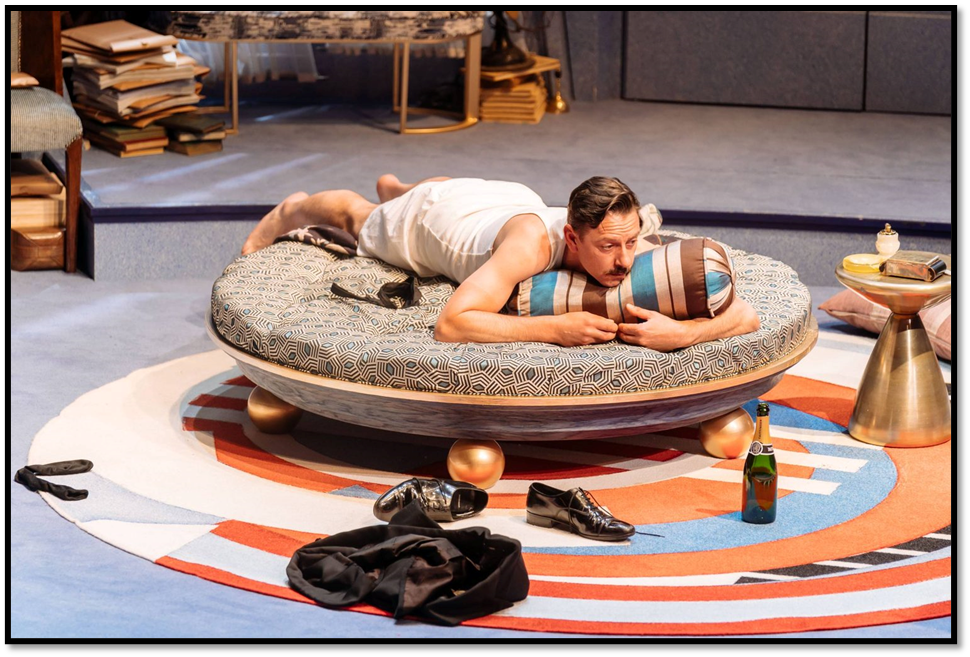
Enzo Cilenti playing Joe, Joanna in Coward’s script, the morning after the night before
Last night I saw the re-streaming of the live performance of Noël Coward’s Present Laughter. The adaptation of the script seemed as I listened minimal, most notable in Act Two, scene two onwards in terms of stage business (from then on there is quite an effort to redeem the character of Roland Maule from how I think Coward would have had him played) and yet the effects achieved chimed with the original despite the omission of some favourites lines. The theme of ‘the firm’ and the stress on Garry’s vulnerability to them as their main money-making asset was played to the full, with plentiful references by Garry to the seeking of 10% by the grouping of director, producer and financier, personal assistant that I don’t recall to be in the script. Indira Varma is brilliant as Liz but cold, so cold in the end in her relation to Garry being, in the revised script ‘The Face of the Firm’.
It was a stroke of genius I thought to change the play to show Garry resisting the decision of Liz, though but by hopeless whining pleas alone, to come’ back to him for good’, as if the play were about a stalled coming out of the queer actor to relative independence in how he ‘acted’. There was power in Liz’s line: ‘I’m thinking of the good of the firm’. For the ‘overacting’ this firm sees as dangerous in Garry is the chance that the star might act his part for his own rather than the Firm’s benefit. In this play, the asset turns on the capitalists and warns them they are living on their capital, rather than investing in it, and allowing it to be wasted. The play ends with a moment where we half-believe Garry is going to cast himself from the high window of his flat in an act of suicide.
The chief change however is in the relationship of the theatre producer, Henry who becomes a bullish lesbian Helen Lypiatt, whose affair with women turns the tables on his married partner, now named Joe not Joanna, and played in the manner of a sexily vampish bisexual man, played better and better by better by Enzo Cilenti , the more casually he allows his character to dress and acts, but hilarious once he seeks more limelight for his line about ‘leaving forever’, which he does more than once. It must have struck the play’s cast and director that called Joanna Joe, though appropriate for the minimalization of the change of sex / gender, took away a name for one of the unseen men in Gary’s life as named by Coward in the original for the English working-class effect of the name.
In my first blog on the play I wrote:
As if sailors, with a nouveau riche background were not enough, Monica also mentions ‘Joe’, a stereotypical working-class sobriquet, possibly of a soldier in the army serving in the Empire and living in India. He met him, says Monica, in the South of France (Marseilles being notorious for such meetings – …. – but it is clear that, though he says, ‘Joe was wonderful’, it was likely that he does not remember him precisely since he also says he is ‘dark green and comes from Madras’. Even the mention of the South of France only raises from Garry the witty retort: ‘I do get about, don’t I?’ [1]
That character is now called Mitch, perhaps to make our sailor from the USA, and the ‘green skin’ is gone. In this version Mitch really was a wonderful sexual memory of a beautiful man once had, rather than being the representative of the men so numerous in Coward’s original line that the ‘green skin’ is invented to show that individual men did not stand out in Garry’s memory unless their skin, as was most unlikely, ‘green’. And the Joe of our current production is not a working class man, though it helps that he is Italian to decategorize the class names in Coward’s original.
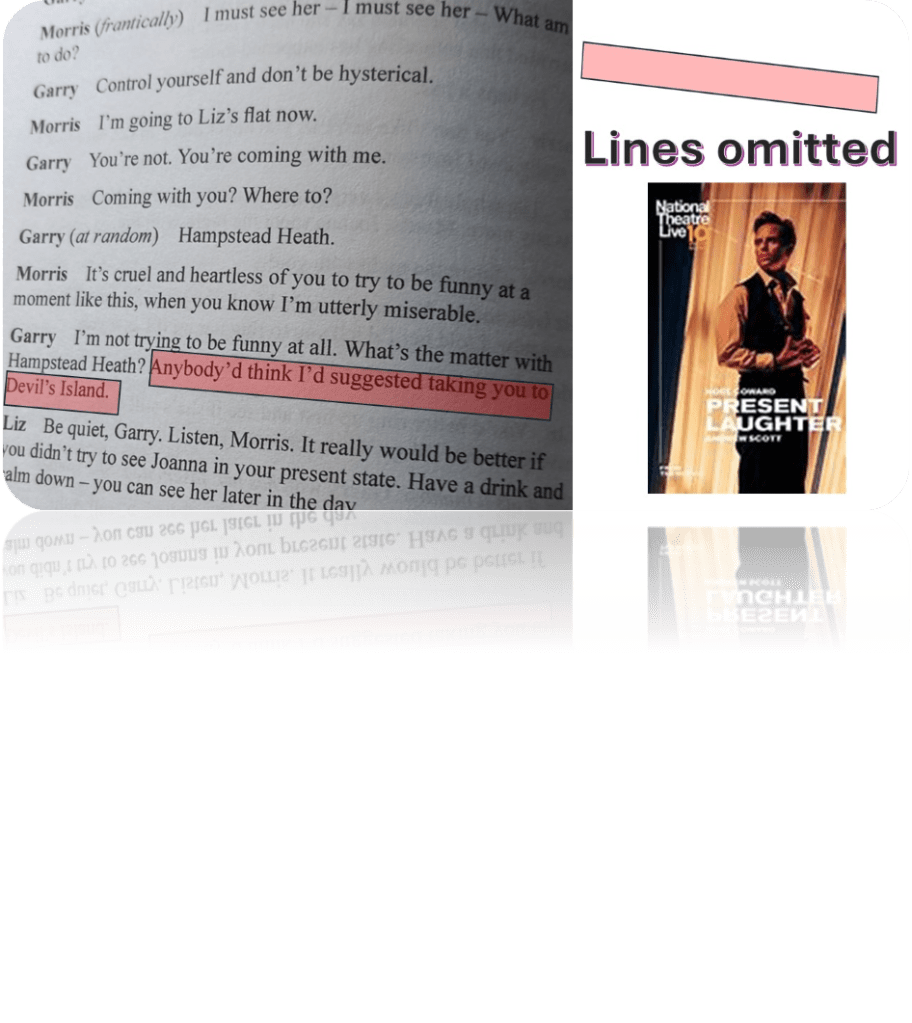
The play director Morris is now more openly queer, hence one might expect the reference to ‘Hampstead Heath to fall flat, The play revision even anticipated that by omitting a line, for of course, this queer Morris, played as coyly as a closet by Adul Salis, would know Hampstead Heath and not equate it with ‘Devil’s Island’ – more likely it would seem a poor coy of ‘Fire Island’:
Joe as a kind of lounge lizard stereotype gigolo, more stereotyped in being Italian, worked well with the script. Even Kitty Archer’s Daphne’s seeing Joe, who she had not met, as a ‘prostitute’, to Garry’ protestation that such talk of the ‘husband’ of a very dear (and rich) friend was inappropriate, seemed more rather than less right in the broad guffaws of a comedy where such stereotypes are permitted, rightly or wrongly, to pass.
Of course the revisions make the isolated projection of Roland Maule as a neurotic queer man less islanded, and less toxic than in the original. The line of Garry to Roland’s protestations of being a lover in the background is cut, I think in this production: ‘You mean you don’t expect me to marry you!’[2] We can laugh without collusive guilt with homophobia at Roland as being ‘over the top’ for we are not laughing at the only visible queer character. At the end of the script, Garry agrees to return to Liz’s flat, to sleep on her couch only of course, because he remembers (as the stage direction says) Maule is still shut away in Monica’s office. In this version, of course this line has gone because Garry resists Liz still and the ‘office’ has already been cleared of Maule, who now, in the wonderful comic acting of Luke Thollan, been added to the slapstick fun of all the company around Garry, the Firm plus others, and merges with their going earlier in the scene.

In this production there is no silent killing of Brother Roland Maule, more silent than that of Sister George, at the end. It would have been inappropriate for Garry as played by Andrew Scott is fully outed as a man romantically and sexually primarily attracted to men through the translation of Joanna into Italian Joe. Scott plays Garry as thoroughly immersed in the kisses of Joe, so why have him terrified by Maule (a line played in this production so lightly no real terror hangs onto it). Helen is revealed as a closet lesbian, as if we couldn’t guess from the bully stereotype taken by the character so brilliantly, and the play ends just as queerly as in the Coward script but queerly AND merrily, not disturbingly queerly, though Garry’s gaze to the inviting pavement through his upper floor window does give us pause.
One of the highlights of this production came in the wonderful good grace of Joshua Hill’s playing of Garry’s working-class valet, Fred. Here was a man who well may have ‘a steward on a very large ship’: worldly-wise about men who ‘get about a bit’ – Joshua knows how to make his eyes twinkle – the more so when Garry gets off, to Joshua’ initial surprise, with another man (Joe) and not a vamp of the Daphne Stillington sort. His graceless handling of an old ill wealthy woman’s wheelchair showed just how little of stewardship or service he was excellent in. Being a pretty but manly guy, available for trade – provided he was the active partner, spoke from his grins. In a storm and with a pay-off his Doris can be someone else’s.
Hence as said, I am reporting back on my original blog because Andrew Scott and the National Theatre company did surprise me with their take. Yes, people did run in and out of various doors to surprise themselves and each other for comic effect like a French Farce. It was done brilliantly. People in cinema and the theatre on the screen laughed uproariously at Helen’s line about her husband Joe: “He says he feels as if he were in a French Farce and is sick to death of it, he sounds upset’. [3]

If you can see this screened production do. It is life-enhancing.
With love
Steven xxxxxxxxx
[1] Noël Coward (2023: 86) Act One, Present Laughter London, Methuen Drama
[2] Act 3, ibid: 96f.
[3] Act 2, Scene 2, ibid: 79, as edited by the production.
 Steve_Bamlett_blog
One thought on “This is a blog on the National Theatre Live revision of Noël Coward’s ‘Present Laughter’.”