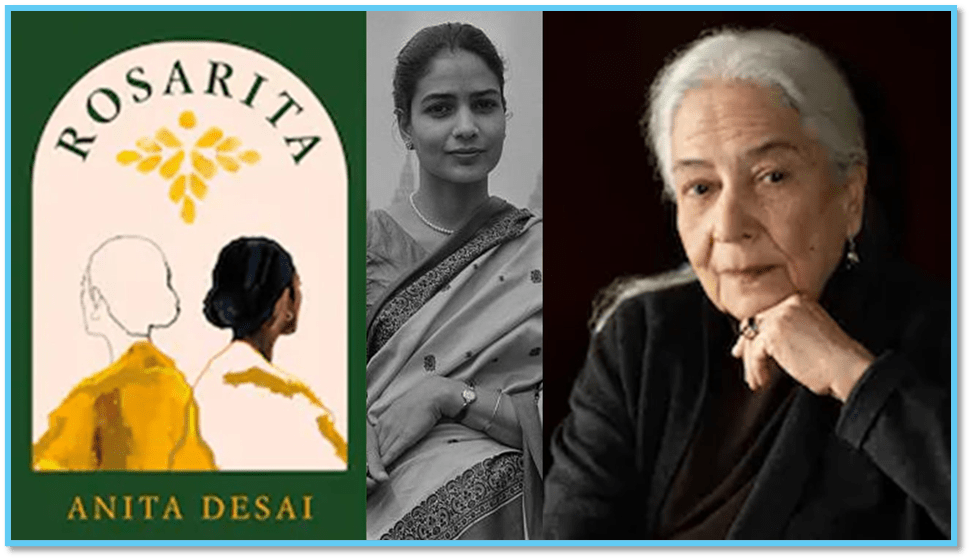
Early in Anita Desai’s Rosarita, a daughter remembers a family jointly (or so it seems) pondering, during a specific dinner where her mother broke the codes that hold together middle-class families with servants, and other revelatory incidents, that mother’s ‘unsuitability for a wife’. In a generalised point of view within Desai’s elegant prose, told largely from the daughter’s point of view in the second person where she is ‘you’, asks that, if a ‘Father’s family had established order; out of what disorder had she arrived?’[1] Meanwhile, a flamboyant and changeable female character who seems cut out only for the stage is pictured as ‘beating the bad hombres out of a nightmare’.[2] This is a blog about the art of writing out (and perhaps acting out) the disappearance of women from the records of art and history; ‘to a past that had never been mentioned or guessed at, that she might once have had and then was withheld, or lost’.[3] It talks about Anita Desai (2024) Rosarita London & Dublin, Picador.
Anita Desai receives rave reviews quite rightly but her literary status does I think allow some reviewers in the ‘quality’ press to miss the blindingly obvious. Of course, absolutely spellbound by Desai’s gorgeous prose – appropriate at each point and purpose in its register, so did I, as I was reading, miss some of the same ‘obvious’. Of course, there is virtue in missing the obvious as well as carelessness, for it is possible in a novel of this quality to interpret it through some handle offered through a singular interpretation of its multiple themes to miss any number of its multiple nuances and subtleties, and ways of seeing offered to a reader. However, Migrant Women’s Press are well placed to notice an obviousness that needed rescue from such readers, because without reading the novel first for oneself, it may mislead us into not noticing that the central consciousness in this novel, that of Bonita, would, you just know, never associate herself or her comfortable bourgeois family with the idea of being migrant or with having been derived from any other marginal identity not fully validated in mainstream society.
Much of the novel stresses her imagined capacity to be at home and own any world she enters. She has already arrived in Mexico as a linguistics student at the university of San Miguel de Allende. Her purpose is to exploit her already wide proficiency in the language of the colonial powers who once themselves governed the parts of India that to her are now her home, just as some of the same powers hold power over parts of Mexico in the time of the story. Languages, as a whole, make her a global citizen it would seem, having absorbed power from the colonial idea itself embedded in them. Her decision to study language I described as a violent act of taking: ‘seizing as if inspired on the study of languages that would wrench you out, lead you as far away as you could get – French that took you to Pondicherry, Portuguese that took you to Goa, and the Portuguese led you to Spanish …’.[4] The reader may or may not know the colonial history of the French at Pondicherry, or of the Portuguese in Goa, or that of the British Raj which determines the hegemonic language of the novel, but they are all implied in this sentence. To know Pondicherry and Goa is, as it were, to have a foot in the once powerful colonial voice of European nations and their presence and ways of working as colonial settlers may lie buried in the flowering of any life-chances her travelling offers her, for good or ill.
Bonita can only flee India by further penetrating the cultures of its colonial oppressors, and her voyage of discovery may suggest (for the truth of the stories about her mother are never definitively certified with hard evidence, to her that this was a path already trod by her mother, though never revealed to her. If Bonita and her mother both learn to know the condition of the migrant woman, this is in part because the primal experience dug deep into this novel is a historical comparison of modern migrations and their representation in art, in which trains and train transport dominate as the main form of transport. The two forced migrations are those of the Partition of India in 1947 and the flows of populations that characterised Mexican revolution from 1910-1920 onwards in the twentieth-century. Complicating all of these migrations and forms of settlement in the novel, is one that has only a metaphoric colonial tinge. It involves the putative involvement in one the stories of Vicky about Bonita’s mother of former male American soldiers, or G.I.s.
In the stories these GIs (referred to by Vicky, being unsure of its appropriateness, as ‘jee-ayes’),after being disbanded from the colonial war in Vietnam, the free education made available by President Franklin Roosevelt’s Servicemen’s Readjustment Act, commonly known as the GI Bill, of 1944 to seek a life as a hippie artists in Mexico.[5] They brough with them the stories suggest imaginations of the meaning of foreign travel compacted of the violence of ‘war’ and its themes rather than those of either peace or national revolution against those in the country colluding with imperial oppression or its methodologies.[6] These are the bad hombres referred to in my title by the character of whom you might miss the name, though I have already used it. That character is the main conduit of stories about Bonita’s mother, Sorita, who she knows by the Mexicanized sobriquet, Rosarita. Her name is Victoria, although it used only once in the novel (apart from another rare use of the abbreviated Vicky)[7] because the narrator knows her and talks of her mainly by the label Stranger and latterly as Bonita’s suspicions of being deceived mount, Trickster. Yagnishsing Dawoor in The Guardian even colludes in the derivation of that name by referring to Vicky as ‘a tricksy figure in a park’ (my emphasis).[8]
So early in the novel, even Bonita does not identify tricksiness in the character, though she will later. And we should be aware of such distinctions precisely because our only access to the character of Victoria and what she means in the novel is through Bonita, who thinks names and labels of the things you think you know are unchangeable without a trick or deception being involved, even though she knows that names derive from changeable linguistic and cultural convention. After insisting that her mother could not be the Rosarita mentioned by Victoria, her awareness of how names can sound different to ears accustomed to another language and associated meanings emerges but she remains insistent as she is forced, she thinks to confess that her name is Bonita though, ‘aware now that in Spanish it sounds more like a childish endearment than a proper name, so you try to explain: “Like Sunita, Vanita, Ronita … common names in India”’.[9] Whatever else she may appear or sound, Bonita will ever resist appearing or sounding like someone happy to receive a ‘childish endearment’.
Despite, and perhaps at a deeper level because, all of the complex intersections of themes of global crisis and webs of international and intercontinental friction, migration (whether forced or otherwise and by different agencies of oppression including economic ones) is a key feature buried in lives of people in the novel. That is so whether they migrate because of their belief in their superior entitlement to do so or whether they are forced to do so by a power claiming to be higher than theirs. Most people prefer to be known as ‘settled’ by rightful claim and to look as if they are validated in living their lives comfortably without consulting a disturbed past, as Bonita thinks ought to be possible. When she becomes uncomfortable in her skin, or its location in an estranged place or time that cannot be rationalised by student or working status, she presents herself as forced to withdraw, often into passivity or passive-aggression, in front of calls for her to be active.
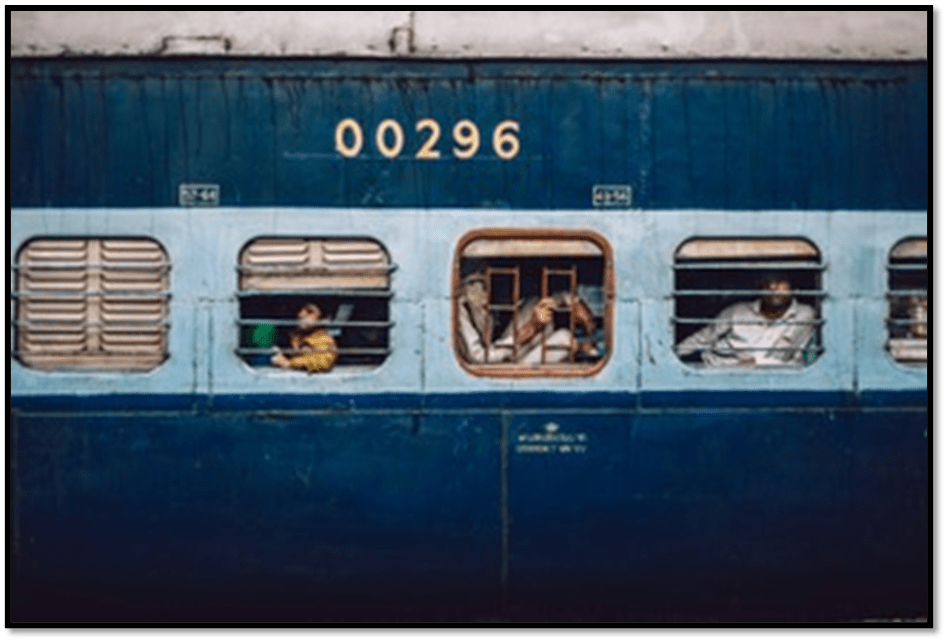
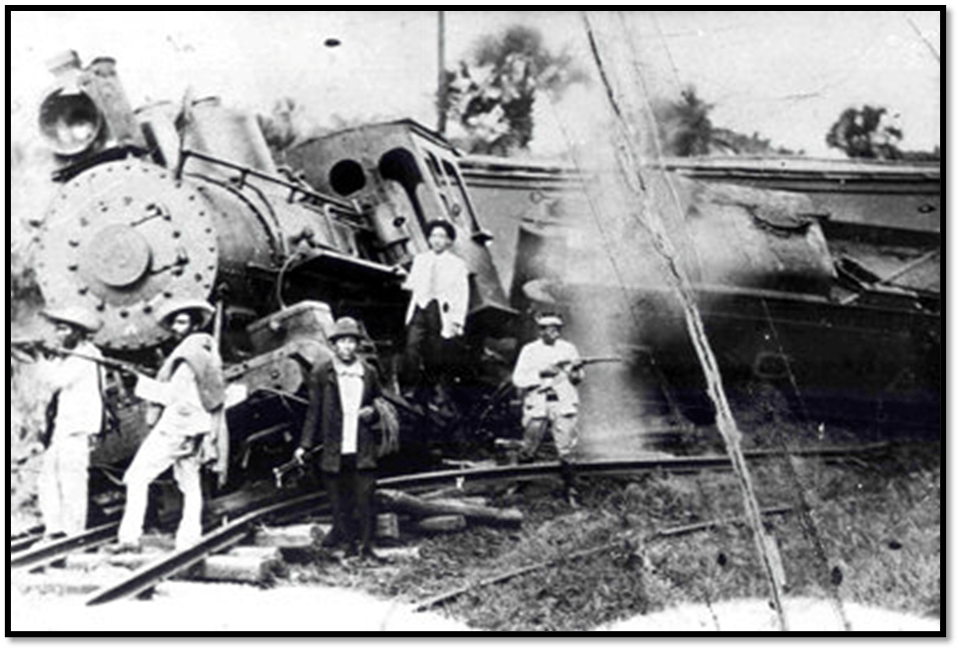
In the story, the involvement of her family, her mother in particular, in the migrations of Indian Partition are almost suppressed in the family history of Bonita, even though they will, like is the norm for the repressed, return. In the novel, they return in a sly chapter that takes on Sorita’s consciousness, perhaps – although that is never clear – a recounting of a lecture in which artistic representations of trains in transit are compared from periods of cultural turbulence in Mexican and Indian-Pakistani history, as in the latter case, those two nations emerged from one and forced hugely dangerous migrations. The art in these times of turbulent population and troop movements often focused on the use of trains, a forceful symbol in the novel. Hence, writing for the online zine, Laura Rodríguez-Davis is almost certainly correct in posing questions pertinent to his novel:
Who do we become when we leave our homeland? And who are we if we return? How do we choose which stories to tell? How do our experiences also shape our loved ones and our relationships with them? Can we fully know ourselves if we don’t fully know our history? Desai’s Rosarita is a prolific tribute to the questions faced by migrant women in their journeys across borders, cultures, time, and identity.[10]
Image by Killian Pham at ‘Unsplash’ available at Laura Rodríguez-Davis op.cit.3
And it is this theme of migrant experience, especially female experience, is that other publications’ reviews miss or glossed over by being related to cognate themes, as in Yagnishsing Dawoor’s review. In many ways I attribute this to the failure of those reviewers to take the experience of the only native Mexican voice in the novel seriously, that of Victoria. Rodríguez-Davis is the only critic, that I read at least, to use the proper name of Victoria rather than the offensive sobriquets employed defensively by Bonita. It is a sign of the respect she holds for characters who are in some way misrepresented by the characteristic voice of the novel (Bonita).
I think then that I want to start my consideration by how the novel mediates our view of this character by Bonita. Steve Davies in The Literary Review sees Victoria as a kind of literary device (and not, in Forster’s term, a ‘rounded character’ at all). She is, he thinks, attached to some of the Gothic novel machinery certainly present in the novel, but in not giving her a proper name, he allows her to fall victim to the way Bonita wishes to see her. And the latter represents her, through her grip on the point of view of the novel, entirely as a function of the over-stimulated and symbolic force that pushes Bonita back into her suppressed past, especially of her female family. This is a space and place to which she resists going. Davies describes the importuning of Bonita by Victoria in ways that uphold the view that Bonita sees what is there rather than events as her bias interprets them:
What’s going on? A case of mistaken identity, surely? … Ridiculous. Embarrassing. She must be deluded or mad. The narrative assigns her two sobriquets, ‘the Stranger’ and ‘the Trickster’. We are in one of the novella’s favourite realms: enigma and equivocation – the haunt of the doppelgänger and the shapeshifter.[11]
And, of course, he is correct about the significant role of the doppelgänger and the shapeshifter. However, this is only one strand of how the novel works and misses the fact that Bonita needs to see her introduction to a past she has suppressed as a work of an ignorant unknown, or even a ‘trickster’. In this he is right no more than Rodríguez-Davis is in getting only a partial grasp of the novel. Both Rodríguez-Davis and I would argue that the bodily reality of Victoria independent of the themes and devices she acts out in the novel. If that was not the point, we would miss the point of why Bonita constantly sees Victoria as an actor laying a role, as someone essentially inauthentic – and not so much enacting as overacting that role, as if that of a convenient stereotype. After all, this tendency in Bonita to dislike the culturally flamboyant is how we assess her character also and its insistence on staying comfortably on the surface of things if she can.
Thus we only know how Victoria dresses and does her ‘make-up’ because Bonita makes much of those phenomena. She dresses in fact with make-up to match and in a way that emphasises her role as a ‘watcher’ of events and persons (those ‘kohl-rimmed eyes’ for instance). She is dressed, thinks Bonita, only as Mexican women do in carnivals (and over-playing Mexican flamboyance). Eventually we will not be able to miss how Bonita theatricalises Victoria: ‘the floodlight focus of her enormous, theatrically outlined eyes, her ferocious attention’. Later, as Vicky tells the story (a ‘fantastical tale’ according to Bonita) of Sorita’s mother’s supposed life as Rosarita in San Miguel de Allende, and of how that life is changed in the present, Bonita’s point of view in the narrative presents Victoria as groaning ‘theatrically’, and thinks: ‘Had she been an actress once? You wonder, not the first time. Was this a scene she was acting in her own play?’ Victoria becomes a Trickster as well as a stranger because of Bonita discerning that very trait of roleplay in her. She later asserts, herself a bit melodramatically, to us of Victoria: ‘Nothing could be beyond her, her stagecraft, her omniscience’, as if she were a master narrator with the qualities of God over his creation. When Victoria falls into an argument with her relative, who she thinks is robbing her of her inheritance, Bonita feels that ‘you feel excused from the scene of a melodrama’.[12] The use of a second person narration comes into its own in that phrase. Bonita is all object, asserting her objectivity, never a subject ’I’ asserting its honestly subjective point of view.
All of this tells us as much about Bonita as a narrator and constructor of character – as if she were the one merely acting, acting just as ‘you’ would in her position, colluding with the reader’s conservatism vis-à-vis extreme characters. They are in fact characters pushed to extremity by the oppressive circumstances of their life. When Bonita asserts her right to be ‘excused from the scene of a melodrama’, as cited above, she is witnessing a scene in which Victoria is being swindled rom any right to her childhood home at Colima by relatives who have current possession on their side. But why should Bonita care or even have empathy? In all of the instances I cite above Bonita withdraws from the fray, retreats to a safer place, some interior that cannot be got at, or so she hopes, by the extremes of a world of importunate persons that can’t be controlled: ‘drawing back and keeping hold of the newspaper as some flimsy form of defence’, ‘preparing to make an escape’ and eventually; ‘You draw back – in fear, unease, or suspicion? Yes, all three?’[13] The only time she comes to terms with Victoria is when her friend Isabel describes here as of a type that can be dismissed, revealing the true vulnerability of the anciano, who is Victoria: hotels are full of displaced and ‘mostly old people who have lived here for years and are going nowhere’.[14]
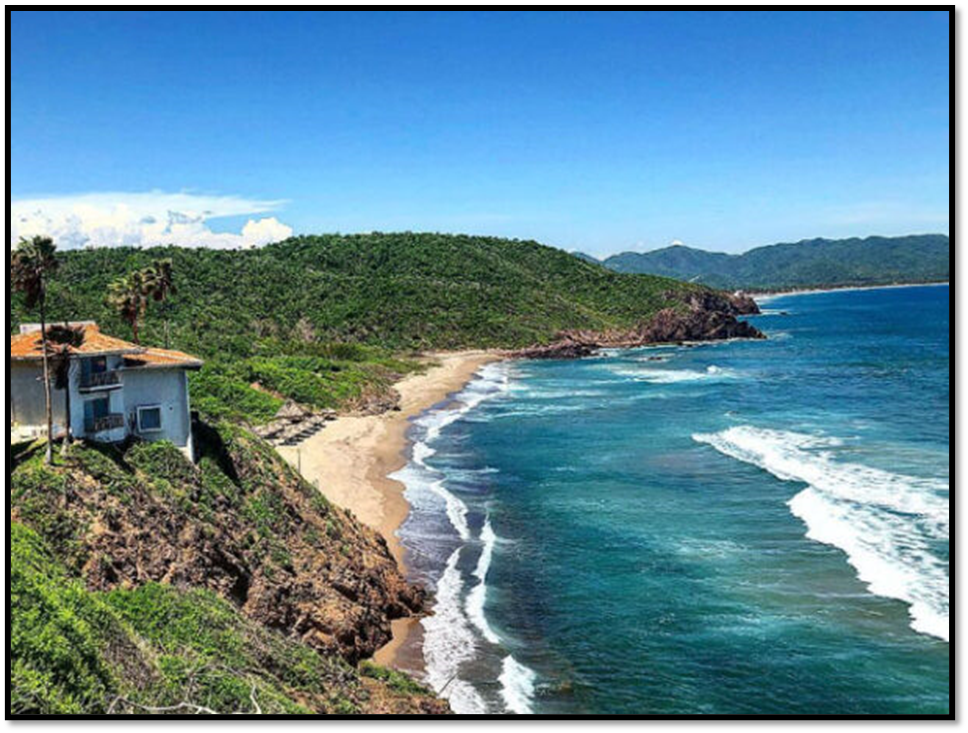
Unsurprisingly, we learn that this distrust of the extrovert character that enacts its role publicly comes from her heavily repressed Father, and she intuits that such may have been too his effect upon her mother. As she reflects on her early family life she imagines the challenge her mother taking up art would have had, if indeed she had taken up art which Bonita won’t yet admit. In other households it would be ‘acknowledged and discussed’; ‘but this is one from which drama and melodrama have been banned, prohibited’ (my emphasis).[15] Herein lies the reason why Bonita must, in the early stages of the story, present Victoria as absurd in her theatricality. Only much later will Bonita take the stage herself and reveal, totally implicitly of course not explicitly, that she too is an actress, and will become a better one, with a chance of settling a coastal part of Mexico, the artists’ beach colony – ideal for a budding writer as well as painter, at La Manzanilla. Her prose lifts into gorgeous conflicting metaphors and she feels like a literal diva, out-acting any hammy Victoria:
Now she is sure that she will capture a scene that gets lost in the lighting of the night so quickly that ‘you almost miss it’:
But you have not and the drama of it is so perfectly orchestrated you feel like applauding as you might the successful end of a performance. Of course you do not but you distinctly hear clapping and shouts of “Bravo!”[16]
If Bonita is the true ‘shapeshifter’, not Victoria, and I think she is merely acting out the drama of a woman who, if she must migrate and then settle, she will settle as a valid colonist not a victim of enforced expulsion from her own country, and La Manzanilla is the perfect spot – made up of maestros looking to train artists, as Sorita was trained perhaps, and failing that be easy prey for marriage with the owner of one of the ‘luxury cruise ships from Puerta Vallarta, you’d surely catch their eyes, millionaires, divorcés, …’. So her new found settler girlfriends advise her. And you are watched now only by extremely silent ‘marsh crocodiles pile up on one another, as still as stone’, and maybe you feel like one.[17] Obviously I stress the issue of the ‘unreliable narrator’ in this novel, who acts a role she never reveals or perhaps of which she is not fully conscious, and thus I lose the feeling in Rodríguez-Davis’s review that Bonita relives her mother’s experience innocently. She says brilliantly:
Through the eyes of an artist and cross-generational narrative, Desai connects Mexican and Indian history while exploring the understanding of self through another culture and familial choices.[18]
For if Sorita was an innocent and fell victim to ‘bad hombres’ like Victoria too, Bonita has learned to enact the role such as she will not, watching for a moment like a marsh crocodile.
This is I think a great novel. It must and ought to be on the Booker shortlist at the very least. However, I can only argue my case tentatively and have decided to do so by, in the remainder of this blog, looking at some ways of working in the novel that spin around its characteristic features, which integrate the following characteristics of his writing, structure, characterisation and meta themes of language, the hidden in history (perhaps ‘herstory’), the act of colonial settlement, the role of revolution and of art, as a guide to better and more healthy communication. So why not use the sub-headings as follows:
The exploitation of theatrical settings and casting and polyglot scripts as metaphors for plot elements and characterisation.
The role of hidden subtexts in histories and those stories told by women that have to uses some degree of the hidden within them.
Settling in: Colonial and Native
The role of revolutions in addressing that which is sick, divided and wounded.
The Role of art as a paradigm of communion, communication and renewalContact
The exploitation of theatrical settings and casting and polyglot scripts as metaphors for plot elements and characterisation
Settings
The novel we have opens and closes in places and spaces that are treated as the sets of a play or film. We have already seen this clearly in some of the theatricality of Bonita’s later description of La Manzanilla and her soliloquy in praise of what she captures in that scene. As Bonita remembers her childhood, whilst her shape shifts to the person who was a child so, the sounds and sights of the view from her rooms at San Miguel shifts to, as if the scene itself were shifted by memory and an estranged consciousness. The effect and word is theatrical:
The scene that should be so foreign to you is, at its deepest level, utterly familiar. You are back in the garden In India that you had known in your earliest years, the years no one mentioned again once they were over, the time when Mother was absent and you were taken to live in your grandparents’ house in New Delhi.[19]
The writing mediates the unknown in memorial history through shifting sets that nevertheless stay the same. At some deep level this is the psychology of both the settlement and colonialism of ‘foreign’ countries, as we will explore later, but we barely notice that as we read, intent on the way in which Bonita is constantly in the ‘scenes’ she acts in and upon on the cusp of the familiar and the stranger – an unheimlich space which is neither home nor not home, where figures of strangers can become substitutive mothers. In fact this is what happens to Vicky in memory in La Manzanilla, in an entirely theatricalised setting:
Now the plaza is empty, the stage waits for the next act. Who will appear now, you wonder, certain that someone will – but who will it be, Mother or Trickster/ Or are they after all the same?[20]
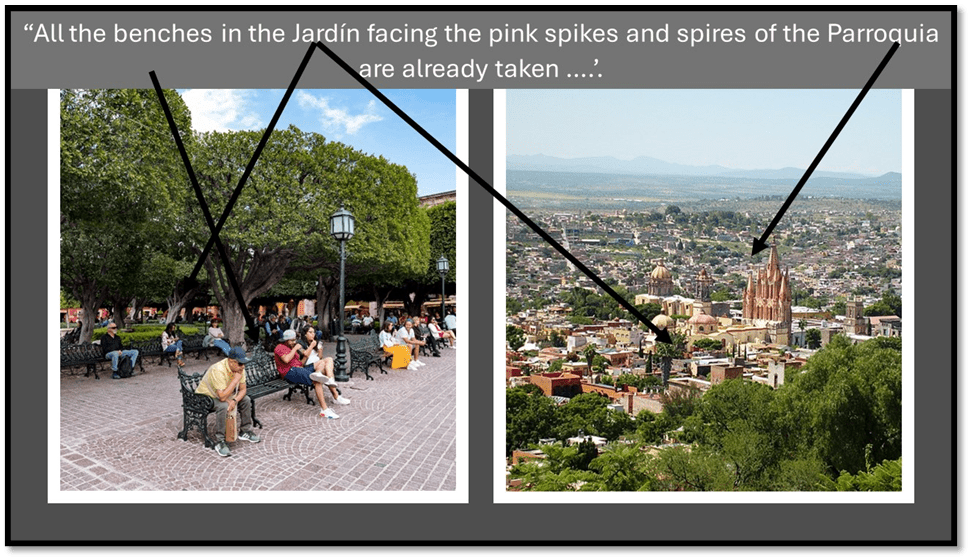
The opening set of the novel is the well known garden (all real enough as shown in the collage below) of what could well feel to eyes from the USA, if not India, to look like a stage set.
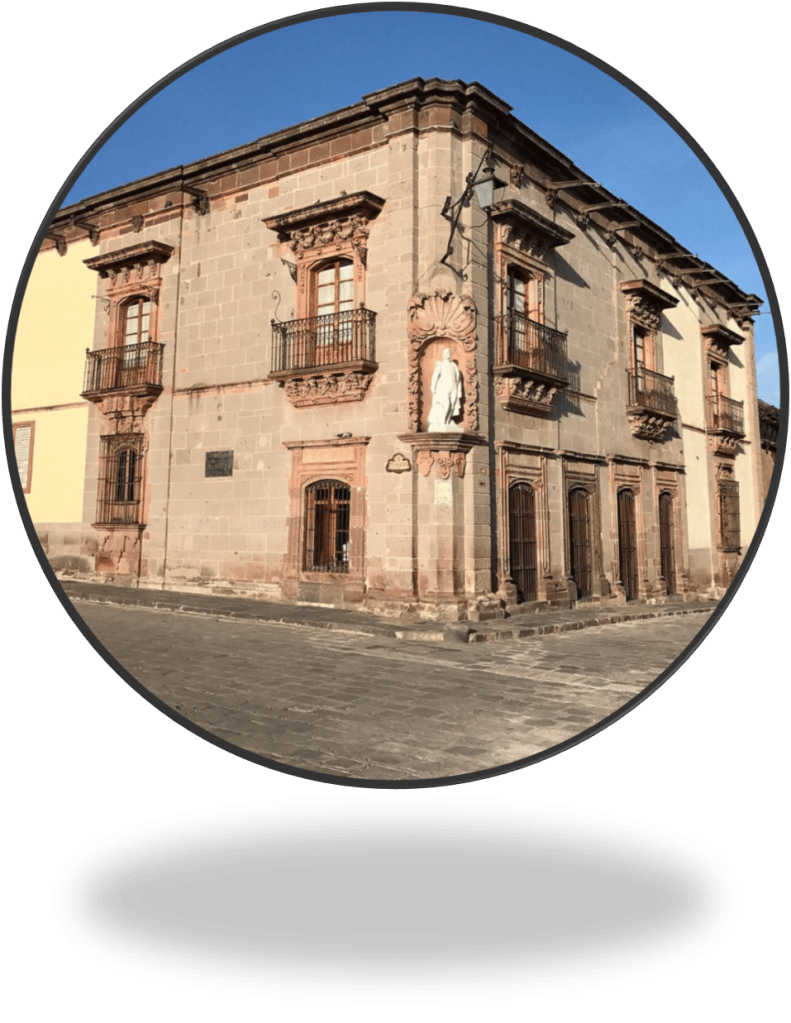
And that San Miguel is not only a kind of place where familiarity takes time to acquire could not be clearer than from its publicity collages, as below. It is a city of playacting – the Parroquia being modelled by a Mexican mason’s view of a Gothic cathedral in Europe, its housing and grand institutions in the manner of long and entitled Spanish Imperial settlement.[21]
Bonita familiarises herself with strangeness by consulting what she knows, with her eyes down in ‘Spanish-language newspapers’ and by hiding from attention that otherwise, especially if the viewer seems strange and whose ‘unembarrassed attention’ acts ‘like insects on your skin, exploring’.[22]
The role of Victoria will be to locate scenes into which Bonita wants and can be persuaded to briefly inhabit, looking at first for her Mother planned after the failure to meet her, even in spirit, in the place given the name of places of rendezvous, Los Encuentros.[23] These places are accessed by bus, aeroplane and private taxi respectively, the visits being paid for, as Bonita reminds us, solely by her. I will deal with the old ruined art school in Los Encuentros in a later section of the blog, that on Art and its purpose. In the last two scene sets, those in Colima and La Manzanilla, Bonita’s story becomes increasingly caught up with and then leaves behind Victoria’s story, as that woman becomes part and parcel of the symbols of Bonita’s lost guides to a space which may be guides to lost pasts and perhaps alternative futures, both for her mother and herself. As I have already cited, Both Victoria and Sorita / Rosarita are becoming the same In Bonita’s mind by then.
Imperial Spanish housing, such as Victoria claims is partly her birthright, the sea and the Volcano at Colima.
Like San Miguel, Colima is another stage se for more characters, like Victoria’s nephew Arturo, whom Bonita warns herself, has the look of an actor.[24] She directs the play between them for laughs, undercutting the emotion of Victoria. In the colonial style courtyard of her birthplace this paragraph is telling, played initially for an audience of one, a cynical grackle: ‘A grackle, perched on a fig tree, lets out a sharp, sarcastic whistle to express its opinion of the scene’.[25]
A grackle
I have already spoken of La Manzanilla as a stage set for the conduct of art where scene sets do remarkable things. Bonita gets up early to ‘open the door and survey the scene before you’.[26]
Casting Characters
If the novel is played to sets, it has to an element in which people in it are ‘cast’ as the characters of the dramas. Again Rodríguez-Davis is the best interpreter of the novel in using the fact of a second-person narrative, noticed universally by the critics, in this light (my emphases in her text):
Told in the second-person voice, Rosarita reads like poetic stage directions, casting the reader as a suspicious Bonita, immediately dubious of the effusive stranger, Vicky, claiming to have known Bonita’s mother, Rosarita.
But ‘casting’ (even type-casting) character is a feature of Bonita’s narrative style, hence the genesis of the Trickster out of a woman who really is only loving and gregarious, one suspects. But a cast is born out of a good script, and in this novel, that script is polyglot, and opens up parts for endless national types and stereotypes, like Arturo almost self-typecast and the American and English ‘girlfriends’ at La Manzanilla, as well as deeply moving rounded characters.
How one speaks is determined at least in strong part by the language or languages one speaks, and language variations matter a lot in this novel, and sometimes play into characterisation. Bonita has, as already said, tried to seize the world through the opportunities of being polyglot. She knows so many languages but tends to speak in or refer to languages native to the Indian sub-continent the least, instead choosing the languages of its colonisers and settlers by trade: Portuguese, French, Spanish (via Portuguese), and of course, so ubiquitous, it is not named English, including American English.
Yet some scripts, though demanded, like South-American-Spanish, cannot be entirely regulated if spoken to one than read. Comfortable with Spanish-language newspapers at least, when Victoria accost her, Bonita begins to understand that some language gets too close to you for comfort, even though she had, in the abstract, yearned for conversation with a ‘native speaker’:
What made you so defensive? You have come to San Miguel to attend the language school, you should want – and are certainly in need of – exactly such an ‘interchange’ with a ‘native speaker’ who approaches you so warmly, so effusively; what makes you draw back and close up?[27]
This is interesting not because it speaks of language, but because it dramatises the registers of different ‘sub-languages’ within what is called ‘one’ language. Only certain people use words like ‘interchange’ and ‘native speaker’ to describe what is, after all ordinary conversation with a friendly stranger. It illustrates how certain features of language are used not to approach the other in the communion of communication but to set up barriers to them, like Arturo’s post-colonial ‘politeness’. And it is the blend of defence and approach in language that is emphasised, like the use of a ’foreign’ language to indicate some superiority, very much why European languages in Bonita’s early family life, but it not a superiority she can import into countries you visit, however clever it seems to uses these languages, as here: ‘Spanish had brought you here – here and now. Aqui y ahora’.[28]
I think you have to read the italicised words here (the author’s italics) with a self-consciousness that they are NOT your own language but ones you are trained to see as superior by a Eurocentric colonial filter. This attitude won’t wash however where natives speak a Spanish of their own version like Victoria. In formal occasions like an expensive hotel dining room, ordering a meal on a Spanish menu, contains ‘a tremor of fear and pride at your daring, at this learned accomplishment’, but sometimes you can be so thrown by your true ignorance of the hearts and minds of speakers of the language that claim familiarity with you that you are no longer able to find pleasure in seeing ‘people you don’t know’ and hearing ‘voices and languages you can’t decipher’ and relishing only the silence’ of an a square empty of people and in the absence (for a moment while you wait still – silently and motionless) for a woman to address you warmly. It might be a voluble Mexican lady OR the mother she talks about. They are nevertheless ghosts who arise in front of you.[29]
And the same language multiplies in its types through intrusion through colonialism and colonial settlement. Bonita’s friend Isabel who has come to Mexico to study comparatively the effect of multiple different colonial experiences On the Spanish spoken in her homeland, the Philippines, and Mexico.[30] Hence language scripts are difficult for even internally they can follow a different ‘tenor or trajectory’ than that you expect to find in the language you merely learned without knowledge of the differences between its speakers. Of course you can sometimes blame the wine or the excellent meal for ‘you’ not ‘following the conversation’, in which the language spoken we find, leaving mystery behind its wake, is not ‘Spanish’ as such. Here Arturo and Victoria are speaking (my italics in this quotation):
For a while they are punctilious about making it intelligible to their guest – questions about the fate and fortunes of others in the family, it seems – but when they realize these are not comprehensible to you, slipping into Spanish.[31]
Scripts in language are not always meant to create non-exclusive communication, as we see, even when the language is ‘known’ by everyone in it. However, as we shall say later, art has something to say about language and communion too.
The role of hidden subtexts in histories and those stories told by women that have to uses some degree of the hidden within them.
When language is used in larger units of meaning like narratives, it must use awareness of its capacity to obscure what it hints at as well as speak out about it. Politeness, for instance, is one such variation of this use of language, where certain things that must be understood are not directly sayable. Arturo is a master of this, Victoria is not. Bonita will learn from both. Not only languages but things speak to create a sense of awe that reminds people they must not even appear to be aspiring to such worlds. When Bonita looks over the colonial villa that ought in part to be Victoria’s birthright but will not be, the interior décor speaks to her, for in some versions of Imperial décor ‘everything about them is on a scale that makes your own minor, negligible size, your inappropriateness, marks of a lesser race’. Even Victoria sees this as a holy ‘scene’ that will in the event exclude her from sharing it.[32]
I italicised ‘marks of a lesser race’ for it is one of the markers of a major hidden subtext that speaks of the effects of colonialism and entitled settlement by people who believe themselves superior, by class, sex/gender, race, age, ability, status, colour or even ‘educational achievement’ I have more to say in the next . Here I will stay with a major analogy in the narrative which the hidden history of the colonised and that of women, where ‘history’ supplants ‘herstory’. History is first confronted by Bonita in her grandparents’ home, during the period of her mother’s life whose story has been suppressed by all. Her grandparents recall their national history through art that seems to harmonise the colonia period of the Raj and ‘English artists who had travelled through the “mysterious East”’ and an exoticized and unreal history of pre-British rule (with bits of an equally fantastical Moghul, Pahari, Rajasthani’ background thrown in and this mix replicated in the furniture and family history absorbed, via selective photographs, into it.[33]
When a female scion (it must be Sorita surely) of this family visits an art historical lecture on the conjoint history, as seen through art, of Mexico and India, it is cleat colonial histories are often based on not only the carnage of racial oppression and genocide but of violence received in unequal distribution by virtue of sex/gender, characterising both Mexican revolutions and the Indian partition.
… what emerges is the artists’ engagement with their history, in scene after scene of carnage; …. Women’s bodies are pierced and eviscerated, infants torn out of their wombs and arms, flung into flames, … . …Out of these barbaric landscapes trains arriving, marvels of steel and technology, all smoke and fiery iron, some carrying troops and their arms, others packed with passengers slaughtered along the way, blood oozing out of the carriages when opened, then more blood and still more.[34]
The carnage is enclosed in these phallic containers and women are pierced here as if it was their nature to be so. The men of Revolution are not condemned for they too stand against the penetration of nations by the supposed superiority of a master technology of great precision in such penetration into their colonies, but we are reminded that the stories of female ‘arms’ are less precious in this passage than male ‘arms’ (for the latter kill). As I suggest in my title, women not only escape by chance from male disorder, they are often blamed for it by the agents of the status quo, as is likely with Rosta: ‘Father’s family had established order; out of what disorder had she arrived?’[35]The ‘ruinas, bones, stones’ into which the ‘Jee-ayes’ reduced Victoria’s country, as she believes talked ‘- always – of war’, whilst here we have ‘Re-vol-lu-tion, not war’. Victoria pins the shocking fate of her country’s revolutions on American patriarchal war ideologies of colonial control. Again a suppressed history and again with women as unspoken victims, if not the only ones. These are the ‘the bad hombres out of a nightmare’.[36]
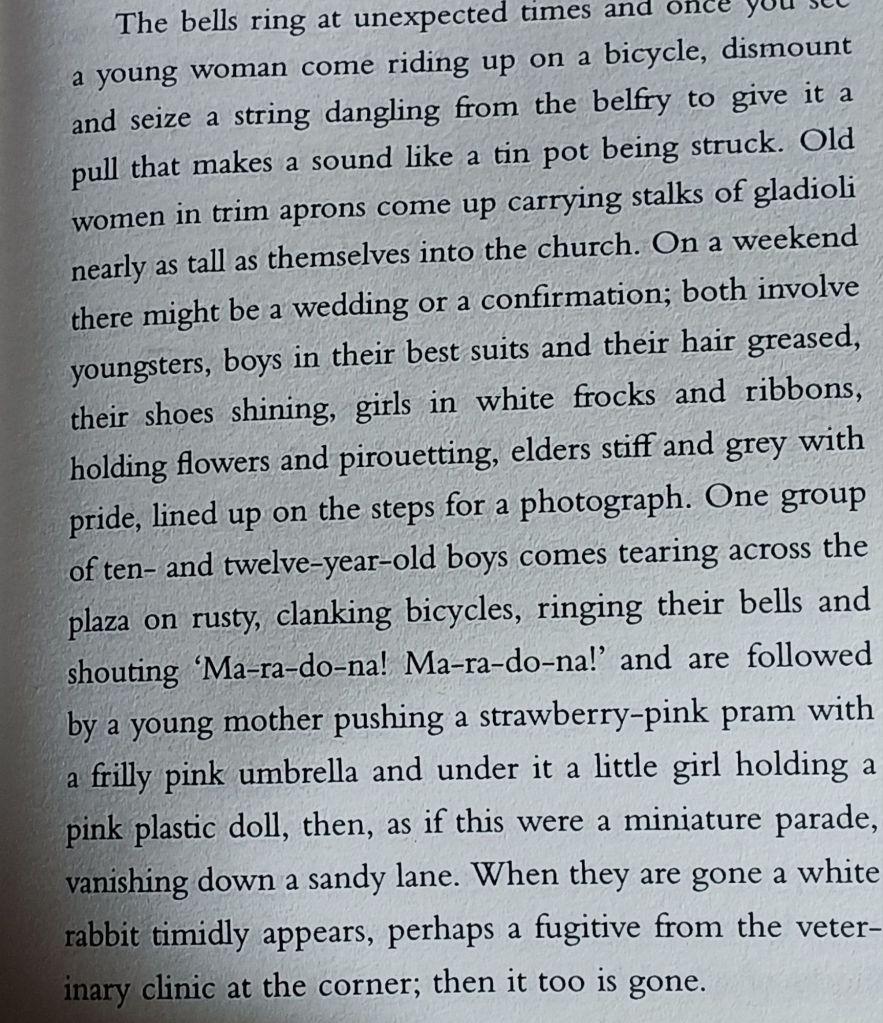
And of course the suppression of female history coloured by the suppression of the evils of colonial rule is precisely the story of Sorita that this novella tries to unearth. Even in La Manzanilla women and girls are embedded in roles that make them secondary or in service to patriarchal placings of men as primary – read how subtly this happens in the page below:
As for whether Bonita will unearth that story or resurrect it in her person I do not know, for Desai is a nuanced writer and knows how to handle unreliable narrators subtly. There is a chance that Bonita buys into a paradigm of colonial settlement as I have already suggested. We need to understand that or we fall into the sentimental reading of the novel by Steve Davies: ‘…, Bonita eventually locates, not her mother, but a mother world’. The point is that this world is easier to live in if you come to it with wealth inherited from a richer world class-system, and Desai is too intelligent to subscribe to the redemptive idea that ‘this plenitude of life releases the narrator from a forsaken past’, for in a way she is replicating the power models of the world as a women who may not address the structural subordination of women.[37] More intelligent Yagnishsing Dawoor, sees the novel as ‘a profound philosophical inquiry, pondering the enigmas of the mind and the self, the frontiers of fantasy and reality, and ultimately, whether one person can ever fully imagine and understand the life of another’. [38] With that I agree, except that it buys into a kind of existential philosophising that pretends the individual consciousness is the ultimate reality rather than the actual power relations structured into the frameworks that frame individual consciousnesses and make one more powerful than another because of a group affiliation.
Settling in: Colonial and Native
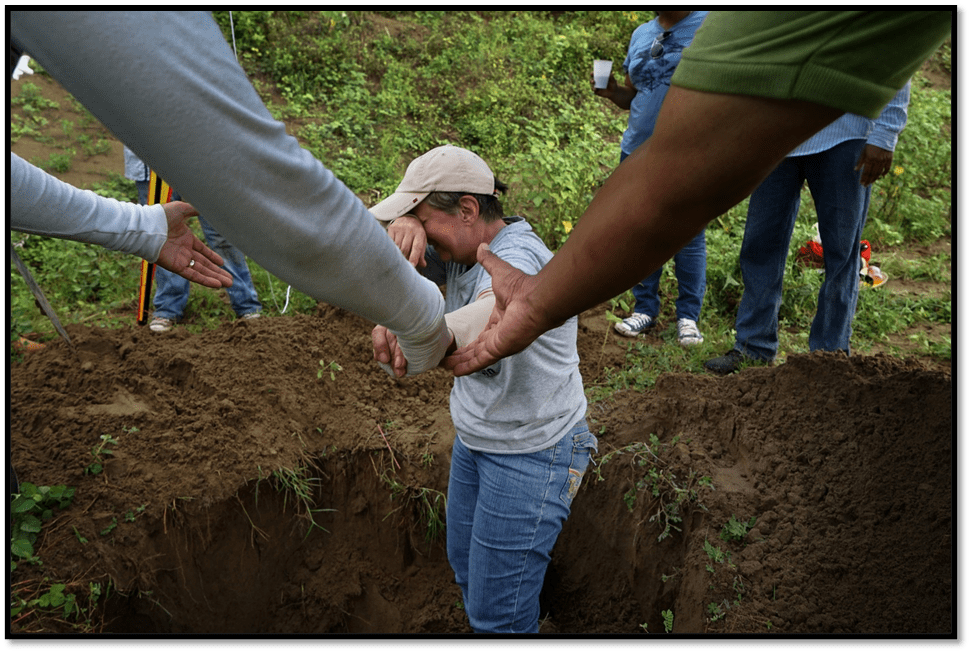
In the end I may already have said all that requires saying in this section. Burt a section helps as mnemonic for the fact that this is a novel about migrancy, that is truly intersectional. We live in a world currently where certain kinds of migrancy, especially ‘economic migrancy’ are demonised whilst the holiday-making or settlement of another nation is no, depending of course on the relative status of groups in diaspora. The subtext of this novel is of how certain migrations bring war and its fruits, ‘ruinas, bones, stones’, whilst others bring, as Victoria says ‘flowering’ of people, lands and artistic subjects, ad is why she loved Rosarita. The suppressed stories in this novel are ghost stories (hence the frequency of the numinous and spectral) . The hope for Bonita is in resurrection rather than imposition of self – hence the key importance of a late passage where she wanders amongst BOTH flowers and graves. She chooses for a moment to ‘wander around the graves dug so deep into the sand’:
A ‘secret grave’ of the disappeared in Mexico
Some have sunk so low they have disappeared into it, just the crosses rising their splintered arms to mark them. A few have been kept freshly whitewashed and have bougainvillea with papery pink and white flowers around them. Here must fishermen and boatbuilders be buried, …: the history of the town itself.
This passage speaks of live resurrection in its imagery of arms raided from the grave, but also shows that histories are selective. The very low disappear out of it, other stories – the proud bourgeois names- are ‘whitewashed’ and their look enhanced by flowers. But is it still all show and a struggle to stay above the earth for the lowly Will this difference be replicated in Bonita’s life. Will she collude with the power of the unequal status quo, or attempt to learn as her mother may have done ‘Re-vo-lu-tion’.
The role of revolutions in addressing that which is sick, divided and wounded.
Another rhetoric in this novel addresses the vulnerable: the old that are forgotten, the sick, wounded and divided from its true self. Division creates horror in life, especially division unaddressed, but it is often disguised by power, such as in a father who allows no difference of religious belief in his family: ‘If there was a god, it could only be The Husband’.[39] Some power can ONLY be overthrown, for otherwise it dominates history by erasing what it cannot tolerate. Rosarita’s history is a Wound:
Anyone trying to explain might suggest that some wound that had been stitched up had split open then. Had the family witnessed that, it might have wondered if it had been accompanied by an admission of her own history, that suppressed one so carefully guarded.[40]
A wound is the most visceral and bloody of divisions in matter, and this one splits families and the idea we like to think unfragmented of the whole nation, ‘all in together’. But it is also a rupture in the psychological self, or the part of the self that ought to form a psychosomatic unit. It replicates disturbances in the earth itself too subterranean And hidden to be considered part of nature, though they are because ‘a volcano is subterranean till it is not, cracks appear’.[41] That volcano may be recalled in the ‘natural one we see again from a [lane in Colima. However, it recalls more the ‘pierced and eviscerated’ bodies of women in the Mexican Indian art works, we have already examined above.[42]
These splits lead to civil war and reactionary backlash in nations. Sometimes the wounds in towns linger as in the absences that were once houses full of people meeting together in Los Encuentros: ‘vacant lots’ like those in Eliot’s The Waste Land, with ‘weeds growing in the cracks’.[43] They lead to people, and one animal ironically called Sultan, ‘whose spirit had been successfully crushed by his captivity’. Such sickness are wounds in communication like that a girl feels who cannot reach out in empathy to Sultan: ‘You were forbidden to touch him and you only looked at each other, covertly, under lowered lids, neither allowed to reach out to the other’.[44]
Such micro-examples of the reactionary call forth the revolutionary that they try to suppress – in women, or a people of a nation – and the result s revolution and, should it not succeed, its re-burial, never to be resurrected the reactionaries hope. Where Bonita stands on this is unclear, The discourse of Re-vo-lu-tion of flowers of the displaced Victoria remains easily typecast as the playing of a trickster, and order suppresses disorder. This feeds into the moral landscapes outside cities where, once people are not and;
… you are in the open campo lying flattened under the equally flattened and open sky. You are pressed between them and yet the highway somehow cuts through, a persistent worm. … Some small ranchos standing behind fences, heads lowered in sleep or dejection.[45]
The harmonies of this passage are those of the low and that which cuts through the pressure that is oppression and repression (those things that literally press you down in ‘sleep or dejection’. How then, short of armed revolution is life that is not just a sham hiding privilege behind it to survive. As with other artists, Desai decides that the answer may be art.
8. The Role of art as a paradigm of communion, communication and renewal
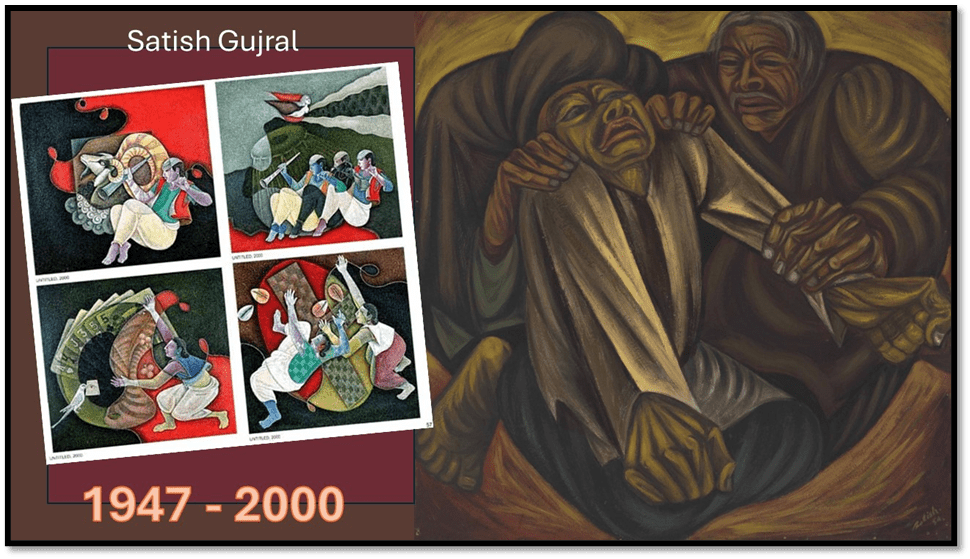
This is a book in which art and artists ride high. It is Victoria who constantly hints that Bonita ought to be, like her mother, an artist, though I think, if that is the result, it will be artist in written or typed words not brushwork. Art reveals the divisions in society as in the lecture discussed above about the analogies of Mexican and Indian art. Here again, Rodríguez-Davis is a step ahead. In her article she cites the example of Indian refugee artist, Satish Gujral, whose art was born out of apprenticeships to Mexican revolutionary maestros, Diego Rivera and David Alfaro Siqueiros. His art is not mentioned but we know its emotional resonance to be relevant.
Indian refugee Satish Gujral, an artist who studied in Mexico on a scholarship, observed these similarities and depicted the same scenes of violence in his own work as that of his Mexican art instructors, including Diego Rivera and David Alfaro Siqueiros.[Rodríguez-Davis, op.cit.}
When Victoria tells Bonita the story of Rosarita as an artist, the former’s memory jogs and she remembers a sketch on the wall of her early home and which seems repainted in a solidifying memory of ghostlike shadows turning into matter:
… the very shadows that come together in brushlike strokes to form it – a sketch in wishy-washy pastels … of a woman seated on a park bench – and yes, it could have been one here in San Miguel – with a child playing in the sand at her feet. She is not looking at the child and the child is not looking at her, as if they had no relation to each other, each absorbed in a separate world, and silent.
Art here shows its purpose in the inversion of that purpose, displaying people of the possible closest of relationships and desire for communion, as well as communication, a mother and child. Yet they may appear to be ‘no relation to each other’ merely because that is the truth. Yet art is a means of building relational links between even Strangers and it uses the means of a Trickster to do it too sometimes. This book refers to know artistic ‘communes’ and the word ‘commune’ is important to my theme of art as the means of resurrecting communion and communication. That failed in the place of meetings or encounters, the literal meaning of Los Encuentros. Its portal is ‘a small chapel, or what must once have been a chapel although it is now a ruin’. The doors stand open to allow only ghosts to meet and the ‘rooms are empty except for fallen tiles’. But art that paints only “guns, bombs and killing, killing!”, resurrects nothing Victoria believes. These GIs painted the planes that bombed Vietnam Not the trains that actually too part in the Mexican revolutions so prominently. Yet art has a duty to the displaced and Victoria cites Sorita as: ‘… she began to cry, la pobrecita, and talk of terrible things, of refugees, killing and vio-lence …’.[47] And if this perception was what brought Sorita to Mexico like Gujral, it had no chance of truly flowering beyond the violence And splits to self that prompted it.
Art ideally causes communion even over large splits and wounds that break open. In La Manzanilla, though Bonita may never be an artist, and may never know for certain that Rosarita was once either, or even existed, but she can walk into a painting (though it is one that doesn’t exist in reality but only in what another activity associates itself with) and lose yourself in its imagined spaces, as perhaps did she in this dream-like passage:
… there is a slight, silent man in a straw hat meditatively raking the sand of the path as if he were painting it; could you go up to him and ask him if he had ever met someone who might have been your mother? In a brief, hallucinatory moment you see her turning onto that path, walking up it, entering that painting and vanishing into it’.[48]
Art here is not a painting but an imagination of one, just as dramatic dialogue can be frameworked as the trickery of acting or the true magic of art. Writers or storytellers too may weave a ‘fantastical tale’, but art that links present, past and future might really be what Bonita imagines Victoria thinks she is: ‘Could she, like a wizard or a magician, bring your mother to life again even if it is a life you never knew or suspected’.[49] Sometimes Desai’s prose has this artistic magic that redeems the dying, rotting and catastrophically vanishing and disappeared of an evil world, like the disappeared of Mexico’s past, back to meaningful life by the trick of her prose:
It is the moment when the perfect circle of the sun begins to collapse: the top flattens, the centre bellies out like an orange rotting, and the weight of it drags it down so the sea, darkening, can rise up and swallow it whole in an instant so swift you almost miss it’[50]
There is cyclic revolution in this image in time and space, declining old worlds allow new ones to ‘rise up’ in ideal revolution, and in dreams devours a world so rotten it can be healed no other way. Of course it is a cognitive-affective revolution, but perhaps true revolution only comes simultaneously with revolutions of the human being that wee share in common. In the common is communion, and there too communication, and only there.
Having written this blog now for so long, there is no way to end this piece neatly. Instead, a plea to read this book. It is only 94 pages and the print is of a readable size, but as writing it excels as few others can, it is pure magic as only a Trickster can write, but beware who you call a Trickster, for they may be the truth-tellers.
With love
Steven xxxxxxxxx
[1] Anita Desai (2024: 20) Rosarita London & Dublin, Picador
[21] The current Gothic façade was constructed in 1880 by Zeferino Gutierrez, an indigenous bricklayer and self-taught architect. It is said Gutierrez’s inspiration came from postcards and lithographs of Gothic churches in Europe; however, the interpretation is his own and more a work of imagination than a faithful reconstruction. From: https://en.wikipedia.org/wiki/San_Miguel_de_Allende





 Steve_Bamlett_blog
One thought on “This blog looks for what is truly revolutionary in Anita Desai’s (2024) ‘Rosarita’.”