Michael G. Cronin reinstates the role of literature as a vehicle for feeling that is radically embodied but in a special sense ‘impersonal’. He uses Rachel Greenwald Smith’s terms to both reinstate the affective as the basis of literature but also to challenge a mode of writing that attributes the ‘ownership’ and regulation of affect or feeling only to individual selves, whether those be the author, narrator or character and to find value instead in destabilising ‘the connection between the emotional and the personal, thereby “reinterpreting feeling not as evidence of the primacy of the self but rather as evidence of the persistence of ecological interconnectedness”.[1] This is a blog on his 2022 book Revolutionary bodies: Homoeroticism and the political imagination in Irish writing Manchester, Manchester University Press.

This book has more than enough theory in it, but the basis of its theory is not in the repertoire of ideas and approaches in queer theory alone but in an attempt to move beyond such theory to find a way of imagining what sexual liberation and a community of the liberated could be like. Such a liberation has never existed as such the book assumes beyond the temporal and geographically placed expressions of optimally better queer identities which is all a literature situated in specific times and place can achieve. This point is well worth understanding. The art chosen is not chosen to find models of queer ‘identity’ that can be idealised or promoted as positive aspirations of self-identification but of such identities situated in place and times in ways they cannot transcend, or even refine except by another articulation of themselves at a later time and in another space, which can only imagine a better way of being than that they exemplify.
Taking the theme of gay marriage, in its conclusion, the book argues we can only progress towards the achievement of difficult-to-comprehend freedoms and equality within the LGBTQI+ acronym or between it an norms of the wider social codes regulating human behaviour if we see any ‘victory’ for gay rights, like securing the right to gay marriage which, in some views apes the heteronormative, by recognising it is a ‘victory that simultaneously makers the society more equal and more unequal’ (my emphasis). He continues by saying that the achievements of queer literature are never final and imitable blueprints of liberation, nor confined just to the queer or intersectional variants of the queer (like that of the possible oxymoron, but imaginatively achieved image, of queer Irish radicalism in Brendan Behan’s The Borstal Boy) but form a way forward to ‘a different form of politics: a politics universal and radically humanist in its objectives’. He characterises such a politics using Herbert Marcuse’s Eros and Civilisation:
What art and literature can provide are guiding images prompting us towards imagining less alienated, more humane and sustainable ways of being human – imaging “a mode of being that has absorbed all becoming, that is for and with itself in all otherness.”’[2]
Although I may quibble at the satisfaction with a humanist ideal, I have to remember that this book springs from the Irish University of Maynooth, once the stronghold of Jesuit intellectualism. It forgets that a liberation that stops at the human universal cannot aspire as it must to the liberation of the diversity of the animal and vegetable body of being. Even Marvell contrived to imagine a vegetable ideal.
My vegetable love should grow
Vaster than empires and more slow;
But even with Marvell as an example, it is even more difficult to imagine, even if imagine it we must and in forms other than science horror or parody thereof (The Little Shop of Horrors).
However, I cannot pretend to review this book, for I read only in full only the Introduction, Conclusion and Chapters 1 – 3, for chapters 4 and 5 covered a literature of which I Have not the slightest acquaintance (yet at least). Its Conclusion is fired by a debate around the visual and performance art of Joe Caslin, even reflecting on the negativity of a placement of that art by Emer O’Toole, inspired by the fact that an egg was thrown at one of Caslin’s homoerotic images, in ‘statically minoritarian terms – a homogeneously oppressive majority of ‘them’ aligned against an equally homogenised minority of ‘us’. Such static formulations fail to understand the dialectic, Cronin argues, that shows the image still holding much more imaginary power to guide us than the sight of an egg’s remnants dotted on it. Likewise, one of Caslin Volunteers mural series, erected on the wall of The National Museum of Ireland, once the Collins’ Barracks for a National Army, and before that the Royal Barracks of a colonial army, of two young men holding each other.

Joe Caslin and the Collins’ Barracks.
The image had been critiqued for the figure considered dominant, the one facing the drillyard from the wall, appears to be holding up a disabled man in his suffering. The scent of patronage to the physically and mentally different was seen as the ‘paternalist flow of support from “carer” to “client”’., and condemned as patronising. Caslin identified each man, one a volunteer carer and a GAA (Gaelic Athletic Association – a politicised tradition in Irish sport) athlete, the other a 28 year old man with ‘bipolar disorder’. Of this idea, Cronin says, I think correctly, that the strength is between the couple and the hold mutual not from stronger to weaker, The strength of the wounded man is multiplied in the fact that he sustains the position on bare feet, his head not subordinated and looking down but using all its strength to support the athlete on his right shoulder. Each man sustains the other or, in Cronin’s terms, ‘the two men are literally supporting each other to stay upright’. This is a beautiful illustration of the book’s tendency, although the treatment of the novels in their historical context is much more complex because of the apparent accommodation of very homonormative and homophobic material they contain, as a result of their transcription of a felt ‘reality’ of the times.
However if you go to this book for close reading of novels you won’t be disappointed. The reading of Oscar Wilde’s The Picture of Dorian Gray didn’t add much I felt to my view of that novel, although I was not aware and am grateful to be so of its links to an expression of the Irish nationalist and socialist politics that Wilde defended. Nevertheless, even with these contexts, the novel appears just as it is n endless other readings. Dorian is both ‘an alienated and reified consciousness typical of consumerism; and ‘insurrectionary and subversive’. Where have I read that before? Everywhere! However, to be fair this standard reading plays a part in dealing with much more nuanced readers of better novels – especially in the refined readings, the best I know beyond the authors’ own auto-readings, of Colm Tóibín. The latter is the best known writer present and certainly the one I like best, but they shed light too on precursors, that surprised me in the treatment of Brendan Behan and delighted me with John Broderick, for these readings are so different from my own at significant moments, if not in total (mine are not so well-based in general socio-political and literary theory moreover, and perhaps they ought to be. On the other hand, I am not a professional writer or academic so I will let myself off the hook. Nor, will I try to reconcile those readings as yet, for I have only recently blogged on Tóibín’s latest novel Long Island and there drew very different links to John Broderick’s work (see the blog at this link).
But let’s start with Behan and how Cronin reads him:

Behan never was the stereotype of the queer writer and his take on how and why men might love each other is deeply complicated in ways that cannot be reduced down to the language of the closet. It seemed to demand that he distinguish himself and the boys in the Borstal he ‘loved’ from other ‘types’ of love – that of women which is sustainable – and that independent, or so he thinks ‘of healthy muscle and slim wrought form’, in the ‘powdered pansy’. His kind of mutual-boy-to-boy-love is at once ‘beautiful’ and at the same time a prolongation of narcissistic adolescence. I take this from a passage quoted by Cronin from an unpublished manuscript of Borstal Boy that never saw light of day:
I loved Borstal boys and they loved me. But the absence of girls made it that much imperfect. Homosexuality (of our sort) …is not a substitute for normal sex. It’s a different thing, similar to that of which T.E. Lawrence writes in The Seven Pillars. The youth of healthy muscle and slim wrought form is not the same as the powdered pansy (who I hasten to add, as good as anybody else, has every right to be that and a bloody good artist or anything he wants to be). Our lads saw themselves as beautiful and had to do something about it … As I say however, without women it could not be a pattern of life, only a prolonging of adolescence – it was as beautiful as that. [3]
What Cronin makes of the complicated logic of these sentences is that it represents what Eve Sedgwick calls the ‘radical and irreducible incoherence’ which structures (or fragments if you prefer) ‘modern concepts of sexual identity’, in which ‘our sort’ of ‘homosexuality’ must look different from that despised as a type or stereotype. Such incoherence even structured the attack on negative stereotypes by elements of the early gay movement, pitching its hatred against the feminised or ‘camp’. But Behan’s is a stranger thing yet. The presence of women would make the mutual love of Borstal boys less ‘imperfect’, but how and why? How are we to read the idea that such love ;could not be a pattern of life’, is that because he is saying that only heteronormativity can attain such patterns or because it could then exist alongside and independent of heteronormativity and thence take on a kind of perfection it could not have otherwise. It is a puzzling passage.
Cronin argues that Behan removed the passage because he may have felt it too rigid a statement of his experience, trying to categorise what cannot be categorised and implying without intending to so value judgements that are strictly unnecessary. These boys may not wish to be seen as like Wilde, great artists who enact the feminised ‘powdered pansy’ even though they do not deny them that right, but as archetypes of a youth that is definitively masculine, wherein a male can see the male body as beautiful and can do it in a prolonged way for they are not asked to take on adult roles until they leave Borstal. And yet it is still a ‘sort’ of homosexuality, like the ‘powdered pansy’s’.
In the novel itself Cronin instances an ‘unsteady combination of bold assertion, parenthetical equivocation and unstable taxonomic categorisation’ but in a form that is ‘more allusive and elliptical, and idealised as erotic friendship’. He instances the narrator’s ‘innocent admiring the back of’ a young sailor’s neck whilst the queue to wash, and part where, with his special friend Charlie, he ‘ “wiped, carefully, the back of his ears” – the parenthetical emphasis on ‘carefully’ reiterating the tenderness of the gesture’.[4] The whole passage, which precedes the entry to Borstal in the remand prison, in fact speaks of male interest in male bodies as a masked eroticism, which is too constant and prolonged to be truly spoken of as being ‘innocently admiring’. Every body is assessed and evaluated, sometimes against ones negatively evaluated, usually fat bodies like the character nicknamed ‘Tubby’, who is a prisoner who mediates the warders’ orders.
Tubby looks into the cubicles of the bathing new lads, offering to wash their backs. When Ginger lets him, we hear him reprimanded to “Give over, you dirty old bastard”.[5] The special love that the narrator, called Behan, feels for Charlie is especially masked in its expression, with Charlie often denying what we have to sense, that he also feels an interest in lithe healthy young male bodies and Charlie’s in particular. It is Charlie who is often forced to have sexual attention and jokes directed at him. Tubby says that to the narrator that Charlie will ‘go to Borstal and all. Want to watch his ring though’. He then shouts so that Charlie will hear too: “ ‘ever ‘ad a length of the bo’sun’s whistle? Any old three-badge stoker shown to the golden rivet?” This witness of both beauty and potential to experience to the young sailor is seen throughout in the narrator’s hearing and, in my view is another form of masked desire, not least in Charlie’s resistance to it as he ‘stood, holding a towel to himself, proud and fierce’.[6]
Even when this takes the form of a laddish joke in the borstal proper the incident the narrator chooses to both narrate and then downplay eventually as being only about ‘a manner of speaking’ with ‘no harm in it’ is about a sexual play for Charlie from their friend Joe:
Joe said, “I’ll get kipped in beside you, Charlie, and don’t scream in the night, it’ll only be me.”
“Oh, sod off!” said Charlie. “I wouldn’t sleep in the same field as –“
Their team leader Heath tells Joe to ‘keep that kind of talk to yourself. …, and if I get you or any other filthy bloody swine talking like that he’ll know all about it”.[7] Again, the narrator is merely a witness of a recognition of Charlie’s desirability and his resistance to fulfilling the desire of any young male caller irrespective of who they are. The whole becomes in my view as supported, I think, by Cronin’s readings a masked love symphonic piece of adoration of Charlie that feeds into a romantic vision of politically engaged youth. Cronin finds these in the use of songs idealised young Irish martyrs or even of Charles Stuart that had for the IRA a Republican reading, as set against the established Protestant nation of England. The songs are aligned with the masked homoerotic Cronin argues, as young male followers sing of the ‘beautiful lightsome, awesome boy’.[8]
The normative reading of the novel Cronin says is to see Brendan led via the ‘erotic and affective intensification of his and Charlie’s bodies’ to an appreciation of the working-class culture of English boys too and a shift from the extremes of Republican extremism. In Cronin’s readings the change is not from one to another but a means of forming a political imagination that embraces both with ‘liberation’ uniting with Eros in a ‘transformation of social consciousness beyond national consciousness’. It is the first great example of the dialectic Cronin wishes to illustrate – a new politics of political and sexual liberation that has as yet no fully visible form but that is only in ‘becoming’ so that ‘we can only speculate, and hope, about how ‘wonderful’ they might be’.[9]
I think I can only throw this reading out there together with some of my readings from passages of the novel. I would however have to read the novel fully again (I read it in the 1990s and not since) to test Cronin’s reading but that it interested me enough to want to do that is already high praise for literary criticism, which is, on the whole, far from inspiring as reading for me these days.
Cronin moves on in the book to John Broderick, whose novels he reads as coming essentially from a Catholic religious consciousness that demands to be taken seriously (again perhaps the Maynooth strain but essentially matching the seriousness with which Broderick too Catholicism as truth sometimes masked by its ecclesiastical manifestations) through the use of a binary of the ‘convert’ and the ‘pervert’. His discussion of perversity starts with the theoretical concept of original sin as deviation from the will of God to its discussion by Jonathan Dollimore where it takes on the form of revolution as well as ‘inversion, distortion, transformation, reversal, subversion’. As with Behan categories of the sexual are manifold and incoherent, with lesser time given to the ‘repressed homosexual’ than to gloriously subversive sexual-religious heretics, political insurrectionists, and some ‘wayward women’, like Julia in The Pilgrimage. In my first blog on Broderick (see it at this link), I cited Julia saying something that united her as a ‘wayward women’ to men who would always see norms as imprisonment.
She didn’t suppose that there was very much difference between the promiscuity of young men like Tommy and the life she had lived herself. It was a hard, inexorable existence: exciting, and completely without tenderness and compassion. It had something of the in it of the ruthless law of the jungle. Those wild creatures who live within its shadows can never completely rid themselves of its influence. They may try to adjust themselves to the humdrum rhythms of conventional existence; but sooner or later they will break the chains and sink back to their accustomed haunts.[10]
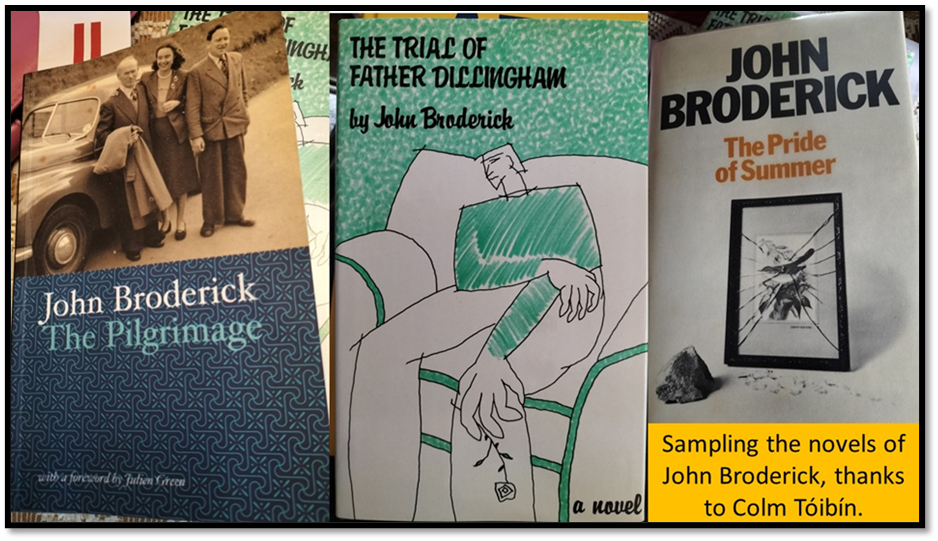
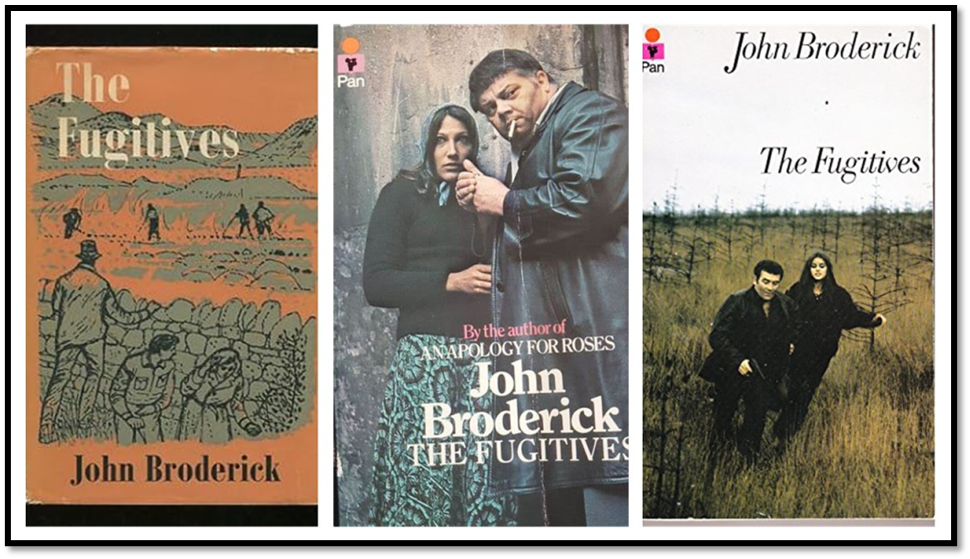
The interesting ‘perverse figures’ in Broderick, Cronin argues, are not repressed homosexuals who are often marked as unpleasant and exploitative (a kind of blaming the victim still quite common in his time), since the repression was not primarily of their own making however they burnished it to a gleam. Instead he liked queer apocalyptic messengers of a future time – riddled with contradiction but hard to pin down. These include Hugh Ward in The Fugitives (see my blog at this link) whose passion for a young man is often seen as devious but more often as a kind of transformative magic ideal that redeems his political acedia.
Their finest example is the elderly and dying Willie Ryan (see my blog at this link), a kind of fay fairy figure between youth and age, suspicious of the connection of sex to love, with the experience of rape from repressed homosexuals like his brother and the man he loved who betrayed him behind him:
In spite of his snow-white hair, and the hollows in his temples, he had preserved a startling, even a shocking youthfulness. His pale skin was unlined, fine, clear and taut. The features were blunt and mask-like, with wide nostrils, thick lips, and brows almond-shaped eyes. Raised now, drained of shadows, with eyes puckered against the light, the young-old face was tense and watchful, the lithe body stiff as the rough clothes which enclosed it.

Willie represents a resistance to all kinds of oppression – of younger sons by elders and parents, of the lightly framed effeminate male, of incarceration as mentally ill in the interests of others. He has the ability to bring worlds, that feel to themselves secure, to their knees. Yet Cronin feels his role is to stand as ‘an unalienated form of life, imaged in the ideal of male friendship’.[11] And hence he must be cut from stuff that is not of the realist novel of midlands urban life in Ireland, as something other, that is erotic even in its chastity, something fay and beautiful. In the end, Willie is a symbol of everything wrong and false in the frame working of the ‘real’ through norms. As Cronin puts it:
Perhaps what makes this fiction so intractable for contemporary literary criticism is that perversity is not the substratum for a politics of identity – as readers we are not required to identify with these figures – but of insurrection.[12]
I have found it difficult to characterise Cronin talking about Broderick without intruding too much myself. The solution is to read the book itself primarily and I think this will be more so with my attempt to talk about Cronin’s beautifully nuanced readings of early queer novels by Colm Tóibín. I have not read these novels, though I revere them, for a long time (I used to read each as it came out and even then re-reading was too soon after the first reading). The Blackwater Lightship stunned me, so much so it instigated a visit to Wexford to haunt the scenes in it and The Heather Blazing.
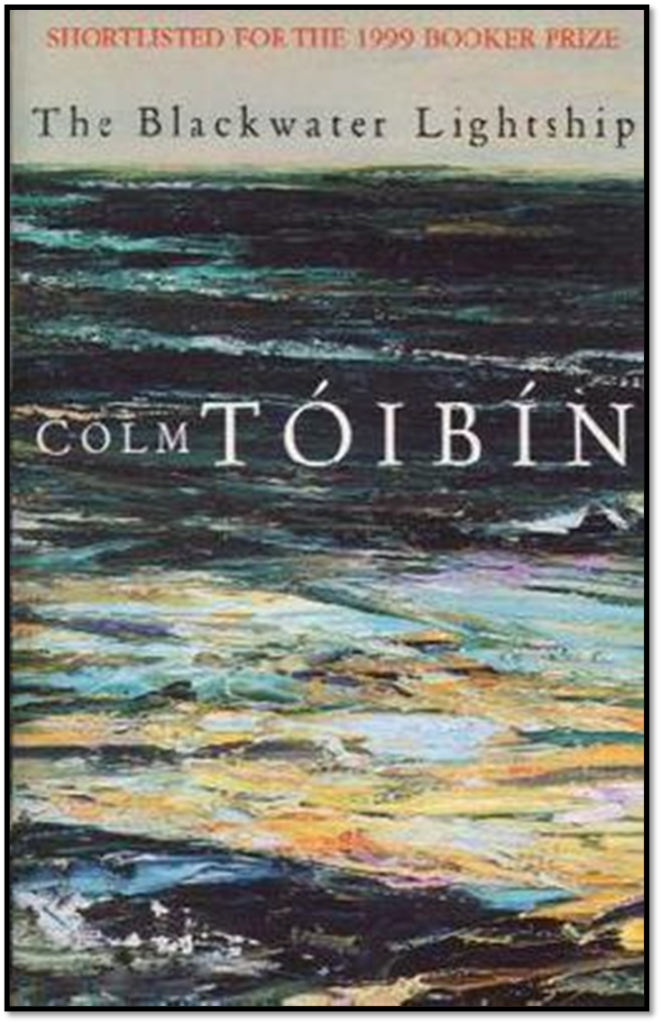
Cronin’s thesis is that the novels address the neoliberal global revolution that put the self as the primary factor before the belief in any community, even those of the family. Even the queer novels situate themselves in the neoliberal changes in Argentina and Ireland in The Story of the Night and The Blackwater Lightship respectively, seeing individuals taking the stress on self to benefit from its necessary changes when they can by using them or working within them positively for less selfish ends, such as Larry’s work with President Mary Robinson in The Blackwater Lightship.
Neoliberalism allows those choices and explicates them in narratives of individuals being ‘realistic’ and taking responsibility for their feelings and acting for and with them with the self being the agent that is doing the driving. Cronin believes Tóibín writes such novels, that at one level affirm the advantages of the neoliberal, except where the subject is the apprehension of that which has aesthetic and sensual pull – the male body, even the dying male body. And it is his style of writing that opens doors to a critique of the neoliberal, asserting feelings that are textured and ‘impersonal’ (not attributable to a single ‘self’), that assemble collectivities, like the chosen family collected together around the man dying with AIDS, where politics and communal truth are the same thing. I need to consider longer but I find quite magic Cronin’s last sentences on Tóibín. First noting that Jeremy Gilbert says that the refined style of the realist novel Tóibín writes, the tradition from Jane Austen onwards, tends to privatise feeling in the self and inhibit ‘the emergence of all forms of potent collectivity’, he says:
By reframing sexuality as erotic needs, vulnerabilities and, above all, relationality, Tóibín creates a style of writing about homoeroticism and the male body which gives us ways of imagining just such ‘potent collectivity’.
This is rich thinking. It fits too with the dialectical reading promoted. There are no ideal representation of liberation, there is only the ability to see that an innovation can foster simultaneously a positive and a negative energy in relation to progress towards a liberation we do not yet know or see but darkly. Those glimpses of ‘potent collectivity’ may well be its reflex though they yet live in darkness visible.
This is a very rich book. I admire it. It is not a book that you come to terms with immediately, but it is a guiding light to a better formulation of the uses of queer writing. I recommend it.
With love
Steven
[1] Michael G. Cronin (2022: 5f.) Revolutionary bodies: Homoeroticism and the Political Imagination in Irish writing Manchester, Manchester University Press.
[2] Ibid: 211. My emphases again.
[3] Cited ibid: 44f.
[4] Cited 43 – 47
[5] Brendan Behan (1990: 34f.) The Borstal Boy Arrow Books, Kindle Ed.
[6] Ibid: 39
[7] Ibid: 219
[8] Ibid: 16
[9] Ibid: 58f
[10] John Broderick (2004: 152, originally published 1961) The Pilgrimage Dublin, The Lilliput Press.
[11] Cronin, op.cit: 79
[12] Ibid: 87f.
 Steve_Bamlett_blog