‘“What do you remember? Can you tell me?” / But it was clear from the disappointed fall of Pyara’s face, the slow release of his shoulder, that the past had given him the slip, that whichever thread his father had been clutching at had escaped, the memory unspooling into the night’.[1] This is a blog on the vast contribution to the craft of what can remain of the realist novel of social responsibility in Sunjeev Sahota (2024) The Spoiled Heart, Dublin, Harvill Secker.
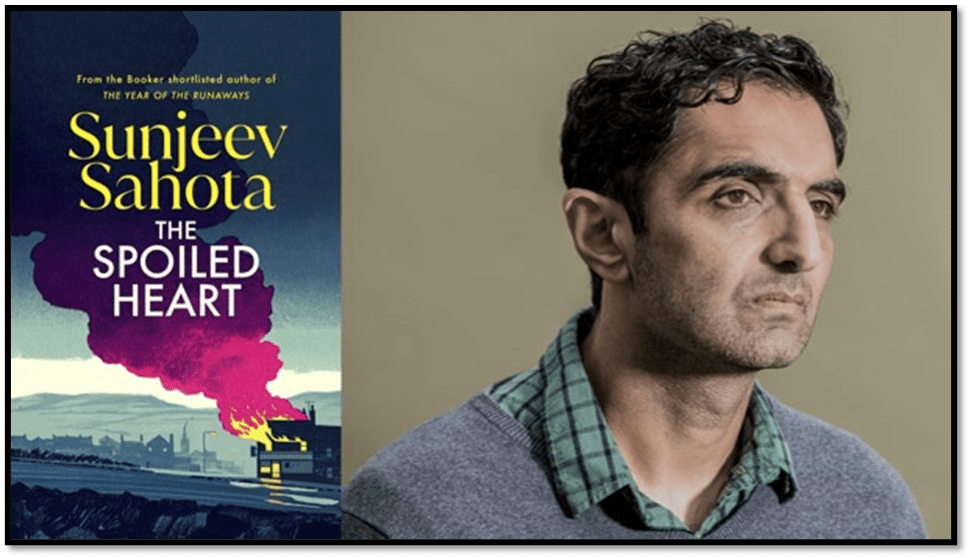
For another blog on this writer’s The China Room, see this link.
I have loved and valued the work of Sunjeev Sahota since his first great novel, Ours Are The Streets. And, when I read that novel, my first response was awe at its brilliance in capturing the voices I both knew and did not know in Sheffield, in a novel almost entirely focused on the out-of-town shopping precinct, Meadowhall. When I voiced that view at an event at the Edinburgh Book Festival, I felt reprimanded by the person who chaired the event as if I had insulted Sahota, as if I ever could, by suggesting that there was in that novel, something centrally and focally working-class and English in his ability to capture even the most charged of multi-racial and multi-cultural scenarios of his age, the voices of a second or third generation of characters following their parents or grandparents moving to the North Of England. Perhaps the chair-holder felt that too far away from The Year of the Runaways, which dealt with the first experience of undocumented immigration and spanned the experience of his characters between continents. This, of course is more true of The China Room. In my reading of it (sadly too minimal) it is taking on the cudgels of the Great Tradition of British novel-writing by confronting the contribution of Henry James directly. However, it was of this novel that he spoke when he made the comments cited first in Sam Byer’s admiring review of The Spoiled Heart.
On the release of his third novel, 2021’s Booker-longlisted China Room, Sunjeev Sahotanoted with some frustration the limiting lens through which his work tends to be viewed. “Everyone always comments on the fact that my novels all have brown protagonists,” he remarked, “but what no one ever says is that there aren’t actually any characters in my novels who aren’t working class.”
The comments are from an interview held in 2021 with Ashish Ghadiali, where Sahota talks very much like the hero of The Spoiled Heart, Nayan Olak, about the primary importance of a class rather than essentially race-bound theory of society. Ghadiali summarises thus:
Class, he insists, has been the overriding concern in both his writing and his life, in which racial prejudice is largely a symptom of a deeper malaise. “It’s kind of dispiriting to me,” he says, “how little we talk about class in the UK today. There are about eight working-class MPs in parliament [and yet] no one seems particularly concerned about that…”.[2]
It is as if there is a debate to be had about the discussion of a politics that emphasised difference and diversity, especially for those who most need social change and an older politics of class solidarity that has failed to see that these battles too are not won. The position in Nayan’s case, for he is a man who ‘is the Union’ in his Trade Union, is nuanced but it doesn’t always sound so nuanced especially when challenged by a younger female colleague with an intense feminist and Black perspective but whose position in the working class has come about by default – by her rejection of her parent’s class and values. One might almost think this is what the novel is about: diversity focused as both a lever, cause and the need for social change and a grasp of the solidarity needed to hold together those who, without change, will remain the oppressed across a range of other kinds of social identity status.
Certainly the novel keeps harking back to Nayan’s stand on the primacy of working class issues that strains not to be colour-blind. A belief in solidarity was his mother, Muneet’s, political gift to him, given using the word beta, which its ability to categorise him both as her son and as a man requiring respect, but echoing too the then MP for Chesterfield, Tony Benn, a solidarity socialist to his privileged roots:
Find the ground on which you can all stand, beta. They were letter-dropping for Tony Benn, … Don’t let anyone tell you you’re different. Even if they treat you differently. Even if those different things look like they’ll help you. They won’t. … The workers in society have to work together, acha? … Have to stay solid. None of this Indians need this, whites this, blacks this. ….[3]
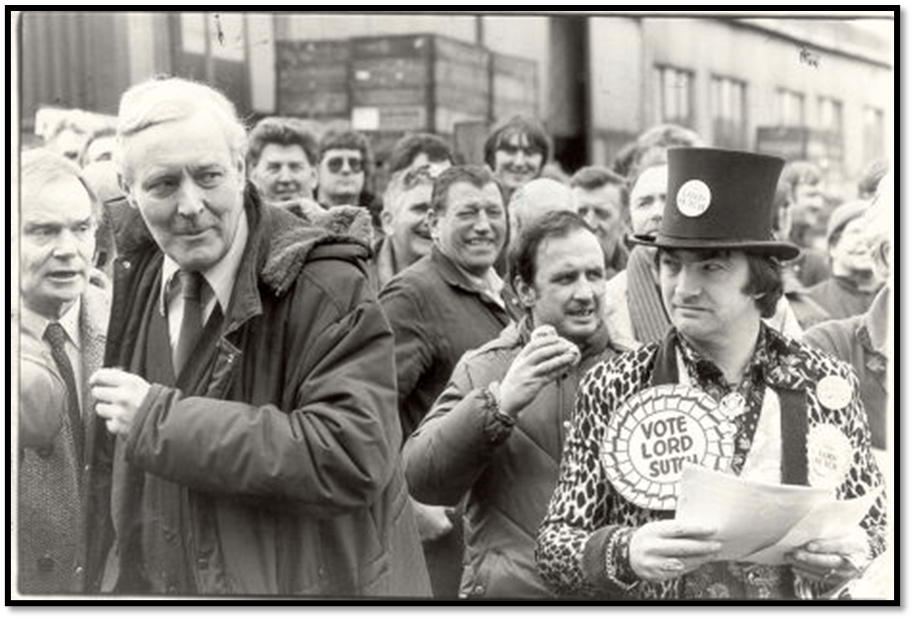
Tony Benn campaigning in Chesterfield. Screaming Lord Sutch muscling in.
Yet this very idea is subjected to the irony of Nayan being defeated in the Union presidential elections, eventually, by his rival and treated as old-fashioned by most of the younger people in the novel. There is one person who does not do that, and she leads a crowd of students into the debate: Claudia. However, even then, a co-student of hers steals her thunder and makes her supporting speech for Nayan in the big Union leader debate in the novel look slightly, well … academic, remote from the workaday issues of solidarity politico-economics promoted by Muneet, canvasing in her sari for Tony Benn. Claudia is treated with irony in the summary of her speech by Sahota – and stopped speaking by the embarrassed Nayan just when she:
… still had over a century of ground to cover, from Toussaint L’Ouverture, via C.L. R. James, to the league of the Revolutionary Struggle, from the Chartists’ alliance with Indian mutineers all the way back to Jayaben Desai, and that was before she even got to the two-page conclusion where she’d make the case for Nayan, and Nayan’s politics, sat squarely in this radical tradition of lasting social transformation brought about by transracial, working-class solidarity.[4]
Could Claudia in all her white entitlement be even more humiliated. Well, yes, she can, and is!. Claudia’s ideological rival in her college seminar group gets up at this point to remind the audience that the murdered Stephen Lawrence was murdered because he was Black.
Even the white protégé Brandon that Nayan takes on and promotes as a chef with his networks (and indeed tskes on as a substitute son, to enhance his chances with his mother, Helen Fletcher) has trouble with the solidarity argument. To a native English speaker, an entitled native role, there is something ‘funny’ about Nayan’ mother’s phrasing of ‘solidarity’ (quoted above) ‘Stay solid’ and which Nayan has used in his election literature. The leaflet is to be be now read by Brandon in order to provide ‘a fresh set of eyes on this. Young eyes’. The dialogue is full of the most delicious dramatic ironies that rather lower our sense of Nayan’s ‘nous’ as a campaigner of ‘today’.
“Let’s Stay solid?” Brandon said.
“Solid as in solidarity. Sticking together to make real change happen.”
“Right.”
“Why? What’s the matter?” The boy was looking doubtful.
“Nothing. I just think – solid to me, means, you know, solids. Like – poo.”
It is the fun that Sahota has with this theme which makes me think of it as a kind of working theme no less important to him but not at the root of the novel’s skill as an innovative and brilliant novel such as Sahota is capable of writing and with the quite consciously aware craft of a highly skilled artist in his form. The theme of racial diversity does unite Brandon and Nayan’s story in other ways. Both are accused of failing to see their failings by younger Black women, in the case of Brandon where the young woman understandably mistakes Brandon’s words to her in a situation where he has no power to correct the impression made. In the case of Nayan, the flaw in his personality is both more tragic and lies deeper. We can look at that nuance later. However, what truly is the structural analogy in their situations, and that of others, is whether they enabled to stay put in situations that have caused them to look deep[ly compromised as characters and if so, at what cost to themselves or others.
This is the situation of many others in the novel also, including Nayan’s father, Pyara, and Helen Fletcher. Helen is forced to ‘go’ from her unstable home, but home nevertheless, more than once, and otherwise uses seclusion as a means of escape from community. But she had a sister, Sonia, once known to Nayan, who is ‘a layer now. In Chicago. Legged it as soon as she could’.[6] However it is also true of a character we hardly notice in the novel until lately – the very unreliable narrator, named only once in full in it but central to the story – which is only nominally Nayan’s story and is, at its most elaborated that supposedly of his writing, Sajjan Dhanoa. Early in the novel he becomes interested in Nayan as the subject of a novel and interrogates him until Nayan indicates his doubts about Sajjan’s probity, as a man too ready to blame brown communities for the ills of white society. Nayan summarises his take on Dhanoa thus:
Sajjan Dhanoa. Local writer. Except there’s nothing local about you. Got out to London as quick as you could and never looked back. And now lives within spitting distance, spitting away, building a career out of making us look contemptible.[7]
Sam Byers treats Sajjan as a very cleverly used novelistic device of Sahota’s. Much of what he says hits the spot precisely:
For a narrator, Sahota casts a Zuckerman-like alter ego: Sajjan, a writer from the same town who reconnects with a bruised Nayan and pieces together his unravelling. This additional layer of perspective provides both layered ambiguity and a broadened scope, allowing the novel to take in other lives and viewpoints: Helen, towards whom Nayan is increasingly attracted, and her son Brandon, who is rebuilding his life after a viral public shaming. As Sajjan probes, he gives shape not only to the collapse of Nayan’s seemingly assured election campaign, but to the weight of grief that precedes and in some ways informs it: the death, in an unexplained fire, of Nayan’s mother and infant son.
The technical device of the witness-narrator certainly has these functions. This narrator can interview other people who become characters in the novel such as the deputy who runs for election with Nayan, Lise-Marie and, especially important in this case, Helen Fletcher who knew Nayan form different perspectives. However, I think Sajjan’s role in the novel is greater than a mere narrative device. I suspect Byers may think so too but is unable to explore that given his duty as a reviewer not to make spoilers that inform readers before they have a chance to experience them of twists in the plotting of the novel. It is only when we understand the main twists of the novel, very late in it, that we will see the skill of the writer in the manner of his handling of Sajjan’s own parents, who ought not to figure in the story that much, in its earlier moments. Rather than commit the spoiling myself I will merely give the page references in a footnote that are particularly appropriate to appreciating the skill of the novelist. Don’t look at this footnote, if you don’t want a massive spoiler.[8]
I think though to explore the theme I think central need not bring us into spoilers. Sajjan is accused in the piece I cited above as a kind of class and community traitor – a writer, who, in order to become a writer as recognised in communities of writers, must leave behind the very background in which his skills are fostered and from which he will take at least some of his stories. No doubt Sunjeev Sahota will recognise this paradigm as having some relation to his own story, for Ashish Ghadiali retells it, such as Sahota gave it in his interview with him as a story based on having left behind a community in Chesterfield – where his parents owned a shop having lost the manual labour jobs they had, and struggled. It is worth reading the story in full, for Sahota felt that his dissatisfaction was not with his own Community and parents but with the working class community of Sheffield and Chesterfield as a whole between which and him there seemed a mutual relationship of rejection. He says of his own dissatisfaction there that:
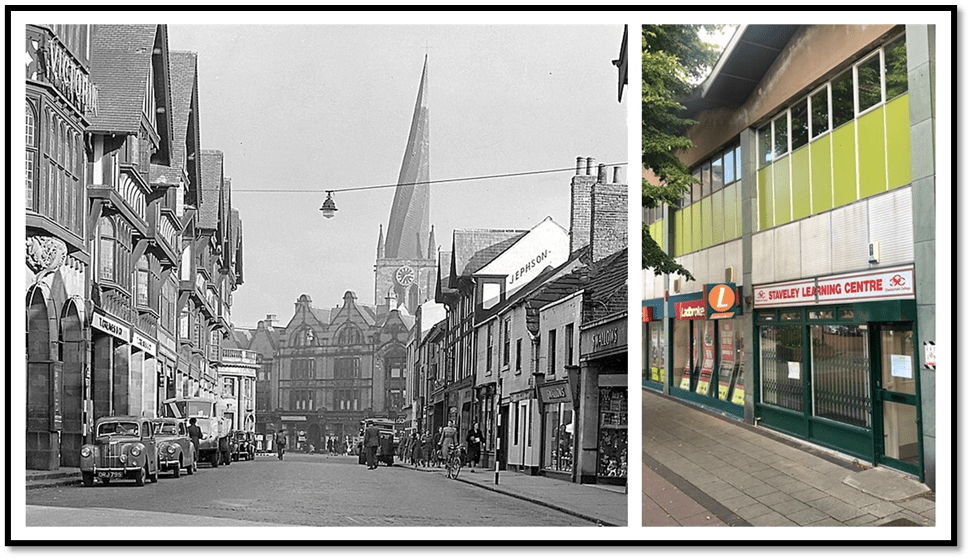
Chesterfield High Street past and present
… that dissatisfaction was based upon a lack of self-worth, a lack of jobs, rather than anything to do with race. “There was a lot of anger and a deep sense of betrayal that still hangs in the air in Chesterfield. I think that kind of despair and anger affected all races in the working class and I remember thinking that, as much as race, class is going to be a big factor for me… Growing up, I don’t remember wanting to be white, but I do remember for ever yearning to be a different class.”
He recalls friends’ fathers, “former miners who were now stacking supermarket shelves in the evening, at supermarkets outside of where they lived because there was a lot of shame and feelings of being humiliated by the policies of the day. That kind of humiliation,” he believes, “destroys any tenderness and any kind of friendly feeling towards other people.”
…
In the summer before university (he studied maths at Imperial College London), Sahota had an epiphany when he discovered literature could open up new worlds.“I think I was always just looking for meaning,” he explains. “When I started reading, I felt a real sense that the conversation between the reader and the writer is something where meaning and truth is found. I must have responded to that incredibly strongly, because I did just bury myself in novels from that point.”
Is this the story of Sajjan, with some of the longing to be the ‘transracial’ working-class hero of a character he tries out in creating Nayan. To my mind, this is very likely to be the case. The novelist of the earlier novels is a man who knows novels of classic status and whose aspiration is to match what these novels do. The tension in the novels is likely then to be that of a man who returned to Chesterfield, as he says in the interview too, to take over his parent’s shop whilst his father was ill and re-confronted the complexities of transracial working-class identities. Sam Byers thinks he gets elements of the intersection in identities between ‘race’, ethnicity, sex/gender and class wrong – over-polarising the Nayan and his election for Union president rival, Megha. He also thinks that the story of Brandon lacked the ‘depth and subtlety’ of other characters in the novel. I cannot agree with him for the tragedy of Brandon is precisely the ease with which a white working-class boy can drop from the human race, and, in his case, actually stay unsullied by racism proper.
Brandon is another person asked to ‘go’ and, when that fails is hounded out by vicious political campaigning on Twitter based entirely on ignorance of the facts. He returns to his roots, is reintegrated by Nayan as a mock father but drops away again for no fault of his own – but because of tensions in the thing he has learned to call ‘home’ temporarily. His is the tragedy of being evacuated from his life, like some off those of brown characters in The Year of the Runaways, and it is a tragedy where a false claim of racism is too easy for a young entitled Black women, the daughter of a diplomat living in Richmond in Surrey, too young to be circumspect but, quite unsurprisingly, expecting racism from the white working-class. All that works for me and builds a brilliant parallel to Nayan’s story who has his own problems with both staying and letting go.
Byers correctly sees the strictures caused by creating opposition as a framework for a relationship between Nayan and Megha because he feels that such things do not happen in real life. Likewise he praises the novelist’s redemption of Megha’s character at the end of the novel by blaming the novelist for not showing hints of it earlier. My own experience of the world is less that of Sam Byers and much more like Sunjeev Sahota’s. People do get their relationships structured by oppositions from which escape is made impossible. No-one allows Brandon to explain himself to the young entitled student – his worth is not considered enough to facilitate that. Likewise, Megha struggles as a writer. Her little articles are written so badly – her accusations against Nayan appear too brutal. But hat is her way, as they say. One thing is clear, Nayan is not in control enough of his own narrative, even when he alone drives it, to see how he impacts upon people especially in the use and abuse of male status.
He cannot let go of his role even when it is clear he should. He use patriarchal networks (his relationship to his superior Carswell for instance, as well as male bonhomie) to sustain his power for he feels unjustly accused. And in part he is. He means well. Yet here Sahota is brilliant. We feel for him in the description of his encounter with Megha at the Diwali he organises for the Union and for his campaign, though we are aware he can be insensitive to the feelings of others as a public speaker (as can his rival). A scene at the Diwali where Megha and Nayan have a conversation that is difficult to end will become crucial in the novel’s denouement, though we cannot know that the first time we hear of it, Yet though it is crucial too to the theme I mentioned earlier, it is not for that reason it will shape the novel’s ending:
“…. . Your kind of politics” – he didn’t realise that he’d taken a step towards her, that his shoulder had expanded and she was bending away from him – “this identity swizz you get off on,” Nayan continued loudly. “has cost them their dignity, their pride, their sense of self-worth.”
“You don’t know what –“
“Your kind of politics has forced that phrase* on them and left them behind, as backward, racist fuckwits.”
“I’m going. You need to move aside.”
“You need to hear this.” She tried to go; he wanted her to stay.
Perhaps to readers who are women, this may not seem as innocent as it did to me on first reading. Of course I noticed the male tactics – rendering the appearance of a bigger body yet bigger, the raised voice, but I think we might feel at this point that Megha deserves treatment commensurate with an ambition that seems entirely personal. Do we notice that she is not allowed to explain herself but is mansplained. Yet only later does it become clear that verbal bullying here, supported by body language, is also perhaps more than that – physical bullying. The ‘tried to go: he wanted her to stay’ seems relatively a matter of contested will.
Later we, and Nayan, notice that it was not just that. In her first email of the two that break Nayan she says: ‘When I tried to get away, he assaulted me’. In the second she sends date-stamped photograph of her bruised wrist.[11] Bruising meant that the hold on Megha’s arm is more easily seen, and is, assault. Knowing this turns her ‘pushing’ in the earlier scene into a means of escaping pain, her “what are doing …”, remark into something that should have alerted Nayan to an abuse of power; not signs of her political slipperiness as Nayan sees it at the time. The novel plays clever tricks like that. It shows that as readers our attitudes to characters can be unfairly moulded to the positive and negative and shows that the use of opposed characters was psychologically deliberate. It shows that some bullying males think they can’t be bullies because their mothers loved them. Just as Megha leaves, her look in a sari reminds him of Muneet. The memory though is used to contrast Muneet’s cautious giving way to bullying men (the cause after all of her death) with Megha’s failure to do this strategically or well. Of course, we should be on her side, but are we?
Seek not temptation then, which to avoide
Were better, and most likelie if from mee
Thou sever not: Trial will come unsought.
Wouldst thou approve thy constancie, approve
First thy obedience; th' other who can know,
Not seeing thee attempted, who attest?
But if thou think, trial unsought may finde
Us both securer then thus warnd thou seemst,
Go; for thy stay, not free, absents thee more;
Adam lets her ‘go’ whilst asking her to ‘stay’. In words only does he compromise Eve’s freedom. It is a sign of his exceedingly aware of the issue in literature and life that makes Sahota make so much of the novel’s development hang on this instance and the appeal to reward much more carefully we do in both. We see these contests of decision about going and staying played out in lots of character’s self-reflections as they work out if either response is entirely because they are ordered to go or choose to do so. Of course there is perhaps always a mix in our reluctance to stay or go because we are told so, as Lennox shows in Act 3, Scene 4 of Macbeth, having to be told by the imperious Lady Macbeth to:
Stand not upon the order of thy going
But go at once.
Do our characters stay (or ‘stand’) where they are when they ought to go, or do they go where they ought to stay where they are. Suddenly ashamed after exposure of a story he had forgotten, Nayan asks to leave the office where he is picking up his things and blames Max for not ‘letting him go’.[12] We know the issues is deeper. There is considerable tension in this for all of them – notably in Nayan who is told by a Twitter hashtag repeated over more than one page to go: ‘#OlakMustGo!’[13] The means by and for which people stay or go to face the music as they understand cycle Nayak’s brain late in the novel.[14] This constant wish to return to the past however painful the discoveries that will be made is the kernel of this novel. This trait characterises the narrator who returns constantly to his fascination with Nayan for a reason he cannot name. All of the characters return to Chesterfield, just as Sahota had to do to run his father’s shop in 2019 at a cusp in his academic career. Here is Sajjan in one of his frameworks of narration on the hunt for a story from some past deeper than he realises:
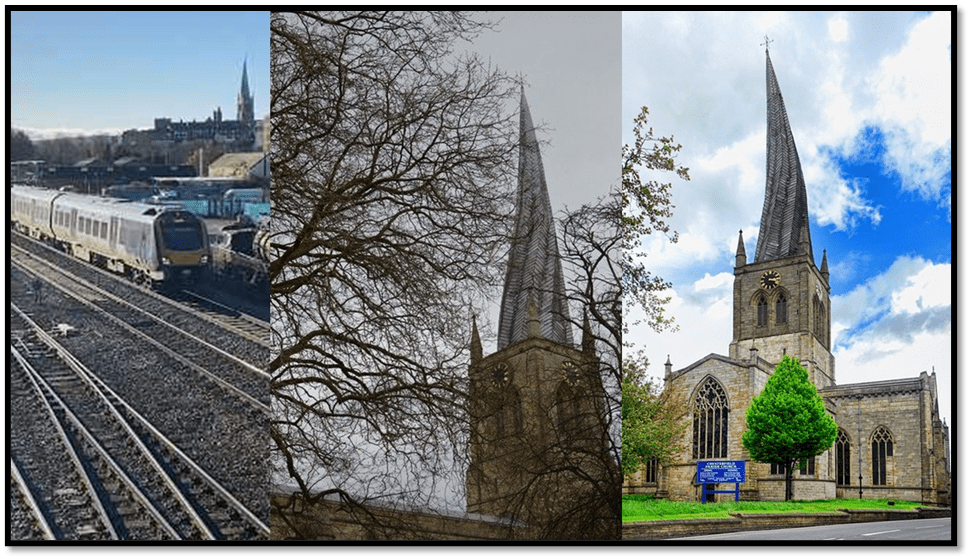
On the morning I was next to meet Nayan, I first climbed up the pedestrian bridge outside Chesterfield railway station I looked out. The bent spire. The emptied centre. The desolate car park. The sense of a town betrayed. The waste. If I hated the place so much, why did I live down the road? Why did I keep coming back, time and again?[15]
This scene almost mirrors Helen’s return to Chesterfield after her the death of her mother – a sex-worker working men, like Pyara, in order to buy drugs who finds there, even in its station and church spire, ‘twisted as if trying to peer behind itself’, the ‘same damp foreboding’.[16] Like the spire all of the characters are ‘twisted as if trying to peer behind’ themselves. They look back for some primal cause of their current misery and the hopelessness that passes for a future. In the end this is why, in this novel, the politics is personal. It looks for origins of the human condition in events rather than looking to change the status quo.
One fine example comes in Nayan’s searching for the roots of opposition between himself and Megha, Showered by online abuse once his possible physical violence to Megha has been revealed, he still resists believing that he is a man capable of such violence, still hiding behind the narcissism invested him in by the wonderful mother of mothers, Muneet: ‘For a long time, he just sat there: help, memory, help. He could remember his anger in the gurdwara and the sense of overstepping the mark. But he’d not hurt her. Of that he was adamant’.[17]
Look behind us as we may, we never notice that even we are, like the Chesterfield spire, twisted. And this applies to all of Sahota’s characters despite their position on vital debates about social change. I think this is too where Sam Byers gets it wrong , if only just, about the more rounded view of Megha we only see at the novel’s end. This is not a fault in the novelist; or with more nuance, it is not that the novelist’s finesse as a creator of character is constrained by his theme about the nature of binary oppositions in politics and life but that the novelist is precisely making this point. We fail to see people or interactions between them as, in Forster’s word, ‘rounded’, because we are stuck in past modes of thinking that are essentially narcissistic. The final comment on the novel by Byers could not be improved upon:
The Spoiled Heart, ultimately, is a novel of guilt, and in its closing stages we come to appreciate that its design is in part its message. Without avoiding individual culpability, Sahota builds a forceful portrait of collective moral failure and responsibility. Guilt, we ultimately realise, is not only individualised, it is diffuse and shared. In this, The Spoiled Heart feels genuinely, uncomfortably contemporary – a novel at once unafraid of judgment and admirably concerned about its consequences. Sahota is a political writer in the truest sense, one who understands that in the end, politics is nothing more than the friction and compromise of life as it is lived. Or, as Sajjan beautifully puts it, “The effort of life, the work of it.”
This is sensitive critique at its best. The only contribution I could make is to add that Sahota sees the ‘design’ issue picked out here as endemic to story-telling, in life as well as novels. We struggle to see self in an adequate timeline wherein our responsibilities are clarified because we constantly want to rescue our self-image from the tarnish of ordinary conditions of humanity that we do not want to believe in. Until, for instance, we realise how much we are tempted by action and reflection that shows up to us only a comforting idea of ourselves, we will not get to the root of eradicating self-interest as the motive of history and its bourgeois dynamics. That is why people in the novel struggle with time – it is essentially a lockdown novel, since so many of its characters get locked down by the response to COVID.
Sajjan spends such empty time that ‘passed in which Nayan and’ he ‘could not meet’ time in isolated reflection, because as for Nayan, ‘the pandemic had necessitated a lot of rethinking’.[18] Even in his downfall, in which we see Nayan at the beginning of the narration but cannot yet understand, the chaos of that man’s room gives Sajjan an idea that time has passed Nayan by now: ‘There was a sense of things running away with him or of him trying to catch up’.[19] Hence in the story Sajjan tells we always see Nayan finding solace by pulling on ‘his running gear and up and over the monumental hills he went’. That search for the monumental outside time is paradoxically only a thing you can chase after. It’s dark heart lies in the moment he recalls ‘running through the streets to save Veer’, his son, when we know that Veer and Muneet are already suffocated by fire in his parents’ shop.[20]
Stories are the heart of the novel and are both its dark and its light, the route to damnation and redemption. The narrative retrieval begins on walking trips in which Sajjan quizzes Naan whilst the latter tries to prolong the use of the light left in the day on those monumental hills, where very early on we get the whole garbled story of Najan’s past and the loss of his son and mother in an inferno, Sajjan seeing him as a kind of absurd enactment of a ‘tragic figure’:
“Shall we head back?” he’d call.
“Can do, No rush.” The silence up there felt magnificent and bright, giving everything a proper scale, clarity. …
He would nod. “Yeah, let’s wait. We’ve perhaps another hour of light yet.”[21]
This is symbolic dramatic writing of a high order, using its terms to suggest how the use of words, silence and duration are the stuff of stories and the novel – and why Sahota is possibly our most treasured form of self-conscious writerly-writer in the UK currently. Time is not ‘running away’ so fatally here without the hope of light yet left to get the story clear. If the whole story is there in full at that moment its garbled nature tells us of the novelist’s insistence that every story we tell is garbled for one reason or another, and usually a shadow falling off our vanity about wanting to appear a hero in it, tragic or otherwise. There are tragic heroes. Nayan is one, but like them all, but maybe Oedipus and King Lear especially, he is not in control of his destiny or the telling of its story, being fundamentally blind about his past, present and the meanings he wants to find in his future.
At this point we can return to my title quotation:
‘“What do you remember? Can you tell me?”
But it was clear from the disappointed fall of Pyara’s face, the slow release of his shoulder, that the past had given him the slip, that whichever thread his father had been clutching at had escaped, the memory unspooling into the night’.[22]
This is a strange moment where a son queries his father who has the cognitive losses caused by dementia and Parkinson’s Disease to remember what, if the son knew anything about, he would not WANT to hear is Oedipal. He wants to know if Pyara loved his mother as he did – it is literally Oedipal in the Freudian sense. But what he does not know is that in his father fragmented memories are spooling narrative threads that link him, his son, the death of Veet and Muneet, and Helen Fletcher full of holes. None of the characters in this story know the full story but some hate to think they do like Helen. Movingly Buddy (another character beautifully rounded and real and yet deliberately marginal) who is caring for Pyara but thinks that Nayan ought to have some kind of ‘parental’ responsibility’ for him rather than Brandon, tries again to get the older man to reassembled his scrambled memories.[23] Yet again memories are being reassembled, And this is the design of the whole novel. Nayan tells his story but we don’t hear it – we hear only that story as re assembled by Sajjan.
Pyara is very difficult to like as a character but the moment that we hear his story of guilt for crime that goes unpunished we do not know, but will if we read the novel again, why this is so moving – his ‘violent episodes’ wherein he is ‘knifing his own bed’, his accusations against a racist police and his attempts at redemption by creating shadow memories, just like Nayan (but much more significant) are wrongly attributed entirely to ‘early onset dementia and Parkinson’s to boot’. This is a perfect capture of how symptomatology is used to erase the meaning of those with dementia, as if the disease were not enough.[24]
These days I tend to spend much time discoursing the queer novel. However, though all art queers normality and this is no different, I think this novel should be feted as the sign that brilliant writing is still possible in British culture and is at its best when British culture is scrutinised for its absences of memory and narrative reconstruction, as is recreated by Sunjeev Sahota’s skill and imagination, Sahota himself knows another quality is needed: sheer hard painful work of reconstruction. He is perhaps our finest novelist. As I read Andrew O’Hagan now I winder at why his latest novel Caledonian Road, readable as it is, is so much more feted than Sahota’s. Could it be that, like the girl who hears racism in Brandon’s tone rather than nervous lack of authority and how to handle that when he says; ‘… you’re not allowed here’, Sahota too hears behind diminished praise for his work the same thing and that, as a writer he is of Megha’s party, without knowing it, and rightly so. After All Megha starts off the novel described as a ‘snake’ for betraying Nayan.[25] It is not a great step from serpent to Satan. But then Satan perhaps better knows the score than a blaming God. William Blake though Milton knew that.
You need to read this novel. It will, if there are literary standards, which I sometimes doubt, ne remembered long after us and Sunjeev.
[8] The main twist in the novel around ibid: 318ff, but is foreshadowed, but only noticeable on a second reading in superb dramatic writing (by dramatic I don’t intend the way in which ‘dramatic’ is often used to mean sensational) in these pages: ibid: 111, 52, 68, 297, and possibly others.



 Steve_Bamlett_blog
One thought on “‘“What do you remember? Can you tell me?” This is a blog on Sunjeev Sahota (2024) ‘The Spoiled Heart’.”