If you like watching how bisexual threesomes might occur that goes no further than the operations of eyes and thoughts, Luca Guadagnino ‘s Challengers will seem to you to be a film worth giving up over 2 hours of your life to. A film without love and remarkably little insight into the sexuality of a threesome, except perhaps on the tennis court. A note on Challengers seen yesterday at Odeon Durham.

Even the publicity poster emphasise the head-twisting gaze of the sexual subject on its objects.
The Guardian / Observer critics both made Challengers their film of the week. Its reviewers (Perter Bradshaw and Wendy Ide) both declare it a film that titillates them no end: Ide calls it:
… an absurdly sexy movie. With its power plays and exquisite cruelty, the shimmering beauty of its three leads and their tantalising interlocking desires, and the slow-motion shots of pooling sweat dripping on to the lens, the film borders on trashy at times, but it’s so much fun that it’s practically indecent.[1]
I find this statement a particularly cold view of what constitutes the ‘sexy’. The fact that male sweat is observed arising from the hot sweat of a body, though usually one playing tennis is true, but the fact that it falls on a lens and makes the lens visible by clouding its vision shows to me the deliberate alienation of us from the hot, or even lukewarm, embodied male sexual impulse it implies. It is a film where sex is optical and cognitive, not that of felt bodies. ‘Trashy’ doesn’t quite describe it – for the trashy involves the experienced. Here sex is intellectualised from the gaze inwards and the gaze, as an alerted sense function, almost alone: certainly in its male-on-male sexual content. The scenes of heteronormative turn-on are, however, closer to the mark, though I can not possibly know for certain, being me.
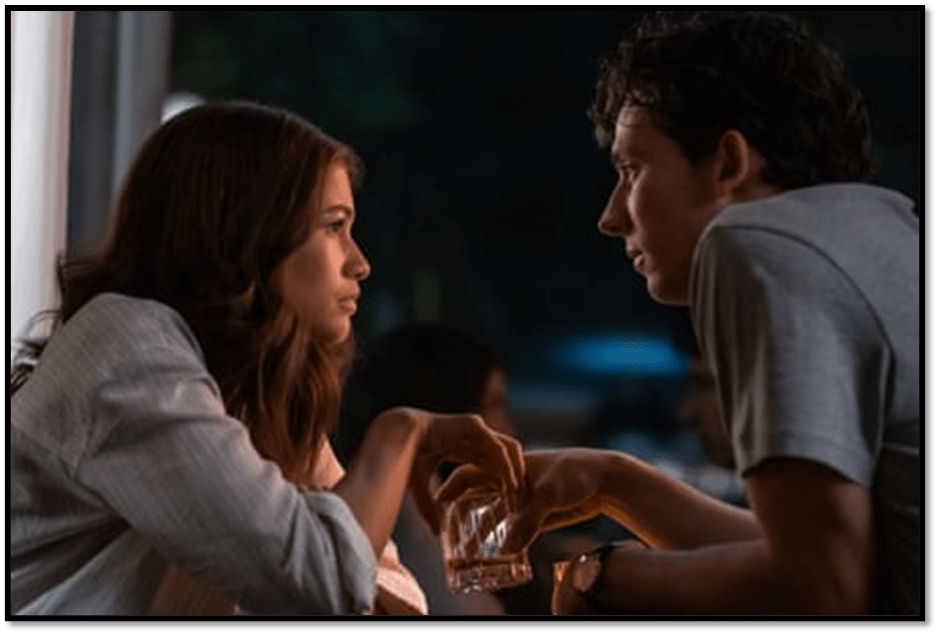
Zendaya and the ‘devilishly charming’ Josh O’Connor. Photograph: 2024 Metro-Goldwyn-Mayer Pictures Inc
Bradshaw possibly attempts to name the imbalance in the bisexuality of the film by calling it ‘an uproarious screwball dramedy of straight sex and queer tennis: one player, incidentally, is renowned for his large penis’.[2] Now, where does the information came from about the particular player’s large penis? Does he invoke the reputation, not known to me, of the actor Josh O’Connor, the most likely bearer of this fabled penis being the player named Patrick in the film. Maybe there was something about the dialogue or what is shown visibly in the film that I missed. There is no obvious emphasis of shorts bulging in the tennis shots, but no more than such physical stances would create in anyone.
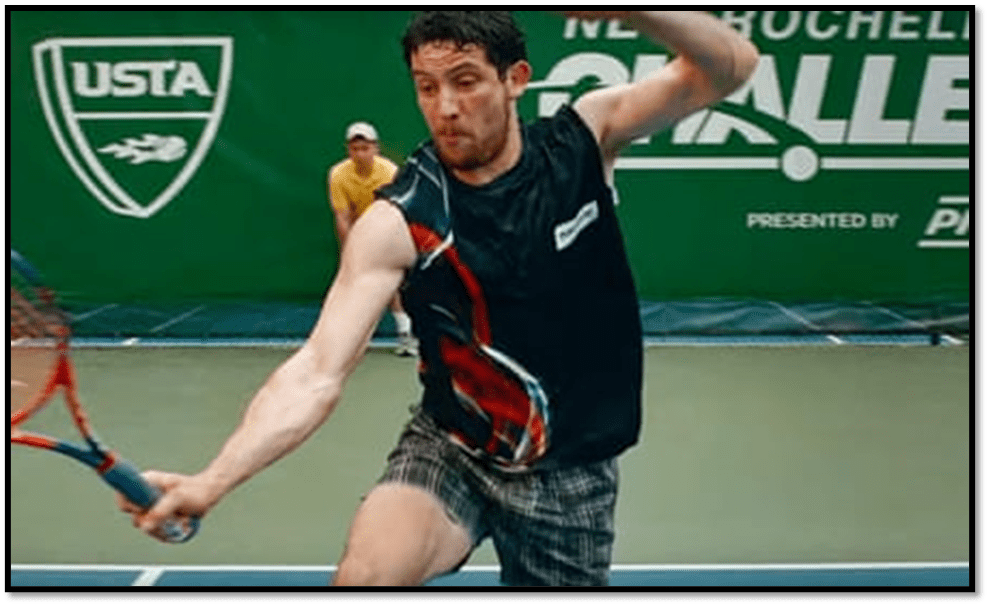
O’Connor in Challengers. Photograph: Landmark Media/Alamy
Or perhaps, in the following still, Patrick is not just commenting on the distance from the desired thst a particular tennis shot fell. Well, ya gotta laugh!
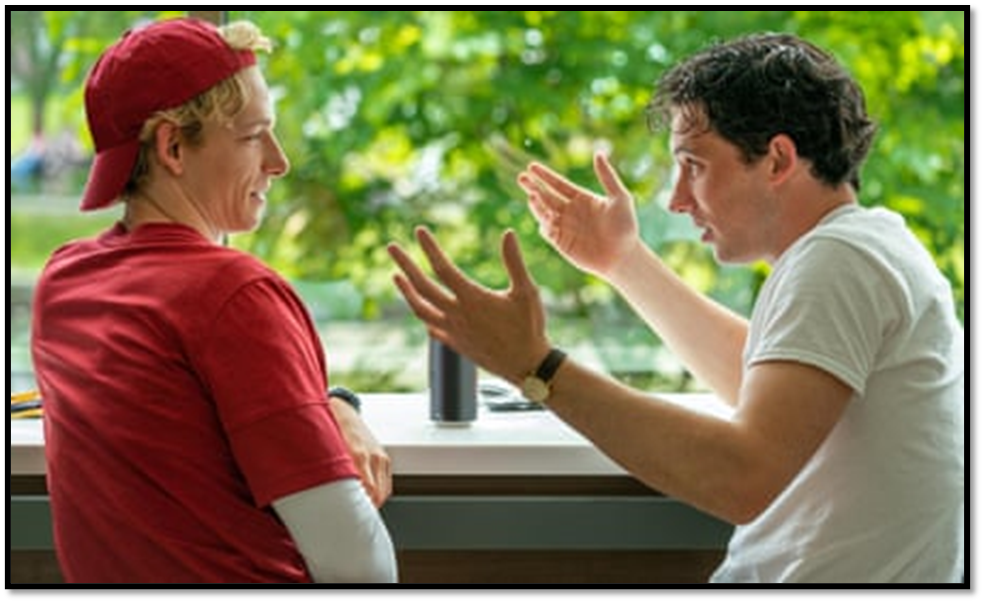
A brutal zero-sum game of winners and losers … Mike Faist and Josh O’Connor in Challengers. Photograph: Landmark Media/Alamy
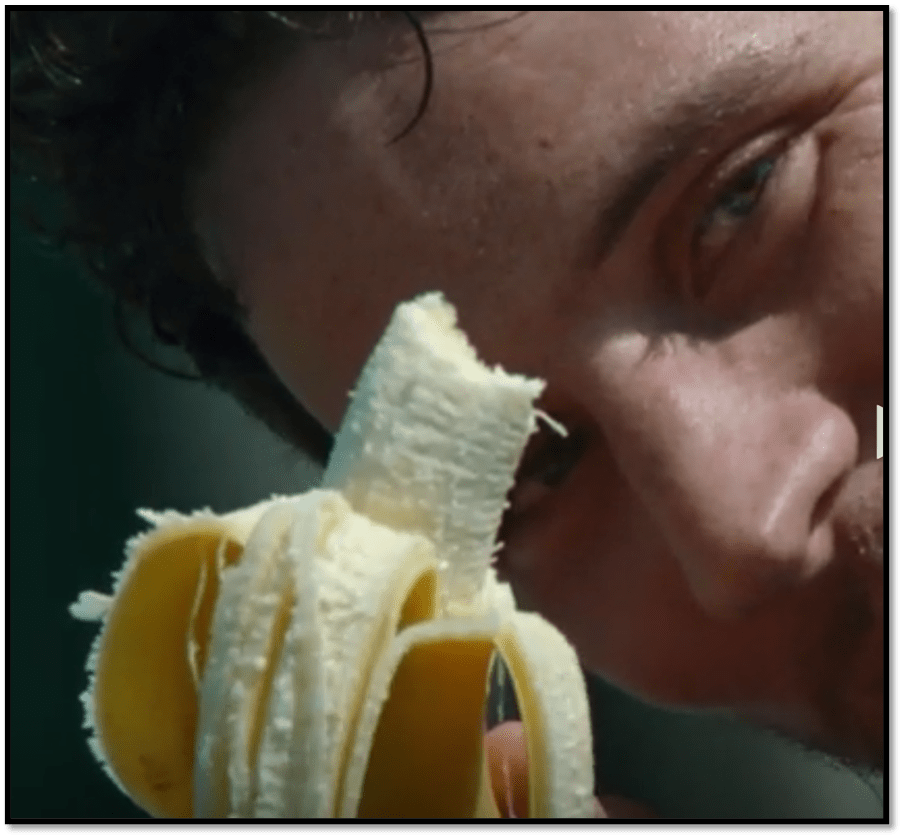
In a wonderful scene on court Patrick shows Art his bitten banana, holding it in the air, with his signature cheeky smile at its best:
There is also a scene that both intrigues and obfuscates as it displays as near as we get to the male queer sex content. Patrick joins Art, the latter played by Michael Faist, in a hot but not very steamy sauna hut, with his towel hanging loose from his shoulder rather than tied very precisely and with skill around his lower half, as is Art’s. Though the audience does not get the chance to judge the truth of the statement, Art accuses Patrick of coming in here ‘swinging his dick around’, and I suppose we are meant to infer that Patrick would only do so because he is well-endowed in that particular. Art says it twice, once in anger, when he is leaving the hut.
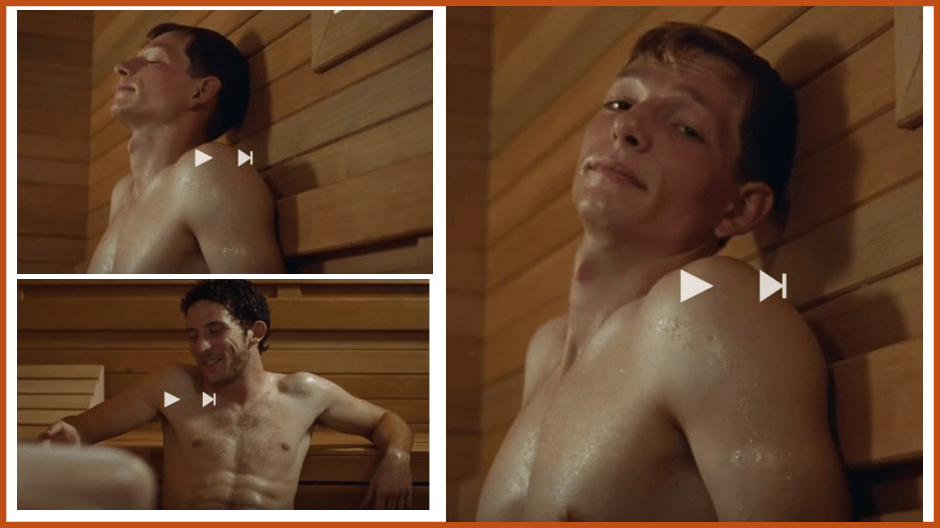
From the trailer of course.
In the sauna, the men discuss their relative rights to the sexual interest of the woman, Tashi. Both throughout like the look and sexual invite of Tashi (who wouldn’t …’, as Patrick and Art both say emphasising the heteronormative behind the film’s surface content at least more than once). But just before Art finally objects to Patrick’s presence and leaves the sauna, Patrick says his interest in talking to Art is not in the mutual sexual competition for Tashi (won formally by Art because they are married now with a fairly conveniently absent daughter looked after by Tashi’s mother) but with wanting to know what Art thinks about him.
We know that Art learned as a 12 year-old to master bate under Patrick’s tuition for the first time. They both tell that story to Tashi. The focus of each on Patrick’s showy dick in the sauna, though accompanied by angry denial of interest in Art, might, but one would never be that sure, mean not just the men talk about the bromance-like affection these old schoolfriends have for each other but whatever genital sex they might have experienced with each other thatvremaibs an untold story.
The whole set-up of the threesome-triangle is after one engineered, it seems by Tashi. In a flashback, before she arrives at their male-messy room with its shared double-bed, near thd time of their first meeting Art tries to ensure in private conversation with Patrick, that if one of them is chosen for sex with Tashi by her, the other will sit in the bathroom throughout the duration of it.
But when she enters the hastily tidied room, after her knock on the hotel door, Tashi insists that she does not want to be a ‘home breaker’ (a statement that echoes through the film in varying tenses). When the possibility of sexual choice occurs she invites both to sit at each side of her on the bed(an invitation swiftly accepted) and creates a very mouths-and-tongues sharing kiss between the three of them, after trying each man in the same way individually. Her strategy is eventually to push the lads into intent sexual kissing of each other.
Then, having achieved this, she leaves, after pushing out a challenge that she will give her cell phone number to whoever wins the tennis game that the boys will play on the morrow. Why? They ask? Because I want to see ‘some good tennis’ she says. For the BBC’s reviewer, Caryn James, this is extremely psychologically shallow play at relationships and understanding them, whither between couples or threesomes.
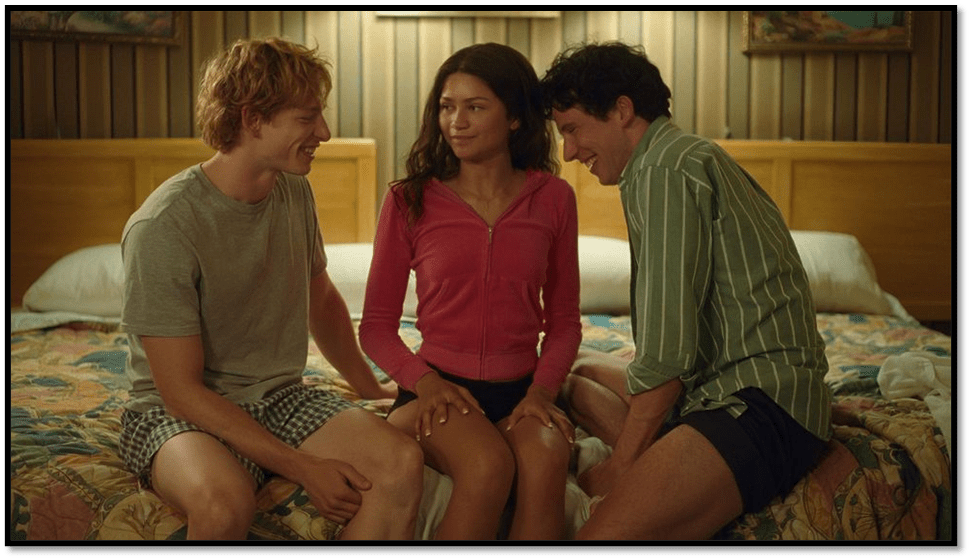
Zendaya, Josh O’Connor and Mike Faist are a love triangle in a tennis drama with “a lot of sport, a lot of wigs and a lot of sexual tension” – but not enough psychological intrigue. ((Image credit: Amazon MGM)
She says:
In one of the screenplay’s shrewdest turns, Tashi sets up a contest that would have been thoroughly toxic if one of the men had suggested it. Art and Patrick are set to play against each other the next day, and whoever wins will get her phone number, she says. It’s the kind of subversive, unexpected twist the film could have used much more of. … O’Connor told Empire magazine about the film, “The tennis is the sex”, which is a great quote, and also… no. The tennis is the tennis and the sex is the sex. They never really come together, even when Tashi starts talking about tennis when she’s beginning to have sex with Patrick in her dorm room. But there is a definite electricity between Tashi and bad-boy Patrick that she does not have with safe, good-guy Art.
…
As the years go on there is betrayal and subterfuge all around, in scenes that surface here and there almost glancingly. More of the psychological intrigue would have helped. And the liveliness of the early scenes dissipates. By the end, Art is a depressed noodle. Zendaya spends the final stretch looking stern, although she does play the last tricky scenes very well, as we are led to question what Tashi’s motives are when she makes another audacious move.[3]
This is a tough take on the film and not altogether fair. It is certainly not true that: ‘The tennis is the tennis and the sex is the sex’. If that were so, the final scene would be meaningless. That scene is the best in the film. The film entrains its viewer, for instance, throughout to be aware of how watching live tennis causes its viewers that are present on the courtside to shift their head from side-to-side to see the play at each end of the court. One reason, it is so insistent on doing that is to make us notice that Tashi alone amongst the tennis court audience stops doing this kind of watching of both men at play, often focusing her gaze syraight aheadbof her on the central net.
This trait of the actorly gaze makes the return of her shared and interested gaze on both men in the final tennis scene, her head bouncing back and forth with the rest of the audience and the ball one after the other) extremely meaningful. It complements the lead up to Art’s leap over the net into a manly embrace of Patrick, and almost a kiss, at the end of the ‘tie-break’ in a draw (though this is not how tennis works really as Peter Bradshaw tells us). The point being, I think that Tashi is only really happily sexually about either man in an enduring manner, if she can have both simultaneously whilst they have her and each other simultaneously.
There are two issues here. First the translation of sex, especially male-on-male sex into competitive tennis, and secondly the unanswered question of what happens in the film after Tashi leaves the guy’s double room, given that both have had their taboo on touching each other most convincingly removed by Tashi. These two issues are, however, conjoint. This film will never show us what, if anything, happens on that double bed after Tashi leaves, though it is clear that there must be a history that explains the sauna discussion about Patrick’s flaunted dick that explains their knowledge of each other beyond the sexual competition for Tashi. James correctly says of the film that ‘teasing sexuality is an anomaly, not the norm’ in it.
That is what I mean by the sex in the film staying in the eyes and ideas of an audience rather than being embodied, although the latter is less true of Patrick’s sexual engagements with Tashi whilst she is married to Art. Instead it will show the sweat dropping onto a camera lens in the scene of the morrow’s game. Moreover, I think the film is at its strongest when it critiques, as I think it does, all three of its protagonist, but especially Tashi, for being unable to make any relationship (sexual, romantic or of social contract like marriage) witgout it also being about tennis. This is what causes her split from Patrick (because he won the game he became her boyfriend) before she marries Art, and is the basis too of her planned divorce from Art, where the fate of the forgettable daughter is not mentioned, because he announces his retirement from tennis.
There is no deep psychology here, as James says, though there is a bit of ‘game theory’ focused on tennis. Her judgement is more correct than Bradshaw and Ide when she says of the last scene: ‘For a few enlivening seconds, there is a glimpse of a bolder, better version of Challengers lurking behind the competent, uninspired film we have’. It is a technically brilliant film though rather than just competent.
That being true, however, Bradshaw overeggs the case for the film’s brilliance, since convincing tennis can not substitute for convincing story as it seems to do, in his last sentence:
Moment by moment, line by line and scene by scene, Challengers delivers sexiness and laughs, intrigue and resentment, and Guadagnino’s signature is there in the intensity, the closeups and the music stabs.[4]
Ide is even more alarmingly convinced by the sex, and the tennis analogy, but rather gives away that that she shares the excitement of a female intellect in Tashi, rather than passion, running the show, making the men into puppets. She cites Tashi’s line at a party as central:
“Tennis is a relationship.” A piano motif – uneasy, excitable, off-balance – leaves us with no doubt about what kind of relationship she means. A smouldering hotel room scene, … / Music is a potent force throughout. When the blood is up, on the tennis court or elsewhere, prowling, pulse-racing techno thunders on the score (by Trent Reznor and Atticus Ross), an instantly thrilling jolt of adrenaline. It’s an assertive, almost aggressive musical decision, but then perhaps the film-making choices need to be big and bold, if only to match the oversized egos of the ultra-competitive and manipulative central characters. … The sex is like tennis: fierce, combative bouts in which there will always be a winner and a loser. And the tennis, ultimately, is like sex: an ecstatic consummation between two perfectly matched people at their glistening physical peak.[5]
D.H. Lawrence used to accuse his rivals as artists, especially in the Bloomsbury Group, of exploring sex ‘in the head’ rather than the body. In the same way, Ide and Luca Guadagnino have a Bloomsbury feel about them, too. The gaze and the idea that the body itself is a visible idea is very dominant in this film, even by virtue of bodies sweating onto a lens. That is particularly so in the depiction of the male sexual interest in another male in this film. Indeed this interest is almost burnt out of the film except as a hint in the background, and possibly one that lives most in the character of Tashi, with her obsessions about gaming and winning, that modify only when two men become one in her, and the film audience’s, mind.
I think this film one of the most brilliant technical achievements I have seen but as a story – it sucks!
With love
Steven xxxxxxxx
[1] Wendy Ide (2024) ‘Challengers review – Zendaya holds court in absurdly sexy three-way tennis romance’ in The Observer (Sun 28 Apr 2024 08.00 BST) Available at: https://www.theguardian.com/film/2024/apr/28/challengers-review-luca-guadagnino-zendaya-mike-faist-josh-o-connor
[2] Peter Bradshaw (2024) ‘Challengers review – Zendaya aces uproariously sexy tennis-set love triangle’ in The Guardian (Fri 12 Apr 2024 17.00 BST) Available at: https://www.theguardian.com/film/2024/apr/12/challengers-review-luca-guadagnino-zendaya
[3] Caryn James (2024) ‘Challengers review: ‘A lot of sport, a lot of wigs and a lot of sexual tension’ in Luca Guadagnino’s menage à tennis’ in BBC Culture Online [12th April 2024] Available at: https://www.bbc.co.uk/culture/article/20240412-challengers-review-a-lot-of-sport-a-lot-of-wigs-and-a-lot-of-sexual-tension-in-luca-guadagninos-menage-tennis
[4] Bradshaw, op. cit.
[5] Ide, op.cit.
 Steve_Bamlett_blog