Can horror-genre films really ever ‘say some serious things about mental illness’? This blog uses as a test case, the cult horror film ‘Daniel Isn’t Real’.
Can horror-genre films really ever ‘say some serious things about mental illness’? This blog uses as a test case, the cult horror film Daniel Isn’t Real (directed by Adam Egypt Mortimer 2019 and written by Mortimer & Brian DeLeeuw, using Brian’s original story from the novel In This Way I was Saved. It is in two parts.
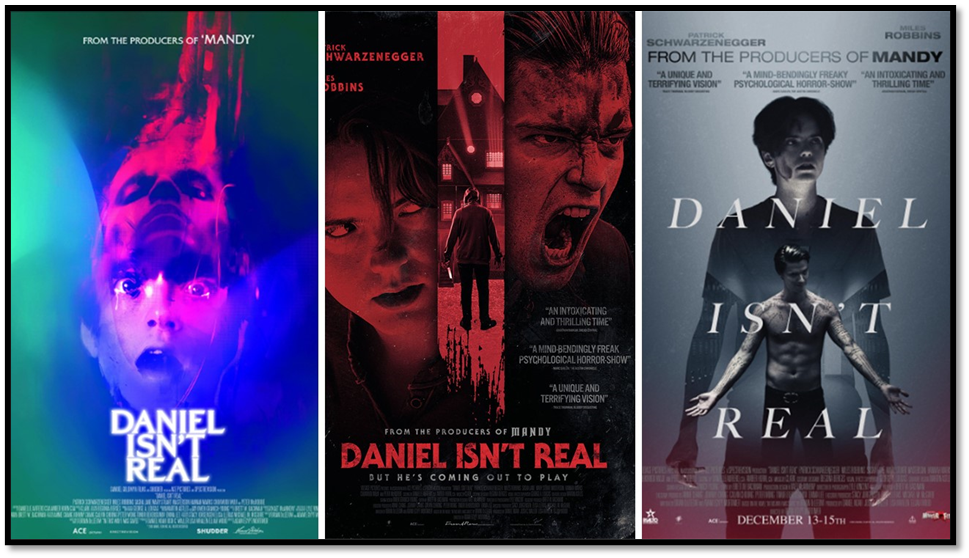
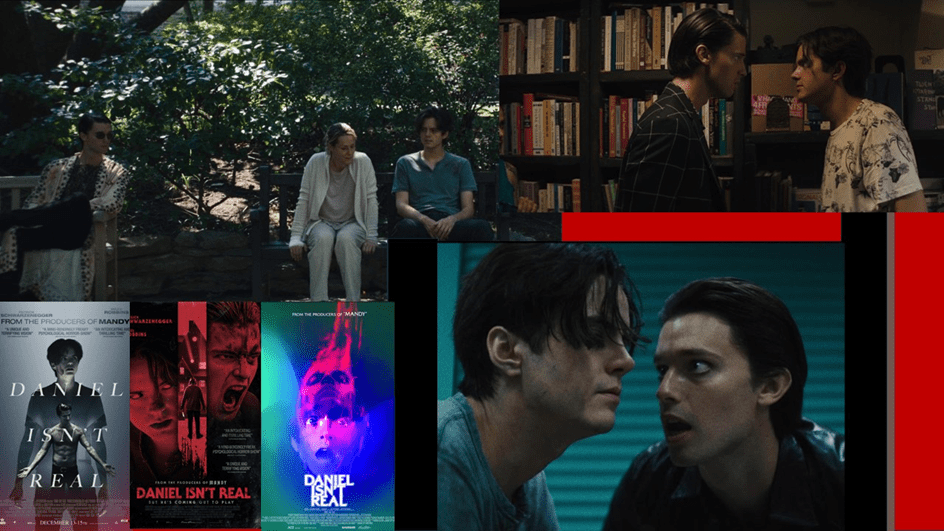
Three posters for ‘Daniel Isn’t Real’. Whilst a case can be made for considering the first and third as semi-serious about schizophrenia (although they still confute it with the popular myth that schizophrenia is a condition of ‘split-personality (which it is not)), the second one invokes tropes from popular ‘scary movies’ including the crass title ‘But He’s Coming Out to Play’ under a picture of a man on the street with a knife and blood-red colouring against a black background. The third rather overstates the content of the film in which men are seen as a sex-object.
This blog is in 2 parts:
Film or Therapy?
Daniel’s big Ego and the liberation of relations of possession and ownership through Gothic Art’s insistence on free spatial relations: the possible meaning of Freud’s: “Wo Es war, soll Ich werden” (“Where It was, there I shall be”).[1]
ONE: Film or Therapy?
In reviewing Daniel Isn’t Real for The Guardian in 2020, Cath Clarke, in a very mixed review, says:
You get the sense that Mortimer and his co-writer Brian DeLeeuw, adapting his own novel, would like to say, perhaps even to suggest some semi-serious things about mental illness (and perhaps even about the incel community). But the film lost me at the point when Mortimer unleashed a hell-fury of special effects as Daniel literally gets under Luke’s skin.[2]
It is clear, even here, but certainly in the rest of the review, that Clarke believes that a major deficiency of the film is this pretension in the film that it has things to stay about mental illness, whilst employing every horror-movie trope and special effect that renders mental illness in a sensationalised, and very negative fashion, and increases the effect of common myths about mental illness and the mentally ill. And if my inference of her attitude is correct, I agree. Myths about mental illness play a part in popular thinking (which doesn’t mean professionals are free of them in my experience of many colleagues when I worked in that domain of health and social care work). This is particularly so when the mental illness label dealt with is schizophrenia, a highly contested diagnosis, still confused with a popular notion of the split personality. That latter idea is not justified by the serious psychiatric literature nor etymology (schizophrenia does deprive from Greek words that indicate ‘split mind’ but this term does not signify dual personality, for which other diagnostic categories exist that are equally problematic). Yet in Daniel Isn’t Real, dual personality is the indicator to the film’s use of the term schizophrenia, as we shall see.
In my own career, which has involved work with people labelled with ‘severe and enduring mental illnesses’, people with specific labels like schizophrenia, though in truth what I will say equally applies to the catch all term ‘psychosis’ preferred in the Outreach team I worked within, usually found the myths and the misunderstandings that stem from such mythologised ideas obstacles to a fulfilled life. This is particularly so of the view that schizophrenia is linked per se to violent and dangerous, and, uncontrolled and uncontrollable personality shifts. Though there are risks involved, the largest part of them is to the person with the schizophrenia in work in this area, sometimes from the effects of stigma and ignorance based on knowledge absorbed from horror genre films into the popular consciousness.
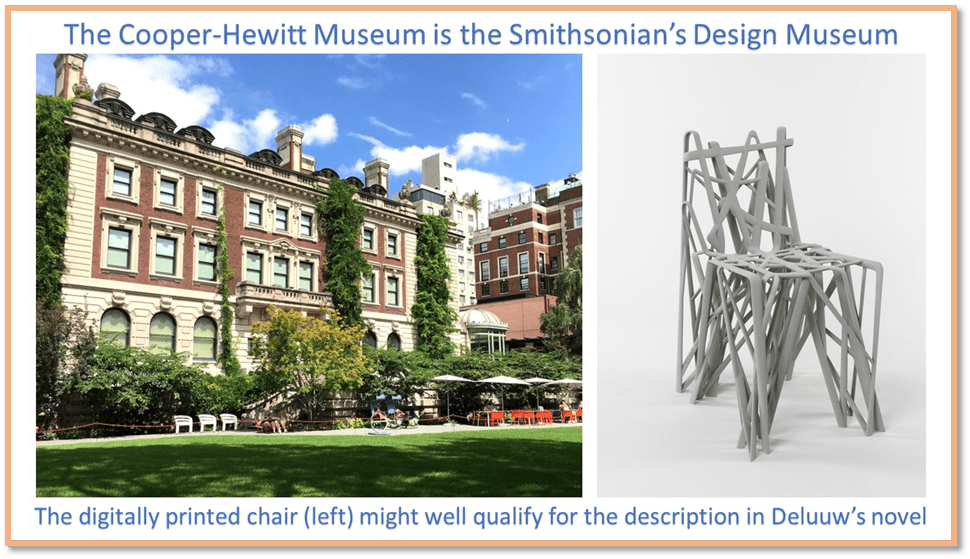
That this applies to film is an important point – I searched in vain for the term ‘schizophrenia’ in the germ novel for Mortimer’s film (even double testing with the Kindle digital search), Brian DeLeeuw’s In This Way I was Saved. Trying for ‘schizophrenic’ yielded one find. In that Daniel narrates (for he is the storyteller in the novel) that Luke and he were walking past the Smithsonian’s design museum. ‘the Cooper-Hewitt and its schizophrenic’s lawn of modernist furniture’ and then walking on. However, this is not, I think a highly significant use except in characterising modern lawn furniture design.[3] This is far from the case in the film.
After all, the most damaging of the myths of mental illness, not least damaging to the people who experience them, is that people with mental illness per se (and regardless of other factors like social neglect) are a serious risk to others. That Daniel Isn’t Real has a number of plotlines predisposed to that myth is fairly clear. Major examples of such myths are that there is ALWAYS and by necessity danger to the child of a mentally ill mother and similarly ALWAYS danger to the partners of mentally ill adults or young people, or even to professionals who work with them. Yet all three of these are plotlines are represented in the film. Luke and others are represented as posing a risk to the life of many people in precisely in this misleading way – his mother, Claire, being a case in point, for her failures with his care are clearly shown if also accounted for by her illness. Luke is a threat to his mother too, when, for instance, in his early childhood, he tries to poison her, under deceptive advice from his alter-ego or ‘imaginary friend’, Daniel, that he is providing her with a beneficial aid to her health and career. Again, Luke, via Daniel, who by this point is capable of entering into Luke’s own body to take it over or physically merge with him, is a threat to all the women he may become attached to. He even murders his psychiatrist Dr. Braun, who is a mine of misinformation about the condition of schizophrenia on the whole and who dies by virtue of a ritual knife he introduces into the ‘curative’ therapy he finally resorts to from Tibetan folklore.
Moreover Luke, a bookish and intelligent young man with hidden creative flair and an ability to learn rapidly, is actually seen reading a book to help with his ‘schizophrenia’, once he has accepted the diagnosis. The title is Living In Schizophrenia (presumably to distinguish it from the plethora of real self-help books with a title using a different, and more easily meaningful, preposition, Living With Schizophrenia ). My search on Amazon and Abebooks has found no example of the first title, if the second is ‘legion’. Given the nature of the film’s claims, this attempt to authorise and normalise the ideas in it by locating the knowledge in a library book (read in an august college library and hence a symbol of institutional authority), seems particularly dangerous and cruel.
Moreover, the ‘diagnosis’ is further authorised by being many of the classic aetiological factors spoken of in psychiatry, or at least popular versions thereof. A significant character in the film is John Ingpen (played by Daniel Marconi), whose massacre of innocents in a high street coffee-bar opens the film. Ingpen himself, also labelled schizophrenic, is, according to Katie Rife, a model of what Luke may become: another entitled white boy shut off from sexual experience (an ‘incel’ – the modern term for a ‘involuntary celibate’ Cath Clarke calls him) since she says with apparent authority uncited: ‘Mass shooters are overwhelmingly white men like Luke will someday grow up to be’ with a ‘toxic brew of entitlement and rage that will ale Luke’s life a nightmare later on’.[4]
This apart, Ingpen’s shocking killings are seen as in part the cause of Luke’s ‘illness’. Luke sees, apparently without emotion, the bloodied corpses of Ingpen’s high street massacre, hanging out from the door of a diner behind police incident tape. Yet when he sees this Daniel is observing it too by his side very early in the film and hence his illness has other causation too. As an aetiological or causative factor, this trauma joins many others supposed as traumatic; the others being his observation of the breakdown of his parent’ marriage, his isolation, his own mother’s episodes of self-and-home destructive ‘madness’ and an otherwise unexplained but possibly congenital heritable schizophrenia from her. There is too many of these stock-in-trade explanations to be an accident and again they lend authority to the ‘diagnosis’ as it is represented in the film’s play with dual personality.
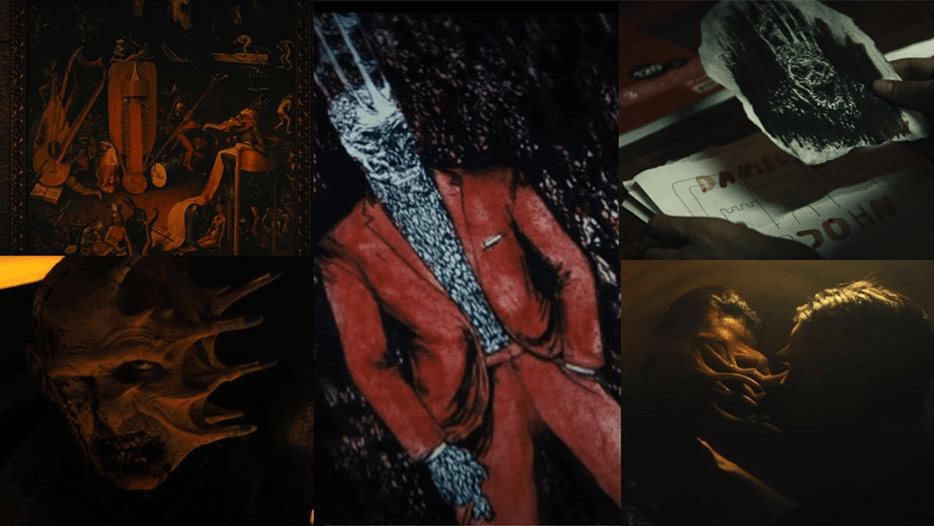
Moreover, as Cath Clark says there is a filmic cop-out near mid-way through the film: where the representation of schizophrenia also employs horror tropes, including deceptive appearances based on Daniel’s ability, though but imaginary, to disguise himself as Luke, and entering into him. Not only are these filmic visual horrors a means of de-realising the psychobabble that precedes them, the screenwriters change the novel to give Daniel a spiritual history prior to Daniel, not only in the terrorist-like and military-style murders of John Ingpen, but in a supposed backstory of historical wandering, like Mephistopheles in Goethe. Daniel, when asked: “What are you?’, replies that he is “Just a traveller, searching for a home”. His progenitors appear to have family relationship to horror-trope of films about demonic possession, like Poltergeist for instance, as we can see in the collaged examples below, with the same devil like appearance in the monstrous true shape of Daniel, a shape in which even John Ingpen returns to Luke near the end of the endgame. Moreover, hen visiting Ingpen’s father, Percy (Peter McRobbie), Luke finds John’s drawings of his own ‘imaginary friend’: sleek, well-dressed and a sexy-looking man about town like Luke’s Daniel were it not for his horrific demon-like visage (and also named ‘DANIEL’ in John’s notebook – see the still in the collage). In the novel ‘Daniel’ accepts that as his name because Luke gives it to him on their first playground meeting: ‘Daniel? It was true, that was my name. That was how things were at first: Luke said it and that made it so’.[5]
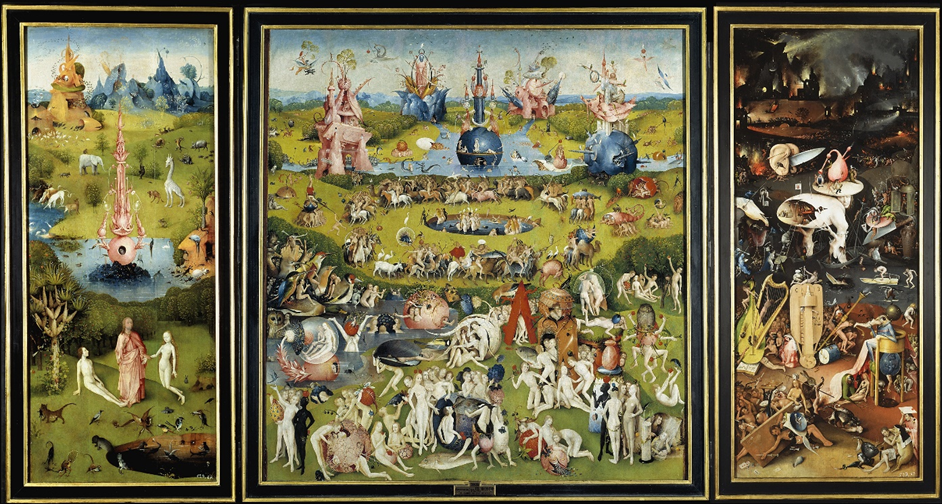
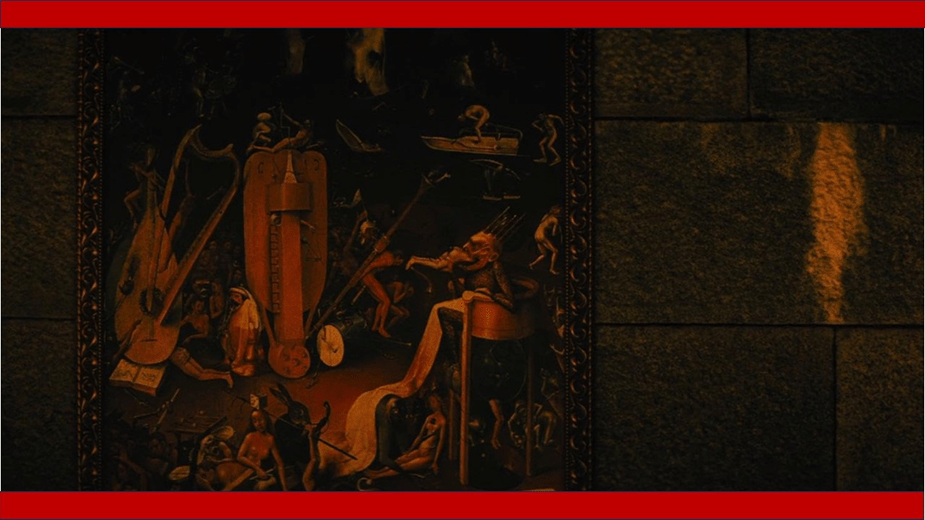
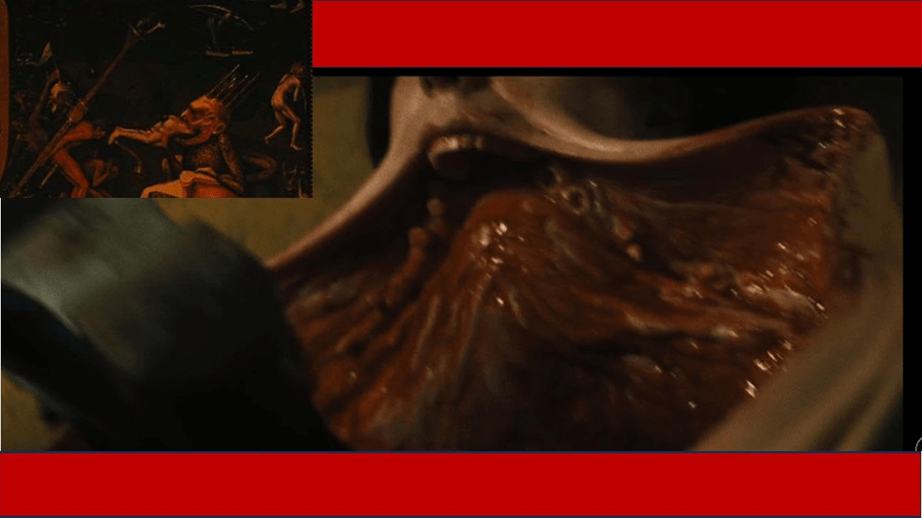
The collage of details of moments from the film above is made up partly of drawings given to Luke by Percy Ingpen but also shows stills in the midst of dynamic exchanges of flesh in a monstrous but fluid way between the two young men, or man and demon. The mask-like face bottom left (for the viewer) is the appearance of the monster who speaks as John Ingpen later, but its type is in Ingpen’s two drawings. These drawings are labelled and here Luke discovers that Ingpen’s ‘imaginary other’ was named ‘Daniel’ too. But that collage contains a version of the right-wing panel of The Bosch triptych painting The Garden of Earthly Delights, which, as it were, links Daniel to he role of Satanic temptation to Sin, and provides models for the kind of evil he will become, once earthy delights are passed, including a scene where ingestion is seen to occur. Most commentators thereafter describe the special effects as straining to a ‘Boschian nightmare’.
Below is this right panel as it appears in the Gothic castle to which Luke is despatched, via his grandmother’s dolls-house (in which Daniel himself was incarcerated during Luke’s teenage) closely followed by one of the scene in which Daniel forces his own ingestion by Luke to become him, with its Jabba the Hut elastic mouth recalling that scene in Bosch.
It follows then, as I end Part 1 that I feel with Clarke that Mortimer is irresponsible, though no more than the genre he writes in, about the representation of mental illness and that it might be better if that were recognised widely. This does not mean however, that Gothic fantasy has nothing to say about the psychology of fear and desire. Hence, part two follows below.
TWO: Daniel’s big Ego and the liberation of relations of possession and ownership through Gothic Art’s insistence on free spatial relations: the possible meaning of Freud’s: “Wo Es war, soll Ich werden” (“Where It was, there I shall be”).
Daniel starts off this film as a boy like Luke, and we will return to this. However, even on his return into Luke’s life in young adult form and body, he is a kind of recognisably human type – sociopathic, misogynistic, predatory and narcissistic with a toxic version of human masculinity. Katie Rife quotes Mortimer himself in asserting that the film shows:
The confusion and fear felt by boys faced with cultural messaging about the violent extremes of manhood. He calls it, “a film about men for women,” an outstretched hand across a deep pit.[6]
I think I take this idea seriously though whether this film is really an example, even as Mortimer says it, of men excusing themselves for a patriarchal entitlement they cannot handle remains an open question. Few women, I think, will be convinced of aught else and I think rightly. Moreover, as with Gothic genres generally, there is a sense in which the obsession with powerful men whom norms cannot explicate fully isn’t always, at least in part a queer male film. It certainly speaks to me thus, in its bifurcation of strength and weakness and the terrible accusation raised against the latter by Daniel, to Dr. Braun for instance, before Daniel/Luke kills him.
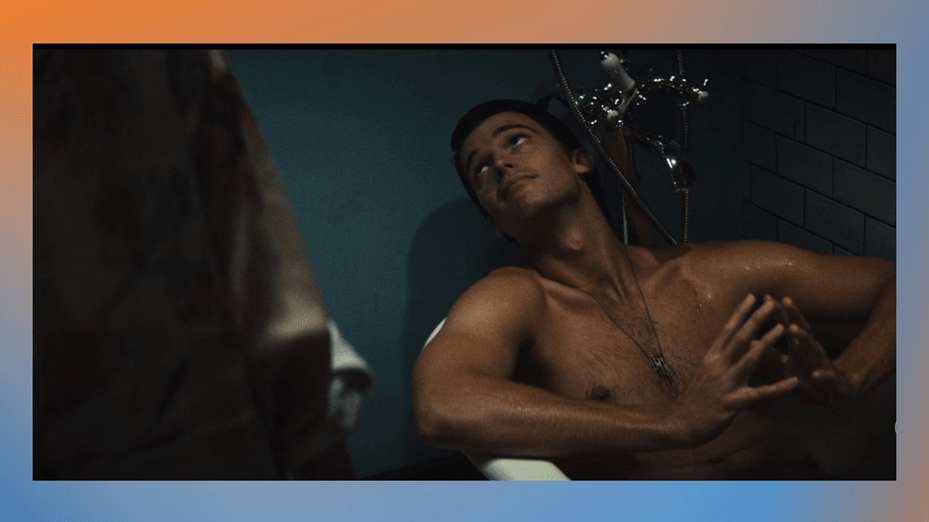
Daniel is certainly a doppelgänger, and doppelgängers often play the role in male fiction about male sexuality and criminal violence (in Stevenson’s 1886 Strange Case of Dr Jekyll and Mr Hyde for instance). But even without feminist (or queer) theory, Daniel is a recognisable human type, somewhat short of being typed as mentally ill himself. Rife even shows that his energy is presented as an attractive asset and as very like current models of the successful business entrepreneur (Donald Trump when young and doubly narcissistic): “because he lives in a society that rewards well-dressed men with crocodile grins – after all, an estimated one in five CEOs are sociopaths – Daniel is actually an asset at first’.[7] Daniel, in the form of actor Patrick Schwarzenegger – doing duty for his Dad, Arnold’s reputation – is sexually attractive across sex/gender binaries, and hence displayed best semi-naked, apparently for Luke’s benefit. The point that being naked is for Luke’s benefit, though, is never laboured – it is just part of the logic that only Luke can see Daniel.
It first happens when Daniel uses his naked body as a living crib in an examination sat by Luke dealing with hugely complex looking equations, the answers to which Daniel has inscribed on his body, pointing to each separate answer as needed. One can just about get away here with the explanation that only on a naked torso could we read exam answers written in black pen. Daniel turns Luke into an exam cheat, but with the panache of a prankster that the audience is meant to enjoy, even in the admiration of Patrick Schwarzenegger’s well-toned and muscular torso as Daniel. The cheeky smile may be playful but it is also a come-on for the only one to be able to see it, Luke, and maybe for an audience equally open to such invitation, whether female or male but probably young.
Likewise, but with less excuse for nudity for imaginary and disembodied people rarely need to bathe, when Luke breaks into the bathroom to rescue his mother from self-harm, unbeknownst to her, Daniel is espied in the bath again semi-naked but for convenient bath foam, but again with allure and self-consciousness of his own attractive quality.
These shots make me think Clark’s summary unfair to the film’s possible subtleties. She says: ‘Is Luke suffering from delusions, a raging id or has he actually got an imaginary frenemy?’. But surely there is more to the relationship between the boys and the men and more than can be indicated or represented by simple binaries like real or fantasy, internal or external threat, or the desiring bonds of friendship against the repulsive ones of hate. These apparent extremes continually get confused. It works, when it does, as a film because it dramatises those relationships where attraction and repulsion combine and become almost one but never fully. But the attraction posed by Daniel is really, and is what he provokes in all encounters, though with some nuance of a more generous playfulness of spirit I will investigate later, is to the display of male POWER. Luke finds a girlfriend, Cassie, though only it has been made clear by Daniel that she would have been his second choice after the more conventionally attractive Sophie, to whom Daniel guides him at a college fraternity party.
We will have to look at Cassie more in terms of the theme of art and play in the film, but here note that she and Luke have entered illegally, and at night, a bookshop (one of the many book repositories in the film) she worked for three years ago and for which she still has a key for the unchanged locks. Cassie extracts from the shelves Maurice Sendak’s Where the Wild Things Are, another adventure of a boy growing up into adult manhood and attempting to exert power over his mother. Since Daniel is behind Cassie, he can see the book’s text and urges Luke on in a game where Luke shows a word-perfect memory of that text apparently and to Cassie’s expressed admiration, but is in fact only repeating the words after Daniel speaks them. The same happens again but a final book is the Bible and Luke is challenging to cite verse and chapter from Exodus, one of the many passages in which Yahweh asserts verbally his enormous power and desire to be the only loved object of Israel, but most usually its men.
Daniel reads out the correct section but Luke demurs to Daniel’s chagrin, his voice rising to a crescendo as he demands exclusive love, as it seems and as he becomes more perturbed to Luke’s resistance to him, from Luke, when he mouths, as if his own, Yahweh’s insistence that this man have NO OTHER GOD BEFORE ME. Instead Luke repeats a limerick about a ‘man from Nantucket’ with a cock so big he could ‘suck it’. It is clear by now that Daniel’s attraction, but also the reason he rightly repels is his insistence on possessive POWER over another, but here in a game that is sexualised. If you have read the book it recalls Luke’s first girlfriend whom he literally forces, manipulating her head as he does so, to fellate him, whilst Daniel looks on so sorely jealous that Luke gets use of this body not he. It is a passage fully homoerotic whilst played out in heterosexual game-play, of a rapist’s kind of what is called ‘play’ here, of course.
Games of sex and power are continually represented in the film, but most when Daniel takes Luke’s body after the murder of Braun. He opens Luke’s shoulder bag and throws out everything he value – his ART which we will look at more closely later – and the implement of his art, his camera, flinging it over his head. It is the moment where the power game is at its apex. Luke has taken on entirely the POWER men assume by appearance of the body (looks), relative wealth and an attitude to others that diminishes them and their interests as without value – as so much rubbish. Sex is power with Sophie, though even she rejects the brutal male competition that leads Daniel to beat up to near death, Luke’s college roommate earlier. Now the game is played on Cassie. But jealous power-hunger has appeared even earlier in the film.
It is clear in the mother – son relationship where his mother, Claire (Mary Stuart Masterson – a tremendous performance), loses all authority (and power) on her divorce, even, as it seems her son begins to reject it to, which hate mixing with love. Daniel is part of this too, becoming able to fill multiple roles: slightly bigger than Luke he is a father / adviser ‘ older brother, replacing the lost father and caring in a way that challenges his mother’s role. Daniel facilitates Luke to express quite directly both love and hate, attraction and fear, and, subservience and rebellion in their power relations. And he can do this now simultaneously, as in the wonderful scene where Claire nearly dies of the toxic milk-shake Luke and Daniel cook up and the child-actor, Griffin Robert Faulkner, expertly plays at the same time, guilt, pity, fear (but equally acceptance) of his mother’s death, though taught to call it ‘bad’ (so much so it leads to Daniel’s incarceration in the doll’s house).
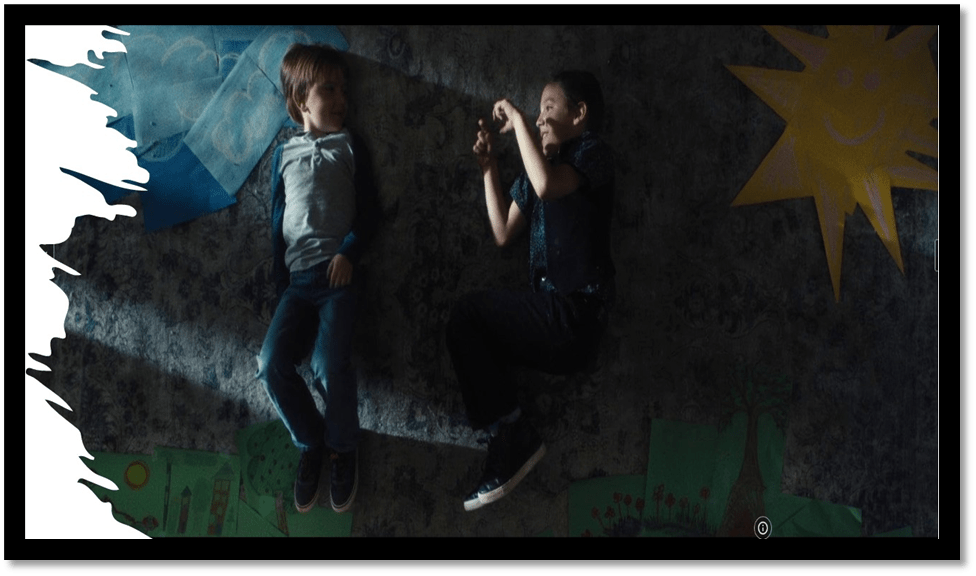
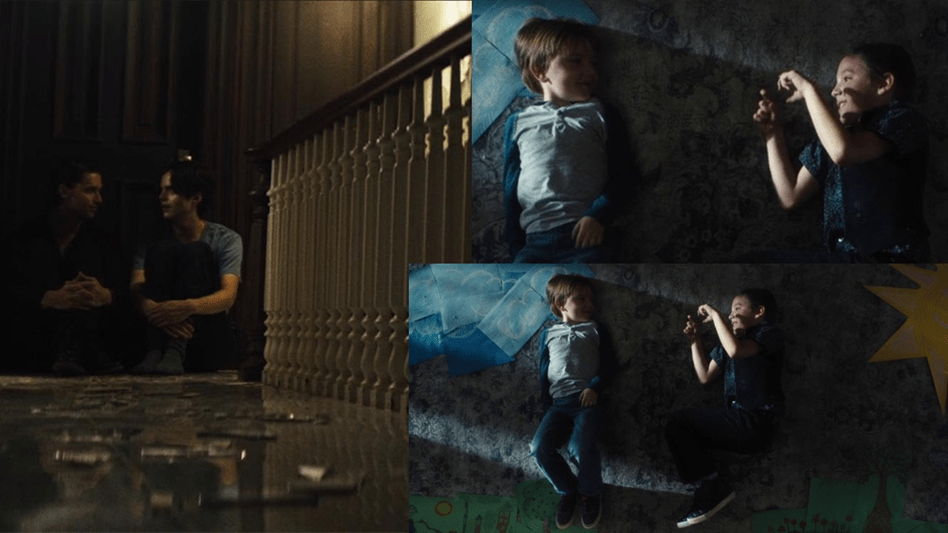
Nut power is unmistakable. Even as a child, Daniel enacts an admiring pose in relation to Luke, building his self-efficacy as a man who takes risks. He casts, for instance, Luke as a parachutist and himself as an adoring photographer, replete with framed gaze on the loved one. The two enact this lying prone on a bedroom carpet miming a jump as it would look if it were seen from above (as the film camera sees it) and with props (blue fluffy clouds near to Luke and a paper sun near Daniel. Luke jumps from an imaginary plane with Daniel whilst both writhe their young bodies on the bedroom floor, Daniel maintain his shot by scrunching his body to Luke’s lesser ‘height’.
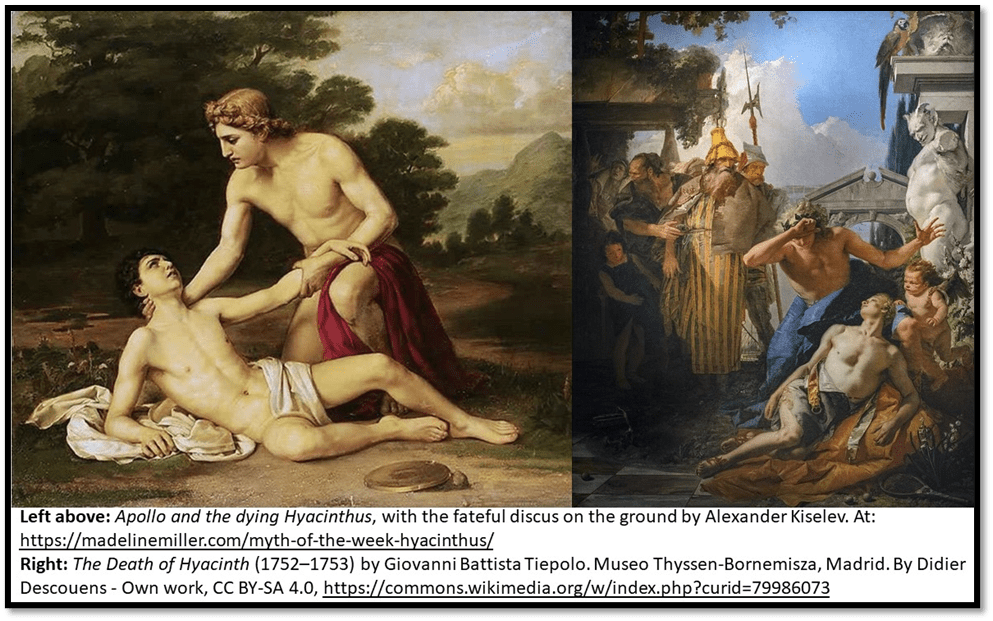
That child-like relationship forms power dependencies but also models a certain narcissistic attachment type. Daniel represents himself as the function that will always enhance Luke’s role, even his body curves in to match Luke’s back (the suggestion of anal sexual penetration even being there perhaps though not imagined as in Luke’s mind)– perhaps even suggesting a complicity of bodies, a mutual shaping of attraction but shaped by the boy nearer the cut-out son, the Apollo (nearest the cut-out Sun on the floor in its metamorphosis as sky) to Luke’s Hyacinthus, enwrapped in drawings of more flimsy clouds.
That closeness enfeebles the loved inferior, as Apollo does unwittingly (for Gods aren’t always percipient of the effect of their superior power or as narcissists one falls in love with tell me) Hyacinth in killing the thing he loves like each man does according to Oscar Wilde. Later, as adults, that child-like closeness becomes an endearing but dangerous way of expressing that Luke is weak and inferior at the same time as showing his love, caring but stifling, as each cower above shattered glass in a wondrous long shot down the landing of a stairway, in a film full of such ‘tunnel visions’ as we shall see.
It is worth noting how low the angle of vision of the young men is on that landing shot, how perilously close to the cutting ability of the shattered glass it even appears to look up to. In both shots note, it is Daniel who determines the mutual angle of vision, who suggests to him too the body posture of closure – tighter in Daniel than Luke. The relationship in a full sense is one of full and unavoidable mutual surveillance, where Luke’s gaze on Daniel exerts as much power over Luke himself as does Daniel’s constant monitoring commentary on how Luke looks and acts. The collage below shows some moments of that power visualised as an inescapable closeness, even when (as in the park shot where Claire is present) the physical distance is great. Daniel’s gaze is meant to be FELT, and, when it isn’t and Luke tries to ignore it or even contradict its commentary, it becomes assertive and, if that fails, angry.
However, the insistence on unequal power relationship would lack the nuance felt in the film about Daniel, who, at times at least s just delightful, as in the exam cheating and bathing episodes. And that is, I think because representational art is always evoked in this film and not just by the obvious references to Hieronymus Bosch spoken of above.
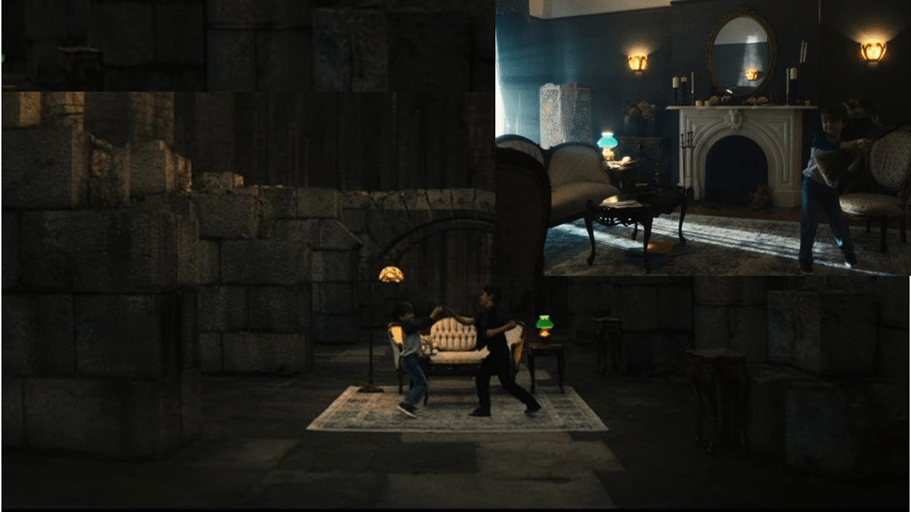
A film that starts in childhood inevitably involves play and games of all kinds are played, but play in this film often takes the form of children’s roleplay, the parachutist, for instance being one the older Daniel reminds Luke of on his return. And when they play this the create scenes and props (a sun and clouds). For play is not only about changing role into another – be it another human or OTHER as in the divine, supernatural, or monstrous, it is, as in Where The Wild Things Are about confronting fears and concerns about mortality – particularly the fear of being eaten, since eating, the child learns, is so necessary to life. But also more obviously about the nature of competition and the consequences of victory or loss, as play becomes more serious – in education (exams for instance) and work-role. For the boy and his imaginary friend the basic game is that of pretend fighting, with broom handles in lieu of swords.
In my collage above inset is the scene of play as Claire, Luke’s mother sees it – in a place, a sitting-room, spacious but not over-grandiose. The boys transfer that play to the set of a play or a film, replete with the half-ruined walls of a castle that will chime with the one in which Luke is later confined in his imagination, following Daniel’s take-over of his body. The carpet and lamps are as they are in the place they playfight but the castle is a space as large as imagination and art can make it beyond those boundaries. And here Daniel and he play with swords that look real, as they will in their last battle in the film. The space is surrounded (not visible in my detail with dark portals of access and egress – there is no limit to what this space either promises or threatens as objects of playful delight or fear, even ‘wild things’ might lurk.
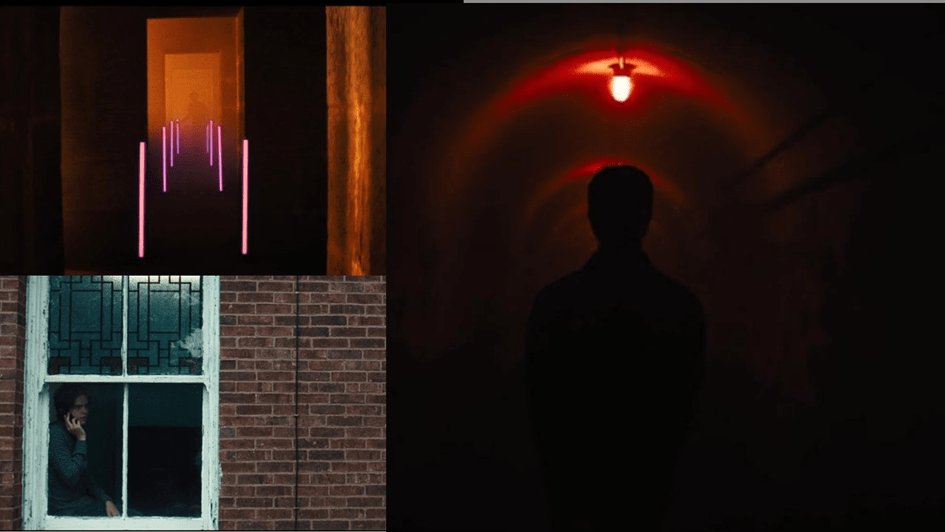
Of course space and place are not binaries, although the second contains more proximity to the imagined and its potential. One of the ways, this is played with in this film is the seeking out of spaces outside the norm and not usually considered for use, such as the large underground spaces discovered by the young students under their university and which they transform into a play venue for lovers, but almost (since the film shows no preparation of that space, magically. In one of these spaces, Sophie learns that their limits to her taking pleasure in pain (either sexually or otherwise), such as she suggests to men she might like, when Daniel (as Luke) almost kills Luke’s nerdy and openly misogynistic roommate. In that space too are what look like endlessly regressive tunnels and passages with severe and unknown marginal portals. We shall see such passages too in the Gothic castle in which Luke is later locked in. They offer a peculiar imaginative tunnel vision, in which play confronts the fear of the dark and the danger of the unknow. That they enter the film with Luke’s sexual awakening, it may be too that they suggest sexualised orifices with power to absorb, mash up or spit out – like the huge mouth Daniel makes in Luke to climb into. I have collected two ‘tunnel vision’ episodes in a collage below:
However, I have placed proximate to these open tunnels with no end, an image that also speaks up constantly through the film which is a scene of ENCLOSURE – being locked in as both Daniel and Luke are at different times locked in a doll’s house, which glows through its window frames with the red fire-light of rage and Hell. The doll’s house will and does become a castle for Luke and he learns to escape it by facing, as no-one else dare (or at least Daniel and John Ingpen daren’t), the thing variously called the Abyss or the Void, though I find neither in the original novel. The beautiful shot of Luke through a window, shows him lonely and bereft, locked in apparently and framed by mullioned windows. The pattern of enclosing rectangles in the window is repeated in the closed redbrick formations of the building around him and the verticals that further divide and bar it. We shall see that the dolls house has barred windows, even castles in the imagination have huge bricks (though sometimes ruined to form open vistas (and the door to the Abyss is bricked up and has to be unbricked).
Play, after all and even when it causes us the thrill that Gothic play does, offers more space for us than constraining reality. And strangely Daniel is a source of play that we enjoy as viewers. At various times we shall see him in the background of scenes (where Luke and Cassie destroy her enclosure-form art installation (enclosed around a flowering toilet bowl) and his arms with the pure joy of empathic energy. And this destruction is a GOOD thing, for Art is not just about construction but destruction of false starts and unnecessary marks – Titian and Frank Auerbach at different periods both glory in ‘scraping off’ paint as much as applying it, and even the latter to cover up earlier marks partially or wholly. At this joy of being ‘destroyer and preserver’ both (as Shelley calls it The Ode to The West Wind) he wheels his corky arms in the air. It is a lovely touch in the film, laughing at clearing out the dead wood of bad art.
O wild West Wind, thou breath of Autumn’s being,
Thou, from whose unseen presence the leaves dead
Are driven, like ghosts from an enchanter fleeing,
In a deleted scene (a bit of bad editing but it is on the Blue-Ray DVD) when Luke turns to photography and discovers he has skills in that art, he takes them to a dry-as-a-stick photography tutor in his college. We hear the desultory and expected brush-off of a bad teacher and worse artist as the camera lingers on Daniel in the corridor. But as we hear Luke’s returning motions, there is a prolonged scene in which Daniel dances in a Bacchic frenzy, like Shelley’s leaves, and shows the difference between the life he enjoys in Luke and the deadening results of academia. And, as for academia and art institutions and shows generally, Cassie agrees. This is why she learns to destroy s well as create and preserve in her own work and in working with Luke as a photographer. That is why Luke prefers Cassie to Daniel’s choice of Sophie, as a sex-object, or even Daniel himself. She replaces fear with creative-destructive skill and she involves him as an equal.
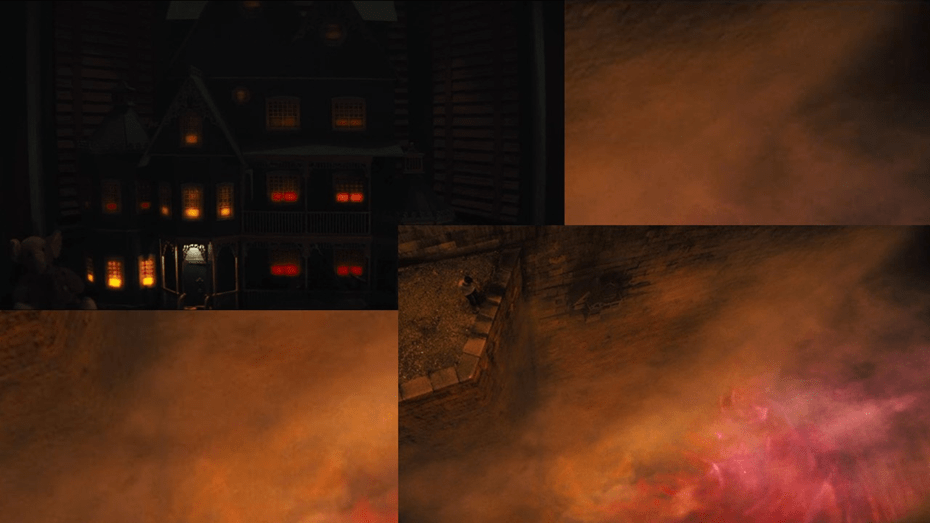
And I think we have to defend Mortimer too as a filmic artist. He knows that Gothic always plays on the cusp of real places transformed or metamorphosed by imagined. Like the boys as either parachutist and photographer or in swordfight. He takes the symbol of Claire’s restrictive and repressive mother’s dolls house in her home and transforms it in to a portal whose dimensions are fluid, where not only Daniel will fit for nearly 20 years (for he is, after all, imaginary, but Luke too, who is not. He knows that he can change its luck by dramatic illusion, even by light and dark (as again Gothic always does – and its tunnel corridors and rooms too. The following collage is experimental to make this point:
The doll’s house has mullioned windows but in this scene, the red glow behind them enlarges their imaginative being, unlike other buildings in the film (the university college for instance). It is large and its is populated. We know that by the different coloured lights at different windows. When Claire shuts it down she not only gets Luke to lock it, to lock Daniel in, but covers it with a dust sheet to keep it dark – a sheet only Luke will later remove. But when locked in it, it becomes a castle, for Luke. He knows that, in his body, Daniel is destroying evidence of his creativity and artistic flair *the throwing away as rubbish of photographs and camera) but also that his kind of replacement of power over women rather than sex as love will seek to destroy Cassie as woman and artist. Indeed Daniel is about to do this, when Luke intuits a need to break free of his Gothic enclosure. Finding a door Ingpen, in the form of a demon, tells him leads to the ‘Abyss’, with fear in his dead voice, Luke begins to unbrick it. Once through that blocked portal he finds a Gothic balcony overhanging what looks like a void that may be the ‘Abyss’ of unfathomable depth and size. His only way out is to throw himself into that Abyss. But the Abyss is a mass of beautiful colours, swirling through mist.
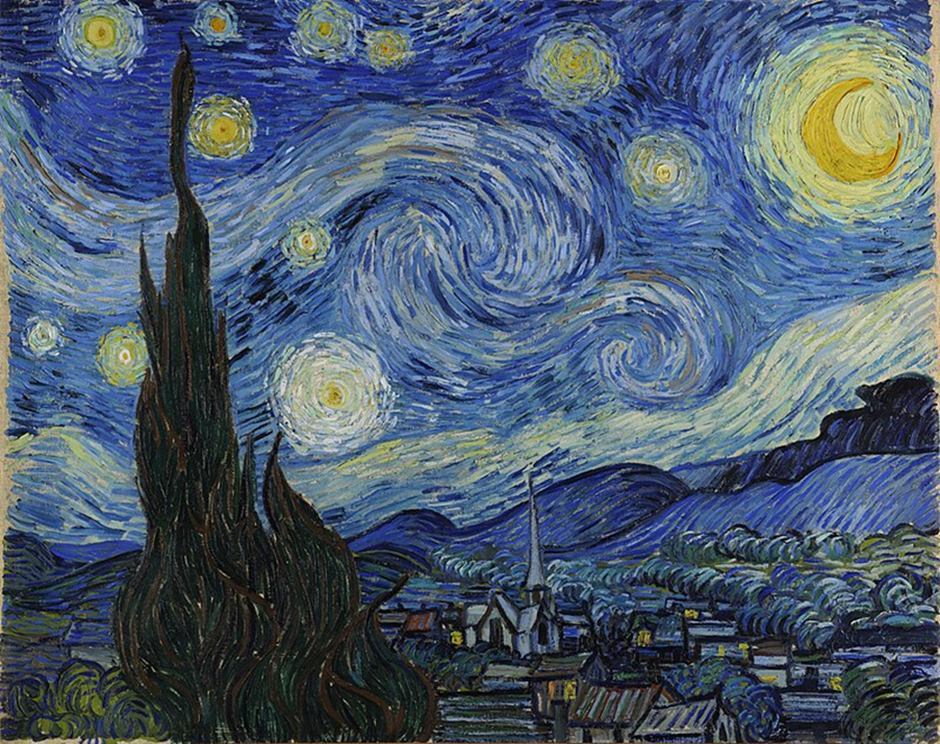
Is the Abyss then frightening – the UNKNOWN which we must not confront or is it the risk-taking Art involves and into which seasoned artists jump, like the swirls of colour in Van Gogh’s Starry Night, that is much more creative than the block squares of the homes of Saint Remy beneath it, about which I have written before (at this link if you want to follow it) – so here again:
Space is a concept related to both infinite expansion and enclosure in a boundary or frame simultaneously. In painting it suggests a flat surface in two dimensions, which sometimes thickens in mixed media like collage. But even in painting, space is not only framed by two material dimensions but also optical illusions of depth, which might be regulated (by perspectival illusions) or merely subjectively layered by colour contrasts.
A small section depicts a place in reserved space that we might think of as provincial Saint-Remy. The town is only a set of straight lines and contained shapes, but its surrounding is not that place but space itself: space that extends from the cypress in the picture plane to the mountains and beyond. For a moment, as you look at it, refuse to see the skies above the town as a projection of Van Gogh’s inner conflict and pain. Why isn’t turbulence here seen as not pain but merely unconstrained pleasurable play on two-dimensional and in the illusion of three-dimensional space, or an even more contradictory way moving the eye from its tense wish to find deep space in a flat one? To me it celebrates space. We lose the sense of spatial perspective around the town and see the play of paint on a flat surface, mocking the supposed solidity of Saint Remy and displacing it with arabesques and rococo swirl. These dynamic brushstrokes and marks increasingly lose any sense of trying to imitate reality as they swell and flow multi-directionally because somehow the illusion of seeing a space moving from front to back no longer holds. So the cypress tree dances with the sky and queries the sense of solidity that must be felt inside the houses of comfortable Saint-Remy.
The swirling colours of the Abyss into which Luke flings himself (to emerge back into the ‘real world’ through the wide round portal of a city storm drain, is I thin (for it punctuates the film of as a multi-coloured phantasmagoria indicating art itself but also the UNCONSCIOUS or ID which feed it – in my reading). Gothic is a genre that courts the UNCONSCIOUS as does great art, that praised by Freud in various places. But we are taught to fear the ID rather than face, yet. Even Freud suggests in the thin writing of the New Introductory Lectures of 1933 that we should displace the ID with the Ego, that force which speaks for the consciousness, but which exists only as a consequence of the primal repression of the ID, so that its vast space potential is ignored, ridiculed and/or feared. Feud puts it thus: Freud’s: “Wo Es war, soll Ich werden” (“Where It was, there I shall be”). But note that literal translation of the German text, which James Strachey translated as “Where ID was, there the EGO will be”. Others have pointed out that the ID seems to act as an imperial Army invading a continent it desires to convert from its heaven ways (and usually profit from it). But Freud’s terms allow more nuance, for this ‘I’ the literal meaning of ego in Latin as Ich in German is a settle not a coloniser of IT (the literal translation of Latin id and German Es, that impersonal stuff underlying our supposed civilisation and manners. It learns from where it goes – it does not just take over and impose its own norms.
This has everything to do with the difference of Luke and Daniel at the end of this film, though Luke dies – and, of course with him, Daniel, foe the I and IT need to know each other, in a wise world to stop the ego colonising and exerting power in its usual patriarchal masculine form. I see Daniel in the film as an EGO – in love with the power of its own image, locked in the primal narcissism that Freud says created it first as a useful tool, and unable to develop – as art develops one. Luke is an ‘I’ who jumps into and embraces the ID. In the film it kills him as a result, but no-one ever argues that confronting one’s demons to see their kinder nature was easy. For the viewer, things do not have to be the same. Somewhere in the film, Daniel says ‘I am the Abyss’, but that is an ego controlling and using the It’s power of frightening those who think themselves fixedly sane. He is as afraid of the Abyss as anyone non-imaginary for it would destroy his power if its playful content were released as its major characteristic. But neither authoritarian government (of nation or social institution) nor authoritarian models of self, selfishness nor narcissistic self-evaluation adore impersonal and communally owned leisure or pleasure, or Art come to that that does not serve selfish ends or the power of the status quo skewed to the interests of a FEW.
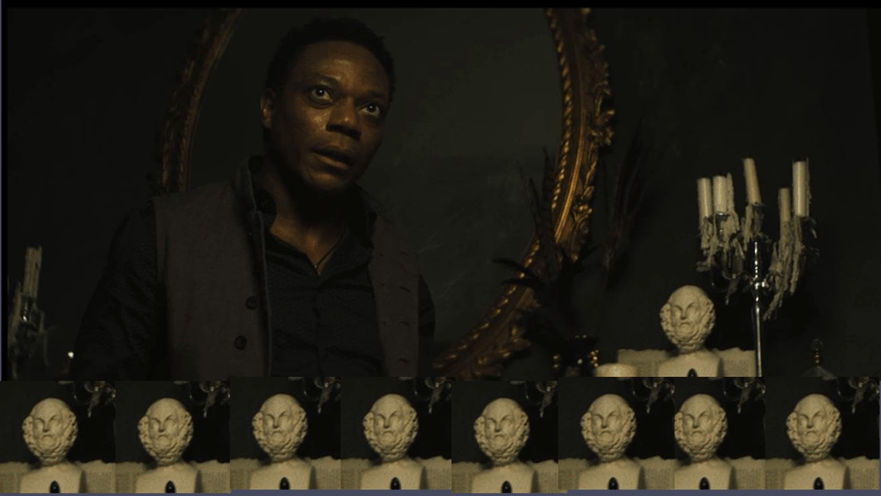
Before I end though, I would like to look back at the psychiatrist, Braun (Brown of course in German). Here is near the end of the film.
I have puzzled and puzzled over who the bust represents on the mantlepiece. I hope someone else recognises it, although from the facial hair it looks nineteenth century (and perhaps German but it is not Freud nor Wagner) and I would have loved to recognise Nietzsche but I don’t, but have given up guessing now, but I expect it is significant and hence why I decorate my collage thus. I am thrust back on the design of the still that shows not Braun directly but his refection in an oval mirror with an ornate gilded frame. Mirrors matter in this film. Claire covers them over or so greases them that she cannot be seen. Yet in a film where narcissism is important, it seem important that we see Braun in a mirror, for Braun is as full of himself, as Daniel, except Daniel uses others as his mirror to feed his ego. In this shot, Braun, though in danger seems to stop to admire himself (and he is a good-looking fella) but I think what he admires is his belief in his own skill of psychological penetration and therapeutic input. He thinks he can uses anything and it will work – even Tibetan folklore and a song bowl. No wonder Daniel laughs at him and finds him easy to gross out. He just enters Luke in front of him, forcing his mouth open.
If we compare Braun with Cassie, we shall see how her sanity is one conversant with IT as well as EGO. And, unlike Braun, she is not a stereotype character from a horror-movie as Braun is the idiot psychologist with no depth of understanding of the impersonal forces a horror-film ostensibly deals with, or even perhaps the It as a powerful force. Cassie is a great character and I agree with Cath Clarke that she is ‘is no one’s idea of a horror-movie damsel, feistily fighting back rather than running and screaming when the time comes’.[8] I rather like this film. I hope you do. Nevertheless, my reservation in the first part of this blog stands. Moreover, if I had to sacrifice art film for better universal mental health, I would, but things are not that simple, and mental health will not come without understanding mental process. And, at the moment I think artists show more interest in this than psychiatry beyond its own interests has ever done.
With love,
Steven.
[1] From Sigmund Freud New Introductory Lectures on Psycho-Analysis 1933
[3]Brian DeLeeuw (2009: 109) In This Way I Was Saved London, John Murray (this from Kindle ed.)
[4] Katie Rife (2019: 10) ‘A Method To His Madness: Schizophrenia and Psychosis in Daniel Isn’t Real’, In The Blue-Ray DVD version of the film in accompanying booklet with Cast & Crew list.
3 thoughts on “Can horror-genre films really ever ‘say some serious things about mental illness’? This blog uses as a test case, the cult horror film ‘Daniel Isn’t Real’.”



 Steve_Bamlett_blog
3 thoughts on “Can horror-genre films really ever ‘say some serious things about mental illness’? This blog uses as a test case, the cult horror film ‘Daniel Isn’t Real’.”