‘… ; she knew it was everything not to die alone, not to be taken brutally, by force. …/ … What could she give him now? She knew what he would want from her: that stillness might grow to peace. Not still: held’.[1] Only when we are held do we know that our stillness is the beginning of a way that time lives numinously on in eternity and the finite lives numinously in the infinite. This blog attempts to explain what we materialists owe to Anne Michaels (2023) Held London & Dublin, Bloomsbury Publishing.

The British and Canadian covers of ‘Held’ surround Anne Michaels: In a book as beautiful as one by Anne Michaels nothing truly dies, and that which makes us what we are never stands still amidst the motion of life around us: ’Animism tells us that the stone wants to fall, the air wants to move. We are porous, fluid, fleeting, seeking; everything alive responding to the chemistry of light’.[2]
If Anne Michaels believed death was final for a once living and moving thing, then I do not think her new book Held would still contain a place at the top of its dedications to John Berger, who died in January 2017. I say ‘living and moving’ but I suspect that the two are often comparative states – where life is reducible just to the movement of growth, however slow. That is because slowness is sometimes perceived wrongly as a stillness in an object which, though it will never will have even a potential to future motion driven by its own free will, still causes somewhere, even if in a perceiver of it, some action of a kind (even if as that developed cognate of motion we call e-motion – see the passage in linked here to get help with this idea).
Michaels’s dedication to her book to Berger is not just a matter of memorialising a great and beautiful lover of the world and hater of the sort of political exclusion that is hardened into various established power-bases but of an emotional attachment that lives on for a still relevant hero of living ideas. As I write that, I remember a reflection made by the character John in the first section of this novel, one set in 1917 in Cambrai amidst the chaos and debris of the apparently meaningless piles of the random dead of the First World War. The words will feel strange to a materialistic philosophy as reductive as that commonly in our present times because it is a call-out to the numinous, perhaps even directly to spiritual, as a kind of generalised emotional take on the world. Yet it occurs in a contextual relationship between committed left Marxist writers like Berger and a whole raft of feminist materialist philosophical poets and novelists he fostered a taste for in the UK, including Arundhati Roy in Southern India and Anne Michaels in Canada.

Photograph by Ulf Andersen from: https://www.theguardian.com/books/2017/jan/02/john-berger-art-critic-and-author-dies-aged-90
Perhaps in death, he thought, we lose the details and keep only the feeling associated with those details. Is that what the soul knows in death – the separation of feelings from memory?[3]
But this refusal of the simply objective in our descriptions of the world should not surprise us – for the left relies on notions of some absolute as the token existence of something derived from the reality of human social emotions. The very existence of love, meeting and collaboration in the common good- and in the name of communities – implies a need for a change in the nature of what we mean by the material body. That change is the material equivalence to the numinous question of the value of the less than visible and less public aspects of human life and interactions. Of course, I struggle as much as anyone else to understand and convey these ideas. Yet, it seems to me that, in order to establish their validity, left philosophers evoke science as much to talk about these issues as they do with other more material issues of the economy and politics. At this point, then, I have looked for help to determine what to say from professional critics.
In Held, the appearance of Pierre and Marie Curie in the penultimate chapter, and Marie Curie alone in the final one after the death of her husband, is the prominent marker of the novel’s respect for science and the rigour of scientific thinking, even the refusal to rule out things not explicable by science. In fact the Curies are hosting the scientist Ernest Rutherford in Paris when we first see them, the very scientist a character earlier in the novel thinks to write to in relation to unexplained phenomena in his photography practice. Lucy Hughes Hallett, an excellent critic, says useful things about the Curies in The Guardian’s review of the book.
Towards the end of Held in terms of pages, but near the beginning in terms of chronology, we find ourselves in Paris in 1908, in very distinguished company. Ernest Rutherford, pioneer of nuclear physics, is dining with Marie and Pierre Curie. It is a hot summer night. The party moves out into the garden to take coffee by the light of a new-fangled lantern – an irradiated copper tube. Talk turns to Madame Palladino, the celebrated medium. Pierre Curie, who has been unable to prove Palladino is a fraud, says: “Science must never foreclose what it does not understand.” There seems to be a correspondence between the eerie light and the equally strange idea that the dead might coexist with the living, remembering us as we remember them.
The Curies are peripheral to the main narrative, but science, hauntings and the way love complicates the linearity of time are themes that recur insistently in this episodic novel. …[4]
I don’t mind that Hallett refuses to be specific here for it is that kind of foreclosure (or enclosure in boxes of various kinds including categories) of meanings we find it difficult to understand that the book contests and why it will never appeal to some, especially those antagonistic to a fuzzy boundary between poetry and prose. These moments are conveyed in the novel by contextualising such terminology in parable-like stories where the difference between things contained (or closed) are contrasted by things lacking containment and numinously open: here in the description of an inn and the walk across open ground to it. Contrasted they may be at first gasp but the liminal is a threshold that allows apparently contradictory things to have continuities with each other.
… leaning into the darkness, she saw, some distance away, the inviting pool of light of the inn.
Later, she would imbue the short walk in the darkness towards the corona of light – the endless fields of invisible grasses rustling around her – with the qualities of a dream; the inevitably of it, the foreknowledge.
Looking into the front window, Helena saw a room enclosed in a time of its own. An inn of legend, of folklore – warmth and woodsmoke. ….[5]
There is no hope of an objective grasp here where measurement fails us – ‘some distance away’ becomes a ‘a short walk’. Light and dark, the visible and invisible, waking and dream, knowledge based on evidence and folklore, the determined nature of world of which we have foreknowledge clashes and the sense of free will Helena feel in taking actions, warmth with an ambient cold surrounding it all give meaning to each other in subjective experience and melt into each other as categories. Of this facet of the novel I will have more to say later.
There are two ways of explaining why the reader needs to take such abstractions into account. The first is a matter of the writing genre of a poet-novelist. As Anne Jolly says in The Observer.
We are asked to let go of traditional narrative structures and surrender to a looser architecture that is held together by association and recurring motifs. As one of Michaels’s characters puts it: “The elusiveness of the form is the form.” Techniques of narrative layering are employed with great skill as themes echo and return.[6]
The loose, the unbounded or fuzzily bounded, thinking based on association and contingency alone matter here more than logic used to understand categories with well-defined shape. But the second point I want to make, here using Hughes-Hallett, is a subtler one:
Held is full of lacunae – great gaps of time in which characters die or give birth or are exiled or despair. Like one of those elaborate knitting patterns, it is largely made up of holes and absences. Its stories are told in glimpses. It is for the reader to join the dots.[7]
I was, by the way, when I cited this, going to miss out the metaphor of the ‘elaborate knitting pattern’ as unworthy of the intelligence of the rest but in fact it is nearly (but significantly in class-terms not quite) the same as Michael’s metaphor for the role of folk crafts in fishing communities whose practical track on the life and death at sea of loved ones could be kept by wives inscribing data about their sea-faring husbands in the pattern (and the deliberate error it contained as a signature of the individual man and the woman who knitted it into the pattern) of their ‘gansey’.[8] The idea of the gansey as a narrative, like the composite genre of writing that is Held and its sub-threads, is a useful one, though it fails the test that makes the whole narrative more easily describable as a bricolage – an object made up of many fragments whose wholeness requires an understanding of its gaps and ‘holes’, as Hallett says above and Jolly implies. In order to fit that idea in the most fragmented part of Helena and John’s story, at the end of Part 1 of the novel, the death of a sailor ‘without a gansey the colour of the dark sea’ (ganseys were usually navy blue) is imagined with no chance of anyone recognising him therefore by using the gansey’s deliberate signature ‘error’.[9]
That idea of errors written into patterns, of holes and gaps in narratives that make them unrememberable or uninterpretable in an easy way runs, through the novel as a recurring theme. It also explicates the manner of its fragmented and sometimes partial stories. It is explained even in the use of the theme of photography related to the means by which instruments capture and still variations of light in a moment or other duration (for photography has a history in this novel too where camera exposure times varied) between 1908 (appearing in a section near the end of the novel, which actually opens in 1917) and ending in an imagined 2025. Is this complex theme, related directly to the social circumstances of its characters, there is also an explanation of gaps and lacunae as attributable to failure or errors in our machinery, even the visceral sort in brains, for recording and reproducing an event that queers our sense of time and the role of human interactions, and individual beings, in them.
“If you hold open the shutter long enough, everything moving disappears.” Or leave only a trace – a clouding of the air, a thickening of the light, the breath of absence.
She thought several things then. That a photographer’s entire life work would add up to a few minutes of time. And one could make a long exposure – say thirty years of married life, or family life in a kitchen, infants growing to adults – and all that photographic plate would show was an empty room. But it would not be empty, instead it would be full of life, invisible and real. And then she thought she would look in the mirror and see only the empty room behind her, And then: with a very, very long exposure – say perhaps eternity – perhaps we reappear.[10]
Making photographs then is a matter of the time we set our equipment to see. We can choose as it were never to expose ourselves to events at all or choose a span of exposure wherein all movement (or evidence of life) has seemed to cease and conclude on that evidence that time and space are empty of life. But, in fact that ‘empty room’ in which all motion is reduced to stillness, presence to absence, and fullness of life to empty space (a room with nothing in it) is a phenomenon caused by our choices about what to expose ourselves to in seeing it. What we see is perhaps anyway always what only the spaces on which visible things are exposed to be recorded as events. Lia in that passage follows through complex thoughts wherein she contemplates time understood in a different way and not as a thing enclosed with limitations of its space like beginnings, middles and ends. Lia thinks in that context within that passage, itself a ‘passage of time’, that, such a view of the temporal would expose us to the possibility of apprehending, and hence ‘seeing’ (for the term ‘see’ is thus ambiguous) the motion (and e-motion) that only seems to disappear and end in it as an aspect of the continuously still eternal. We are back to the numinous being rediscovered through technology as handmade to science, like the Curies’ radium bulbs. When time loses the meanings humans have attributed to it (Aristotle’s ‘beginnings, middles and ends’) in order to construct a ‘reality’ that is comprehensible to those limitations, then the invisibility of much that ought also to be considered as the meaning of life is inevitable. We lose the sense of the cyclical, the returning, the re-appearing. This novel of revenants brings them back.
Hence the last chapter set in 2025, where Anna meets her dead husband again after a presentiment that he was already there with her: ‘like something moving at the edge of the forest, not quite seen’. And then suddenly he is there with the ‘look of one who had been loved, but not in a long time’. For this indeed is NOT her husband but Aimo. And perhaps the exposure to love between human beings across eternity is what revives the lost husband in another man, though the particular man resurrected might ‘not look at all like him’. These are thoughts she captures by reminding herself of a woman ‘who fell in love with a face in an advertisement when she was fifteen’ thinking that this showed ‘how one could fall in love with a photograph as if it were the memory of someone’.[11] And, if so, then we are all alive in eternity in the ‘long fuse of memory, always alight’.[12]
The novel is what it is then, full of what Hughes-Hallett call ‘lacunae’, because it exposes short bits of the finite in time to the suggestion that we would all see ourselves differently, as exempla of an ever-changing life, full of movement; life charged with recurrent and recycling e-motion, in a timeless, because infinite or eternal, exposure. Art has always attempted this play across a liminal space. It enacts events occurring between what it calls the timely and the eternal, the finite and infinite, as aspects of conceptualisations of time/space. Indeed it was at points forced to do so by ‘spiritual’ institutions who have usurped the meaning of ‘life’, sometimes for political purposes and codified them as in Counter-Reformation Baroque Art principles (though artists like Bernini flouted them surreptitiously).
Even in the nineteenth-century where sciences was supposed to bring in doubt of the existence of the non-finite and unmeasurable, Robert Browning said to Ruskin that he used a language requiring the reader to re-imagine its function, defining in the process ‘all poetry’ as ‘being a putting the infinite within the finite’. Michaels builds this attention to the interplay of time and the eternal into her narratives, as Hughes-Hallett notices instancing this opening episode of the novel in which the infinite is turned in on itself and seen as the logical consequence of the finiteness of all lives: ‘We begin by moving in and out of the dazed mind of a wounded soldier. He thinks: “We know life is finite. Why should we believe death lasts forever?”’.[13] For if death is not infinite then and if the binary of life and death holds (we will see this problem in larger terms later in this blog), then life logically must be non-finite or infinite.
John, the soldier mentioned by Hughes-Hallett, thinks in fragments but he is certain that ‘mystery at the heart of things’ is a ‘a place in us for something absolutely precise’ and believes that filling ‘that space with religion or science’ would be, for any human being (to use Sartre’s language of existentialist humanism) an act of mauvaise foi (bad faith), and something ultimately humanly unauthentic. It is better, John believes, to leave the space empty for now but ‘intact; like silence, speechlessness, or duration’.[14] Thus this idea becomes the prologue for the many empty and silent time/spaces in this novel that we fill with elements we know to be fictions, but ones that express true human needs. Take, for instance, the ‘empty room’ at the ‘inn of legend, of folklore – warmth and woodsmoke’ cited before that though empty is filled by magical memories, such as a woodpile that never needs replenishing no matter how much we fuel the stove with wood from it. It is that awareness that things of value are fictions filling a gap that means we stay in good faith with ourselves and truly existentially authentic.
We should note the refusal of mysticism too as other than a temporary and myth-like filler for an empty space we know to be still empty and not yet ‘filled’ and complete. At the same time as all this happens to John, his beloved Helena, back in England, also confronts the same problem of how the finite might contain already the infinite, the ‘measurable’, the ‘countless’, in her memories of John (that she holds just as he holds memories about her that I have not quoted above):
How many times had he felt that velvet when he held open her coat for her. A finite number. Every pleasure in a day or life, numbered. But pleasure was also countless, beyond itself – because it remained, even only in memory; and in your body, even when forgotten. Even the stain of pleasure and its taunting: loss. The finite as unmanageable as the finite.[15]
It is chilling but true that the issue of the measurable and countable finite in time or spatial dimensions gives us no more clarity except that we import from ideology and human mental hubris than do concepts of the Eternal and Infinite. Those concepts don’t work and can’t be managed any more easily even when invoked as alternatives to each other. Indeed, as we shall see later it is unlikely they are true binaries. Yet time/space concepts, at the root of the many metaphysical questions that trouble philosophers, and, in this book keep, repeating themselves in new forms, insisting by their networked plenitude that they fill those gaps or lacunae in space-time that the queer storytelling methods generate. The gaps exist between the stories set in different periods of time and geographical locations, with the transitions of event or relationship – for some characters in it have the same name at different times and different places and are sometimes related to each other in spoken or unspoken ways. Other characters like Aimo become through the power of love, in this case that which Anna (but which Anna in these stories) in 2025 comes to feel for him, because he embodies the memory of her dead husband.
That moment suggests too, as do episodes I have already pointed to above, a link between what Hughes-Hallett calls ‘a pair of extended meditations plaited throughout the narrative’ initiated in the ‘first gnomic paragraphs’: ‘One is about mortality. The other, closely connected, is about photography and other forms of image capture’. What matters here is that the book denies itself a mystically transcendent answer to filling these gaps and lacunae or making connections between apparently disconnected themes. Historians and philosophers have often jumped to fictions and myths, in which they sometimes believed, to fill or explicate gaps in story or ‘history’. These include stories of Providence, the Gods, Fate, the predestined or teleologically ordained or facilitated by some monotheistic force, or even the global ‘Hero’ in Carlyle’s histories or the Übermensch (Superman) in Nietzsche’s Thus Spake Zarathustra (and renascent in Bernard Shaw’s Man and Superman in a thin form).
Instead Michaels has her characters look for a material answer in the stuff that is still left out of unfinished systems such as science: even in Pierre Curie ‘pleading that science must never foreclose what it does not understand’ (italics in the original for the whole chapter).[16] And, for me, this straining to find a yet disguised materialist answer to the continuation of human (or the living and growing animate or once animate) identity and desire explains the book’s dedication to John Berger and its insistence that history is a concept too not fully understood, but as explained in CHAPTER XII is awfully like this novel: ‘History is liminal, the threshold between what we know and can’t know …’. Perhaps it too is not a cataclysmic meeting of converging forces, which Marx forecast, but is:
simply detritus: hidden mounds, ghosts, nets, panoramic beaches of plastic sand. Sometimes both: a continual convergence of stories unfolding too quickly or too gradually to follow; sometimes too intimate to know.[17]
Hughes-Hallett seems on the same page in reading this novel and cites this paragraph in her review to make a similar point, which I quote below in order to refine upon it:
“Sometimes history is simply detritus,” writes Michaels. Her book is an assemblage of truncated stories and floating ideas, but its fragmentation gives it flexibility and resilience. She demonstrates that fugitive pieces can make up a structure as strong and as meaningful as a finished monument.
Fugitive Pieces is, of course the name of Michael’s first novel published in 2007, which more obviously links ‘historical catastrophe’, such as the Holocaust, to fragmented takes upon the history that tries to contain and explicate it, thus far unsuccessfully. But, unlike Hughes Hallett, I can’t be satisfied with an aesthetic resolution where the non-finito work of art takes on the strength of a completed and monumental masterwork, though that view has its value with this novel. In Held love and desire is something that mines deep under specific monads and dyads (individuals and couples) and resurrects an extended love of collective communal humanity that fires political careers. Some politics in some characters in the novel are thin and unsatisfactory, likely to lead to vast betrayal and being absorbed in the maintenance of the status quo, like the photographer’s assistant, Mr Stanley, who advertises his politics by unbuttoning his jacket and showing people that he has ‘a folded copy of The Worker in his breast pocket’.
Stanley cannot bear leaving silent or unfilled lacunae, breaking ‘the silence with not a comment or a question, but a statement, as if he were asserting something for the record, so there should be no doubt of, say, his support of the Triple Alliance or the Poplar Revolt’ (the links give my understanding of the politically left movements referred to).[18] In contrast to this magically shallow view of history that demands nothing of its adherents but completed statements of a stance (and so reminds one of social media politics in our own time) are the politics of Peter and Anna, so deep in their roots they blossom in their daughter Mara, linking finite fragments of time in something larger. Anna is devoted to giving of herself to very material causes – such as wars against injustice or inequalities that crippled marginal or subaltern populations. I find this moment delicious, as Peter (Anna now being dead) in 1984 (the end of the Miners’ Strike) thinks of Mara’s choice of vocation:
Peter knew it was his fault as much as Anna’s that their daughter chose refugee camps, field hospitals, the most dangerous places. His obsession, injustice, bloody Marx, bloody Gramsci. He should have raised her to selfishness.
Mara tells him she must ‘go where I’m needed most’. To which the novel gives a prophetic echo bout not merely moving with the time and following a selfish career: ‘Stay where you’re needed most. Stay’. [19] From some things one does not ‘move on’ when the aim is the mitigation of injustice. Moreover if the end of pursuing justice, as Mara and lover Alan do as medic and journalist in an unspecified difficult place on the globe – Palestine or South America perhaps, to which Berger would express active commitment and go to, to his own danger. It may be that it is true, as Mara and Alan wonder, that it is NOT possible for ‘good to survive long enough, to outlast, to wait, to endure, while evil consumes itself. But even in that knowledge, that they are most likely to die in returning to a war zone and assisting a just cause and effectively committing ‘a kind of suicide’, and committing to ‘failure’, the love expressed as the ‘lay beside each other in the dark’ means they still take that chance the ‘maybe’ they will outlast the evil they stand up against. This is beautiful and about the materialist unknown that fires continuity in a world of what seems hopeless, and its political principle lost.
This meaning is only spelled out late in the novel in when Mara’s partner, Alan, is explaining why he stayed with his father who had Alzheimer’s, though the latter no longer recognised Alan or what Alan did for him. His father has momentary episodes which could be interpreted as some synaptic series of event that cause his father to seem to have reappeared from an empty space. What Alan insists by this is that however hopeless it looks, doing the just and loving thing is right. His father may seem to conform to the common belief that ‘memory loss is the end, .. that the whole intricate, intimate world is obliterated’ and remain ‘completely silent’ showing ‘no sign of recognition or understanding’ but Alan must act as if he did not believe that was the simple material case. This is so, even if his task and Mara’s in a foreign hospital, leads to no sustained good. For with Mara too the many lives she saves, will not ‘survive the next bombing or the next’. His analogy between what he does for his father and Mara in her medical work in a war of justice is explained (and the italics are in his speech) in a parable, which in the light of the situation just paused in Gaza brings tears to my eyes:
When a child survives a long operation, only to die within an hour, when the hospital is blown up … you are surprised to learn that everything matters not less, but more. That, and not the brutality – which never stops being … unspeakable – is the single most important thing I’ve ever learned.[20]
For left philosophy, the belief in a world not necessarily to be governed by selfishness in its own self-interest, the belief that other-centred truths remain, though lying between the shards and detritus thrown up in history, is vital, even if for staying with a just cause there is not a single shred of evidence yet of its material efficacy against the continuous brutality of the self-interested. And this continuation or ‘staying with it’ also involves ‘going’ where you are needed: for staying and going are not binaries, they can happen simultaneously and all life varies on a continuum between them. When people leave because they must you may sob ‘for two days’, like Anna does when Alan leaves her to her task, but eventually the HEAVY boulder in your chest is ‘gone’: ‘It is replaced by emptiness. That was better’.
For, as we have seen already, at many points emptiness and fullness are false binaries too, like completion and incompletion, going and staying, writing or erasure, light and dark, heavy and light burdens, soft or hard, inside or outside, open or enclosed, visible or invisible, warm and cold, life and death, still and moving, truth and fiction, the finite and infinite or time and the eternal. That all of those binaries can be found in the text of this novel is supportable by quotation, but we might be here a long time and still not convince a reader antagonistic to complexities in poetic prose. Each binary category anyway is found in places and times wherein it interacts within itself and between different and other categories of binary to complicate our sense of what is real or supportive of life and what is not. For death in some circumstances supports life, sometimes keeping something in or letting it go (in the drama between Mara, her loving father and her partner Alan for instance).
Nowhere are these questions so satisfyingly discussed than in the concern with photography and photographers, not least when John finds that his photographs bear the imprint some interpret to be a re-appearance of life after death. Such is the parable in the story of a young man who comes to John to take his photograph so the man can give a part of himself to his father to keep now he is leaving him in 1920 ‘for a job away’. The gift is poignant for his mother had died while the young man was away at the First World War battle sites.[21] The story is not taken up again for 13 pages, when John goes to develop the photograph – such temporal pauses filled with other things ensure that gaps of fragmentary story both disrupt and suggest connection to each other, for in the interim both John and his wife Helena are thinking of relatives brutally taken from them. On his return, he finds, as the picture is in the process of developing, an image that should not be there – that of the young man’s dead mother ‘and her expression of intolerable longing’.
The existence of a desire that moves between binaries in the expression of time is feasible john thinks in the counter-intuitive proofs of modern scientific technology wherein we are, ‘moving into an age where what is invisible to the naked eye is made visible through the eye of a machine’. What of starlight – it has reality nut the ‘stars that give us their light do not exist’. So why cannot the real continuous desire of love – parental or of partners not persist – be still there. And for another paradox; ‘In the long exposure, anyone who moves is invisible, only those who are still are perceivable’. [22] At this point John thinks of writing to Ernest Rutherford, the scientist I mentioned in my first paragraph.
We have already seen Lia, at a later point in the novel, thinking similar thoughts to different effects but note the interplay of binaries, as in the scene around the inn where light dark, cold / warm, inside/outside invisible/visible, and shared time a time of its own interact to complex effect to prove to us the world is more than simplistic assumptions, and that it is not science that affords that reductive reading. My favourite interactive binary focuses on the word light meaning either luminosity or the absence of perceived and arduous weight such as is exerted by ‘boulders’ or sheets of glacier ice: a ‘flow of ice growing like stillness’ It but moves but looks still too[23]. See the soldier John at the opening:
Pinned to the ground, no weight upon him.
Who would believe light could fell a man.[24]
The beauty of the ambiguities here plays havoc with binaries, evoking dark and heavy things without naming them. Likewise when we asked to feel that ‘time’ has weight.
The weight of time settled quietly, a slow massive tilting of trees creaking in the wind, thousands of tonnes swaying gently above their heads. The snow almost absent-mindedly, drifted down as if it had all the time in the world.[25]
If time can be simultaneously too fast and too slow, too heavy or so light (like snow that hence just drifts down rather than falls); be forceful and gentle, settled and continually moving then time cannot be known nor history with the methods of simple measures and measurements. And perhaps there is a materially existing faith that redeems time, for the next quotation follows various instances of people reflecting on people and times they have LOST or think they have, using a scientific proof of the potential of continuities of life rather than using it as a negation of subjective qualities like faith. It uses the counter-intuitive facts of the element astatine:
And astatine, the rarest element, reminded Alan of something else: that the mechanism that disproves something is also the very mechanism of proof, and what we do not believe teaches us what we do believe. Faith is a mechanism, just as love is, proving itself, once and for all and again and again by its disappearance.[26]
Of course I could continue forever, for each sentence and phrase of this novel is a node of complexity. It has to be such in this novel in order to support itself against a world antagonistic to everything but what powerful repression from above allows to be known. What is true and beautiful is often an amalgam of every binary, as strangely enough is Keats’ Grecian Urn, where to be ‘unravish’d’ STILL is to forever offered up to noisy ravishment and the ability to MOVE us to that which is to come:
Thou still unravish’d bride of quietness,
Thou foster-child of silence and slow time,
Sylvan historian, who canst thus express
A flowery tale more sweetly than our rhyme:
Let’s end then by citing again the opening quotation, at greater length:
She knew that she and her husband had had more time at the end than most; she knew it was everything not to die alone, not to be taken brutally, by force. She could never explain, she could never imagine a time when she would be able to explain all he was to her.
Lia had drawn a blanket over him. She had dressed. She had made room for herself and lain down next to him. What could she give him now? She knew what he would want from her: that stillness might grow to peace. Not still: held.[27]
Thus a wife respects her dying husband by believing he still was as he had been when she held him in passion as a new partner, that the stillness is a movement outside of time and a witness to the eternal and the infinite without being supernatural or totally immaterial. Hence the material of blankets and the pragmatics of having to make room because her husband can not now create such space himself. She gives him the permission to let go of life as a means of holding life still in the love each has for each. Not being able to imagine a time when mysteries shall be explained does not mean there can never be such a time. I keep getting echoes of that under-rated poem by Browning here of Two in the Campagna (read the whole poem at the link) where the lover wants help from his beloved to ‘Hold it fast’, by which he means the love that arises in the ‘good minute’ of time, but Browning’s narrator lacks faith in the other, thinks anything but single selves unprovable. When he says at the end:
… Only I discern—
Infinite passion, and the pain
Of finite hearts that yearn.
Th issue of resolving finite and infinite, time and the eternal is not going to happen for only the speaker can ‘discern’ its meaning. What he lacks is the leap of faith that will materially connect him to the loved one and ensure that finite and infinite are not seen as binaries but merely interactive problems in the fact of loving that can be ‘held: still’.
For Browning, the brutal world in which a lover can abuse the beloved and turn beauty and truth into an ugly lie, and allow time to resume is sequence that asserts that every meeting has to have a final parting, a letting go, that is final and faithless for both lovers:
No. I yearn upward, touch you close,
Then stand away. I kiss your cheek,
Catch your soul’s warmth,—I pluck the rose
And love it more than tongue can speak—
Then the good minute goes.
That beauty and truth fell into this slot of self-interest needs rescuing and it is for what I call the left to do this, and do it without recourse to the phony spiritual birth with a faith in our ability to love each other, materially in a way that breaks the spell that distinguishes time from the eternal, the finite from the infinite. And love – both sexual and romantic is thus redeemed. See this love-connection between Paavo and Sofia, where the man has such faith in the woman that it becomes material knowledge of each other, where it is impossible that only one person discerns the dilemma, as in the poem we have just looked at. I miss out though those lines at the end with the most stunning contradictions, for if you have read this blog thus far, you need to read the novel and be amazed by them yourself.
They claimed each other. Knowledge passed between them, simultaneous, aligned, murmuration in an evening sky. As Paavo spoke, he saw the depth of her understanding, his own feelings passing across her face as if in a mirror. They entered a lifetime’s conversation, the single conversation with its long silences, repetitions, interruptions; continuous.[28]
I am not sure if this novel will find other than ‘fit audience, though few’, in Milton’s terms, for it is a demanding read that demands what man modern readers are unwilling to give – faith in the integrity of an author who has already proven herself in domains literary, political and interpersonal.
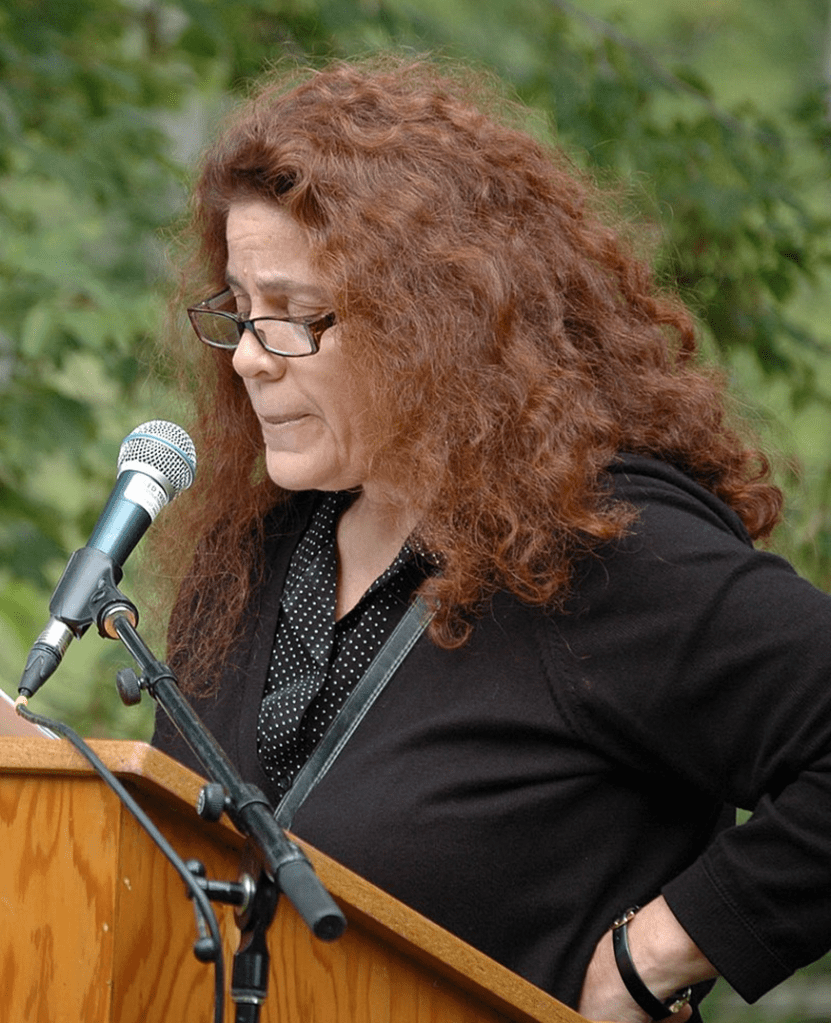
Anne Michaels at the Eden Mills Writers Festival in 2013 by Dan Harasymchuk – This work is free and may be used by anyone for any purpose. If you wish to use this content, you do not need to request permission as long as you follow any licensing requirements mentioned on this page. The Wikimedia Foundation has received an e-mail confirming that the copyright holder has approved publication under the terms mentioned on this page. This correspondence has been reviewed by a Volunteer Response Team (VRT) member and stored in our permission archive. The correspondence is available to trusted volunteers as ticket #2017111910005416.If you have questions about the archived correspondence, please use the VRT noticeboard. Ticket link: https://ticket.wikimedia.org/otrs/index.pl?Action=AgentTicketZoom&TicketNumber=2017111910005416Find other files from the same ticket:, CC BY-SA 4.0, https://commons.wikimedia.org/w/index.php?curid=64190967
All my love
Steve

[1] Anne Michaels (2023: 161) Held London & Dublin, Bloomsbury Publishing.
[2] Ibid: 166
[3] Ibid: 22f.
[4] Lucy Hughes-Hallett (2023) ‘Held by Anne Michaels review – a kaleidoscopic family saga’ in The Guardian (Thu 2 Nov 2023 07.30 GMT) Available at: https://www.theguardian.com/books/2023/nov/02/held-by-anne-michaels-review-a-kaleidoscopic-family-saga
[5] Anne Michaels, op.cit: 10
[6] Anne Jolly (2023) ‘Held by Anne Michaels review – still master of her universe’ in The Observer (Sun 19 Nov 2023 10.30 GMT). Available at: https://www.theguardian.com/books/2023/nov/19/held-anne-michaels-review-fugitive-pieces
[7] Lucy Hughes-Hallett op.cit.
[8] Ibid: 12f. The idea of the identifying pattern in the gansey or Guernsey lives on in folklore. See https://www.propagansey.co.uk/
[9] Anne Michaels op.cit: 24
[10] Ibid: 159f.
[11] Ibid: 219
[12] Ibid: 218
[13] Hughes-Hallett op.cit., quoting the first line /fragment of the novel Held on page 3.
[14] Anne Michaels op.cit: 4
[15] Ibid: 7
[16] Ibid: 191
[17] Ibid: 216
[18] Ibid: 36 & 35 respectively
[19] Ibid:110
[20] Ibid: 143f.
[21] Ibid: 41
[22] Ibid: 55 – 60
[23] Ibid: 163
[24] Ibid: 8
[25] Ibid: 153
[26] Ibid: 146
[27] Ibid: 161
[28] Ibid: 172f.
 Steve_Bamlett_blog
2 thoughts on “‘… ; she knew it was everything not to die alone, not to be taken brutally, by force. …/ … What could she give him now? She knew what he would want from her: that stillness might grow to peace. Not still: held’. This blog attempts to explain what we materialists owe to Anne Michaels (2023) ‘Held’.”