There is an Appendix for Wednesday at this link: https://stevebamlett.home.blog/2023/08/24/diary-of-a-stay-in-edinburgh-part-one-appendix-a-wednesday/
Part 2 is about Peter Howson and on https://stevebamlett.home.blog/2023/08/27/diary-of-a-stay-in-edinburgh-part-two-howsons-art-dr-bendor-grosvenor-britains-best-known-figure-in-the-discipline-known-as-art-connoisseurship-says-of-howson-what-an/
Part 3 will be a continuation and summary of learning in the week from Wednesday. It will include Thursday / Friday.
I am starting this diary entry on Tuesday and Geoff and I have been here since Saturday. Apprehensive from the start about this stay, I felt it might be a reminder continually of the fact that it had been planned around staying here with Jusin and that had influenced the size of the flat we booked and the bookings which had been heavily edited to reflect what might interest Justin. For instance, he had thought I had booked too many LGBTQ+ things so we cancelled some. I almost forced myself to register at the time that this was some kind of indication of a newly emerging willingness to critique of me and Geoff and the lifestyle that he might have felt he was having to adopt to accommodate us (hard to know with Justin for he played everything very close to his chest): it may have been distaste for the openness of it all because he had frequently said he wanted to be ‘normal’ like he used to be. It was a surprise though for had begun to say he loved me and that he was proud to be thought gay in my and my husband’s company. But before this, before we were, as I saw it, ‘together’ (in some way linked), I knew he had been someone who had lived his life bisexually with the gay part played out in equal amounts of guilt and shame in public mode for what was his preference. Still, when I had voiced my concern, he had often got angry for me mistrusting him – so angry that I should have seen he meant he mistrusted himself and that this chimed with his concern that I, since I had a pension income, made him feel he was a ‘rent boy’ (his words). But surely you cannot make one feel they are a rent boy unless the money aspect is more important to them than yourself. I don’t know for these thoughts were arising from some new mode of thinking not expressed before.
But here in Edinburgh with the evidence of spare tickets and an empty room in a flat all paid for, the waste of money does come back with a heavy burden of meaning. I think that had been under control until I saw a show yesterday, The Look of Dusty. Her cover of You Don’t Own Me re-sung by a talented singer fell like a lead weight deep somewhere in my lower intestine, speaking as if with his voice from the graveyard of my heart, the ‘dusty’ tones explained by this earthy but desiccated origin. Had I seemed to make claim on him that was like ownership that he felt I was paying for? I do not know. He must have thought so, although so many reasons were being given for his change of heart. But listening to You Don’t Own Me. my heart broke again in the theatre. I must have so sobbed that Mike, a friend that was visiting for that day felt the vibration and touched my arm in support. From thence every love song or loss song in that show became about him. Yet, I felt grateful for that release then and for its expression externally. Now, though in memory it seems to have returned me o some of the rawness of loss and fear of having misplaced trust or misread the signs of what soke of itself as love and was not. For if it was not love and yet that was what you returned what was it? And what prompted its reproduction as words, acts and even manner of relating to you in the other?
Of course I had got used to not knowing the reason for the ending he enforced (‘bad for you and bad for me. was the only reason given in a text). It is just that this holiday has brought all the rumination back and this song had let some deep hurt I thought now somewhat controlled out of some unknown padded cell. And I feel I am walking within a padded cell always around me at the moment. But I will return to the Tuesday events later in their own right for they were far from being all gloom and doom. Indeed I feel I have written all the worst of that out of me now perhaps.
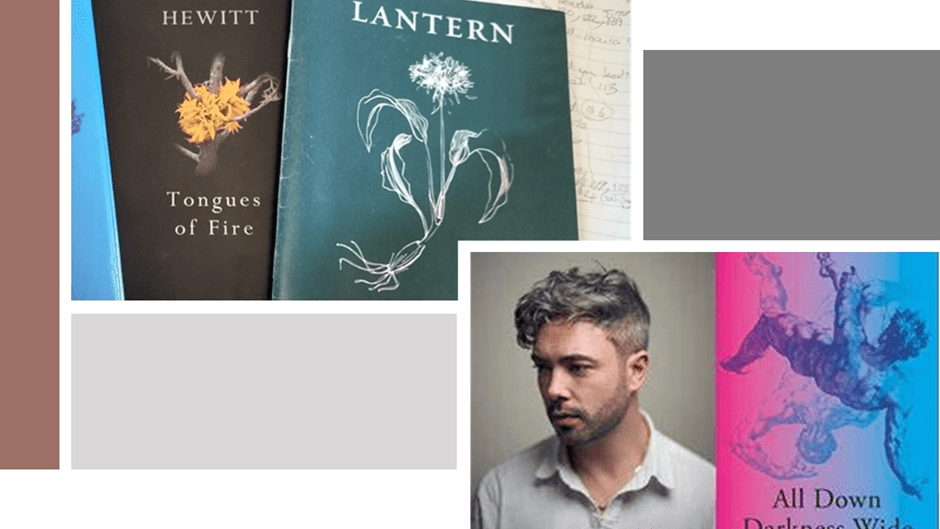
For on Saturday, as we arrived in our student flat – three bedrooms on a corridor and a dining / kitchen area that United Students charged us £1411 for, my main sadness was for having to leave Daisy, our dog, in kennels. I had shared with a friend on What’sApp that I felt was healing rapidly. I had attended on arriving, for instance, a very enjoyable evening session with poet Seán Hewitt on his memoir All Down Darkness Wide and his first poetry collection, Tongues of Fire (2020) which I had brought be signed. I have blogged on both of those books (see links on titles to read these if you wish to read them – there is also one on a single poem from the collection Callery Pear) so it would not be useful to rehearse much of my own thoughts. I listened to the poet and interviewer link the abstracted landscapes of the poetry, in Dryad for instance, with the park and woodland settings in the book whether used for reflective escape, as in Sweden, or for cruising for sex. It seemed to me as I that the interior generalised landscaped settings of the poetry were linked to histories of the occasion of mental disturbance, sexual exploration and even of the suppressed very queer histories of complex oppressive cultures intersected with that of the oppressed which the former’s interests brought into being. For all this I just had to ask a question about St. James Park in Liverpool. Sean confirmed the importance of this and the passages about it in his memoir, that chimed with others.

Sunday started with a visit to the Peter Howson retrospective at the City Art Gallery, about which I will blog separately and put, once it is finished a link to the exhibition title in this sentence, but that is another task. That is a pity for the riches in that show might have compensated in this diary account for the drabber experience of the afternoon. I do not mean that as a criticism of the Edinburgh International Festival showing of Phaedra, a musical piece intended for a master soprano voice such as the one we heard, and a dance piece, Minotaur, about which every review I have seen raved and in which a man nude with a nude torso seemed to fly through the air in the review photography I saw afterwards.
But it was hot in the theatre and I felt my own motivation to realise the art heard and seen into some satisfying inner experience to be entirely absent. Racked with anxiety from the start, the aura of a possible panic attack persuaded me to leave in the long interval (Geoff anyway was not enjoying it and had only come to use the ticket we had got for Justin who did seem interested in this – in the dance in particular but also in Britten). But maybe there were too many associations here for me – or maybe the early rising at 6. a.m. was getting to me – leave we did and that is always dispiriting. There was something quite lurid in my heart in responding anyway to how an older married woman became madly disorientated by the passion aroused in her by a young male body. At one point she cupped her hands around an imaginary man’s crutch pulling it to her vagina where her hand rested. It was I thought quite fearsome, quite triggering in a number of ways.
The evening was better. The audience for Graeme Robertson interviewing James Kelman was huge and that was gratifying in itself. But the talk was more so. Perhaps I have never understood so well that Kelman, whatever the punch of his politics, lays its meaning in ideas of empathy and community, as a resistance to instrumental and strategically defined politics. I had already blogged on God’s Teeth (for blog use link on the title), but I had perhaps missed all that in my tendency to defend myself, even from emotion I respect for things and people I respect, in ‘intellectual’ wall-building. Decide for yourself. I am all out of self-analysis. It was a great evening though, one that raised the issues about art and politics and the reasons why exclusions of some writing occur.
Monday promised well and remained so and I therefore need to correct the impression I may have made earlier about the triggers in it, though they will be compounded somewhat by other things I have to say. It was a good day because we had a visitor – a friend willing to take up Justin’s tickets for the day; excluding the evening visit (which in the end I did alone as friend went back to his husband at home in Glasgow). The friend was Mike pictured below by me in a selfie in the dungeon like corridors of the Cowgate Underbelly, waiting outside the Belly Laugh theatre for the play Declan, a play with ironically few (perhaps no) belly laughs in it (but more of that later.

I met Mike at Waverley Station at about 11.5 in the morning, gave them (Mike’s preferred pronouns are they / them) the hug I needed and we walked to the Symposium Space, via the vegan restaurant David Banns on Mary Street that Geoff and I intended to take him to after the events he was going to. Finding it opened at 12 noon suited us and we proceed to the square where we met Geoff. I was a little nervous still, despite the warm hugs, for I had never met Mike in the flesh before and neither had Geoff, and he was a much shyer person than I had imagined even though just as nice as I imagined – and, of course, I had to ask to touch his hairy legs, having turned up in shorts. NIGHT Owl Productions describe the show thus:
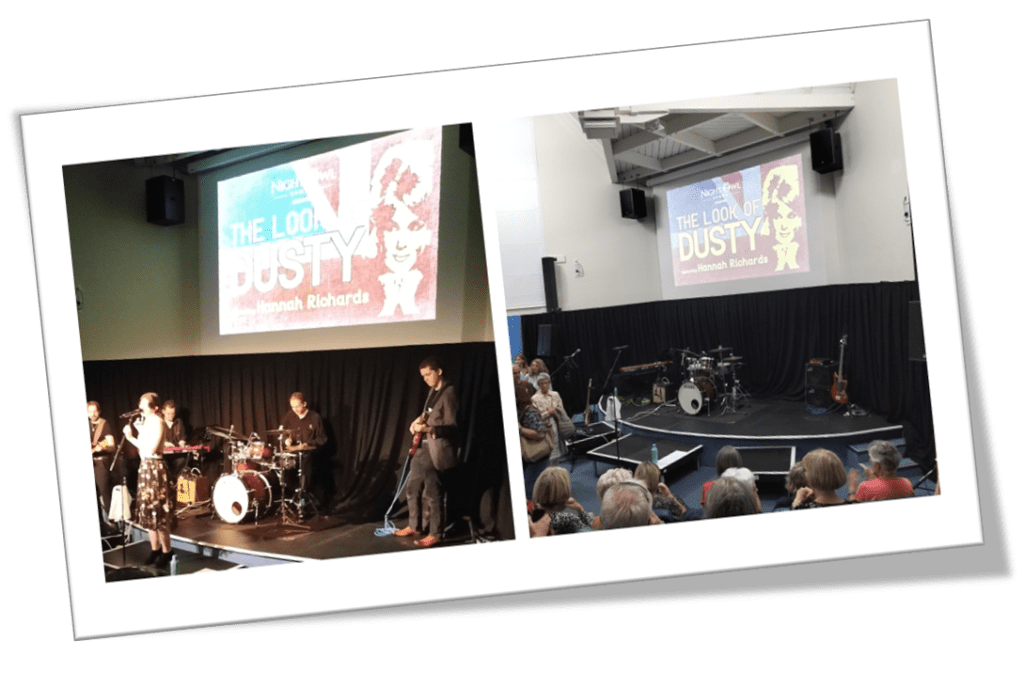
The multi award-winning Night Owl Shows ensemble returns to Fringe with a brand-new show that celebrates the life and music of a true icon: the smoky-voiced singer Dusty Springfield, whose interpretations of pop, soul, jazz and R&B were suffused with a heartbroken wistfulness. The Night Owl band take you through the life of the soulstress known simply as Dusty, accompanied by inimitable interpretations of hits Spooky, I Only Want to Be With You, Son of a Preacher Man, Look of Love and more. Learn the story and enjoy the hits of one of music’s bonafide icons.
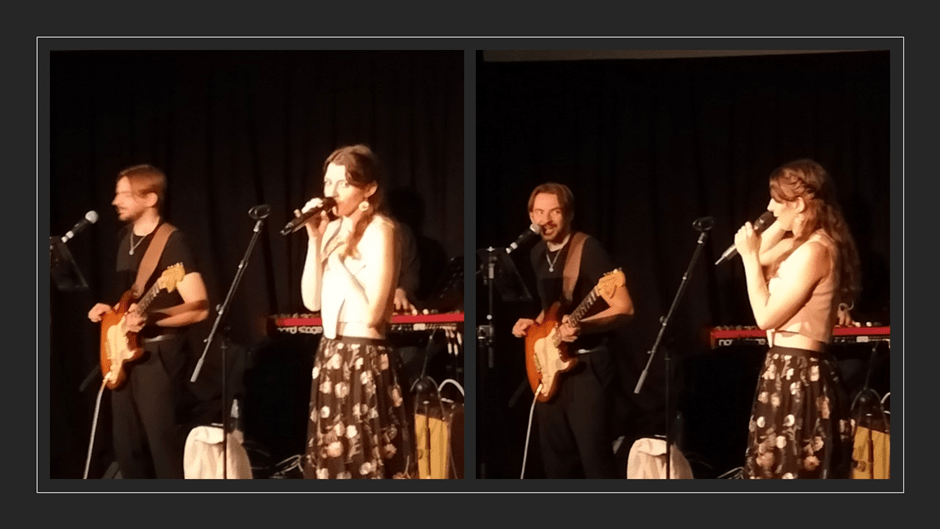
When songs are explicated through a narrative that made the words of the songs a narrative that made you feel the (or ‘a’) persona of Dusty’s – as victim of the record industry and gay icon, though rather with a disregard rather than emphasis on gender for love alone was justification enough for any choice of lover we were told that Dusty thought. Illustrated with press photographs and excerpts from biographies and shows the biographical approach will always win hard hearts, though Geoff felt that too much emphasis was given to the words of songs that Dusty did not write in responses to events, as was almost suggested openly by the introduction to You Don’t Own Me when the song was actually a cover of someone else’s song. Live music is always a winner. For it is always a joy to see a band in operation, with even the manners of an early period – backing musicians who exude an almost studied indifference to the delightful emotion they have the talent to convey on their instruments.

I have said in my opening paragraph how some of these songs had a triggering effect upon me. But it was not an effect that was dominant – perhaps it lurked till the next day that effect. The singer was super – both when it came to a charming rendition of the Pet Shop Boys song What Have I Done To Deserve This with her by a rather lovely young man on the guitar – my own ‘Pet Shop Boy’ she said.

Emotionally charged we walked from there to The Cowgate Underbelly, arrived early and so looked at the HIV/AIDs exhibition currently on at the National Library of Scotland, a one-room display of the Scottish struggle to gain rights to both health provision and respect that marked that dreadful epidemic. It was heartening rather than otherwise.
Declan may have helped deepen triggers to my mood on Tuesday – very low – though yet again it was not felt on the day. Both Geoff and I attribute that to Mike’s presence. Declan tells the story of a kind of love story that never got stated between a young man named Jimbo and Declan a man who sometimes stopped over at Jimbo’s surreptitiously and invited Jimbo to give him a ‘hand’ to achieve more successful sex than simple self-masturbation. Jimbo’s refusal was based on a massive overevaluation of what doing so would have meant to him and his fear here as elsewhere of not ‘getting it right’. Whether this rejection contributed to Declan’s disappearance in the canal was never clear but clearly further isolated that beautifully sad and needy character, who was anyway perhaps imagined by Jimbo. The play opens with Jimbo speaking to a vampire who sucks Jimbo’s blood in an exceedingly queered sexual manner, allowing Jimbo satisfactions reality never yielded to him and where the vampire takes over the sexual initiative entirely.
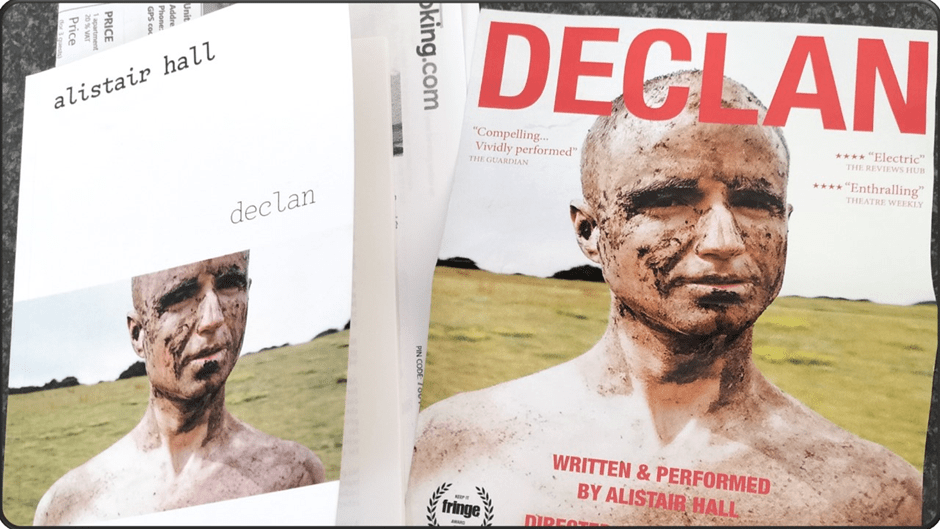
But Jimbo was abused by both parents – his mother sexually, his father physically. The latter is almost in retribution to his wife, whom Jimbo tries to return to his father in the form of a Barbie doll, but which doll his father mutilates. Jimbo is played by Alistair Hall who wrote it, told the story, including in the words and voice of different characters whose identity and reality was somewhat suspect in many cases except for the stone-real neighbours. That Declan is a play about how the psyche is mauled by a society which makes loss an inevitable part of the emotional landscape for queer people to a degree more noted than for those privileged by societal norms and distributions of power cannot have escaped me.
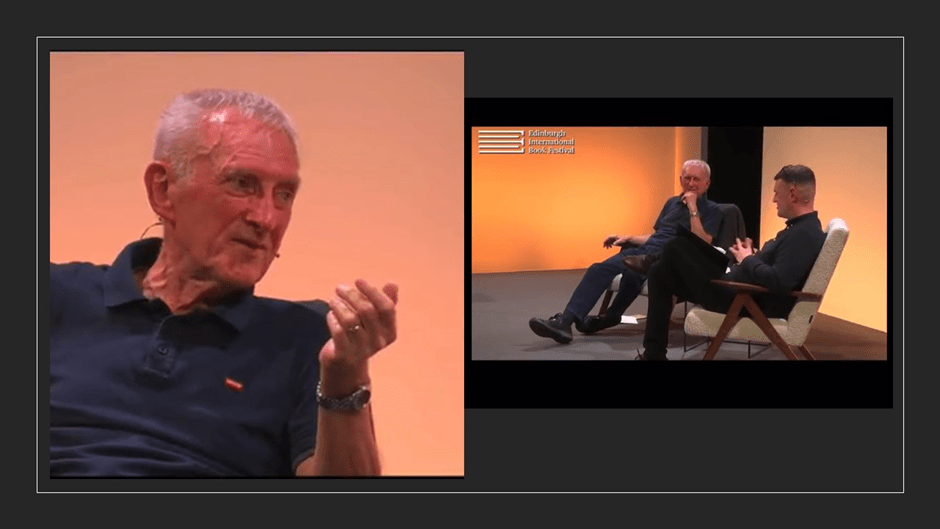
When Mike left us I went to See Ian McEwan, who did not tread from Lessons, his latest and very good novel, about which I have already blogged – link is here – but he did have a great conversation with Kirsty Wark and I was able o ask a question that interested me (see Boo Festival website recording). McEwan said in the signing later that, though not in these unkind words, that I over-read my favourite lines – ‘Books are difficult to tidy. …/ They resist’, but interestingly enough when I asked him to write one of them as a monogram to his signature on the book, he misquoted them. So I will stick with the possible fancifulness in my blog. But it is a wonderful novel and he signed my early first editions too.
The next day was quiet and I took many naps but also seemed perpetually anxious. Tomorrow is another day but the play Geoff and I saw, Bacon was a tour de force, as the reviews are already saying – praising the subtleties of script, acting, direction and set design, a huge seesaw that could be transformed into a static bench. As the reviewer for broadwayworld.com says, the set was integral:
Set Designer Natalie Johnson’s huge seesaw is a perfect example of how to transform a show with one simple set piece. Matthew Iliffe’s direction sees the actors swiftly rising and falling at key points in the story, meeting in the middle in moments of tension. Sections of the play where two scenes take place at once are brought to life with an intelligent sense of parallelism, drawing out the script’s full potential.
And what a script it is – [Sophie] Swithinbank dives headfirst into the rough, the ugly, the gasp-inducing and the hard-to-watch. Bacon is gripping from start to finish, while still maintaining moments of comedy and levity. Particularly engaging is the scenes of overlapping dialogue, giving the play a powerful sense of rhythm and drawing surprising parallels between the characters. The little details of everyday life at an English state secondary school keep this hard-hitting script grounded in reality. Both characters fit into archetypes we’re all familiar with – everyone had a Darren-type bully at their school – before subverting our expectations and fleshing Mark and Darren out into unique people that we care for. The writer unpacks masculinity and sexuality with hugely impressive perception and precision.[1]
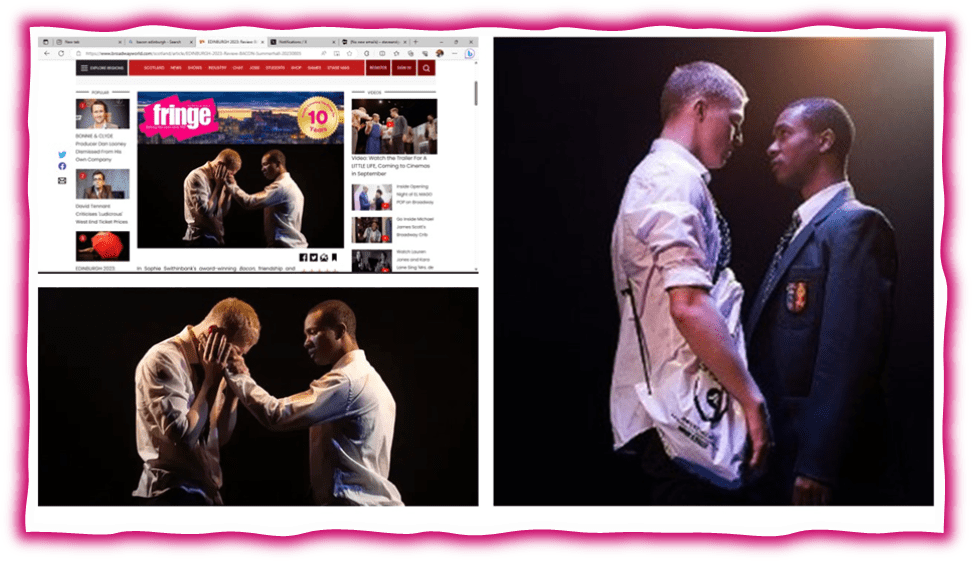
Style aside this review is remarkably accurate about whole effects in this beautiful play in which theatrical talents integrate however charmed one WILL be by the brilliant performances of Corey Montague-Sholay and William Robinson as Mark and Darren. But just a word about the play. I think it excels most because character is so brilliantly captured that politically reductive messaging is otiose. Of course we condemn sexual and other violence but this play does not allow you merely to side with the middle-class victim, Mark, for it is intelligent not only about masculinity and its toxic self-replication in knife culture and fear of appearing ‘soft’ but about class. For though Mark is armed with the language to own and begin to understand the queer as a social reflection of desire, Darren is definitely not. There is a cruelty I would argue in Mark’s decision not to forgive Darren and explain to him – or at least offer him the bacon sandwich he promised him, that in part leads to his isolation in his own mental illness at the end. Of course victim-blaming is always wrong too but there is a reason why the playwright decided that even his own mother found Mark’s decision to avoid reparation ‘boring’ and abandoned him. But it’s a hard and tough theme and doesn’t stop you loving both characters.
Wednesday dawns and bathed and sitting tapping here, I find myself in new mood and perhaps free. Blogging does help. Not that it gives (that horrible word) ‘closure’ where none can exist but forgiveness of self and others for our joint failings, understanding of my own. I will publish this and add to it later. This morning’s first event is for a writer too on whom I have already blogged (see link), Ayò̦bámi Adébáyò̦. Will report back.
Bye for now!
Steve
[1] https://www.broadwayworld.com/scotland/article/EDINBURGH-2023-Review-BACON-Summerhall-20230805
 Steve_Bamlett_blog
5 thoughts on “Diary of a stay in Edinburgh (Part One – Saturday to Tuesday):”