A blog: Tuesday 15th August 2023: Lunch with the ideas and forms of Erwin Wurm.
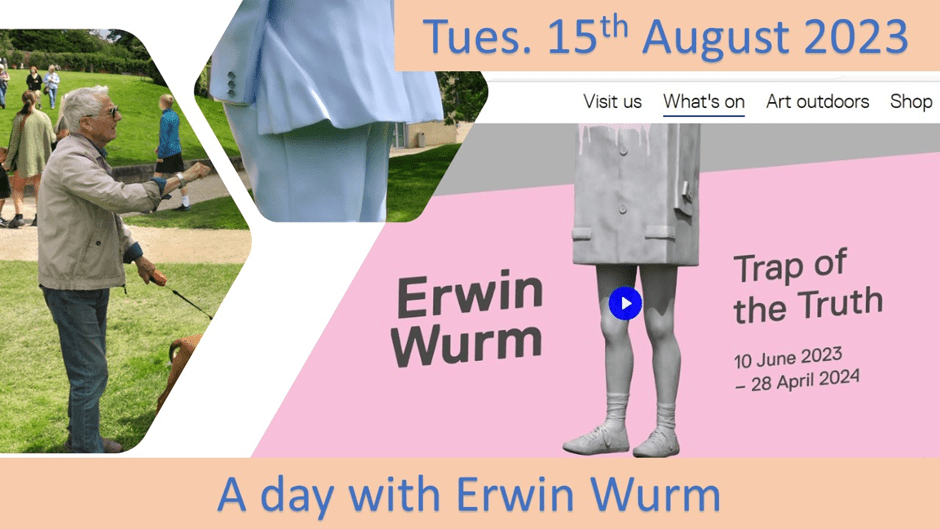
In lieu of a catalogue, even a brief list of works exhibited (one is still being prepared, the other being reprinted currently), to accompany the exhibition of Erwin Wurm’s sculptures, it seemed a distinct disadvantage having no prior knowledge of the artist’s work. However, there is a distinct joy in seeing works in this state of ‘innocence’ (a word I will prefer to ‘ignorance’) of even an artist as obviously celebrated and prolific as Erwin Wurm. You come at the work attempting first to determine how such art might be made accessible and given a framework for being ‘understood’ (whatever understanding may mean in the context and it will obviously differ for different kinds of art). What stood out in the publicity I had seen before were large sculptures, which gave an appearance of some aspect of human life to everyday objects, such as a huge hot-water- bottle, standing, in huge sturdy boots on short stocky legs, and tall against the old stable and out-buildings of the remains of the old Bretton Park, one the home (in my youth in West Yorkshire) of a School of Education.
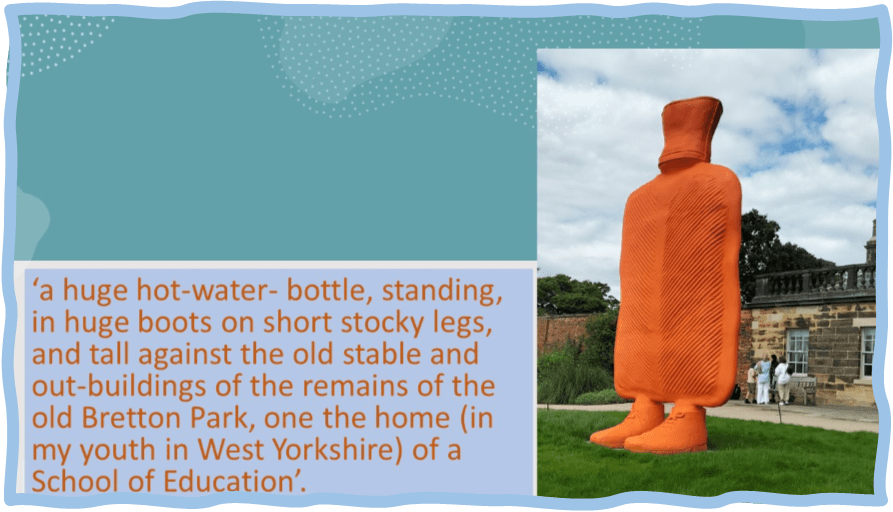
I was semi-aware, for I glanced at some of the books about Wurm in the bookshop relating to earlier exhibitions that Wurm’s project was a serious one – aimed at producing work that is deliberately reflexive on the contexts of sculpture as an art form – the places for instance that it is seen such as important art galleries and the homes of significant and important persons in a nation’s life or the kinds of things represented. Severin Dünser says, for instance, that Wurm ‘has been on an artistic Odyssey aimed at expanding the classic concept of sculpture’ for at least 35 years, and that was said in 2017.[1] But all I knew was my first look at everyday objects given a semi-human animal form and I felt most of all that I either did not understand why a hot water bottle should be represented with legs and offered the significance of size or if I did, the point seemed trivial. Okay – hot water bottles rarely for sculptured figures and to stand one as if it mattered as much as the classical and Biblical figures represented in older figurative sculpture does make a point about the purpose art serves in creating significance around the subjects it selects, but the point does not go that far. Of course children marvelled at the sizer and absurdity of it all, but to them maybe it is still acceptable to personify the common objects to which they become habituated, though I think very few in the current decade may even recognise a ‘hot-water bottle’, although I don’t know this.
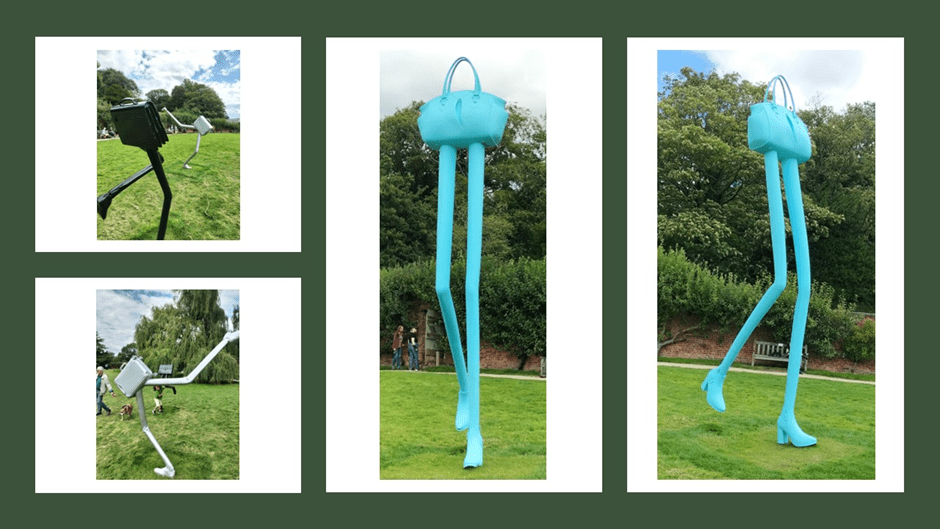
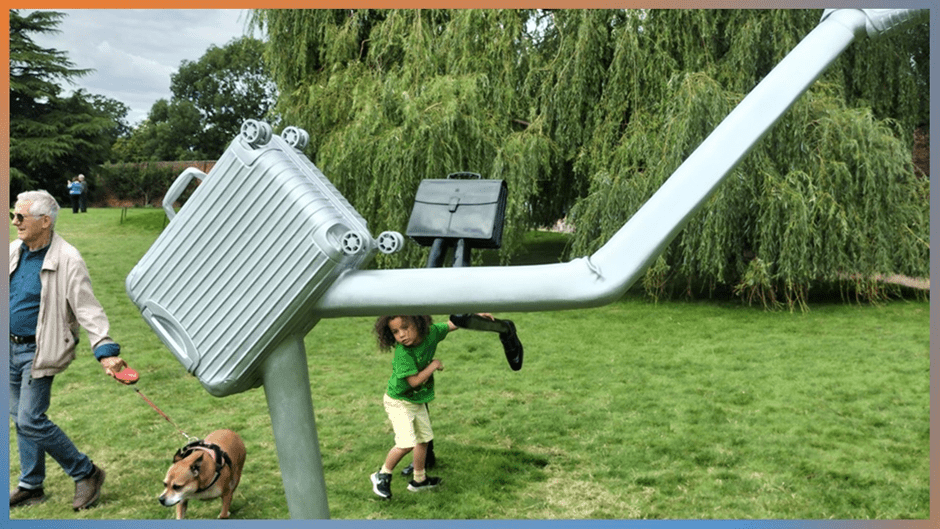
Other everyday objects have ‘human’ legs in these shows and some are represented such that they might seem as you circle them and weave between them to seem animated for their legs are raised in the middle of some action. The ones attracting attention from children seemed in some way to invite them to swing on their sturdy meal cantilevered appendages. Seeing them in the context of the hot-water bottle did perhaps raise the kind of child-like thinking, plentiful in Lewis Carrol, of the characters that seem appropriate to some objects. Mr. Hot-Wate-Bottle would be both static and keen to look as he was moving nowhere, except to lie down in bed, whilst Mr, Ms and non-binary Bags would need legs that seem to move for their conceptual nature is mobile, and purposive both in terms of function and look. The handbag is on long blue thin elegant legs that perform steps of cultured style in modish isolation that is intended to be seen and picked out by others (2 aspects of this sculpture are centre and left in the collage below), whilst both suitcase and briefcase dance (top and bottom right respectively); the suitcase in rather overblown and risk-laden (if balance is the aim) steps in comparison to the briefcase for the latter is at work tomorrow, the former still on holiday.
Those games may be elaborated endlessly in verbal description and there may be a tendency (it certainly was so in me) to see these pieces as therefore playfully conceptual in their aesthetic nature, illustrative of ideas that had near precise possible linguistic forms of their expression that, though they would be verbose in linguistic form to cover all ideas and associations, did not reduce the visual art nor make its meanings unique to their visual form. This is because it seems to use simple everyday objects which were referential to the functional symbolism of everyday life: bags that are carried for different purposes, items used in specific contexts like bedtime.
Actually the more of the standing sculptures that I saw, the less I became interested in them as personifications of everyday items; like a stolid hot-water-bottle, a trend-pacing handbag and a flighty holiday suitcase dancing with a working briefcase, each in their mode. Look at the hot-water-bottle together with two standing figures.
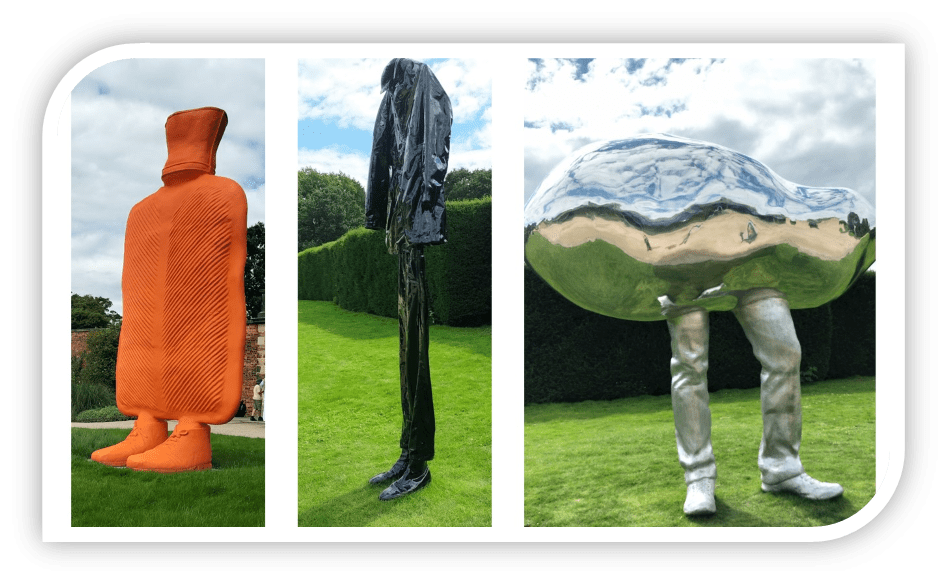
In this comparative context what we have here is not three different items but depictions of figural stance instantiated around different kinds of categories of items – a single item, a set of items adding up to an ensemble of clothes (it is actually a standing suit from the description given on a plaque) and a hybrid of a figure and an abstract solid form. Each stance has a very slight contrapposto stance, most prominent in the third and absolutely minimal in the first. If I am right about this, this alone makes the figures reflexive of the tradition of the contrapposto standing figure important in art since the fifth century BC turn to anatomically realistic but idealised human form. The change in perspective here for me was that the sculptures became about the conception of action, captured in static form of course, but focused on an idea of the dynamics of the presumed body which has been substituted for by an object we do not usually consider as independently animated. Suddenly this art becomes to be about things which just ontologically are to bodies that perform the meanings they want to create in their stance, gesture, and presumptions of attitude inferable from these first two. All of these are illustrated in a way implying the genesis of movement and human intention.
This is the case two where either hybrid or assembly figures (suits especially – assemblies of single clothing items) strike an attitude meant to impose on a viewer or interact with each other less self-conscious of being seen, at least by each other. The rigidity of isolated stances that aim to impress can sometimes be conveyed through the boxlike and over contained shaping of the body as if it were a thing, if a queer thing coloured in non-human-normative hues. But if we understand that we can perform supposed solidity in our isolation (which people do – including myself – all of the time in our society of engineered appearances) as well as more fluid sociality; again it is the idea of performance which is to the fore (as in the collage below).
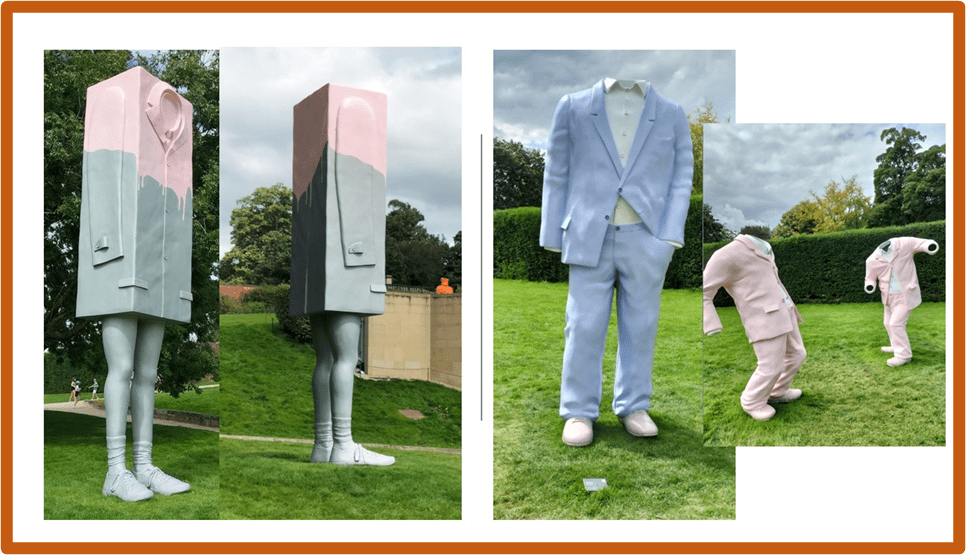
In some works, performance is whittled down to shape that gain dynamism by being seen from the different angles offered to the viewer walking around them. These shapes are often of the appearance on one of their sides of lengths of irregular shaped and curved metal, whilst on their other side moulded into a figurative human shape. Those carved surfaces when on to physically separate lengths of metal can at some angles appear to the viewer’s eye to form wholes that fragment on the viewer’s further movement. Here sculpture is performative (and the performance may be a dance or the act of throwing a cricket ball – I saw that in one) and based on the interaction of the different perspectives on the pieces formed by the viewer’s movement around them, sometimes integrating the shapes but at other times fragmenting them from each other.
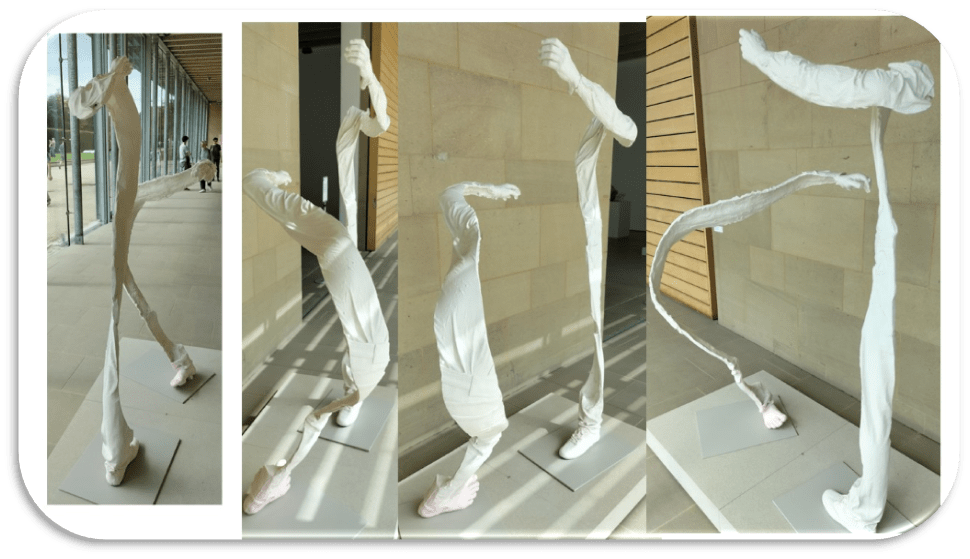
Dancing?
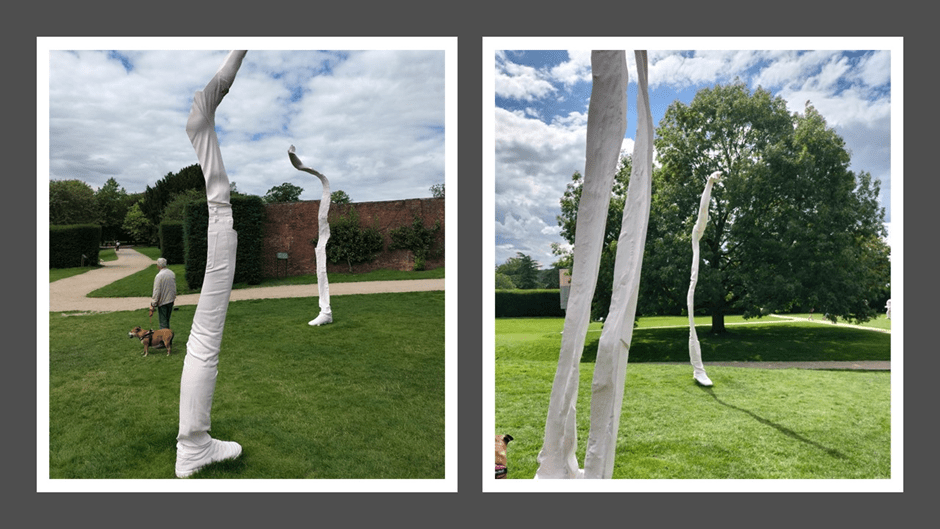
Throwing a cricket ball?
However, if this art is about human performance, about the moment of initiated meaning from the body and the things which signify the body, even when the art itself absents the flesh except by implication, through enabling dynamic form and thence meaning, it does so ONLY through the relative position of pieces in the embodied moving eye of the dynamic observer. Without the latter it is meaningless. Children make that obvious. They love the illusion of what they see and they enjoy its absurdity but can still trust to its solidity and stasis enough (for they engage the world through different kinds of play often simultaneously) to want to swing on it, to the frustration of one mother – she is just off the picture talking with my husband Geoff but she was lovely – you might see that in one of my photographs above (but here it is again, for it is fun).
Earlier I said: ‘The rigidity of isolated stances that aim to impress can sometimes be conveyed through the boxlike and over contained shaping of the body as if it were a thing, if a queer thing coloured in non-human-normative hues’. I can’t leave this point without reference to the many pieces from Wurm’s career that ‘use garments as the basic materials of his sculptures’. These, according to Dünser, began to appear in the work from the 1980s and were their effective because of their ‘reference to the human body as opposed to the alienation of that same body when imposing a geometrical form upon it’ (is the German better: ihrem Bezug zum menschlichen Körper im Kontrast zur Verfremdung durch das Aufzwingen einer geometrischen Form’).[2]
Nevertheless when placed in a gallery in assembled form those various gestures and attitudes of clothed forms, where meaning emerges through form interacting with intuited attitudes, sometimes the dynamism achieved by the movement of the viewer’s eye around and through the middle of the supposedly separate shapes engage us in forming embodied feelings and ideas of the manner of social performance – performance relating to the proxemics of imagined bodies in varying proximity to each other. Look at the two perspectives, for instance, on the SAME group, in the collage below> n fact many more perspectives would help make my point much better.
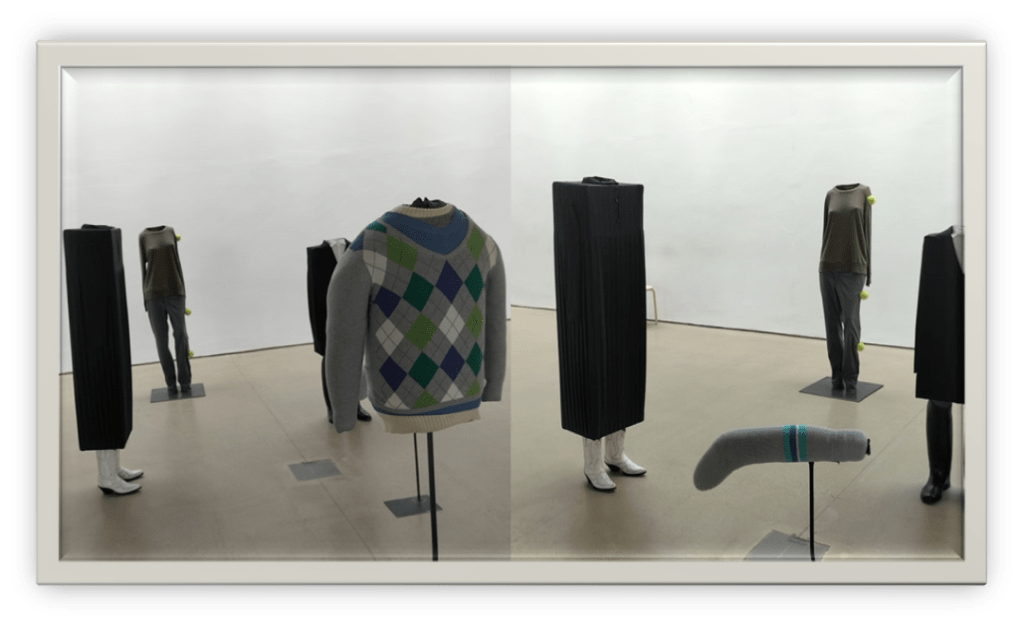
Social performance is interesting too in the absurd pieces which show sausages dancing together, which I neglected to take a picture – feeling it at the time, too ‘cartoonish’, in a rejection of my child-memory-formed perspectives, as adults are unfortunately too wont to do. Instead of the term ‘absurd’ Dünser uses in English the better term ‘ridiculousness’ for this, instead of a term too mauled by literary critical terminology (as in references in English Artaud’s the Theatre of the Absurd): even better ‘Lächerlichkeit’ in German (which sounds wonderful).
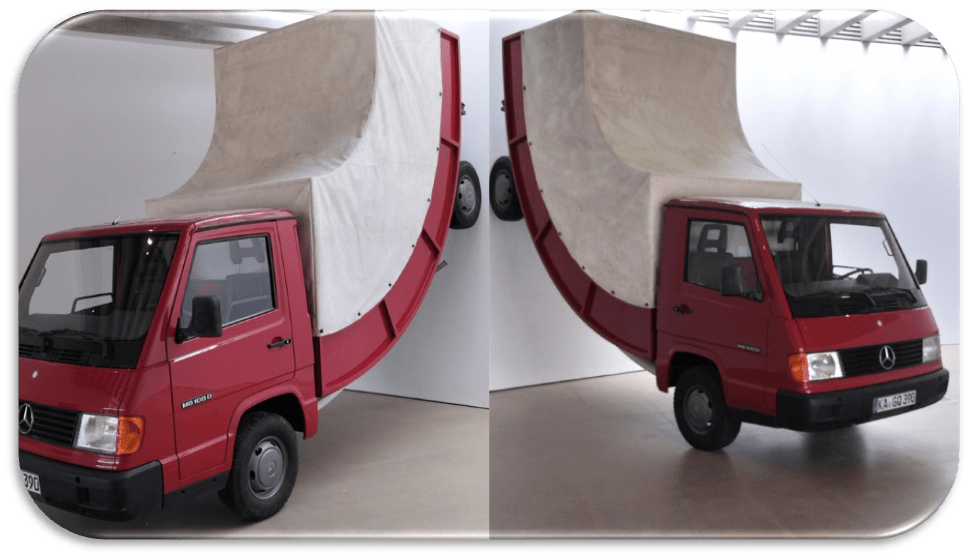
This idea of statically visualized human performance is seen at even one further remove when the human thinking, feeling and sensing body is present only by another level of inference in relation to objects in which they engineer social and private meanings. Here the Lächerlichkeit element does overtime. Let’s take the apparently simple idea of a human being reversing a truck, an in a static image speaking its own ridiculous dynamics of meaning you get this static performance piece:
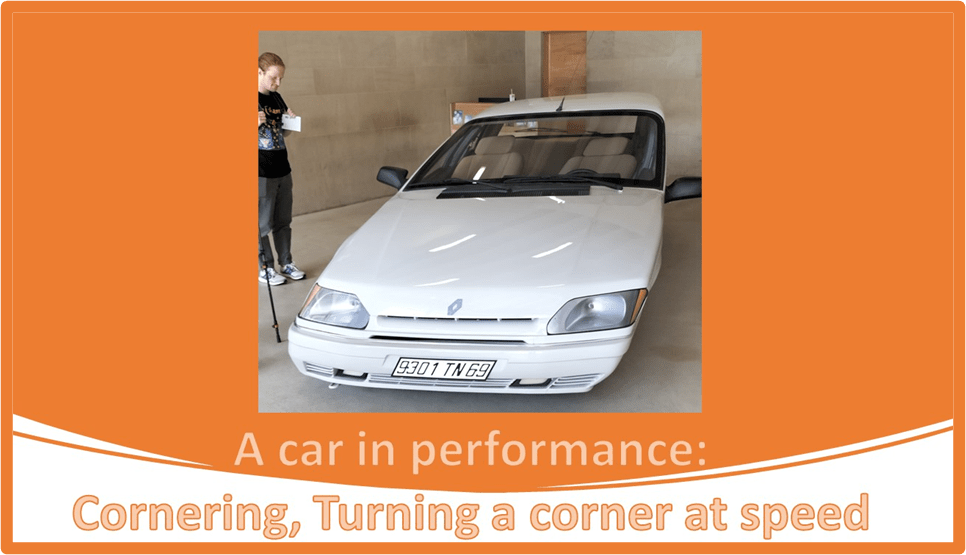
Similarly I took a long time to see why I and other observers loved the car below which uses artistic modes of queering form to show both sensation and emotion in the handling a car’s motion and meaning-making for human beings. It is performance in a wonderful way, dependent on how the human eye roves the object and works with it:
The first piece Geoff and I saw on our visit however was that below. At the time the art seemed to me to be about conceptions and ideas – about being turned into description and I saw this piece as about that, not even (not having seen the above examples yet) fusing the ideas of car form with the idea of an accident or crash as if meaning lay in this hybrid ‘collision’ (not a thought-out joke that) of ideas from one narrative and evoking moral meaning. But only learning more in later exhibits and, to be fair in reading later (Dünser and others), did I see that this masked another idea essential to what Wurm calls (though I did not know it at the time) performative sculpture.
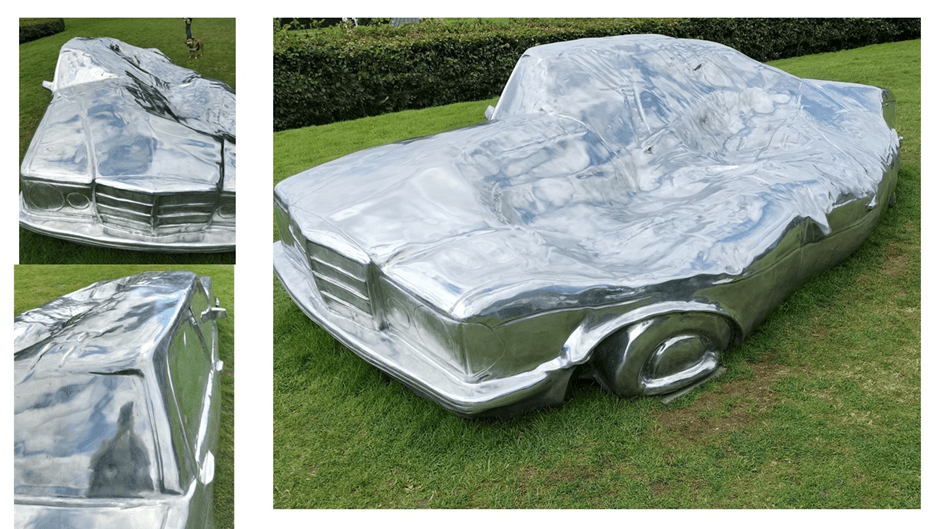
As a moralising piece on the damage and danger (in road traffic accidents) of that ubiquitous form we call a car this may seem meaningful, but really even the nature of the damage does not really signify ‘accident’. Later I was to realise that it does signify a term that has come to define Wurm’s later approach to some of his performance sculptures of attack. For this car seems to bear the brunt of having been MADE unusable – of the performance of its making as art that is both constructive and destructive of form, that betrays the active performing hand (and other body parts and movement used in making art) of the artist< it comes out in violence, sometimes aided by heavy tools. In this sense, it still bears witness to older artistic traditions, such as the heavy laying on tools – palette knife and heavy brush of later Titian and even of the visible hand – of the late Titian (people still claim to see his finger marks). These elements of art seem to reperform the making of that art in the past moment, even when (as in Titian’s case) this was centuries ago. The collage below use photographic record from one of the wall plaques of this exhibition where the concept of ‘attack’ as a means of showing the artist in the performance o making his art and leaving heavy signs. And we should see that in the car above, though the denting attacking tools are very heavy and less directly associated to one artist’s body, as with these attacked ‘house’ or architectural model forms (both pieces from 2012) shown for the many in the catalogue edited by Stella Rollig in 2017.[3]
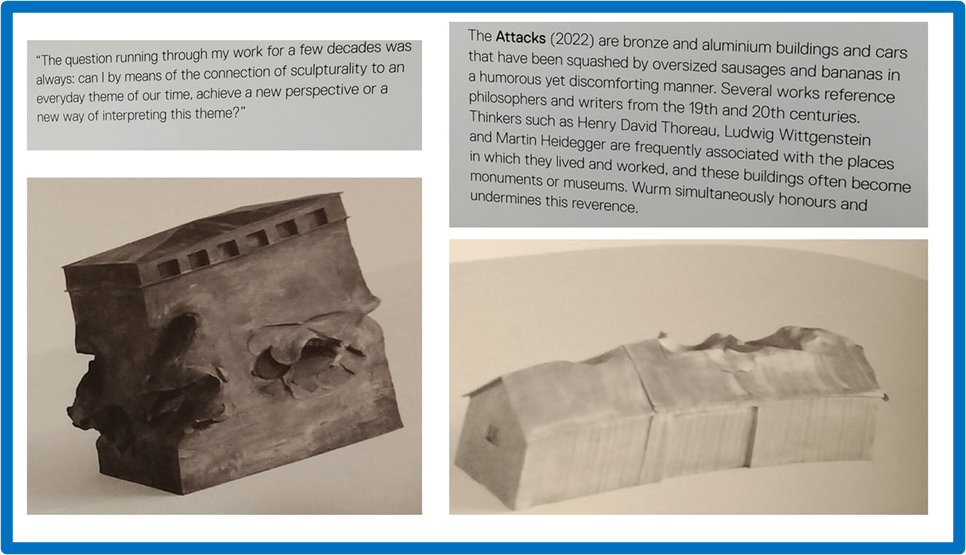
The 2012 pieces from Rollig (ed.) [2017) are labelled in the catalogue (from left to right) Detain and Dismiss respectively. I have no explanation for these titles.
The houses referred to the text in the collage above as for examples of attack mode I decided to show you separately for they blend the imprint of the artist with introduced performative ‘ridiculousness’ of replacing a naked hole with a ridiculous explanation of the damage made – such as the huge out-of-scale German sausage that pokes out from the holes made in the representation of what was Heidegger’s hut in the mountains (see this link for a blog on Banville that uses this hut and shows other pictured representations of it).
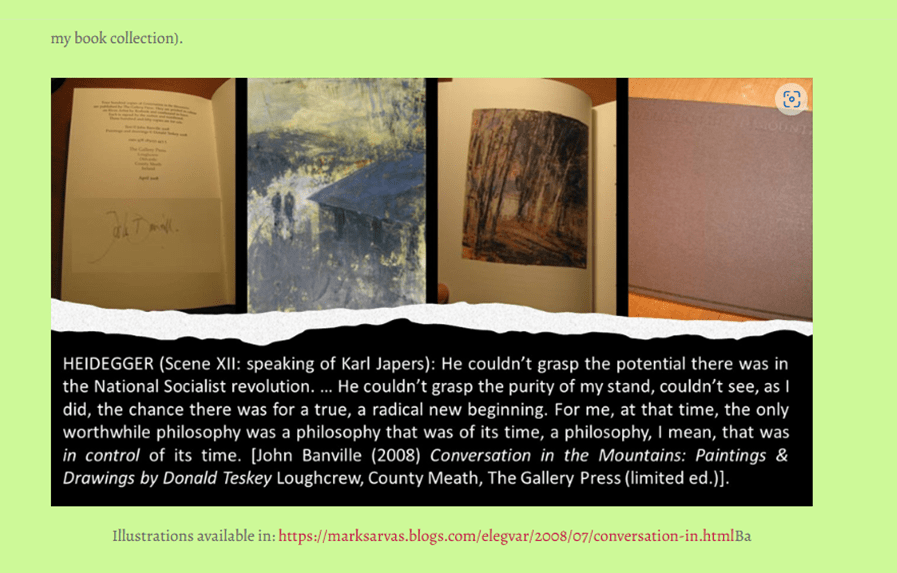
The Banville blog pictures of Heidegger’s hut
The banana attack sculpture one is purely delicious. I find the explanation of these that the houses (here both representing houses owned by great men’) are attacked because such housing is often used as a form of traditional art museum less than compelling, even if true. For me the attack is about form as deformation – the creative and destructive in artistic making, the serious (and what is more serious than Heidegger with his formal fascism) that is the important idea about the kind of performative we find in the later sculptures – the body of Wurm being intuited in the visibility of the remaining attack.
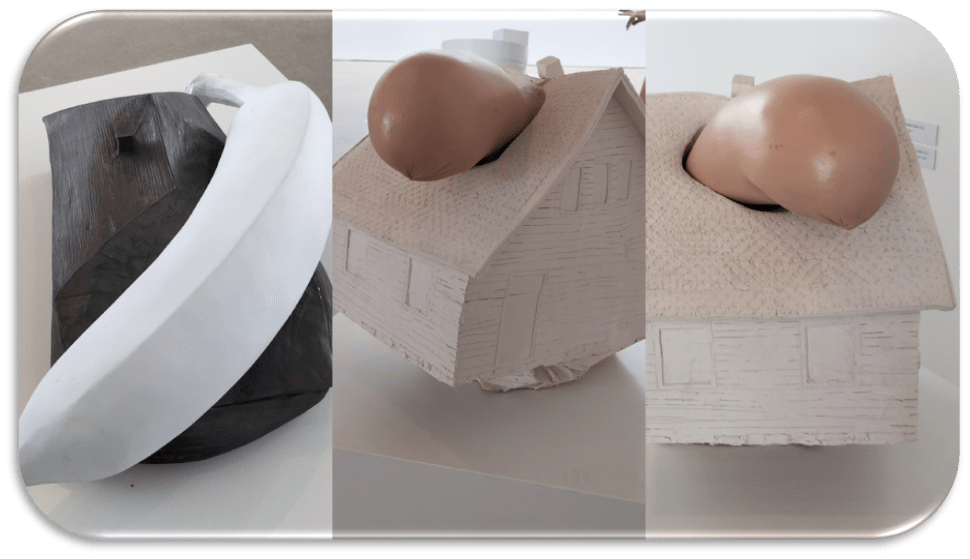
Banana attack and the attacking sausage in Heidegger’s life-hut.
I will end this blog with more thoughts about attack as an icon of the performative in art for it links many themes that I usefully learned from the 2017 Rollig catalogue, especially from Severin Dünser. For in both Dünser (and Alfred Weidlinger’s interview with Wurm) I learned how Wurm married the need to show his own body dynamics intuited in the ‘marks’ in and made on his art with actual collaborative performance. I did not stay long with the One-Minute Sculptures reproducible in the final room of the housed Wurm exhibition at YSP for that might have spoiled the joy of the children (many of them) involved in helping Wurm (even when he was not present) remake these works of art but I observed with pleasure what make these words from Wurm more pleasurable as ways into the sculpture I then resaw:
Right at the beginning I just took lumps of clay as they were delivered. I drilled or punched my hand into them, or kneeled on them. The imprints of my body were the sudden gestures that deformed the clay. When I sat down on the clay, the imprint of my rear was the work.[4]
It’s easier to see the point iun the collage below using pictures from the same source, but where we see Wurm ‘attacking’ or in the making process of one of his clay house models:
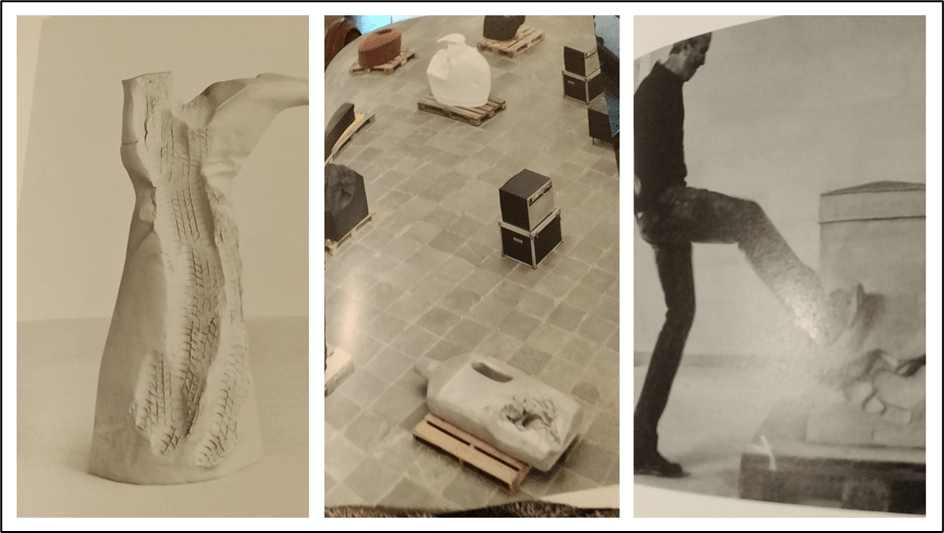
There are also examples there of many of the attack pieces that focus furniture, clothes and models of everyday objects – such as bottles of domestic cleaning fluid. My favourite is the boot cast with the visible ‘tread’ of a bike wheel imprinted (in relief – for imprinted is too flat and superficial a word). Of course this plays conceptual games. Boots tread and shoes and tyres have tread – both made marks in relief in softer more vulnerable material (and as we have seen even a metal car can be vulnerable). The idea of harm and ‘accidental’ or even intended violence in the performative is never far away. And see the detail from Snow below where a cast of a footprint in soft snow is violently hardened in coarse clay material – its ‘tread’ varying as the depth of the wound in the vulnerable surface responds to varied FORCES.
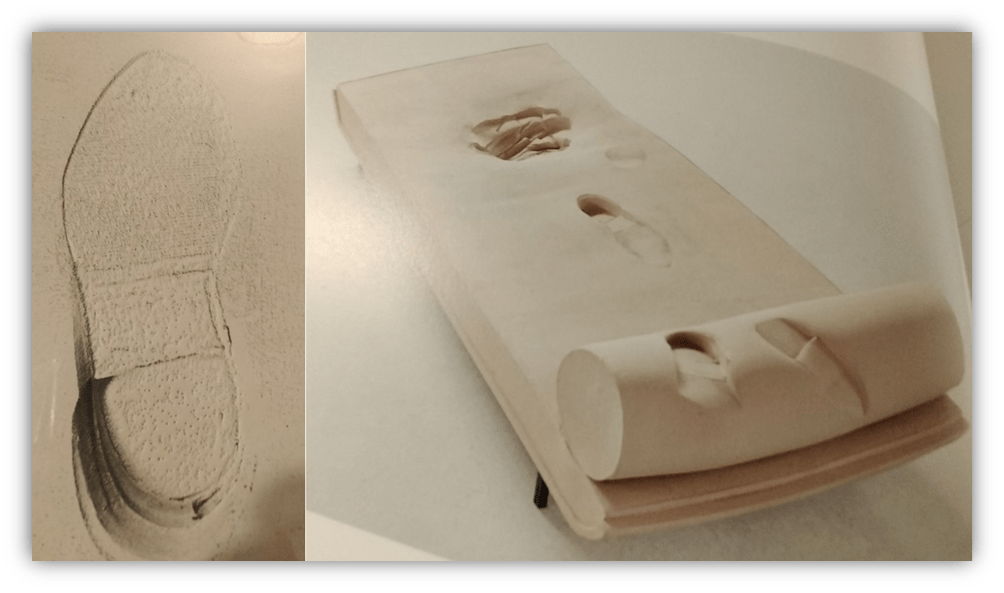
It feels even sexually and domestically violent in the cast of the futon bed, where a foot makes varied impression on a bedhead – on a head we feel – and in the stomach of the piece, gouging deep in an evident print hollowed out in relief from a ‘bum’ print. This is fearful stuff to me in the performative canon. And it made me see (those pictures above from the catalogue, those furniture and house pieces I saw on this day. Below is my final photographic collage in this blog. Note the bed above was present but I did not then have it imprinted in my psyche as it performatively and repetitively (like trauma) as it is now.
But always imprinted was the house sculpture deformed into performative flow, as if exposed to some fearful heat, perhaps of a bomb. Form here begins to overspill and threaten all containment, showing that performance might be reducible entirely to the impact of fashioned human energies – of destruction as well as construction. These are frightening thoughts but they are the stuff of true art.
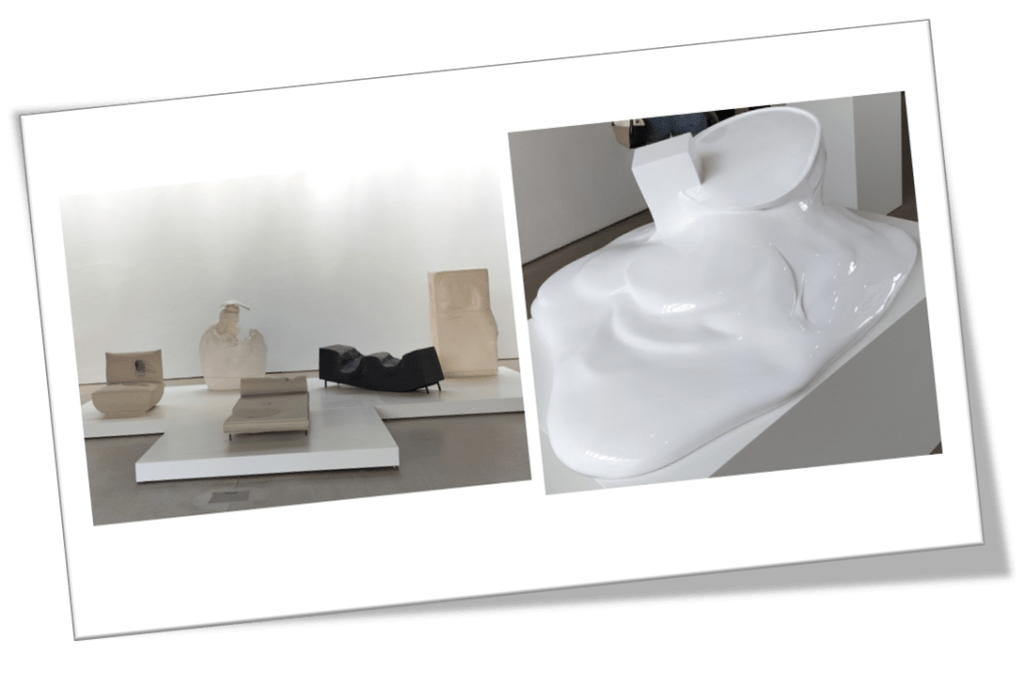
You must see this exhibition. YSP is well supported but it is always a treat and the experience is often deep.
Love
Steve
[1] Severin Dünser (2017: 197) ‘Attempts at Liberation in the Fog of Sculpture: On Erwin Wurm’s Performative Sculptures’ in Stella Rollig (Ed.) Erwin Wurm: Performative Sculpturen / Performative Sculptures, Vienna, VfmK Verlag für modern Kunst GmbH.197 – 209.
[2] Severin Dünser op.cit: 197.
[3] Stella Rollig (ed.) op.cit:
[4] Wurm (2017: 193) in ‘Erwin Wurm talks to Alfred Weidlinger’ in Rollig (Ed.) op.cit: 185 – 195.
 Steve_Bamlett_blog
One thought on “A blog: Tuesday 15th August 2023: Lunch with the ideas and forms of Erwin Wurm.”