‘
‘“Tell me a story.” … / “I cannot,” I whisper. I hide my face in your shoulder. I cry. “I cannot lose you.” I pull you closer to me, I cannot lose you after all of our stories. My life is tangled into yours and I fear pieces of me will die with you. … “Tell me something sweet in Portuguese,” I ask Esme, … / “Well, I have love for one word that only Brazilians say,” she tells me.’ … “Saudade is the enjoyment of remembering, a feeling that comes to you when you remember things from the past and feel good about them.” …/ “We are talking about a genuine feeling of happiness that comes from remembering things that are long past.” I let my mind drift as I climb next to you in your hospital bed’.[1] This blog looks at Ahmad Danny Ramadan (2019, Ist. published 2017) The Clothesline Swing London, The Indigo Press and wonders about the therapeutic in the act of storytelling, even those that might pass between an author’s first novel and his second, The Foghorn Echoes (2023). Info to @TheDannyRamadan
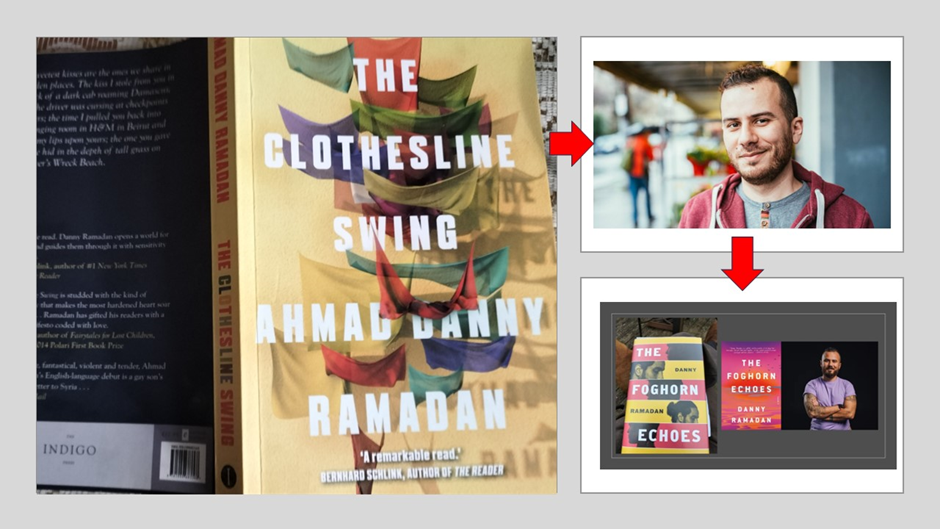
The 2019 front cover referred to in the blog, the younger author and a reminder of him in 2023 (follow the direction arrows).
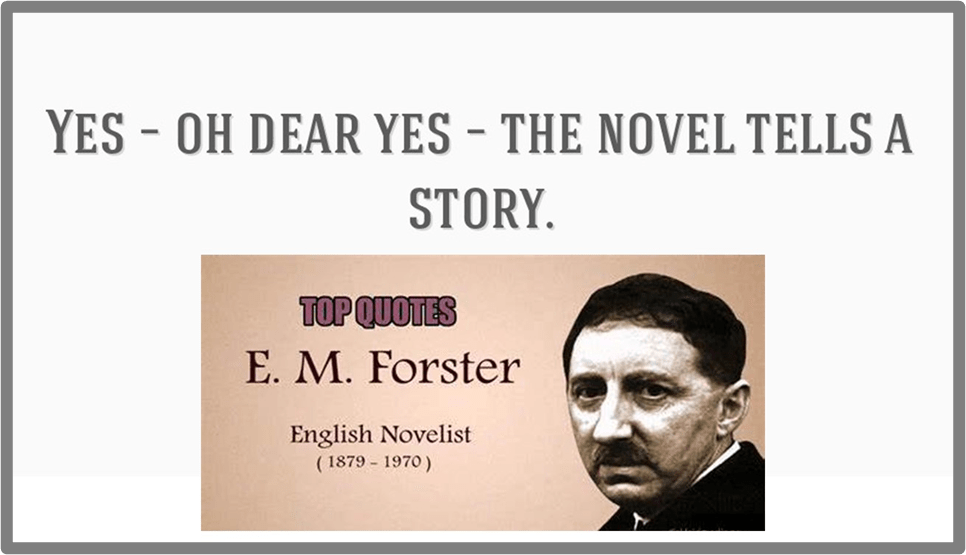
In an earlier blog I tried to show the pure mastery of Danny Ramadan’s 2023 novel The Foghorn Echoes. (The blog can be accessed at this link). Though this is as fine a story about the diversities and intersections of human rights that includes those of queer people, its virtue is that it does not pretend that even the experience of multiple oppressions and powers to be oppressive are the only issues in any one person’s or group’s life. However, in these novels it is resoundingly clear that we must take the oppression people experience as a whole, including that they are capable of exercising on another, as do some (of course not all) white gay Canadian men in the novel with him. It is also clear, however, that the novel tells us that ‘telling stories’ needs to be as open to the mental and social operations that mould storytelling – about its primary feature that ‘it tells a story’ (in Forster’s massively significant phrase) or stories in ways with which any person can connect in memory or imagination – as it is about oppression. My own feeling is that this is true of his first novel too, although it bears more marks of the pain with which it gained the experiences it also painfully talks about. This first novel is perhaps too more self-conscious of its role as a story about telling than the latter one where stories are told at moments in interactions where we might imagine ourselves telling a story too, just in fact as E.M. Forster does, rather than as part of the literary apparatus, devices and tropes of the novel.
Sarah Gilmartin in a 2019 review of the paperback publication in The Irish Times makes it clear that she finds the apparatus of story-telling in The Clothesline Swing rather too artificial. She characterises the main narrator as ‘a gay Syrian refugee who tells the story of his life in a Scheherazade bid to keep his terminally ill lover alive’. She later informs us, usefully for me that the name given to that narrator, Hakawati, most often within it, is ‘ the Arabic word for storyteller’.[2] The Scheherazade reference (to the epic set of stories usually misnamed The Arabian Nights) is not just Gilmartin’s – it is consciously employed by the eighty plus year old narrator, Hakawati, to tell of his situation, caring for his dying male partner, and makes her is conscious model and the support of his favoured identity:
I imagine Scheherazade and her life, without her unruly king demanding stories or threatening to send his bride to the swordsman to cut off his head, where would she be? … She needed to tell the king her stories as much as he needed her to mend his broken heart with fairy tales.[3]
We will return to this attempt to give framework to the stories told by Hakawati a common framework with The Arabian Nights later. Here, I just want to point to the fact that Gilmartin sees this attempt as the source of this debut novel’s problems as a novel, for she concludes that, in effect:
Hakawati tells tales of war and leaving home, his childhood in Damascus, his family’s violent reaction to his homosexuality, and his various ex-lovers. The novel reads at times like a confused collection of stories as Hakawati also flits between the lives and stories of his friends – with jarring issues of time and sequencing.
The ‘confusion’ is clearly here meant to be a negative judgement of the effect of the whole novel, as is the brutal descriptor ‘jarring’. She hates the story-telling devices – especially the presence of Death, ‘a hackneyed figure who looms large over the narrative’ as a listener – and she finds the stories themselves to be never ‘deep enough’ to draw the reader’s empathy with the characters in them, a factor compounded by the ‘whirlwind of locations – Syria, Egypt, Canada, Turkey, Lebanon’ in which the stories are set. There is in my view much unfairness in this expression of settings as a problem in the novel, for after all, the novel tells the story largely of the displaced and the marginalised, who find settlement itself a practical issue expressing that marginalisation and, of course, the story of migrants, to whom a ‘whirlwind of locations’ presented in their life-stories is hardly a voluntarily chosen mere literary device.
What Gilmartin seems to want from the novel is to pigeonhole it into the category of ‘minority writers’ who seek ‘a platform to tell their stories’. Hence, she picks out the intense confrontations between young gay men (and women) and their fathers where she believes the story is told convincingly enough to allow us to care for the victims of these interactions, In brief, though the debut novelist is attempting to, possibly in the line of the self-conscious magic realism of Salman Rushdie, be self-conscious about why stories matter and are essential means of validating marginalised lives:
Unlike its premise, The Clothesline Swing is not a book with Scheherazade charms, but rather a testament to the troubles endured by a beleaguered minority.
Perhaps even more hurtfully she says that it ‘allow us to learn much about the cruelties of life in far-flung lands’. To my mind, there is more than a little racism in that last phrase, however unconscious it probably is. What emerges is the sense that lives in ‘far-flung’ lands are likely to be lived with a more ‘primitive’ force of cruelty and violence, something that besmirches the culture of Arabs across many nations. Such a conclusion totally ignores the fact that the cruelties occur too in Canada, hardly covered by the term ‘far-flung lands’ even if you are witing in Dublin, at the hands of white thugs and racist administrators of white institutions. It ignores the simple beauty of certain aspects of the culture in which the Syrian characters are raised with its folk crafts and traditions, such as the ‘clothesline swing’ itself, invented out of parental love but perverted by the exigencies of sexism and civil war against fascism.[4] It ignore the fact that the brutality in Syria is located not in its foreign exoticism but in a distinct politics that is often a response to Western imperialism and is nuanced in the telling, especially in the tracing of the history of the Assad regime, and juxtaposing it first to that ubiquitous figure, Death (hardly ‘hackneyed’ in this context) to the imported ideologies of the Marvel comics, and especially the story of Superman.[5] The characterisation of that latter superhero is brilliant for it shows how white imperialist ideas are embedded in products aimed at the indoctrination of the young globally, as The narrator half explains to his father, himself something of a tyrant.
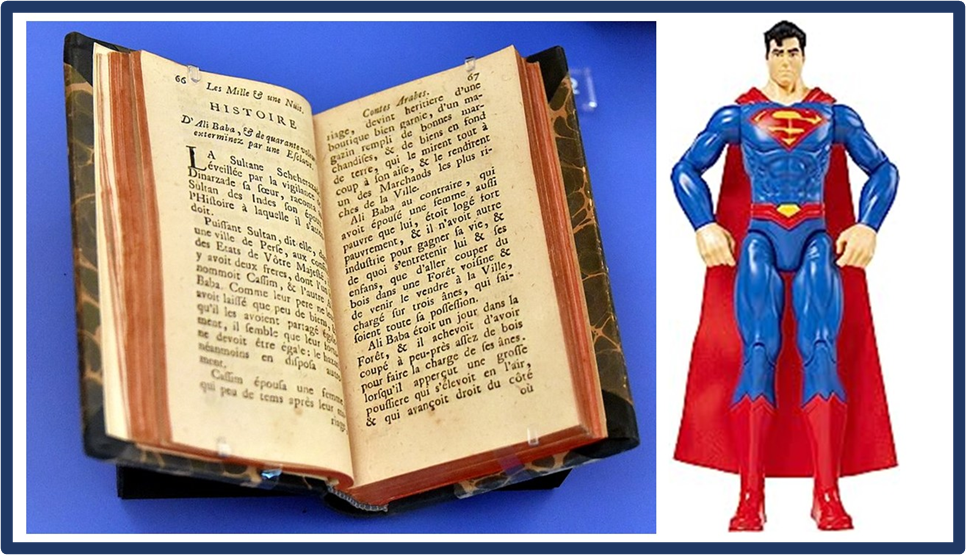
The first European edition of The Arabian Nights By Osama Shukir Muhammed Amin FRCP(Glasg) – Own work, CC BY-SA 4.0, in https://commons.wikimedia.org/w/index.php?curid=92800765 (it was in French) & Superman toy.
“Superman has always been my least favourite,” I told him. An alien comes from across the universe and takes control of the world without election, bringing all kinds of monsters who truly only want him, while the people dying around him are collateral damage.[6]
This characterisation of the effect of Occidental imperialism is telling and accurate. There is much more, in fact, in the novel that is about how young children, including queer children, learn the complicated mechanisms of the oppression they will face as adults and its origins in ‘the crushing weight of so much past’.[7] I think likewise the ‘confusion’ of ‘time and sequencing’ noted by Gilmartin is relevantly purposive to the experience of migrants pulled from any comfort in their own settled time and space. It is not surprising that when people meet across distances between which they have been dispersed they feel: ‘Time loses track of us’.[8]
In these contexts asking each other to exchange stories becomes a means of locating self across multiple times and spaces. This is especially perhaps the case for queer people forced to lie about the locations in which they find love. The first time the narrator introduces himself to the lover, the duration of whose life and death are the main repository of his attempts to make connection by storytelling, is the first time he calls himself ‘a fabulist, a writer, a hakawati’. The stories comprise the places they make love, whose specificity of location had to be disguised in the past: he remembers that fading and dying lover in his youth ‘fabricating stories to your mother about your whereabouts’. [9] Love is described in these places as sharing aspects of the socio-political and military ‘background’ of the novel as the lover is remembered as making ‘love to me as if you were an invading army in a sudden war’.[10] Those disguises, born out of oppression, sometimes have to be adopted in love, as in that wonderful moment where after the death of a vanished Syrian in Assad’s jails his gay male friends tell her lies – that they are college friends – because ‘telling her the true version of events would destroy the poor woman’. There is even humour in these eight gay men ‘all pretending way too hard to sound straight, all there to help the mother during the crisis’. [11]
All of this Gilmartin misses because she expects stories of queer Syrians to be the stories of ‘victims’ alone, not as people empowering themselves to find ways of telling their own stories. Gilmartin has a point that this novel may attempt too much – but that ‘too much’ that is also mixed up and confused is a reflection of the multiplicity of intersecting oppressions of which the story of one alone would grossly oversimplify. And I think myself this book beautiful, if raw (and hence I prefer the lighter The Foghorn Echoes), because it insists that one reason we need stories and a lot of them is to evade or ‘escape’ endings sometimes – like the death of your partner – but at other times to remember and re-imagine them so that one is not overwhelmed by some final apocalypse.

This passage struck me as beautiful. In it the end of ‘love’ is allowed to fill the mind of a reader. For the narrator himself, it allows him to divert and escape from his dream that has predicted he will die alone: ‘a cold death, on a metal hospital bed’ (a fear of many childless lone men). He remembers a time when apparently left by his lover in the past for three years. The absence is not permanent but feels as if it is and hence it tries out painful thoughts, not all of which one could be proud of:
“He broke up with me because he couldn’t handle my pain, while I was there for his.” I hated you. All the photos of us I saw on Facebook were blaming me for trusting you. All the poems I wrote for you felt like unattached words, divorcing each other and walking in different directions. …
….
… I felt like an old shield that had been carried by a courageous warrior, protecting him from arrows and swords, then dropped in a corner, forgotten, replaced by a beautiful new shield that didn’t carry the scars that I did.[12]
Having just undergone a break-up of a sort I recognise all that and also recognise its tendency to oversimplification of both the self, the other and the roots of feelings of betrayal. I think that in itself is therapeutic because understanding the dramatic soliloquies of the abandoned is a process every dumped person must go through – not least for the same unreasonableness will characterise the death of our beloved one or that of our self – the same attempt to pretend one’s own innocence and ignore the pain of the other, the same excited imagination, the same recourse to tired imagery of the most plangent kind that is in some way narcissistic – for one never was a warrior, nor your relationship so simple as shielding the other.
Similarly stories of security often centre on the examination of the spaces we call homes – houses of differing relationship to us sometimes. Houses make themselves complicit with the dramas of separation and attachment, as in Chapter 9 ‘The House with the Belvedere’. They dramatise settlement and nomadic migrancy, inclusion and exclusion, invitation and expulsion. If this is not understood as this subtle you will not be able to read the beauty of this whole chapter for: ‘Houses have stories to tell but sadly, not many of them speak loudly’.[13]
It is in this chapter that the narrator’s mother explores all these themes in her relation to the ‘clothesline’ makeshift swing, which in the end opens spaces to her – interior spaces which equate with an escape into psychosis and which offer to the narrator an invitation to him, for he ‘wanted to know those places too’, where one feels ‘capable of everything’.[14] They are an escape he will find nowhere else until he undergoes therapy, a therapy that extends for the novelist into the achievement of his second novel which impels order into places where previously no order can be. It readies you for the death of love itself, or what feels like that. As he awaits news of his partner’s death in hospital:
I rush through the halls of our empty house, looking for the real you. I hear you recite words of abandonment and fear from all the corners, some in your strong husky voice, others in your soft, well-spoken older voice. Death swiftly catches up with me; he covers me with this cloak.[15]
I find that passage unspeakably beautiful and accept the emergence of death personified for it is they who reveal to us that loss here is the loss of meaning of familiar spaces, a prediction not only of the loss of those we love more than, apparently, life itself but of our own death, a thing we must accept before we accept that of the other, which might otherwise have stolen up on us unawares and pretended we were immune from the same fate. I cannot convince you I am sure that this is a safe reading of the novel. It is a novel that inhabits spaces few others do and will not be simplified as the voice of a minority. It is the discovery of voice from the fragments of the marginalisation and oppression that give anyone but the entitled and unimaginative a taste of a loss so great, it is a gain in humanity. A sense that we allow other and ourselves to pass is the only route to anything like maturity, to say nothing of therapeutic recovery from trauma which continually presents loss as apocalypse. It is a giving up of the exchange of stories though, as we see in this strange seminal paragraph about survival articulated around memory of that ubiquitous clothesline swing:
To survive, you allowed your stories to commit suicide. They hanged themselves on a clothesline. To survive, I allowed my stories to consume me: my body will continue this insane swing regardless of how many times I feel like throwing up.[16]
There is an end to that swinging only when we accept exchange of lives is no longer possible and stories either die at their own hand or consume their progenitor in their own death.
Now whether you believe this or not, I insist this is a very good novel indeed. Do read it, but really read it. Do not pick it up as a gay novel or a novel of LGBTQI+ migration – read it as a document that speaks to your mortal humanity. Such things involve manipulation of narratives in time including illogicality in sequencing, something like what fills the space between the definition of the Brazilian Portuguese word I cite from the novel in my title and the decision the narrator makes to lie on the bed and comfort his dying lover, though the feelings, action and thoughts are far from ‘long past’ yet.
“Saudade is the enjoyment of remembering, a feeling that comes to you when you remember things from the past and feel good about them.” …/ “We are talking about a genuine feeling of happiness that comes from remembering things that are long past.” I let my mind drift as I climb next to you in your hospital bed’.[17]
Love
Steve
[1] Ahmad Danny Ramadan (2019: 95-7, Ist. published 2017) The Clothesline Swing London, The Indigo Press
[2] Sarah Gilmartin (2019) ‘The Clothesline Swing review: Striking account of growing up gay in Syria’ in The Irish Times (Sat May 11, 2019 – 06:00). Available at: https://www.irishtimes.com/culture/books/the-clothesline-swing-review-striking-account-of-growing-up-gay-in-syria-1.3883435
[3] Ahmad Danny Ramadan (2019: 182, Ist. published 2017) The Clothesline Swing London, The Indigo Press
[4] For the clothesline swing see references, from various times in its inception by the narrator’s father and use by his mother in ibid: 133, 180 & 198, respectively.
[5] Ibid c. 122ff.
[6] Ibid: 123
[7] The quotation is from the novel’s epigram (ibid: 9) from that anti-imperialist fabulist, Gabriel Garcia Marquez.
[8] Ibid: 196
[9] Ibid: 13f.
[10] Ibid: 15
[11] Ibid: 127
[12] Ibid: 96f.
[13] ibid; 129. It is in this chapter that the narrator’s mother explores all these themes in her relation to the ‘clothesline’ makeshift swing, which in the end opens spaces to her –
[14] Ibid: 134
[15] Ibid: 186f.
[16] Ibid: 180
[17] Ibid: 95-7
 Steve_Bamlett_blog