An update based on actually seeing the production of The Faggots & Their Friends Between Revolutions (based on the cult book of that name by Larry Mitchell & illustrated by Ned Asta. A brilliant show at Home Theatre 1 in Manchester on Sunday 2nd July at 3.00 p.m., as part of a selection of the items from the Manchester International Festival.
The original blog available at this link.
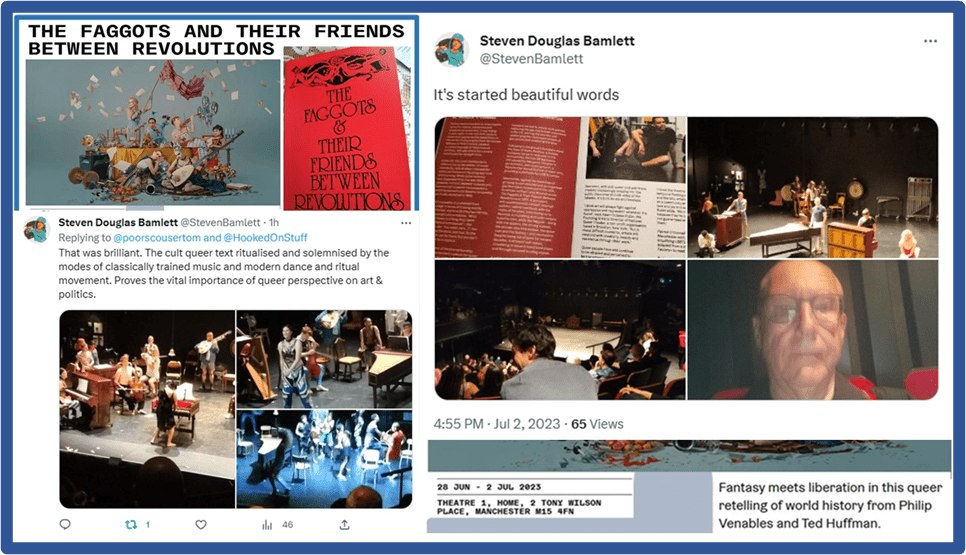
This is a blog updating my thoughts after seeing the drama based on it today at 3 p.m. at Theatre 1, Home in Manchester. It was a nervous start for me because I tried to walk from our accommodation. Geoff stayed in with the dog who gets nervous on holiday. The printed Google map I used was near to useless though and I had to be helped along the way by many people who could not have been more thoughtful and concerned. In fact, I found this kind of attitude throughout, which helped since I was alone on this part of the trip (given Geoff preferred to dog-sit) because I had been dumped by the friend that I was coming to meet in Manchester two days ago, and hence wandered around half lost in emotions based on feeling rejection and self-doubt. However, I did reach the theatre eventually, although finding and choosing just one of the three empty seats awaiting me made me gulp with an intensity I can only remember from adolescence.
But this was a production I will never forget. It was marked as the ‘relaxed version’ of the show which seemed to mean that help was available to people who felt nervous and that the production was opened and interrupted by a hello and talk with the audience beautifully judged by Kit Green, the main narrator of the event, whose voice turned the words added and those from the original text into the appropriate kind of poetry. Kit’s (whose pronouns are either they/their or she/her by her choice) role included song, spoken word poetry or poetic prose and gestural dance and movement. One could not help but love her and the guidance she gave – its tone so witty and yet so fundamentally serious.
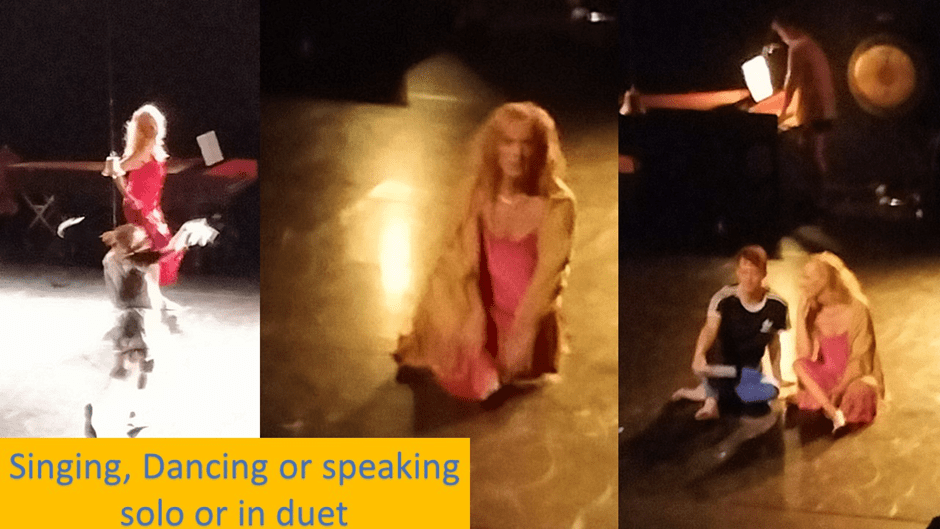
The poetry I referred to above so well spoken by Kit was sometimes classical pastoral (in the story of the fairies life in a world of vanished ‘gentle folk’) or epic. The latter genre characterized the opening story of the genesis of ‘the men’ who remain the epitome of all that is mean, vicious and selfish to the ‘gentle people’ they displaced, and the women, fairies and faggots treated as the dialectical opposite of their meanness and fear of the body who were born to house the remnant gentleness and sharing. It is a story of the birth of an aggressive capitalism, imperialism and inequality which is summarised in the phallocentric character of the city of Ramrod with its leader, Warren-And-His-Fuckpole. All this opening feels much more like poetry, even the prose, because of Kit’s almost classical ability to render rhythm in speech than when I merely read it to myself in the book.
But I wonder if only we beneficiaries of the ‘relaxed version’ took part in Kit turning the material about the use of psychiatric categories to control the gentle, faggots and fairies into a form of communal singing, based on that very stanza I quote in an illustration in my late blog (the picture is reproduced below).
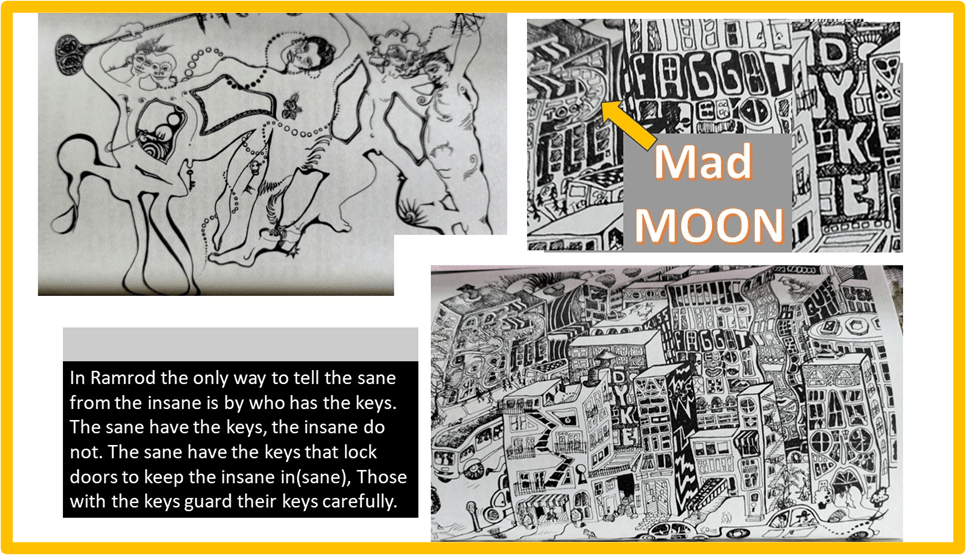
Pages 40f (left) & 81 (right).
As I said in that blog, these drawings really show the moments when the faggots seize the keys to the insane asylum, and dance with them in a way that changes its meaning. In our production, the text was a little truncated and turned into verse lines with the wording changed. The audience was rehearsed through the lines and urged to shake keys (I did that – what a playful boy I felt) every time keys were mentioned. It was the only equivalent of the otherwise unused lines from the original here:
One day all the faggots appear with keys. Keys on long chains and on short chains; keys on the right side and keys on the left; keys on the cock and keys out the ass; keys on the tits and keys under the arms; keys to proclaim sanity by those the men see as insane. [1]
Though the sexual reference was lost or played down in the production, our understanding of this section remained joyful – made serious only by the trans woman Kit telling the story of how she had to accept the diagnosis ‘sexual dysphoria’ in order to access surgery for transition. Reassured the diagnosis would never be used and remain locked in a filing cabinet, Kit nevertheless asks: “But who had the keys”. The Men of course. As an audience made up mainly of LGBTQI+ people the search for our own keys and our jingling thereof gave some nuanced insight into the feeling of being more entitled than our equivalents in the 1970s (after all, I was one) but yet mainly playing at entitlement, on condition we allow the men (the powerful, the 1% owners of the majority of wealth, the imperialists, racists and so on all assumed in in this) to keep their hegemonic hold on power. Larry Mitchell in a Question-and-Answer in the theatre programme summarises the politics of his original book, from which the theatre and music writers Ted Huffman and Philip Venables took inspiration, thus (acknowledging that it contains part history, part commentary and part fantasy):
The book describes three waves of revolutions: first, the devastating revolutions that created a patriarchal ‘civilisation’. Second, the mollifying revolutions that modernised and tempered the brutality of that patriarchy. Third, the revolutions that are coming.[2]
The second set of revolutions included the compromise with paper systems (by which the text and show represents both money and a contractual and ownership culture in capitalism) includes the view that gay marriage was such a tenet of the ‘mollifying revolution’ creating a homonormative culture that would collude with the men and have some of the same interests politically and socially.
However, my expectations of the show were, it being described in the publicity I saw beforehand as a ‘musical’, that it would be a light-hearted resumé of the history. This is probably a gross misrepresentation in my mind of ‘musicals’ but this show was nearer to a collage, with seams sometimes and sometimes not, of opera (which is how Venables describes his musical composition in the programme), modern dance and social ritual including geometric and other kinds of dynamic spatial sculpture of the stage space. This led me to tweet thus when I emerged blinking, radiant and warm (even on a cold day in what was once a cold mood before entering) and in love again with our community.
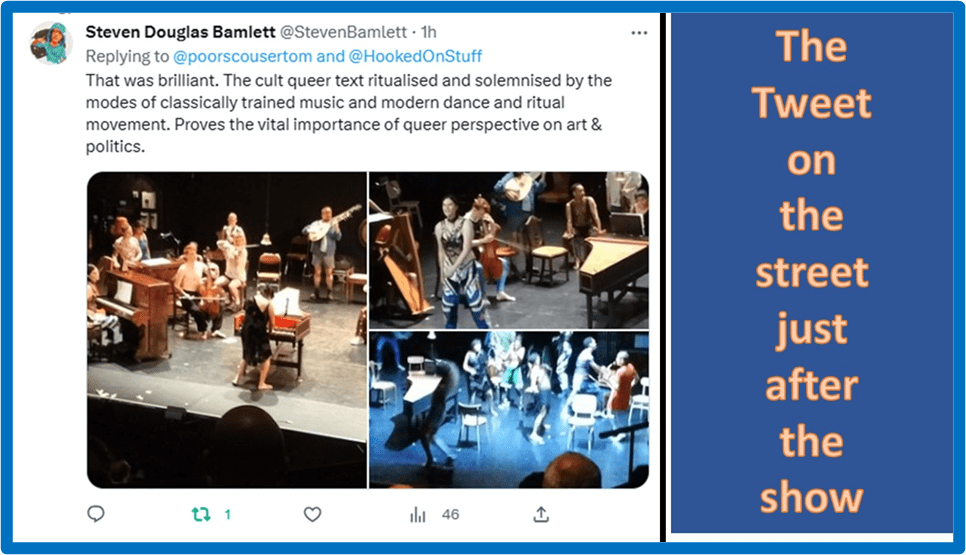
For as I said there this was community ‘ritualised and solemnised’. It was reflected in the warmth of the response of the audience on the stage and, yes, two each other. I was sitting to two remarkable young women, I think a pairing, who restored my faith that the gender-critical movement was an evil aberration, of the men, even when lead by prominent women, including some very entitled white lesbians. It was a high art, very definitely though it referenced the popular, as well as folk traditions in many genres. The voice of Deepa Johnny was direct from operatic tradition but complemented by Yandass, with a set of skills from different traditions.
The play of shaping and reshaping of the sculpturing of space includes bodies-in-motion and instruments (often in motion too). The work is an ensemble one in the best sense, just as the instrumentation was often orchestral in feel. A major metaphor of the play’s work on us was the harmony of just and ‘sharing’ societies in comparison with the dissonances of patriarchal capitalism and its variants. These effects were created in contrastive sequence or even mixed motion, stiller sculpture of space and objects and voice (spoken or sung). Even posture mattered.
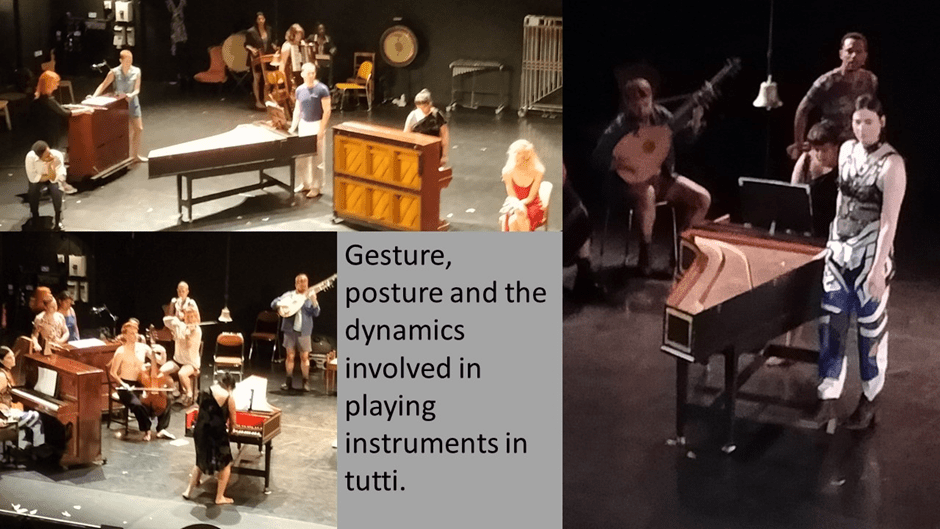
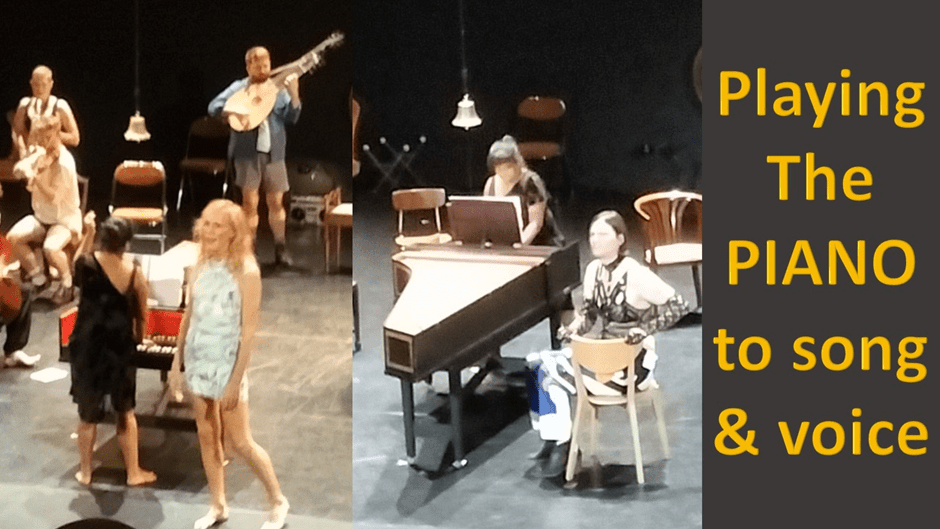
And even the placing of instrument and performer -often contrasting performers who might turn their back io us and those that never do, as in these contrasting pieces for voice and the piano.
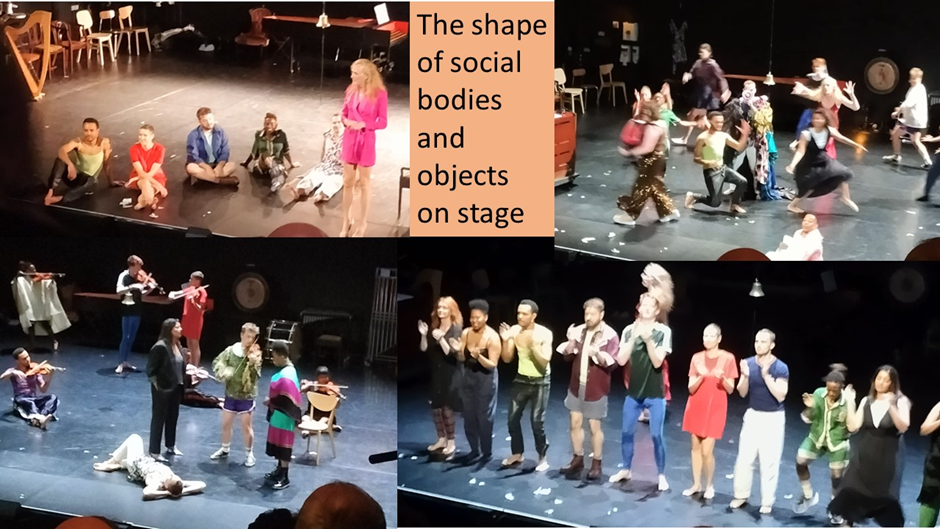
Shape shaped by bodies is expected in ballet but here it came into its own in the use of very different media of artistic expression, co-operation and conflict. Bodies reshape space whether passively (if that is the right word) sitting or in motion – in geometric (or other abstract) form or representationally.
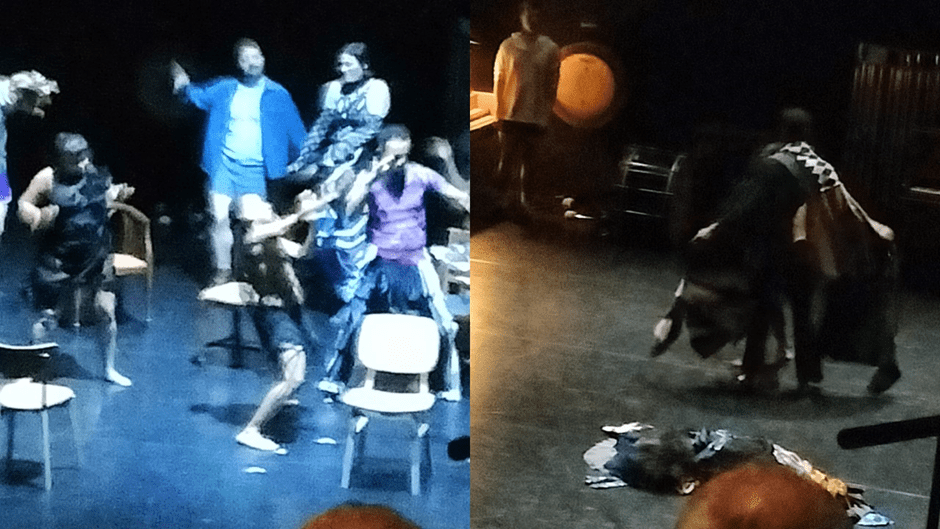
Sometimes these effects range to clothing, especially clothing visibly put on, exchanged, discarded or left in a pile as a kind of medium through which to move. My expectation of high camp was most fully destroyed. There was such variation in the self-representation by clothes. In one scene one actor moved across the stage in a voluminous mass of flexible fabric, introducing the theme of the ‘queens’. Indeed ‘stately as a galleon’ as Joyce Grenfell would have said) but with the cynical sneer removed. For there was great wit in this show but it always had aesthetic dimensions greater than that. Disco dance – was that discord though (for it represented the disco dance of faggots and their friends) or harmonious. This was about nuance and about taking further the politics I saw in my last blog on this as intersectional as modern reality itself. For as Venables says in his programme piece:
We think it is a timeless piece. However, we also wanted to include a more contemporary intersectional aspect, which is indeed part of Mitchell’s own philosophy.
This is not just because it includes massive reference to feminist and race politics less prominent in the original, seen in casting choices, but because the dividing line between collusion and opposition varies intersectionally with some people who ought to be part of the harmony being part of the dissonance.
There is NOT now still chance to get a ticket. It’s run ended on the 2nd of July. For me, what was important was that I left the theatre, however still alone, a much more whole and integrated person than I went in. Let’s hope it returns and sets a trend for this kind of mature queer art.
Love
Steve
All my love
Steve
[1] Larry Mitchell & illustrated by Ned Asta (2019: 40) The Faggots & Their Friends Between Revolutions New York, Nightboat Books.
[2] Manchester International Festival at Home (2023) Programme for the show
 Steve_Bamlett_blog
One thought on “An update based on actually seeing the production of ‘The Faggots & Their Friends Between Revolutions’ (based on the cult book of that name by Larry Mitchell & illustrated by Ned Asta). A brilliant show at Home Theatre 1 in Manchester on Sunday 2nd July at 3.00 p.m., as part of a selection of the items from the Manchester International Festival.”