The feminist philosopher Clare Carlisle says that ‘marriage is rarely treated as a philosophical question’ despite the fact, being a ‘leap into the open-endedness of another human being’, it is ‘difficult to look at directly’, ‘difficult to think that thought’ just like any other ‘shifting, shimmering question, all indeterminacy and iridescence’.[1] Yet despite the language of glitter here and the philosophical ambition that it betokens, Jane O’Grady says that ambition remains unfulfilled, leaving her saying: ‘What exactly is philosophising on marriage supposed to consist of?’[2] Is Jane O’Grady correct to be unsatisfied in this respect? This is a blog that tries to enter this debate on Clare Carlisle’s (2023) The Marriage Question: George Eliot’s Double Life Allen Lane, Life Penguin Random House
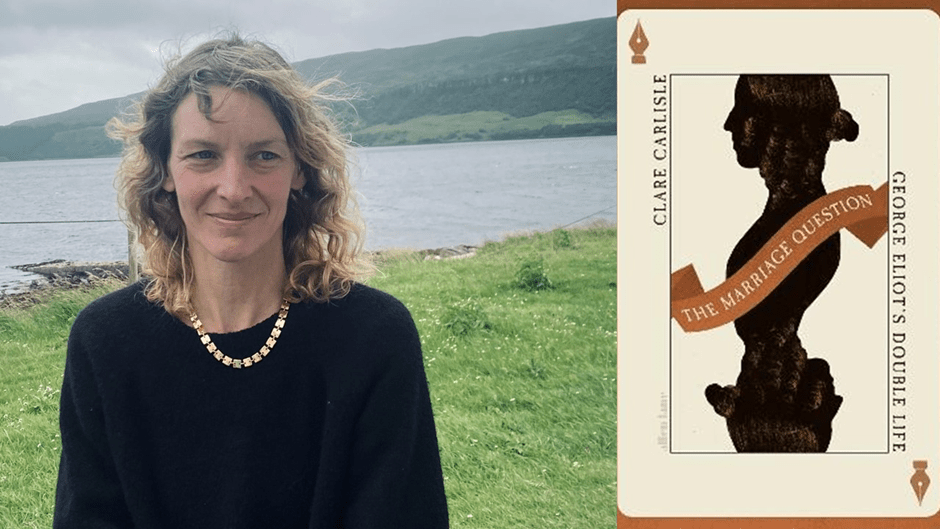
The author, feminist philosopher, Clare Carlisle, and her book
I find it difficult to read critical books on ‘classic’ authors I love these days so I began this book with trepidation for that reason but hope too because it offered an entirely new perspective: that of a philosopher who took the fact of George Eliot’s absorption in the history and practice of philosophy seriously. Yet Jane O’Grady, herself a published teaching philosopher, though she calls the book ‘fascinating and scholarly’ also thinks that ‘it does not quite fulfil the ambitious promises its author makes. What exactly is philosophising on marriage supposed to consist of?’[3] And, after reading this I returned to those promises as Carlisle makes them in her Preface:
There is something dazzling about marriage – that leap into the open-endedness of another human being. It is difficult to look at directly at it, difficult to think that thought. A philosopher usually swoops on such things like a magpie: Look! A shifting, shimmering question, all indeterminacy and iridescence. Don’t you just want to snatch it up, take it home, and sit on it for a long time? / Yet marriage is rarely treated as a philosophical question.’ [4]
Without doubt Clare Carlisle does pose her project as philosophical – as a kind of question around which her discipline ought to be organising a response, even if not providing an answer. Luciano Floridi defines philosophical questions as:
questions whose answers are in principle open to informed, rational, and honest disagreement, ultimate but not absolute, closed under further questioning, possibly constrained by empirical and logico-mathematical resources, but requiring noetic resources to be answered.
Noetic, by the way, merely means that these resources are based on mental activity or the intellect. Of course, put like that any topic, opens itself to askable questions. And, to be fair, Carlisle does say of what these questions might consist (I’m not going to join O’Grady in ending a sentence with a preposition – old duddy that I am). They are, as I rewrite them from Carlisle’s list, again in her Preface[5]:
Should I or anyone else marry someone else?
Who should I marry?
How should me and my spouse live within a marriage?
Should I remain married whatever may occur in my marriage or in me or my spouse?
Eliot certainly examined possible solutions to such questions as suggested by her reading as a translator of European philosophy, as a participant in conversations with George Henry Lewes, the man who took the role that husbands often do with Eliot and who read and wrote about philosophy, and as both a novelist writing of the marriage of fictional characters and a person making decisions in her own life based on such questions. Surely then if Carlisle details the questions and possible solutions such as Eliot may be interpreted to ask and answer them, she is telling us exactly what exactly ‘philosophising on marriage’ is ‘supposed to consist of’. Before I think about it further, it’s worth saying that other critics do not raise this as a problem in this book.
Stuart Jeffries is a journalist not a philosopher by trade but he uses Carlisle’s past work as an historian of philosophy to show he has no bones with doubt that philosophy is rightly invoked here, although the label ‘madcap’ used of Kierkegaard hardly shows a due respect for him:
“That leap into the open-endedness of another human being.” Prof Carlisle knows about such leaps: she is the biographer of madcap Danish sage Søren Kierkegaard, for whom Abraham’s leap of faith in God is the ultimate act of trust, beyond reason or calculation. Marriage could be like that.
George Eliot imagined so. “The very possibility of a constantly growing blessedness in marriage is to me the very basis of good in our moral life,” she wrote to a friend.[6]
Likewise Kathryn Hughes, a well-known historian, also explicitly applauds Carlisle for meeting the aims in her preface wherein ‘Carlisle speaks of wanting to employ biography as philosophical inquiry and here she succeeds magnificently’. Hughes goes on to qualify what might be meant by philosophy of course. Her thinking is here:
As Carlisle shows, philosophy in the abstract meant little to Eliot. It wasn’t that she didn’t understand it – she was the first English translator of texts by Feuerbach and Spinoza – but until that theory came clothed in warm and breathing flesh, it remained inert. The question of marriage mattered to George Eliot not as a rhetorical device or a question of law or custom, but as a series of lived possibilities that needed to be tested and tinkered with in a perpetual cycle of renewal and self-healing. [7]
But having read that, I still feel unsure that to implicitly credit Eliot with ‘philosophising about marriage’ by saying that what the philosophy she provided wasn’t – that is it was not just a ‘theory’ a question asked as ‘a rhetorical device or a question of law or custom’ – gets me no nearer to feeling clear that what is described in this book is ‘philosophising’. Indeed I think the best approach to Carlisle is that of Kathy O’Shaughnessy, herself a writer about George Eliot specifically, that this is a book that ‘has many facets to it: biographical, philosophical, literary’, though basically ‘about the theme of marriage’.[8] For to look for how these elements intersect is not fulfilling, especially to try and insist on this book being philosophy or even as ‘philosophising’, though it references both of these activities. It is after all, just a very good book on Eliot, better in some parts than others.
Whilst the treatment for instance of the early novels is often a refined kind of telling the story, it provides, as Hughes rightly tells us ‘a frankly brilliant reading of Middlemarch’. This is nothing though but very rich literary criticism. Hughes says that, ‘Carlisle shows Eliot’s characters grappling not simply with the stark binary of desire v duty, but also with the “imagined otherwise” of ghostly roads not taken and lives unlived’. So it does and the notion of the philosophising involved here is little more than taking an open-ended approach to any question of human behaviour or institutions with a good sense of the importance of counterfactuals in life and fiction, of multiple potentials existing in life rather than rigid prescriptions. As Hughes puts it, as she describes why it might be that, though Eliot could have made her life with Lewes easier given the facts about Victorian marriage law, she didn’t:
Carlisle offers no single and reductive answer because, of course, there isn’t one. Instead, she points to the way that Eliot’s response to the challenges of living and loving was always plural and protean, always on the point of taking on shimmering new shapes and dimensions.
But then does any novel still worth reading actually do anything else than this. Eliot is a genius in the examination of the interactions of thought and feeling that complicate all human interaction, and not only in relation to marriage but other institutions of civil society. One way in which Carlisle may rescue this as being philosophising is in the fact that Eliot oft used the idea of marriage in terms of talking about factors of human psychological life that are often thought irreconcilable, unmarriable as it may be. Carlisle was especially qualified in this regard for the root source of this expression was Spinoza. Eliot had translated Spinoza, though the translation (unlike her translation of Feuerbach’s The Essence of Christianity) was not published in her lifetime, precisely because Lewes stopped it happening because the fee from the publisher Bohn was insufficient and less than originally agreed. Carlisle calls Spinoza’s Ethics ‘ the greatest work of European philosophy since Plato’s Republic’.
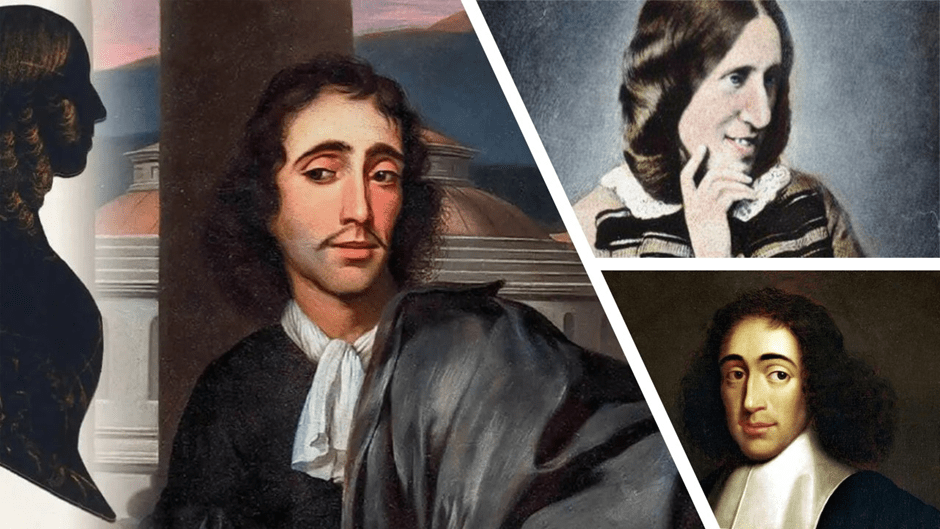
Moreover, this philosopher clearly had challenging ideas about marriage, in Carlisle’s account of him at the least and in Eliot’s translation (which Carlisle has belatedly edited for first publication by Princeton University Press in 2020). He claimed that if ‘two like-minded people live together, they will become “a double individual more powerful than the single”’. This idea runs through Carlisle’s work then, though in tonal variations and sometimes with ironic and even darker variation, as a ‘solitude à deux’. But, as she says on first introducing the philosopher was part of a larger attack on the concentration of Cartesian philosophy on human beings conceived as ‘discrete, self-sufficient substances’ in favour of seeing them ‘amorphous, impressionable ‘modes’ that are continually being formed by their encounters and relationships’ (and not just heterosexual marriages).[9]
Later in the book Carlisle shows us more of Spinoza’s attacks on the notion of discrete personal identity: ‘Of course our bodies die, along with all the memories that make up our personal identity – but the more we share in truth, the greater the part of us that is eternal’. [10] All of this dispersed consideration of Spinoza is meant I believe to support, though not very immediately, the notion in the Preface that marriage is ‘connected with other living things – other people, other relationships – and rooted in an ecosystem’ (or a ‘system of relations’ as Lewes has it in The History of Philosophy). Marriage as well as a dual sharing is therefore also a metaphor (although this thought too never quite gets straightforwardly articulated) of ‘this shared world: again, something that grows and changes’ (and the source of true immortality rather than the dull stasis sometimes imagined).[11]
In the book to marriage is often used to indicate a union of thought and feeling, or cognition and emotion in alternative words and this is an important idea in the book, if not a new one, for it can be attributed to Feuerbach (again in Eliot’s translation) – and was, when I was her student at UCL in the 1980s by A.S. Byatt. Looked at like this ‘marriage’ has a symbolic as well as metaphoric meaning – as used in alchemy where the principles are those of the masculine and feminine for instance and adopted for theory by Carl Jung. One would have liked more on this invocation of masculine and feminine in George Eliot, other than in her quoted letters, for it mattered deeply to Marian Evans and George Eliot (let alone ‘Polly’). But this book is not where you will find it, the subject being too sensitive in these days of gender-critical ‘feminism’ – although I suspect Clare Carlisle is not of that camp. Certainly whether ‘thought’ was a reserve of the masculine was a struggle Eliot faced in her daily work and not only as a novelist.

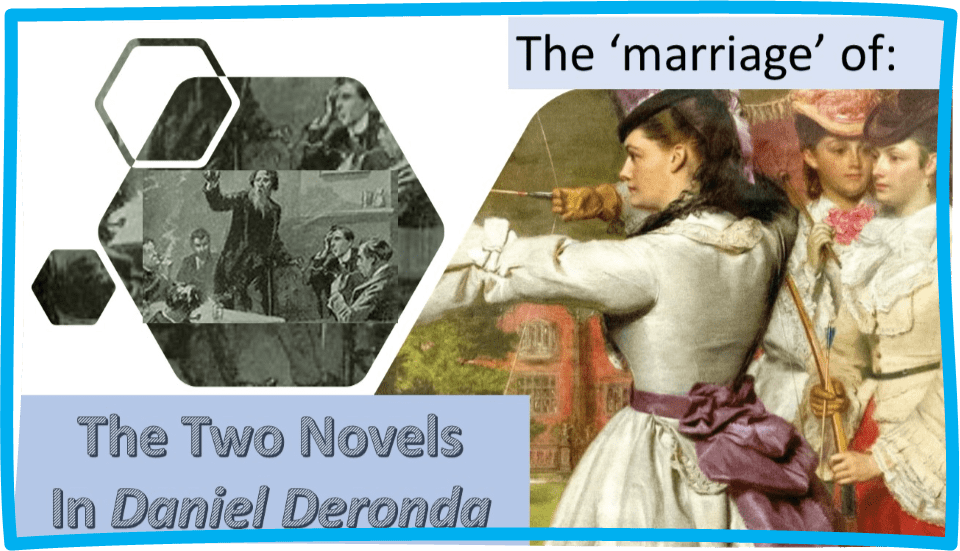
I think all of this suggests a rather fractured book full of brilliance, though oft the brilliance of a good reader of novels and understander of a novelist’s plotting of expectations in the interweaving of human stories (of many things including marriage). It is an irony I believe that Kathryn Hughes is so right about the outstanding reading of Middlemarch. However, had the book worked better we would have recognised that the most brilliant reading in it is of the maligned work Daniel Deronda. The belief that it is two works is much older than F.R. Leavis’s in The Great Tradition, where he recommends divorcing the Jewish novel, fraught with the images of the mystic Kabbalah (including spiritual marriages) from the marriage plot of Gwendolen Harleth. But Carlisle knows that idea is and was a violence to Eliot’s conception and that she felt it deeply when it was mooted by her contemporaries. Of course the two books are irreconcilable, of course the readerly expectation that Deronda might marry Gwendolen in the long duration impossible and fantastic, of course the deeply emotive drive of a story of the illegitimate returning to his/her heritage is miles away in conception from the cognitively controlled ironies (like those in Jane Austen) of Gwendolen’s story. But that is the point. Marriage that may seem impossible, even of two types of novel, may seem impossible and undesirable but sometimes must happen if we are to progress socially.
Carlisle is interesting on the lesbian temptations of Eliot in her later life and one wonders if there an ur-theme there of a different kind of relationship, and, in those days, ‘impossible marriage’ (though some pioneer lesbians managed it). The story of Edith Simcox kissing Eliot and that kiss being returned is beautifully placed in the book.[12] It emphasises that even her marriage to the much younger man, Cross, was described by Caroline Jebb as ‘against nature’, although it is hinted Jebb loved Eliot too. And that Cross tried to kill himself by leaping from his Venetian honeymoon hotel on his wedding consummation night is also indicative of stories of repressed gay men who married their mother-figures to avoid commitment to heterosexual sex, though there is no evidence at all of that for Cross (but then why would there be!). Marriage would be a good subject for a book on Eliot. This isn’t that yet, but it’s a good start. One misses the advent of a critical philosophy free of commitment to marriage as it was and still is to achieve this. But it’s a good book. Just not MY book on my adored and blessed androgyne (despite herself), George Eliot.
All my love
Steve
[1] Clare Carlisle (2023: ix) The Marriage Question: George Eliot’s Double Life Allen Lane, Life Penguin Random House
[2] Jane O’Grady (2023) ‘Writing a Match: The Marriage Question: George Eliot’s Double Life review’ in Literary Review Issue 518 May 2023, pages 11f.
[4] Clare Carlisle op.cit: ix.
[5] Ibid.
[6] Stuart Jeffries (2023) ‘The Marriage Question: George Eliot’s Double Life review – one from the heart’ in The Observer/Guardian online [Sun 19 Mar 2023 09.00 GMT] Available at: https://www.theguardian.com/books/2023/mar/19/the-marriage-question-george-eliot-double-life-clare-carlisle-review
[7] Kathryn Hughes (2023) ‘The Marriage Question by Clare Carlisle review – the lives and loves of George Eliot’ in The Guardian online [Wed 15 Mar 2023 07.30 GMT] Available at: https://www.theguardian.com/books/2023/mar/15/the-marriage-question-by-clare-carlisle-review-the-lives-and-loves-of-george-eliot
[8] Kathy O’Shaughnessy (2023) ‘The Marriage Question — the fascinating doubleness of George Eliot Clare Carlisle’s new biography splendidly locates the novelist in her times’ in The Financial Times online [APRIL 6 2023] Available at: https://www.ft.com/content/fabe58f8-aaaa-4127-9fac-05fd304003d3
[9] Clare Carlisle op.cit: 34 (and footnote ibid; 189f.)
[10] Ibid: xii. For the quote from Lewis ibid: 190.
[11] Ibid: 191
[12] Ibid; 254
 Steve_Bamlett_blog