An update blog on seeing Dancing at Lughnasa by Brian Friel on Monday 17th April 2023 7.30 p.m.
This is an update of relevant text in past bog: Visiting London: A Preview of the Highlights on my visit with Justin from Monday 17th – Wednesday 19th April 2023! See: https://stevebamlett.home.blog/2023/02/18/visiting-london-a-preview-of-the-highlights-on-my-visit-with-justin-from-monday-17th-wednesday-19th-april-2023/

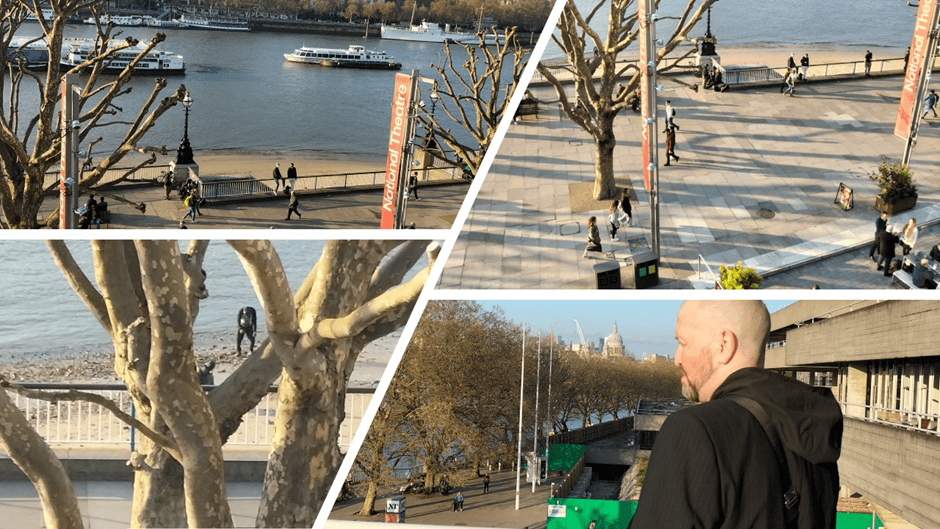
In my preview blog I said that ‘part of the joy for both Justin and me will be … London itself and traversing its streets and underground travel conduits. Even the architecture (exterior and interior) of the venues will please’. In the event this expression of my expectation failed to include the absolute education of my own eyes to see what they otherwise would not have seen. We stayed in a basic hotel in Kings Cross but it took Justin to explain to me the beauty of this listed building (see above). I was delighted too to see other buildings (exterior and interior) again through other eyes. Standing on the Terrace of the National Theatre’s Second Floor (adjacent to the Stalls entrance of the Olivier Auditorium), we saw a diver on a beach of the Thames through the bare arms of what I think was a London Plane tree. A diver, a beach – seen through as though anew but, after all, to me these things were new; something I would not have noticed heretofore. It amazes me how closed were my eyes all those years I lived in London and visited the Thames bank. The collage below attempts to recall those moments on that terrace.
My predicted joy in accompanying Justin ‘to the amphitheatre of the Olivier Theatre, for I know this is a place he goes to for the first time’ was fulfilled in the event. His ability to weld an appreciation with Modernist architecture, even that usually labelled brutal, gave grace to the shaping of space in the Olivier auditorium and the appropriateness of the set for this version of Dancing At Lughnasa.
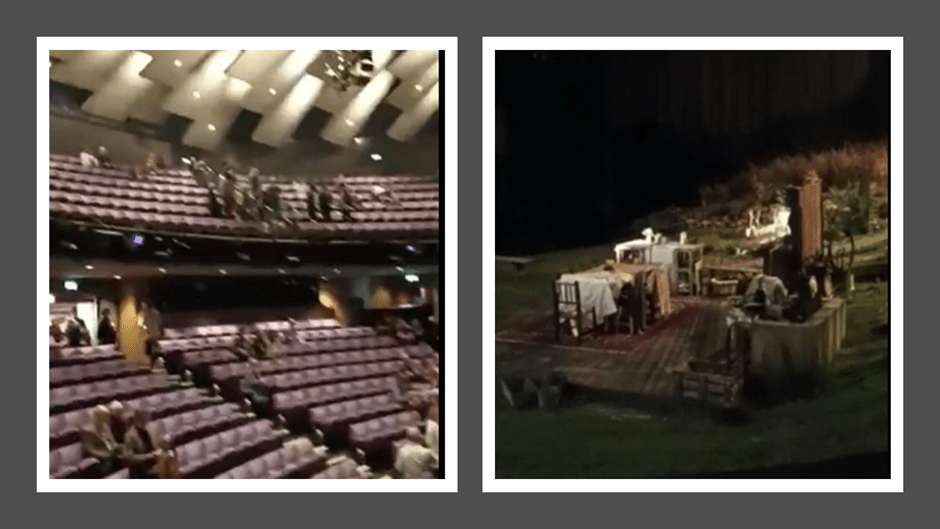
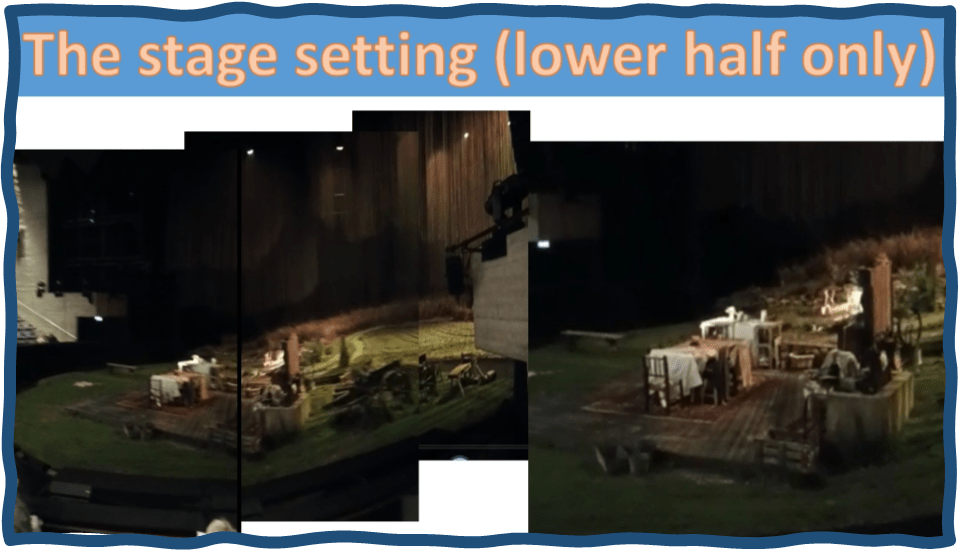
That set opposed the serried ranks of purple seats with a brilliantly constructed mound which recreated not only the enclosure (in every sense of that word) of the home of the Mundy sisters but its garden and wooded environs. The mound above the gate on the lane which led from the home on one side and to the pagan hills on the other with its rough foliage turned to autumn colours and three-D projections on a graded curtain of lightly falling translucence created by hanging cables. The sisters who dared those dangerous external spaces could be typed in mood and the rebelliousness of their spirit by their relative willingness to travel this mound by a road’s regulated pattern, as the teacher and orthodox Catholic Kate does but as Rose in a beautiful scene after meeting a man alone near Loch Anna does not.
In my preview I said of the play:
It’s true that the ‘looking at’ or ‘being looked at’ that occurs in the film (and the play when well directed) is well supported by the text. Moreover, I expect the National Theatre will pull out all the intelligent stops on this. … There is constant surveillance operative between the sisters. In part this is a matter of care, especially in relation to the vulnerabilities of Rose. When Rose goes missing, she must be found before others see her – lest she be in the arms of a man, even a ‘wild’ man’.
The enclosure of the sister’s home in the National Theatre production had mainly to be imagined rather than suggested in the sets. Acting and its blocked direction alone established the position of the doors and windows of its enclosure, which forced attention on the acted body language of ‘looking’. Much of the mutual interaction that involves seeing and not seeing others was emphasised in order to make the audience (gazers par excellence) aware of the mutuality of the gaze through which human beings establish each other’s real and symbolic presence. As I put it in the earlier blog: ‘Staging the play means that the audience not only sees the actions performed but also sees other persons on the stage seeing the action, intuiting thereby those same person’s interpretations of it or its actor as well as their own. Thus, to know this play is to know what surveillance is in a community habituated to surveying itself and others observing them’: (as in Friel’s stage directions): ‘All this is seen- but not heard – by Chris at the kitchen window. Immediately after this kiss GERRY burst into song again, turns AGNES four of five times very rapidly and dances her back to the kitchen’.
With love
Steve
 Steve_Bamlett_blog