Visiting Manchester: A Preview of the Highlights on my visit to Justin from Monday 15th – 17th March 2023. It’s gonna be a blast!
I am visiting Justin soon in Manchester. He is in possibly in everyday and practical turmoil just now and probably wishes I wasn’t going for he has just been offered and taken a move of home. But see him I must – even If I have to arrange a Culture Fest around it to give me an excuse for the indulgence and pleasure of seeing my bestie. So he and I, and his lovely sister, Naomi, on the Tuesday event, are off to see things. I like to think about what I am going to see and arrange my expectations in a way that helps me to enjoy what I get. So here we go for a pictorial beginner:
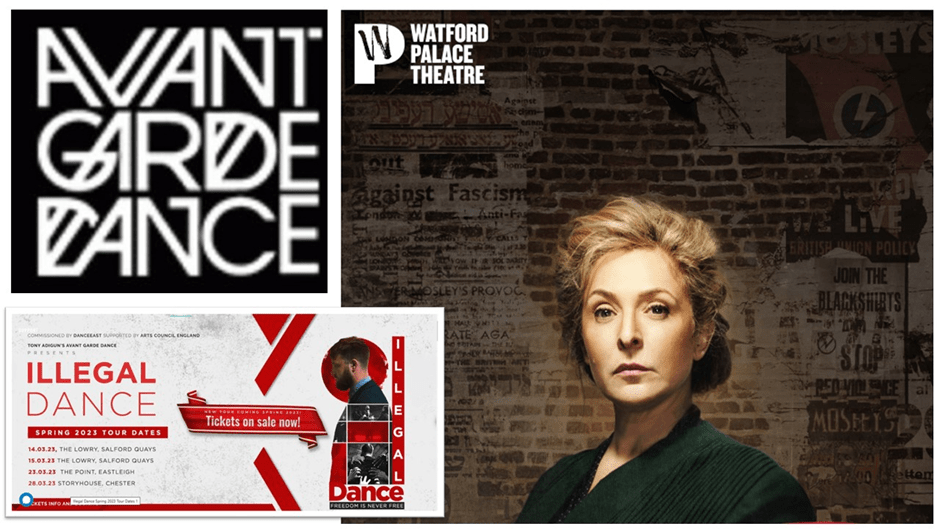
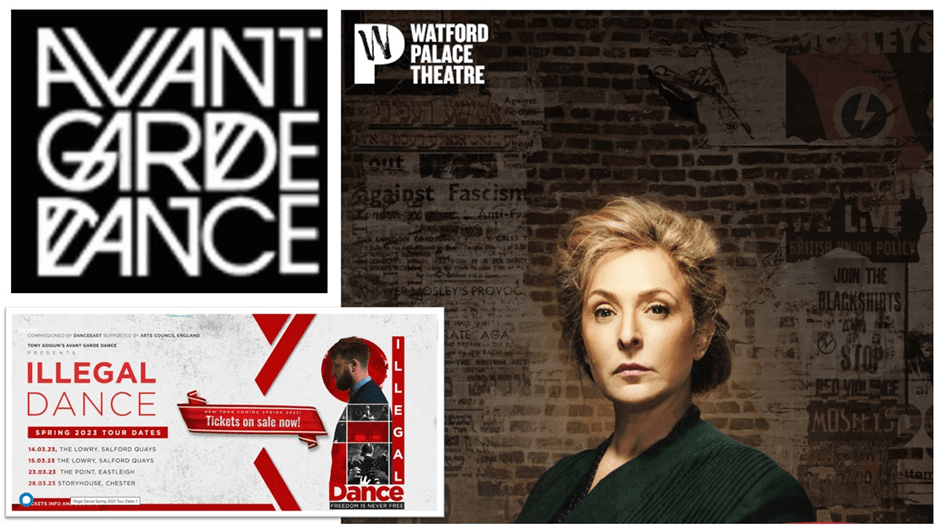
The cultural fare for the Manchester trip is Monday evening: Tony Adigun’s dance company, Avant Garde Dance, perform Illegal Dance at the Quays Theatre in The Lowry, Salford Quays. Tuesday afternoon Watford Theatre Company’s production at the Home Theatre: The Merchant of Venice 1936
It’s a habit of mine to prepare for productions – to read up and to reflect, as this (for me) increases my pleasure in the event, opening up the subtler surprises of the performance, especially of classic pieces. For pieces however that are defined by their novelty of approach that is less comfortable to do, since their effect is more in the surprise of their methods of story creation rather than of re-telling of stories already well-known in ways that sometimes stale their effect unless shaken up in performance. The pre-performance publicity confirms Tony Adigun’s approach for his company. Of the company, Avant Garde Dance, we are told that he created it purposely as a ‘cutting edge hip-hop company’ and that he:
continues to steer his ship into uncharted creative territory. Tony has a razor sharp eye for composition, musicality, and form, which has allowed him to develop a unique dance vocabulary that has gained respect and admiration from the highest echelons of the dance industry.
I could do without some of those stale publicity metaphors about steering ships and faux respect for the ‘highest echelons of the dance industry’ for they seem at odds to the political messages that come with another claim about Adigun in the website that he produces ‘powerful transformative education work, challenging the young people he works with to ‘go against the grain’ and channel their unique identities’. For powerful transformations do not sit comfortably with finding one’s place amongst the ‘higher echelons’ (an intrinsically elitist and hierarchical term) of any status quo institution, even in the arts who sometimes like to present themselves as autonomous of the social structures which can be persuaded to support them. Thus the values of the production we are to see seem In the words I have placed from the publicity in my collage of images from the webpage summary of Adigun’s work in Avant Garde Dance’s website.
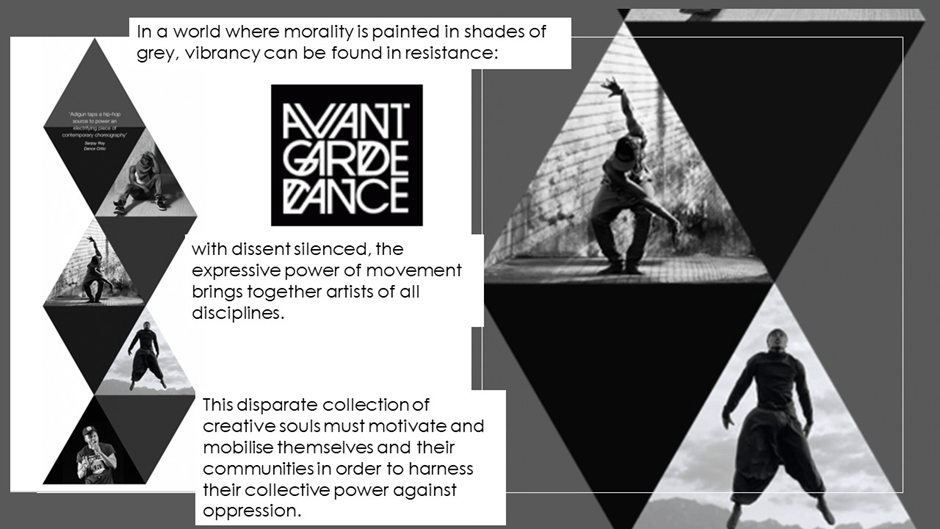
The imagery recalls though the shape and aspiration of Brancusi’s Endless Column, art that really tells you no more than that art is all that endures and that its claim to endurance is a manipulation of appearances. The highest art in the world of modern Art is art about art and its claims – what we might call meta-art (meta being a term that indicates a concept or thing that is in reflection on itself and is, if only in this purpose alone, a transcendent version of that thing, as in metaphysics, metacognition and so on). And clearly the Play ‘Illegal Dance’ is a fable about art and its fate in societies that question the value of creativity and expressiveness, perhaps even expression itself, and hence by definition meta-art (art about art and its function and purpose).
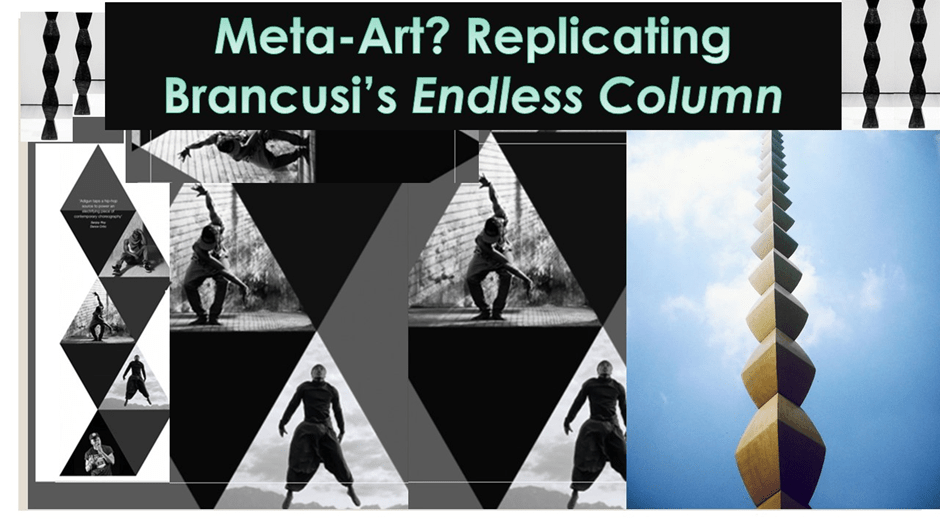
But associations in imagery is not all we find on this webpage. The words I have used in the original collage insist that dance, movement conceived formally as an art, not only aspires to the durability (or endlessness) of art but that dance is an art of communities and collective action, it is art with a purpose then, political art, or art that is not neutral but instead ‘motivates’ and ‘mobilises’ communities who work in it or reflect continually on it. So perhaps, the aim it seeks to achieve is that of political art that reflects on the interaction of art and politics: we could call it Meta-Political-Art. And I think this is what is intended, for pre- production publicity for the work insists on presenting to its audience a basic choice that involves transfer of power, from the production’s erstwhile directors to audiences otherwise though to be passive in conventional theatre, its audiences.
This isn’t necessarily conveyed by some parts of the pre-performance description. Take this description, for instance of what is to be observed, for however ‘dynamic’ and innovative’ the elements of the art are (and however rebellious its content), they are still prescribed by the conventional authorities that have been heretofore its only authority, author/writers, choreographers, set-designers, and professional crews within these arenas of action:
Dynamic contemporary choreography blended with innovative technical stagecraft portrays the tensions in a society that pits order against chaos, security against freedom, and individualism against collective will.
When Justin and myself puzzled over the choice being offered though we could not work out exactly what those proffered choices were, or, if we could, whether they constituted any great political liberation of the audience. For instance the concept of dance is introduced to the audience not by them merely witnessing the dance of professionals being professionally choreographed but by instead being invited first to join the preshow silent disco, a carefully curated mix of dance-inspiring anthems for all ages, after collecting a headset through which the auditory content of the show would play. Moreover the headset it seems will enable each audience member to choose between two forms of the audio content, and indeed to be able to switch those choices as many times as one might wish through the performance. The choices are described as between: ‘the original and rich sound score’ or ‘our B-side, layered with insights into the secret thoughts and narrative of the show’s distinctive characters. Switch sound scores anytime during the show at the click of a button’.
There are obviously then all the ingredients in the show that add up to: ‘a unique multi-sensory dance theatre experience in which every audience member must decide where they stand, pick a token, rebel or conform!’. But we, at least still wondered how real the choice of rebelling or conforming was (short of being able to leave the performance prematurely) for the soundtrack is still described here as ‘our’s’ (that is still owned and controlled by directors who have asked for other than extremely limited participation). For this reason I am intrigued to see how the actual performance works in much more detail, especially regarding the audience role in its unfolding, though Justin promises to show some finesse as a disco dancer in the ‘silent disco’; whatever that ‘disco’ turn out to be.
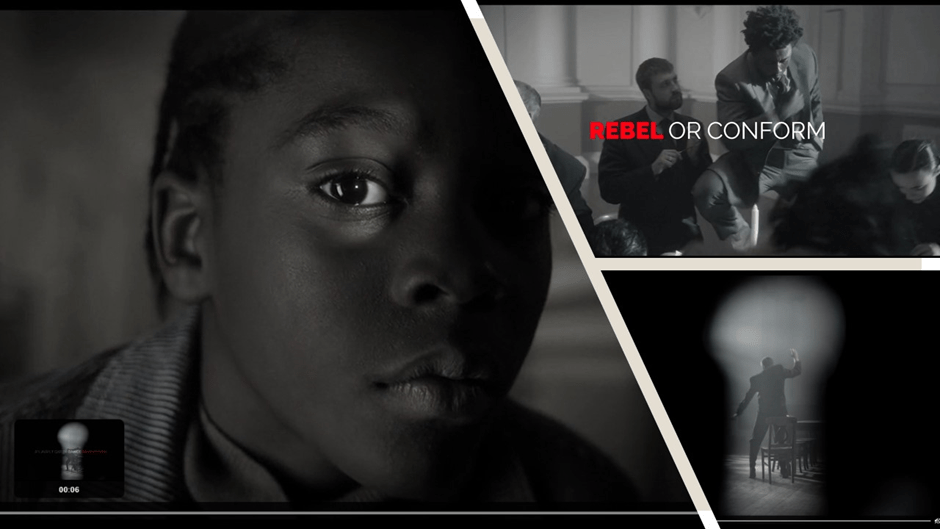
However, the performance is, it would appear from the photographic pre-publicity (presumably from the film version of this show) a performance directed by a black cast of artists, including the dancers. The stress of black performance art will, of course, always have a political edge by necessity, for it is always produced in contexts where the ‘higher echelons’ of any domain of wider Western society are determinedly white, and structured so to be though not necessarily by agencies that are fully conscious of this mission. The filmic material captured in the collage above shows interesting features like forcing the observer to be aware of watching action as if in secret – through a keyhole for instance – and for seeing dance sequences that combine the more random movements of everyday social like (though of course we know them to be determined by multiple social forces) with the choreographed. The publicity cites members who speak of the piece in terms of almost overwhelming ‘intricacy, the detail…phenomenal!’ (Audience Member, The Riley, Leeds) and ‘so relevant; it hit the nail on the head.” (Audience Member, PDSW, Bournemouth).
It plays with the notion of community in terms of its size. The publicity says that; ‘For the select few who opt for a ticket to follow the way of the rebel, an unpredictable and exhilarating immersive experience awaits’. I find such statements even more puzzling because we can only either rebel or conform in this statement by following a pathway set by others. And though the experience is ‘immersive’, who decides on the depth of the immersion and the escape routes from it. We can but ‘experience’ it, Justin and I and decide for ourselves. But do we want to consider ourselves the ‘select few’. Hierarchy gets everwhere.
The story of course already appeals for both of us are politically on the left, though aware of the contradictions to which this kind of contradictory-belief-necessitating system exposes us, our own choices, and behaviours. And we are not far, after all, from knowing in a smaller way the oppressive society to be imagined as that of 2030 in an oppressive society that censors any expression of politics or opinion not that of a ruling group. If ‘dance is a crime’ in this society, dance and other arts are already under threat from ‘big tech and invasive surveillance’, children being allowed to ‘forgot how to sing, paint, and dance, instead absorbing a curriculum of obedience, conformity, and compliance’. For us, as for the imagined dramatis personae too life is ’defined by an irreconcilable tension between the desire for free expression and the desire for safety’. So there is a lot to report back on. Watch this space!
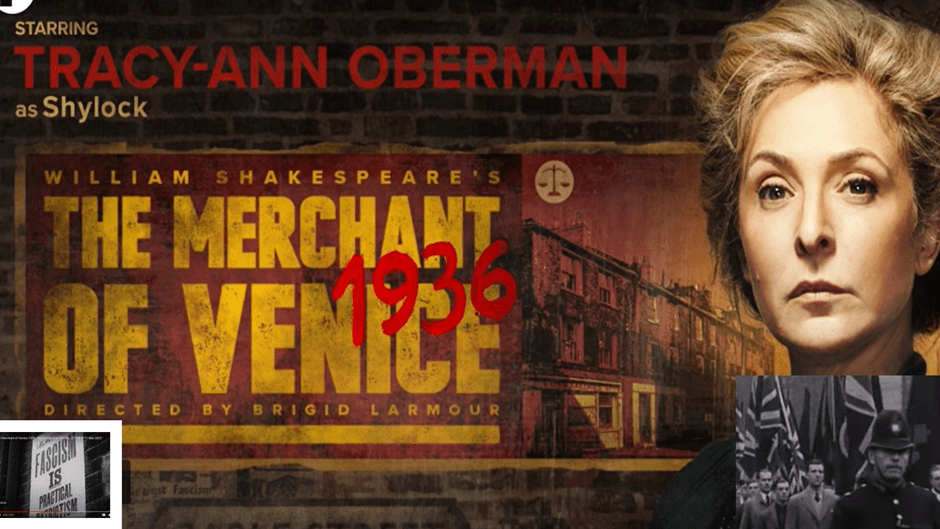
The second event I am attending with Justin and his sister. It is a production of Shakespeare’s The Merchant of Venice, but one set in 1936 in the East End of London, in Cable Street it seems, the space in which Oswald Mosley organised his Fascist blackshirts to show ‘patriotic’ strength against the local population of Jewish settlers, émigrés and Communists, and some brave souls who were both Jewish and Communist. The pre-publicity of this Watford Theatre Company production shows original film track from the period showing Mosley and his Fascistic followers bearing the Union Jack AND black flags as a threat. A poster saying ‘Fascism is Practical Patriotism’ features. This will be chilling, not least because the Cable Street Riot (a bad term used to belittle the import of the rising from the streets and communities involved) will be performed on stage and our party have taken the opportunity to be seated for the performance at a table on the stage itself.
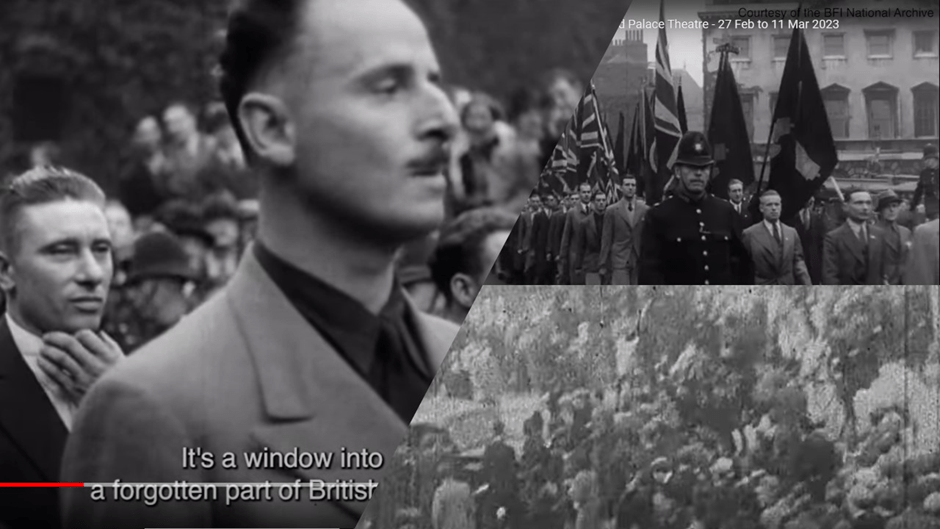
The trailer promises a shorter version of the play and certainly the cast list of The Merchant of Venice 1936 is depleted from the text of the 1600 First Quarto version of The Merchant of Venice.
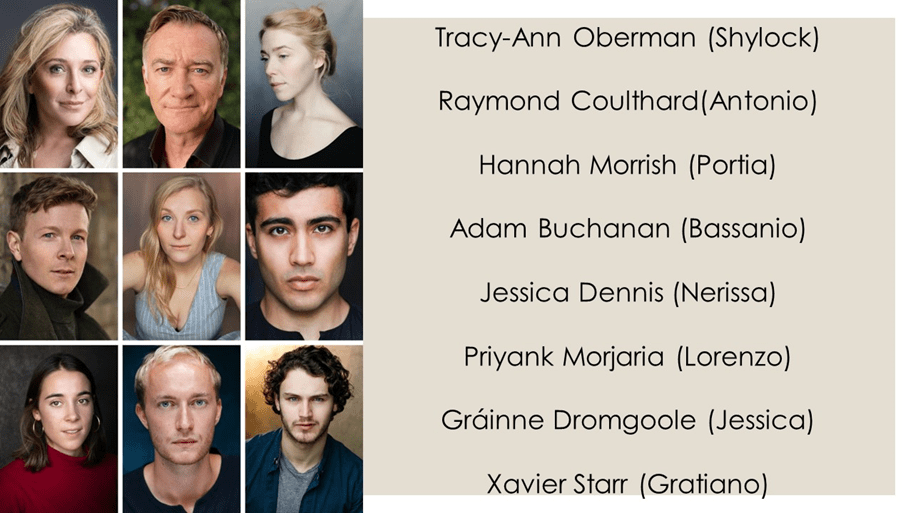
There is no representation of the Venetian State, even translated into government figures of the 1930s, such as The Duke of Venice and his ambassadorial visitors. The friends of Antonio and Bassanio are cut to the minimum and a new character replace Tubal, ‘A Jew, Shylock’s friend) called Juval. There is no clowning either it seems from Launcelot Gobbo and his father, servants to Shylock. Overall a lot of the play can be cut as a result of those differences, although these are not the main differences, for Shylock in our production is played by a woman and as a woman, an East End trader, by Tracy-Ann Oberman. The consequences of this are what we need to see but, according to the trailer, ‘it changes it all’ as far as the play’s meaning and take on anti-Semitism is involved. Tracy-Ann Oberman has based her characterisation of Shylock, a widow, fleeing the Russian pogroms on women from her own family. This will be very moving and recast the speeches of Shylock that otherwise lack any context but in the tropes of the worst kind of anti-Semitism.
I don’t intend to say much more about this for I am going to see Othello in a week or two, the streamed National Theatre Production, and would like to blog about these two plays simultaneously for they are ‘Elephants in the Room’ of British artistic culture, both deeply racist plays (it is undeniable that this is the case as I will argue) but both also famed as plays which challenge the racism they also depict. That should be an interesting topic for that new blog. As for modernising the Merchant to another period, and one in which racism is the central focus, I can’t wait to report how this production handles this.
Recently, since W.H. Auden first suggested it in an influential essay in The Dyer’s Hand, the play has treated centrally of a possible queer connection involving Antonio’s suppressed love, one that render him weary in its beginning, for the young and beautiful Bassanio. Even his language – insisting that Bassanio needs him and his wealth but presented in metaphors of a much preferred alternative – that they commit to each other.
My purse, my person, my extremest means
Lie all unlock’d to your occasions.[1]
This love is overturned by transformation of Bassanio to heteronormative choice of Portia, but one that involves a lot of female to male cross-dressing. This shouldn’t be an expectation of this production for female barristers are not beyond twentieth-century imagination even if not in the realities of 1936. This feature of a modern take on the play may or may not be a part of this production, but I am intrigued. The issue of anti-Semitism will be confronted. Oberman has indeed intervened in current political life, around the supposed anti-Semitism of the Corbynite and pro-Palestinian left, so the play’s summary saying that it is a ‘vivid evocation of our history, and a warning for our times’ makes me wonder how this will go for I do reject quite forcefully that there is a moral equivalence between the anti-Semitism of Oswald Mosley and that supposed of Corbyn or Ken Livingstone. But it is not clear – it never is – what a production may mean when it says ‘our times’ and what political phenomena in whatever those ‘times’ are that it points to. Whatever, this will be a great performance I think and hope.
Moreover, it’s also clear that the production looks at how the British aristocracy bought into Fascism with the circle around Portia shown to be Mosley supporters. It is for reasons like these that Cable Street has always been a part of my political education and background, as important I think a model of resistance as any other I can point to. When I was young we read of it a lot even in the drama of Arnold Wesker. This production though claims it is ‘a forgotten part of British history’. That it be remembered is urgent.
This also links to why Illegal Dance is a political art form because Avant Garde Dance see their primary audience as young people and their primary aim to be education. There is a lot in that. I will report back when I can. Justin often educates me about how to see such art so expect something at least that will be of interest.
All the best
Steve
[1] Shakespeare The Merchant of Venice 1. 1. lls. 138f.
 Steve_Bamlett_blog
One thought on “Visiting Manchester: A Preview of the Highlights on my visit to Justin from Monday 15th – 17th March 2023. It’s gonna be a blast!”