‘…: it’s a catastrophe happening here, sure – an annihilation, an extinction – but there’s also, ultra-paradoxically, a counter-movement of formation, of emergence, going on as well, a sense of something edging its way, through all the chaos, to the threshold of the visible, the comprehensible …’. [1] Postmodern experimental writing might be described as a kind of ‘catastrophe’ and ‘chaos’ out of which black hole a reader willing to endure it might edge towards finding ‘the threshold of the visible, the comprehensible’. This blog reflects on Tom McCarthy (2021) The Making of Incarnation London, Jonathan Cape – UK edition; New York & London, W.W. Norton & Company Ltd. – USA edition.

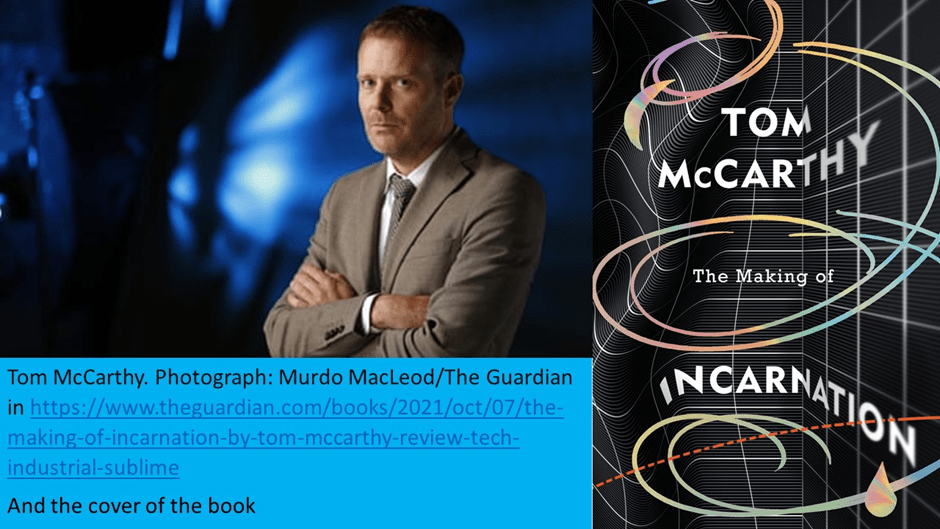
Tom McCarthy with a colourful version of the Front cover of book (mine is silver only)
Post-modernism is known to be hard work and Tom McCarthy’s beautiful prose is often no less so, even whilst its graceful periodic sentences hover around some meaning or other, only to implode in on themselves. They have as a somewhat pure beauty that is ultimately formless except in the repetition of syntactic relations that have no other function than being syntactic relations. Let’s take an example:
These and scores of other moments, transposed and repeated, merging with his own partial reflection in the glass, sparked in him a sudden awareness of synchronicity, of processes all happening at once – or rather, being re-melted, blown into and held within some new formation, an arrangement relegating the time of their actual happening to insignificance. Nor was he observing this from the outside: he was held by the formation too, gathering and absorbed in its consistency: watching, remembering and anticipating fused together, rhythm and suspension merging, thwock, thwock, with his pulse beat … [2]
Of course, ‘hard reading’ readers will find sense here, even happier that they feel that this reading can be exclusive to people only of their self-estimated intelligence, but there is also a softer reading that makes the structures here never more than a meaning coming-into-being rather than already there and visible, to whatever kind of eye that sees and interprets it. For the sentences here are as much about the felt sense of the body of the reader, moulded by the rhythm of sentences reflecting their own bio-rhythms – the thwock, thwock of the heartbeat and its patterning of flow and return, onward pulses and moments of stasis. For reading is an incarnated experience – a feeling of patterned repetitions that sustain a sense of self through changes of excitation and inhibition that are enabled through the sum of innumerable synaptic connections in the body’s central nervous system (a kind of continual orchestration which is the body’s means of living (‘rhythm and suspension merging’). In this mode the formation or ‘making’ of something is a thing that has a simultaneous present, past and future (or ‘synchronicity’), cognitive notions of time encapsulated in a pattern of repetitive change variations (‘watching, remembering and anticipating fused together’) are resolved into the witness of self in internal body rhythms and in mirrors which capture external moments of what can only be the ‘partial self’.
For try as they might those hard-reading readers (paid to be thus in the role of newspaper reviewers and critics) fail to get as involved as this demands and try to see this novel operating merely as a form of obfuscating narrative technique. Thus Steven Poole in The Guardian can say that the novel often fails its readers by being too much of an exposition of McCarthy’s intellectual vision of the world, even though that vision captures truths about the world’s tedium:
It’s only when the writing attempts to stretch beyond its enjoyably ironic style of deadpan cataloguing that it falters, with italics straining to signal importance, or words piled up to grasp at an idea that doesn’t materialise.
The overall effect of The Making of Incarnation, then, is like that of an extremely dense art installation – or indeed a machine, within which the reader, too, can play only the designed function. It is implacable and intermittently tedious, but then isn’t the world, too?[3]
Likewise, a similarly worldly-wise reviewer like James Purdon in the Literary Review says:
McCarthy is a born exegete. You can imagine him, in more enlightened times, contentedly occupying the chair of some well-funded Institut für Kulturforschung. As a novelist, perhaps his greatest asset is his ability to turn abstruse points of cultural theory into provocative narrative games, as in his debut, Remainder (2005), where a thought experiment proposed by the sociologist Jean Baudrillard – is it possible to distinguish between a pretend bank robbery and a real one? – plays out at length as a philosophical heist. … / Indeed, the essay – as his collection Typewriters, Bombs, Jellyfish (2017) demonstrated – is probably McCarthy’s real métier. And it’s tempting to see The Making of Incarnation less as a novel and more as a pretext for a series of clever cultural-studies excursions through, among other things, industrial sociology, financial bubbles, cybernetics, predictive algorithms and forensic architecture.[4]
In both cases, but particularly the second, the critics cannot avoid (for personal and professional reasons no doubt) showing their arch superiority to brainboxes like tom McCarthy. They admire but they ‘got him’ ages ago and he has nothing new to reveal to them, other than be the mainly cognitive artist they believe him be, whether as a maker of conceptual art installations or essayist. I call out these critics not to get one over on them, as Bishop Blougram accuses the journalist, Gigadibs, for trying to get one over on cleverer German Shakespeare critics like Lessing and Fichte, and for over-estimating how enduring will be his work, which is not anywhere like that of ‘the true Dickens’:
You, Gigadibs, who, thirty years of age,
Write statedly for Blackwood’s Magazine,
Believe you see two points in Hamlet’s soul
Unseized by the Germans yet—which view you’ll print—
Meantime the best you have to show being still
That lively lightsome article we took
Almost for the true Dickens,—what’s its name?
“The Slum and Cellar, or Whitechapel life
“Limned after dark!” it made me laugh, I know,
And pleased a month, and brought you in ten pounds.[5]
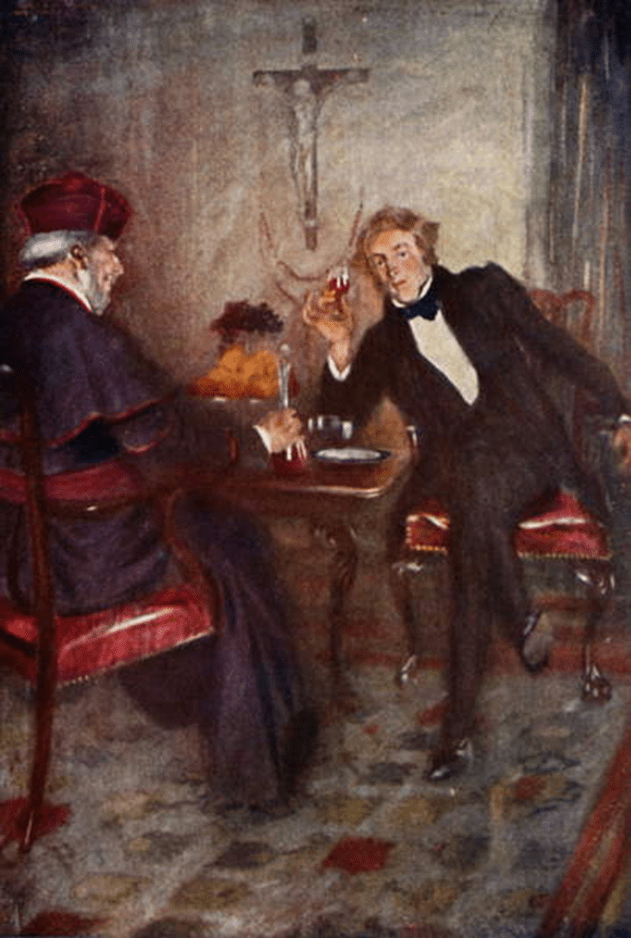
Edmund Joseph Sullivan (Robert Browning: Bishop Blougram”s Apology) available at: https://www.meisterdrucke.com/kunstdrucke/Edmund-Joseph-Sullivan/883966/Robert-Browning:-Bischof-Blougrams-Entschuldigung.html
No. Blougram’s casuistry is much of the same kind as the Gigadibs he smugly critiques. I call out Poole and Purdon rather for reading as if it were possible for the supposed average reader, anticipating their longueurs and forgiving their impatience with literary experiment by clever lads like Tom McCarthy. As a result both insist that this novel works, if at all as a narrative, both use (unexplained) the term MacGuffin to indicate the post-modern novel’s debt to narrative technique analysis as advanced by Alfred Hitchcock to explain the mystery of the quest for Box 808 and its’s wire-frame model of time and motion study (a thing like the Holy Grail in Arthurian Legend that ‘may or may not hold the key to some transcendental mystery’ in the novel.[6] Both then suppose McCarthy does this to explicate ideas. In Purdon it is explicating ‘that process of repetition, repetition and onward transmission that McCarthy has elsewhere described as the foundation of all literature, indeed all culture’.[7] In Poole it leads to ‘constant visions of machines within machines, and the whole universe as a machine. …// ..a mechanical matryoshka or ouroboros of interconnecting yarns past and present’.[8] These are reasonable expressions of what the novel could be said to doing at the level of its conceptual themes but do not, for me at least give any sense of what it feels like to actually read the novel, to sense the rhythms promoted by its syntactical, sound, and haptic patterns. For it is at these levels that I think we get most as a reader of Tom McCarthy, when we share the novel’s effect at the level of the body, where meaning is not merely cognitively framed but collaboratively INCARNATED. The novel may tell the story of the making of a film called Incarnation, which Poole says ‘seems to be even more childishly boring than George Lucas’s first Star Wars prequel’ That comparison is probably apt since it is, as Purdon says, ‘a swashbuckling space saga complete with laser swords, space pirates and a gutsy princess’, as is the evaluation implied by both critics.[9] but the incarnation that emerges is the shared somatic space between reader and text, for which these narrative elements act only as hooks to hang specific sensation of embodied sense, time and motion.

Properly read, McCarthy essays too have a similar effect and are not the over-intellectualised forms of exegesis they are characterised as by Purdon. Take this section from the beautiful essay first published in 2014, Get Real, or What Jellyfish Have To tell Us About Literature. I noticed it particularly for when I saw McCarthy at the Edinburgh Book Festival he said, on the publication of his novel C, that if he characterised narrative as ‘remembering, repeating’ (as Freud characterised melancholia) but not included Freud’s third term in this description which was ‘working through’, in response to my question about this echo from Freud’s essay on Mourning and Melancholia, it was because ‘art was on the side of the somatic symptom not the cure’, unlike Freud himself. But here is an appropriate quotation from the 2014 essay, wherein he describes the real in art as an eruption of the visceral into the otherwise inauthentic representation of reality in repetitive cinematic narrative like Spielberg’s Jaws or repetitive discursive narrative events in a novel like J.G. Ballard’s Crash and the film based on it:
…; a real of the type that I suggest we should embrace and celebrate punctures the screen or strip of film, destroying it: a real that happens, or forever threatens to do so, not as a result of the artist “getting it right” or overcoming inauthenticity, but rather as a radical and disastrous eruption within the always-and-irremediably inauthentic; a traumatic real; a real that’s linked to repetition; a real whose framework of comprehension is ultimately neither literary nor philosophical but psychoanalytic: the real that Lacan defines as “that which always returns to the same place” and as “that which is unassimilable by any system of representation.” The challenge, for the writer, would never be one of depicting this real realistically, or even “well”; but of approaching it in the full knowledge that, like some roving black hole, it represents (although that’s not the right word anymore) the point at which the writing’s entire project crumples and implodes.[10]
It would be a mistake to classify the prose and its style as a cognitive structure, it is rather a structure in which punctuation serves to guide repetition, rhythm and duration effects mainly that guide us to the kind meaning we will find in pre-postmodern ‘literature and philosophy’ (there are exceptions like Sterne’s Tristram Shandy, the subject of another essay in McCarthy’s volume of essays already cited) but which we do find in the prose and deliberate representational complication with which Jacques Lacan describes symptoms and the psychoanalyst’s living through of their interactive effects in transference and counter-transference. Of none of this do I intend to give an exegesis, for my point is that McCarthy redirects from cognitive representation of either thought or story to the viscerally embodied: the sensation of knowing the moment of fragmentation of self and meaning and sensing the hope of reunion in some form whose embodiment is in the making but very far from complete and not yet of certain completion, even in the future.

That passage is important to the film Incarnation in the novel The Making of Incarnation for they use the same metaphors as does the essay. The novel ends, if ends is the right word since it implies completion, approaching a ‘roving black hole’ which threatens to destroy all matter that enters it but which could be the beginning of a new emergence, but who knows: ‘a blackness neither rays nor traces penetrate’.[11] It also shows that the key effect of the novel is to allow the reader to experience writing that aims to make it real by processes of felt (felt in the body) catastrophic destructive implosion of conventional or ‘inauthentic’ meaning in the interests that some new real grasp may ‘emerge’, or more strictly ‘be emergent’( I cite it in my title but give more here, so that a reader may sense and feel and just intellectualise it. In the passage a wrangler, here a person who handles and realises, under direction, required effects achieved by digital data rather than animals, as is a more usual understanding of a wrangler (Briar), IN FILMS is feeding information in manageable quantities and form into a ‘processing pen fenced off from all the others’ and monitor them so that ‘these pens don’t become overcrowded, blocked, stampeded; to ensure the welfare and, indeed, to verify the basic genetic purity of each of one’s charges, …’ (the animal analogy is followed through carefully).[12] Briar’s work achieve, as he visualises the effect of a cosmic wave hitting the bow of a spaceship, effects that equate with
‘forms, dimensions and properties, the very laws by which they’re bound, gone haywire. The bow wave has indeed, as Briar proposed, brought on a general fucking with all terms and values. Basic oppositions – up/down, attraction/repulsion, togetherness/ separateness, even inside/outside (of an object, of the ship, of people’s bodies) – seem to be collapsing…: it’s a catastrophe happening here, sure – an annihilation, an extinction – but there’s also, ultra-paradoxically, a counter-movement of formation, of emergence, going on as well, a sense of something edging its way, through all the chaos, to the threshold of the visible, the comprehensible …’. [13]
What I want to concentrate here is how the sense of collapse is a confusion felt in ‘people’s bodies’ and all other senses and not just merely of the cognitive. The jokes here are about a ‘general fucking with all terms and values’ that make intellectual debate possible and means creative thought deals with not concrete but liminal categories: things sensed but not knowable or representable in any conventional way. To get to this place, to ‘make incarnation’ the reality of art we have to accept that the creation of authentic reality effects can only be glimpsed, through a glass darkly as it were, in the implosion of the world we think we know as cognitively represented that for most of us gets in the way of the real: terms and values that call themselves ‘real’ but which are determinately ‘inauthentic’. Even trying to express this critically is impossible. We must feel it in the disintegration of a syntax that still promises some meaning will yet be made, but not quite yet.
The most vicious of McCarthy’s critics, Edmund Gordon in The Times Literary Supplement, who says that the writer’s prose that is less like Samuel Beckett than ‘the instructions for assembling a piece of flat pack’, requiring ‘maximal engagement for minimal returns’.[14] Is this a matter of taste? I don’t know but cannot disagree with Gordon more, even though he does describe the reaction of a kind of reader who will never ‘like’ McCarthy’s work in any medium. For me the prose moves us into a place where art is something worth having, that which does not attempt to be a substitute for thought but something quite other, something like embodied felt experience, and which works at the level of a suggestion of what is wrong with a world in which Taylorism and Fordism and cybernetic feedback systems are a dominant sign of how the mind and social world interact like a machine and make s see why art is redemptive, just as Keats tries to do but where the impulses of the embodied are conveyed by large effects of repetitive attempts at approaching meaning in a syntax and punctuation that feels rhythmic but whose relationship to the passage of clear meaning between producer and receptor is as minimal as Gordon says. But it is beautiful and disturbing as I read it – destructive of the ego which makes us readers that wish to dominate text with our interpretation (the kind of person my best friend Justin Curley tells me I am – which I am sometimes) and creative of an openness to new conceptions which do not objectify the humanity they help co-create in readers whether in tragic empathy or humour.
Here is a passage that does this latter thing, in unpacking Taylorist time-and-motion modelling, such as that done of ‘Pedestrian Motion’ or ‘Pedestrian Flow in Urban Corridor’ (PM or PFUC – everyone giggles at the latter acronym the novel says), in the company, Pantarey (the brainchild of Mark Phocan, the novel’s central figure and whose first name is punned upon in the passage), In a sense it is about writers think they might manage readers (self-selecting pedestrians) but never quite do in a space that is not just their own space but belongs to all participants. I love it.
They’re to notate, in terms of not just route but also rhythm, the passage of self-selecting, if unwitting, subjects through the area of enquiry, translating every eddy and coagulation, every bump, swerve and dispersal into data-clusters that will form the basis of a model …, reconfiguration of the space under investigation. In lieu of white tape, the space’s borders are defined (although not marked) by T40Ss, nestled furtively under the eaves of facades and the bracket arms of lamp-posts – cameras that, instead of bouncing rays off reflectors stuck to the bodies of their subjects (who today, naturally, aren’t wearing any0, deploy laser-detectors to register depth of field. It’s a new system, a new method, one in terms of whose hard- and software Pantarey have (as Garnett likes to boast) opened up clear blue water between them and their competitors, thus maintaining in their industry not only market advantage but, beyond that, a heroic status tinged with traces of the mystical. Markerless is the holy grail of mo-cap.
Playing with notions of space and passage as definitive of reading, as well as pedestrian experience, a ‘mark’ is the old manner of how significance is created in the analysis of passages and this ‘passage’ mimes what it is to try and follow passages without markers or ‘marks’. And indeed without Mark, because ‘Phocan’s off purchasing gallons of bubble mixture’.[15] But I have the feeling that you could never convince a reader who hated a passage like this to like McCarthy and vice-versa for someone who did like this passage. But do read the book if you can. It isn’t a test of reading or intellect that some people think he is, whether they like or hate that kind of writing that they think it is. It is rather a wonderful and joyful experience to read I think.
All the best
Steve
[1].Tom McCarthy (2021: 319) The Making of Incarnation London, Jonathan Cape – UK edition
[2] Ibid: 313f.
[3] Steven Poole (2021) ‘The Making of Incarnation by Tom McCarthy review – tech-industrial sublime’ In The Guardian Online (Thu 7 Oct 2021 09.00 BST). Available at: https://www.theguardian.com/books/2021/sep/12/the-making-of-incarnation-tom-mccarthy-review
[4] James Purdon ‘Star Wars for Postmodernists: The Making of Incarnation By Tom McCarthy in Literary Review (Sept. 2021) Available online (paywall) at: https://literaryreview.co.uk/star-wars-for-postmodernists
[5] Robert Browning (1812 – 1889) Bishop Blougram’s Apology available at: https://allpoetry.com/Bishop-Blougram’s-Apology
[6] James Purdon, op.cit.
[7] Ibid.
[8] Steven Poole op.cit. (I don’t think the mix of machine motif and mythical/cultural icons (ouroboros and matryoshka) work very well here. Do you?)
[9] Ibid & James Purdon op.cit. respectively.
[10] Tom McCarthy (2017: Part III 69f.) ‘Get Real, or What Jellyfish Have To tell Us About Literature’ in Typewriters, Bombs, Jellyfish: Essays New York, New York Review Books, 57 – 76.
[11] Tom McCarthy 2021 op.cit: 326.
[12] Ibid: 317
[13] ibid:319
[14] Edmund Gordon (2021: 19) ‘Everything is feedback’ in The Times Literary Supplement (October 22, 2021) p.19.
[15] Ibid: 101
 Steve_Bamlett_blog