A blog on my introductory lecture to a Human Growth and Development Course in Social Work (Sample Lecture 1). PERSPECTIVES on HUMAN GROWTH & DEVELOPMENT: SECTION A: THEORIES & MODELS; (a) The Perils and Pitfalls of Developmental Theories, Models & Life Patterns. (b) An introduction to Neurobiological Models and Developmental Predictors. [An introduction to some Key Concepts. With a focus on the life stories of people whose use alcohol is problematic to self and/or others].
I have been tasked with creating a specification for a rewritten Human Growth and Development course for New College (revalidation looming) which I intend to call Perspectives on Human Growth and Development for Social Workers. My aim is to build a course which, as its second nature aims to inbuild perspectives across helping discipline professionals and proud non-professionals. A key aim is to fit the perspective of people with lived experience of services into the mix and as its rationale but also to include specific domains of work in Social Work. Hence this first one will:
- Highlight that theory alone is incomplete for a social work approach. This applies to theories from non-applied or sciences that see their aim as solely objective in describing the arena of a social worker’s remit which is intervention into the lives of others. Such sciences in particular that are relatively insensitive not only to the qualitative in research (for that’s rarer than it once was thankfully even in biological and medical approaches) but to the qualitative agency that needs to be impelled into that theory from people with lived experience of having their lives interpreted and acted upon on the basis of such theories.
- Take an introduction to selected biological theories, but by necessity neuroscience, as a starting point.
- Ensure key basic concepts are conveyed which help[ locate the political and institutional flavour of all theories, especially their attitude to the agency of people offered support by services.
- Feature some life-stories as an introduction to narrative approaches in social work, and finally –
- Raise questions about what must be included in suites of theory aimed at social work, using the debate around medical/biological (not conceived of as the same), psychosocial models based on the individual and the challenge of the biopsychosocial model in theory and observed application in health dominated multidisciplinary teams.
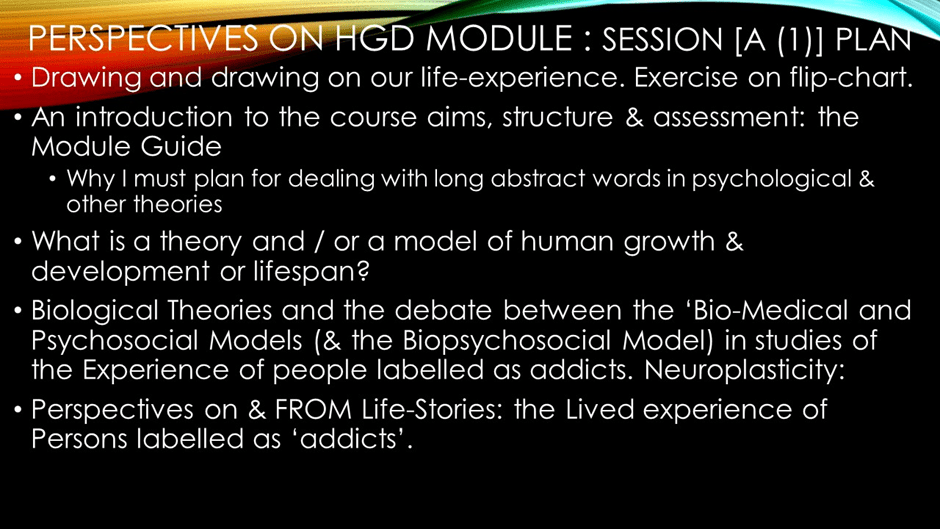
Hence the description of remit on the slide above. Pointing to how the lecture is sectioned up. The visit to the Module Guide will open up my plan / advise that they keep a vocabulary / definition record in a manner of their choice, because jargon is inevitable. They will need to be able to find ways of describing these concepts with an over academic terminology, so this prepares them not only for assessment on the course but their social work practice both on the course and in their Assessed Year in Work after it.
But we start with an exercise. I intend in my trial of this session this year to ask learners to create their own life-course line supplying them with the text of Activity 1.1 in Janet Walker & Nigel Horner (6th ed., 2020: 14f.) Social Work and Human Development London, Learning Matters, Sage. That has a much neater lifeline labelled as you might expect an invented or edited exempla from a textbook to me. However, the one in my slides has more authenticity I think.

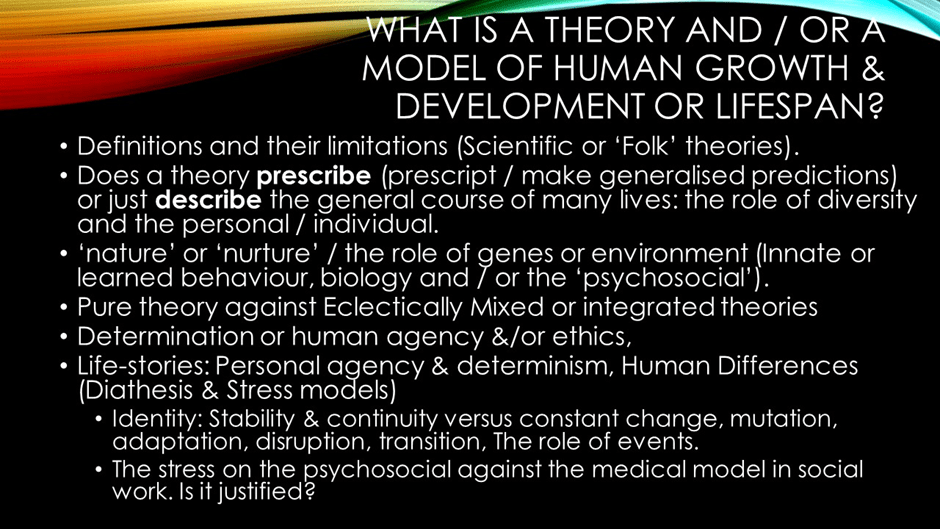
We now move to the first sub-heading of the lecture which details how the term ‘theory’ will be queried. I will point out this is done with varying sophistication and purpose across their reading list for the whole course. As usual the most sophisticated treatment academically is Margarete Parrish’s (2nd ed., 2014: 1-9, Ch. 1) Social Work Perspectives on Human Behaviour Maidenhead, Open University Press. My treatment is, as always eclectic from sources.
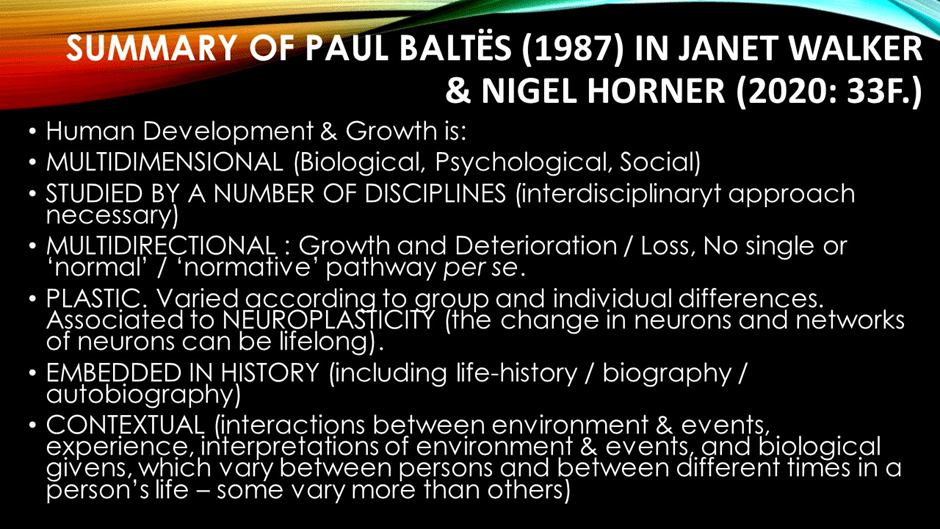
I illustrate the limitations of definitions of development by illustrating the attack by Paul and Margaret Baltës on the universality of the notion of the ‘inverted U’ curve as the description of normal aging in their version of Lifespan Psychology. The more modern terms for some of their categories of human functioning will appear in a video of twin / adoption studies later, to ensure continuity of concept appearance. In this slide there is a link (under the term ‘Lifespan Psychology’) to a very brief extract from a film about the concept of the ‘inverted U’ and how and why they overturn it to describe a richer sense of what aging might mean and how it can be experienced. Excellent for specialists in Older People’s social work (where I started out in the profession). The video link is: https://youtu.be/g2JXyl-gek4?t=135.
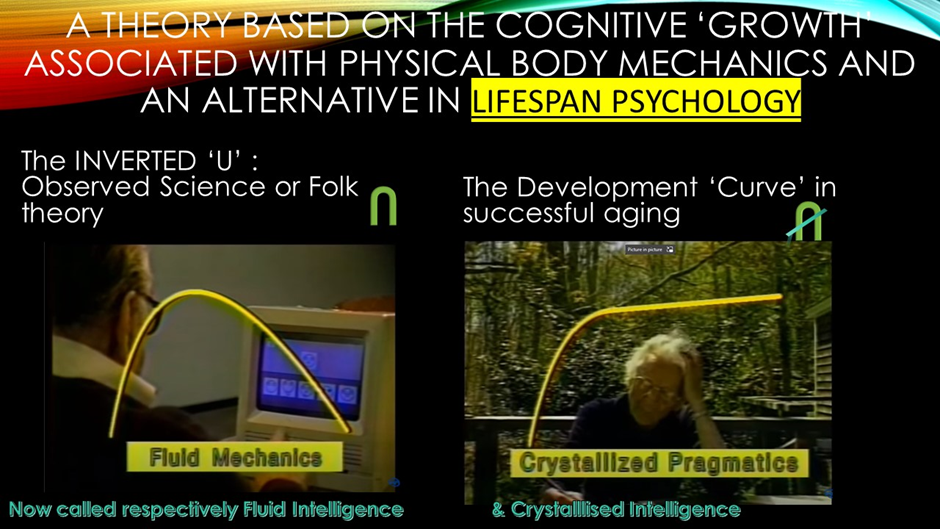
I centre the visit to the Baltës by referring to key concepts used in one of the textbooks from his 1987 book. In such a brief look at select ideas it allows me to introduce the concept of neuroplasticity at an early point, for it is redemptive in terms of how neuropsychology has refined the pertinence of the discipline as a whole for workers using human sciences and narrative approaches (to come later) since it no longer insists on biological determinism of a simple kind.
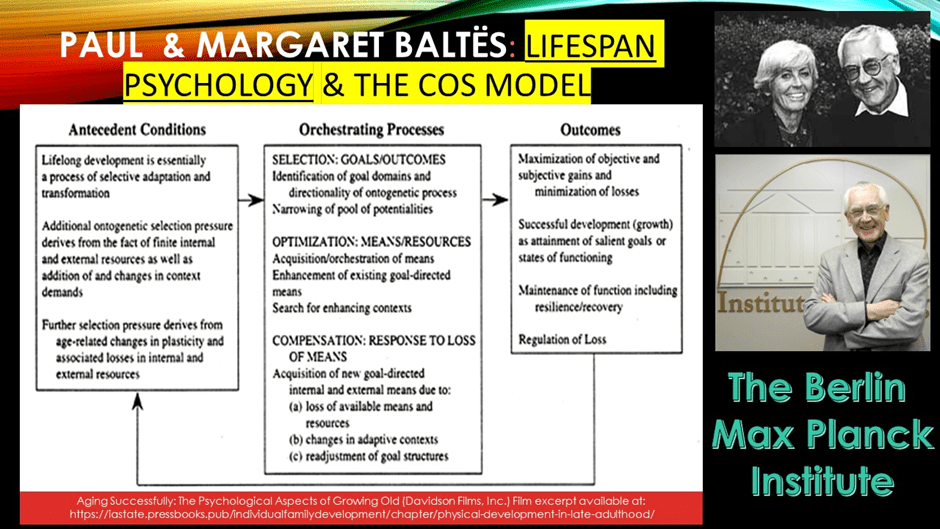
I leave him by showing how ‘the inverted U’ is further undermined by the complex theory / model (important they know how to use both terms and get them in terminology records) set just described by showing the COS Model. This will make deeper exploration of the concepts in the video extract, which also has a link to it on this slide (under Lifespan Psychology’).
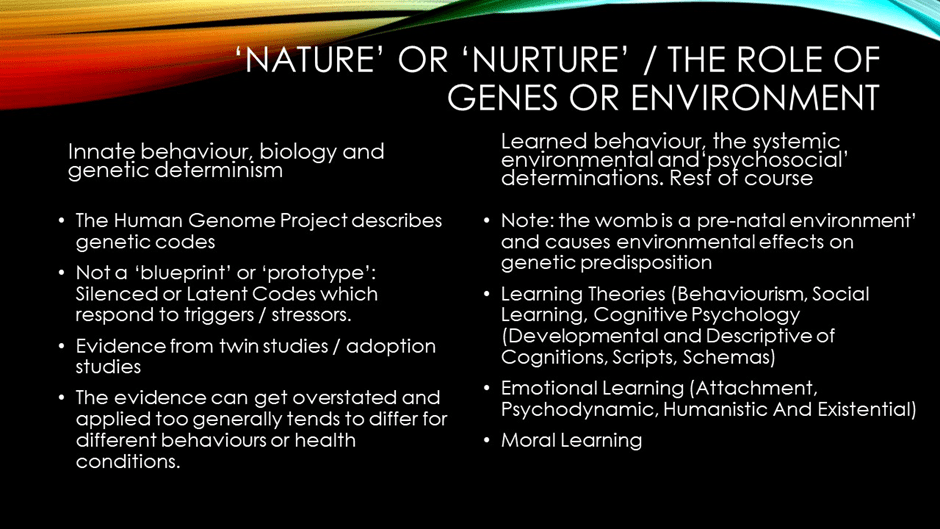
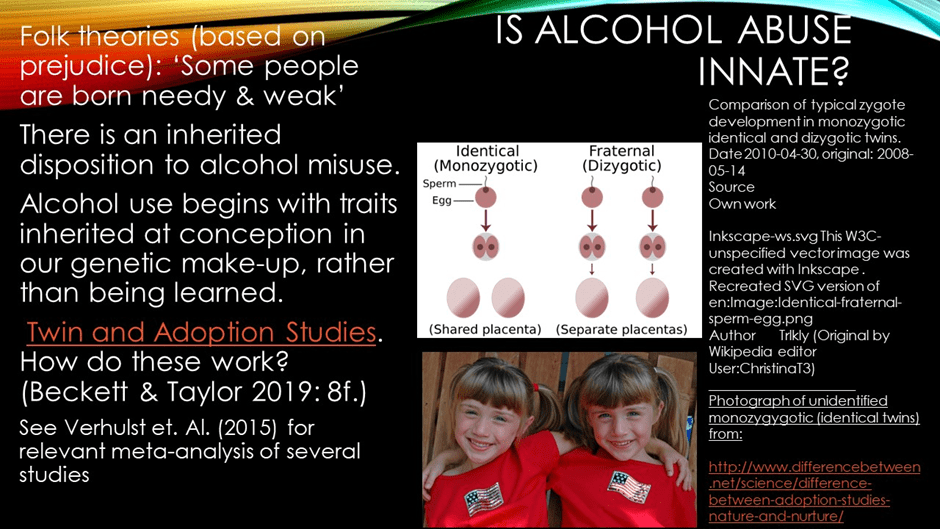
We then move to the section of the theory discussion on one of the central issues in all the textbooks on the reading list. Sensitise to the word ‘innate’ and why these days it often refers to conception not parturition, since environmental factors (and agentive responses to them) are active in the womb.
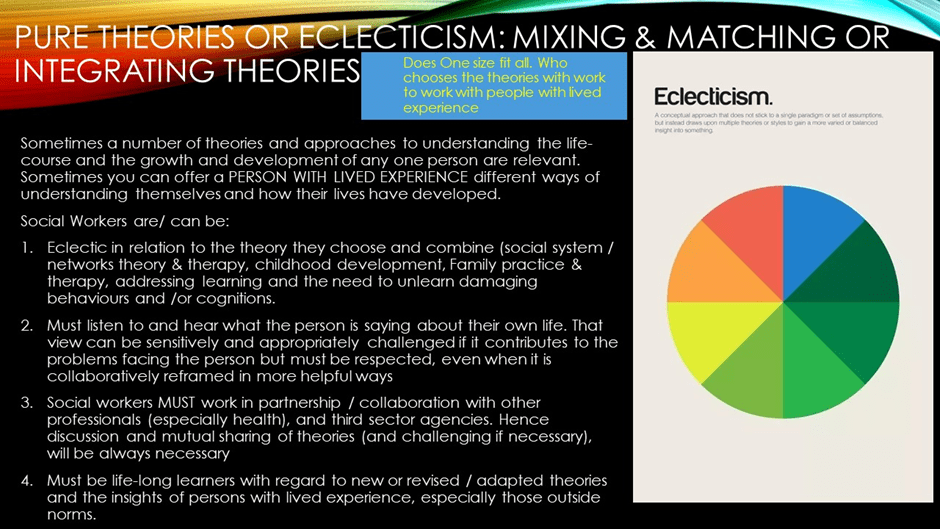
This also predicts issues in the next section on Biological Approaches. We then take the next basic issue – the tendency to eclecticism as an approach in social work and why this matters, which looks forward to the life-story section of the lecture.THIS SLIDE WILL HAVE TEXT SIMPLIFIED.
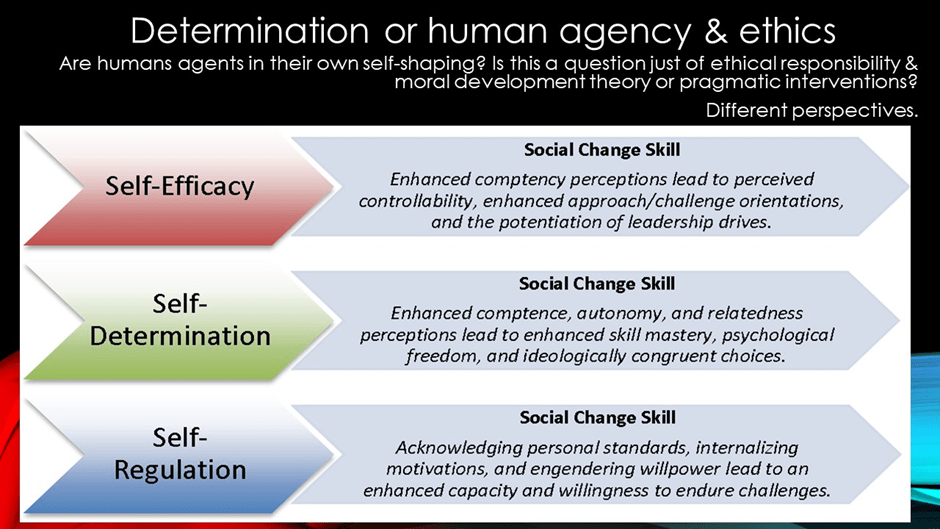
The final general is that variously referred to but too often by the term from philosophy of ‘free will against determinism’. I will point out that I will not here (or possibly ever) cover theories of moral development in the course but that, if they wish to follow it up there is more than enough (at least in its application to adolescence) in Beckett, C. & Taylor, H. (4th ed., 2019: 118f., 121) Human Growth and Development London, Sage. However, my focus is on Learning Theory and the issues raised by psychologists interested in human agency and the means by which a person’s sense of agency (and ethics too) is assisted by social workers aware of Bandura’s later work – more to come in Behaviourism / Social Learning Section. These are strategies too for improving collaborative work with people with lived experience of services.
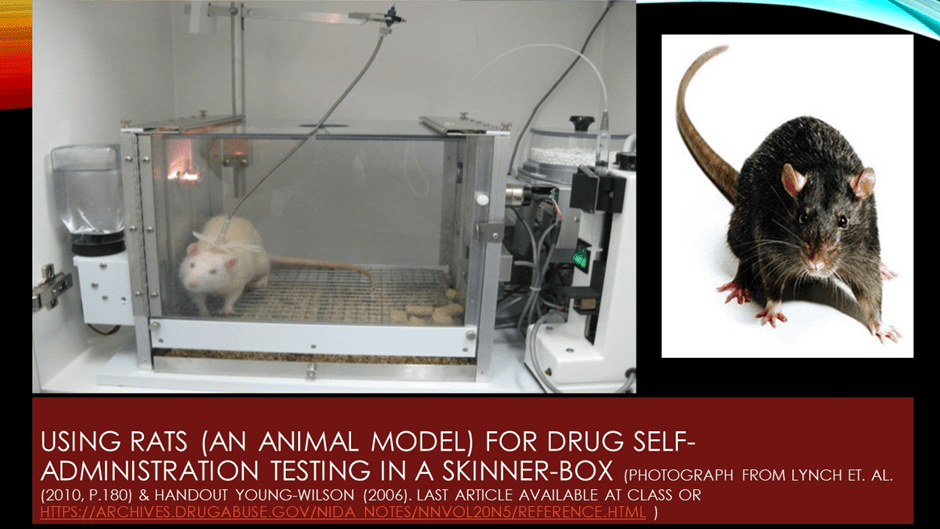
The next section heading introduces Biological Theories by linking them to an area of work common to all social workers whether generic in practice or working with either children & families or adult teams. It is not just a subject for specialist drug & alcohol teams. The stress on the Biopsychosocial in this section is really there to avoid too early a formal introduction to the concept of interactions, for the message of twin studies is I think that of the importance of interaction even in determined behaviours using genetic / environmental interactive mechanisms and before we look at personal agency, whatever the hype for the primacy of genetics in the video I show. The list of subpoints in this section are to show that I think social workers need at least these issues in focus: (a) The notion of predisposition as primary to environment (the underlying theme of not only addictive personalities discourse but also genetic over-explanation of mental ill-health, etc. (b) Basic neuroscience concepts – pathways, neurons, transmission of messages in the network (action potentials in the Neuron, neurochemical at the synapse between neurons), (c) To illustrate biomedical disease model will focus on the scientific methods of neuroscience (I stop shot of neuro-imaging because there is too much material to summarise) I will deal with the dopamine hypothesis and how it is established in Skinner box animal models and generalised to humans.

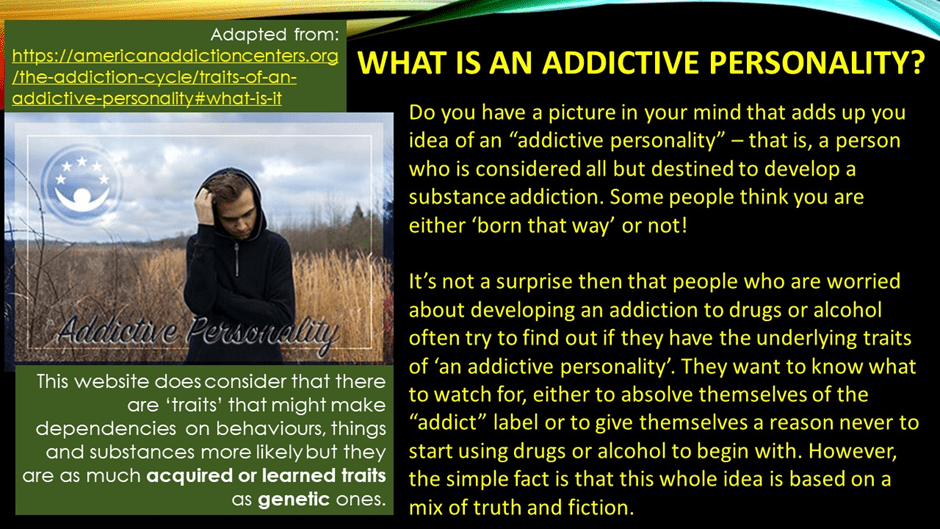
This slide is just to allow the notion of an addictive personality to be opened up, although this concept is not only tied to biologically determined personality traits to those of disposition (which might be conditioned too by early environment) or temperament (used by some child psychologists to convey hard-wired characteristics / traits of the person). For more see O’Brien (2020: 171) on three main categories of baby temperament including ‘slow to warm up babies’. The point is that there if there are ‘personality traits’ that predispose (or are the diathesis) for conditions related to ‘addiction’ they are not found always clustered in a personality type and are certainly not necessarily genetically determined. I do not intend to use notions of temperament until Section B of the course, where the debate is focused on infancy particularly.
The next slide necessitates being clear about what we mean by ‘innate’, since it comes from a period when people considered that babies genetic predispositions could be summed up from birth state, ignoring the environmental experience of the womb and the systems which create particular factors to be present in the womb as an environment (mother’s physical / mental health / wellbeing, family stability or otherwise, socio-economic-cultural factors in the particular external environment during pregnancy). The pre-set pointing to an article (a meta-analysis of twin and adoption studies [Verhuist et. al. (2015)], which raises difficulties of the terminology of quantitative research to which learners will be encouraged to express initial sense of alienation therefrom, with a pointer to them using terminology record-keeping). If they ask for it, I will provide a beginning sample of definitions for terms as they are encountered, using this difficult paper as an example.
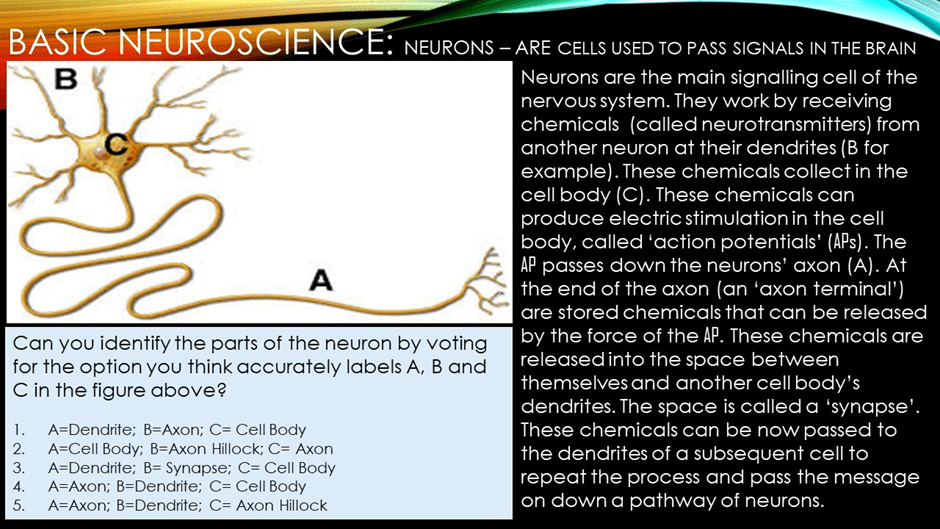
We now move to introduction to basis concepts in neuroscience. After brief spoken talk through of schematic diagram of a neuron, we will use the quiz on there (source is Open University SDK228 course associate lecturer slides) to show where terminology dictionary might help. The next example is specific about the synapse. Learners are encouraged to think that knowing this will help in multi-disciplinary conditions and when the mechanics of neuronal pathways might be evoked in multi-disciplinary conferences (with developmental paediatricians, medical mental health specialists etc.). Operate the link under Tein and Adoption Studies here: https://www.youtube.com/watch?v=qZiWr9G-mkg. The video is just over 13 minutes. May use only a part. Refer anyway for second viewing (slides and this blog accessible from Teams to learners).
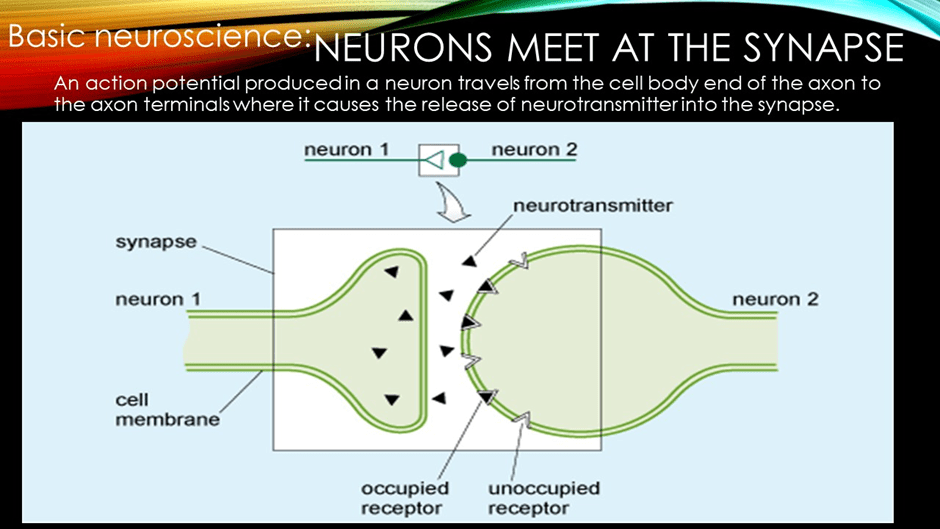
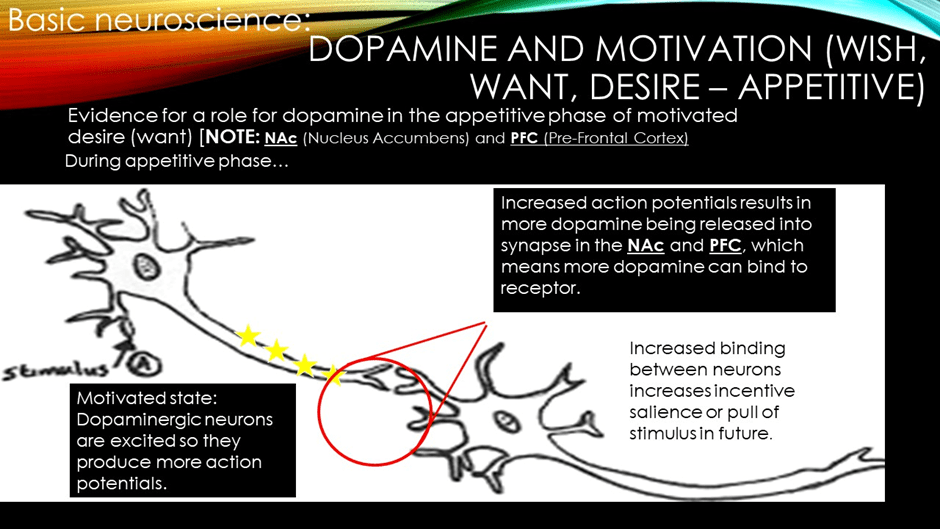
The next slide relies on the basic knowledge above to understand one aspect of the dopamine hypothesis as commonly used in biomedical explanations of ‘addiction’ (and the commonalities underlying supposedly ‘diseased’ responses to a rage of substances, and ./ or in some views behaviours, such as eating disorders , gambling, sex etc.
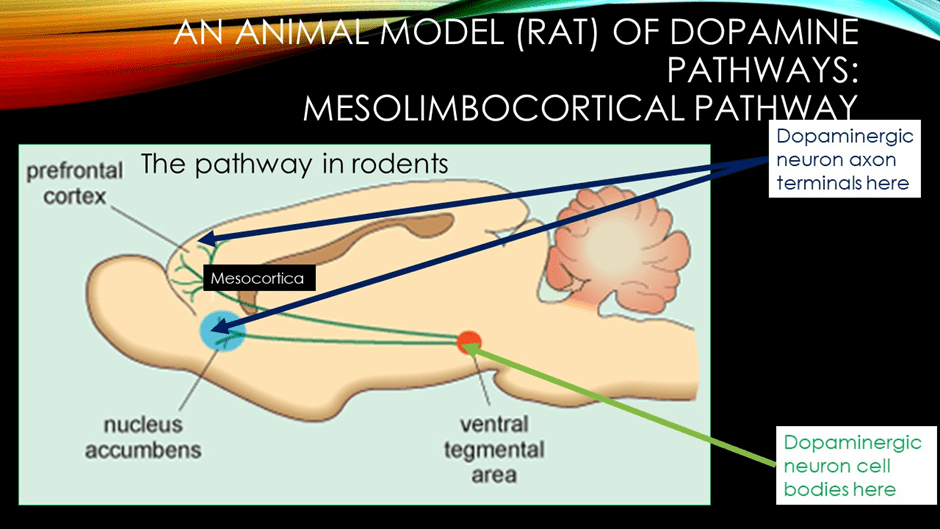
The next slide looks at specific uses of the term ‘model’ (as opposed to theory but related to it by exemplifying the above schematic diagram on a schematic cross-section of a rat model. It will identify the NAc and PFC referred to above as components of the pathway. The next slide further looks at how animal models might be used into controlled experiments on the visceral animal). The rat remains a model for it constrained by experimental controls, including surgical manipulation). Will point to additional reading. The state of what we mean by the objective may, 9should) evoke issues regarding ethics in research and or work with less powerful ‘subjects’ in social work.
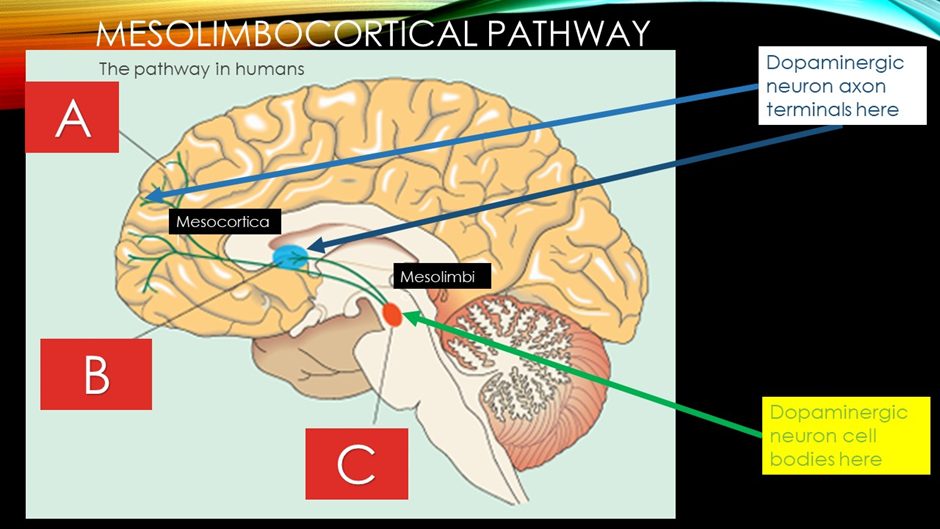
The discussion of an animal model is translated to a model of the ‘same’ processes in the human brain, where features can be labelled(for they have same names as in rat model). Try short quiz on tables to identify A, B & C. (pre-frontal cortex, nucleus accumbens and ventral tegmental area respectively). The discussion of ‘primitive’ brain and its oppressive characteristics (even when used of animals) can be discussed, for it feeds into ideologies of care of the ‘vulnerable’.
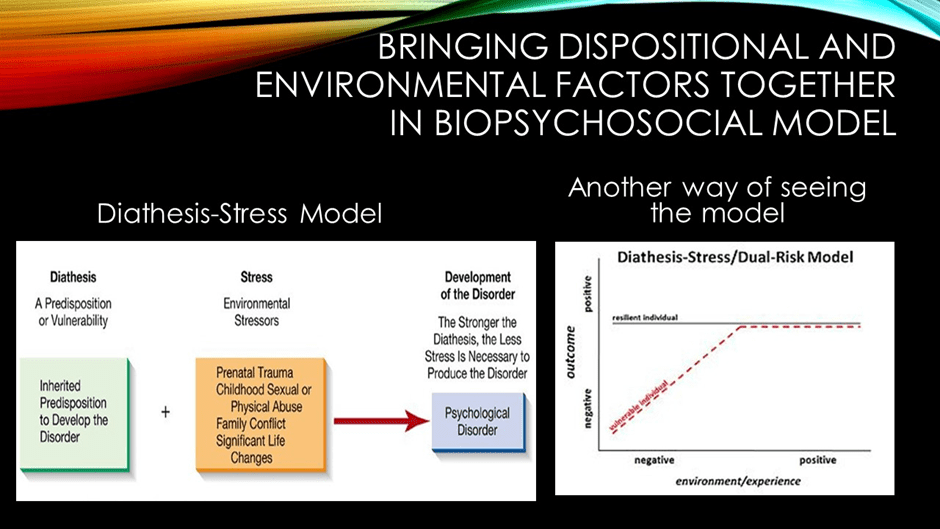
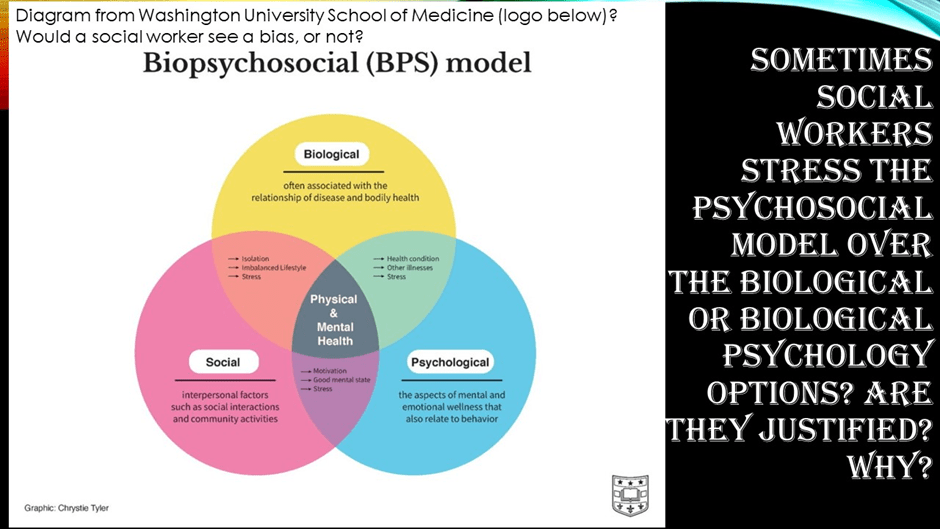
Now introduce the Biopsychosocial Model and its link to the diathesis / stress model for an explanation of an interface between biology and psychosocial.
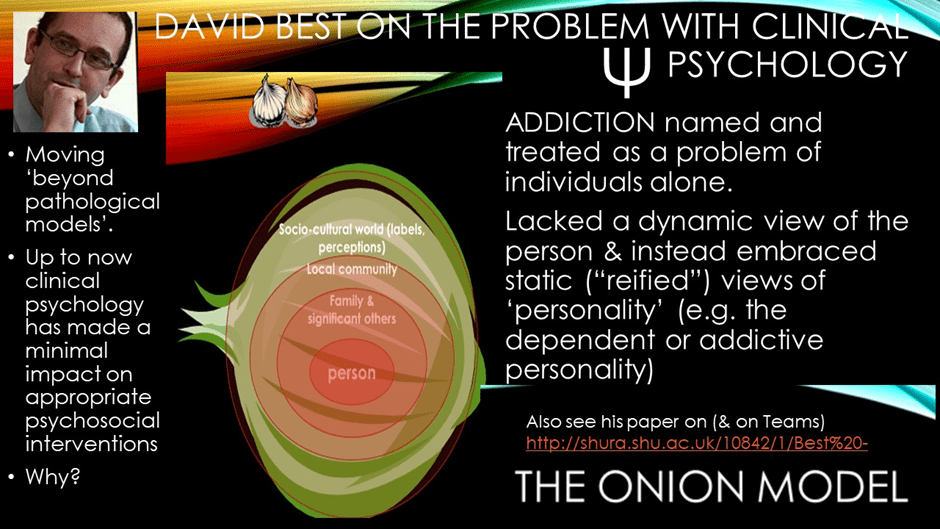
Look at the ‘Onion Model’ as David Best’s popularization of the Bronfenbrenner systemic theory. I don’t intend to introduce systems theory as such, only to rationalise why such approaches began with psychological medicine. Best says the model allows us to break with ‘pathological’ models of drug use. What does he mean? Explore.
In the next slide I allow myself free, and invoke my own blog, to distinguish the biopsychosocial model from the biomedical model for latter introduces specifically institutionalised medical concepts which aren’t the same. It was born from my experience of a course that invoked the category ‘malingerer’ to describe a type of patient and pretended it was an objective term because consultants used it.
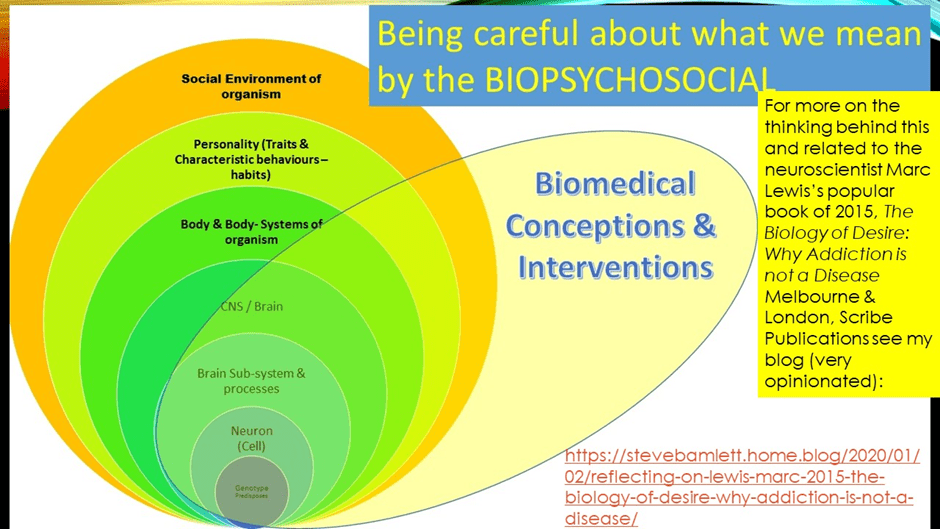
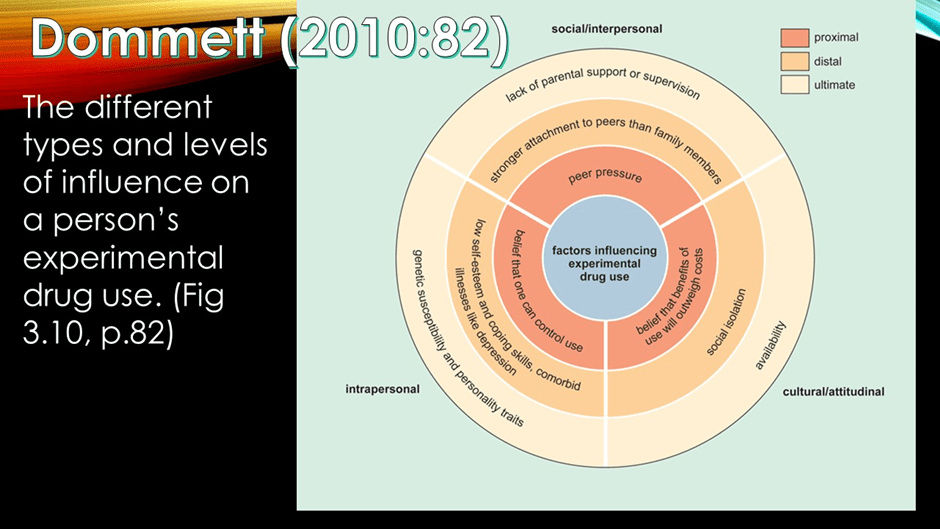
A very good model of how to use biopsychosocial system theory to conceptualise possible factors in a person’s experimental drug use, on pathway to dependence.
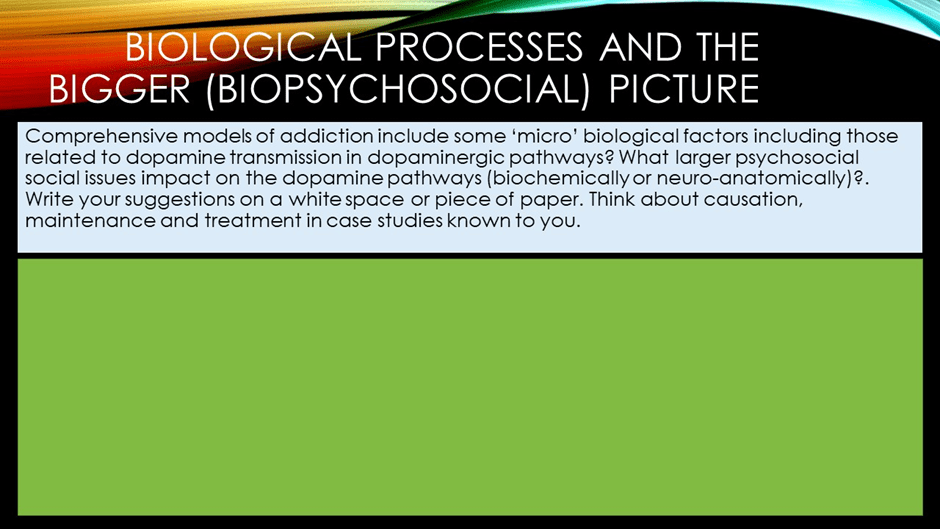
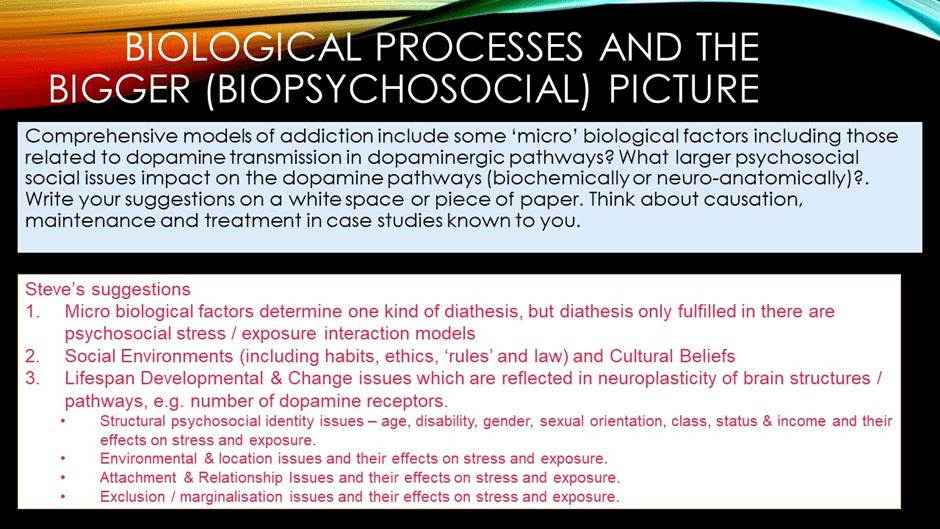
The next is a group discussion (difficult and might have to be abandoned if stress inducing. Of course I will further explicate question and its terms but evoke use of terminology dictionaries. The slide is animated so green cover is removed after discussion showing slide as it is in the subsequent form.
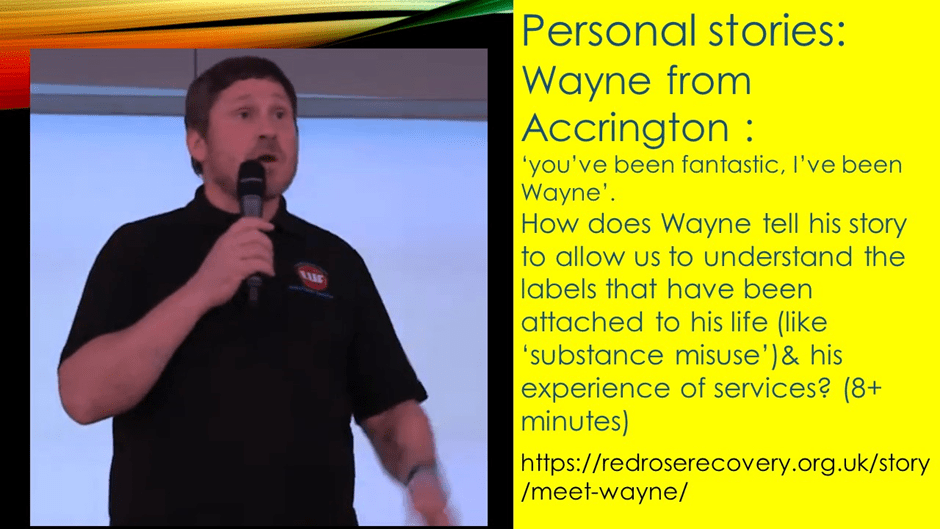
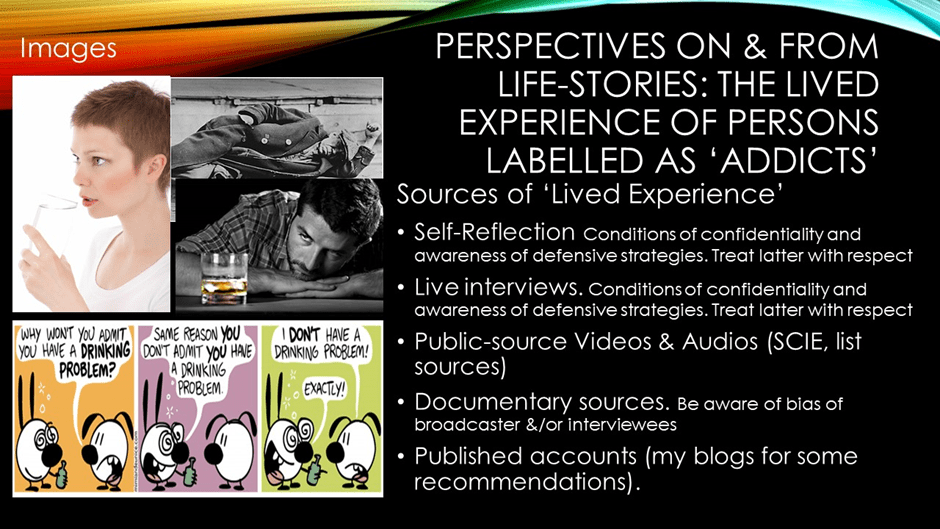
Rather than evoke straight way the next lecture section header, will look at a life-story as given (in public conditions of course) by Wayne, who barely mentions substance abuse though that is the rationale for his talk. The learning from this is that though a professional will foicus on an element of someone’s life-story, that is not how it seems in the world of the person with lived experience.
Now onto the header on life-stories, narrative sources and theory and interventions (highly recommend to social workers).
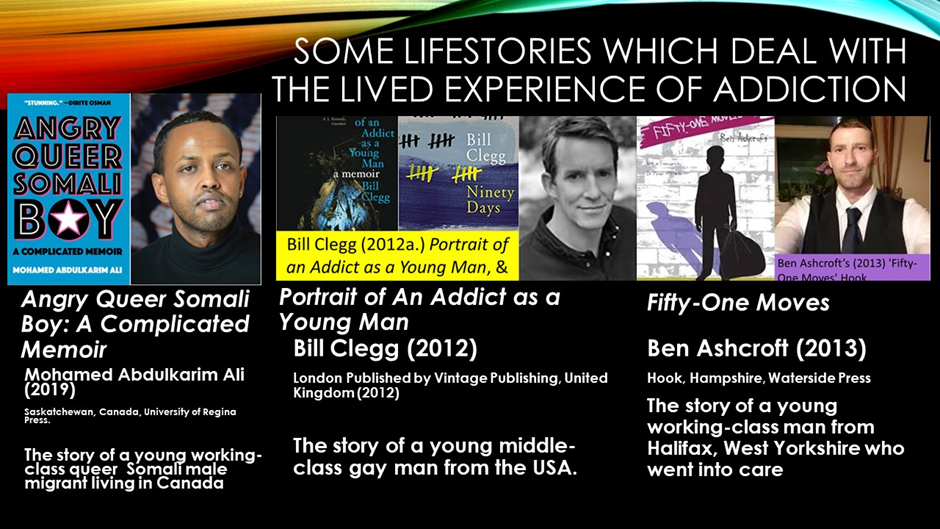
The next story illustrates issues of diversity and connection to other issues including experience of oppression and trauma.
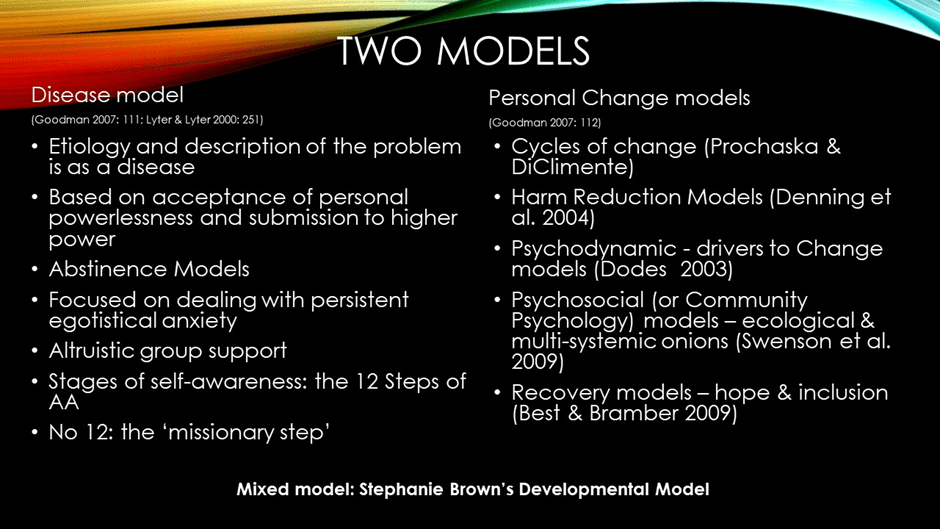
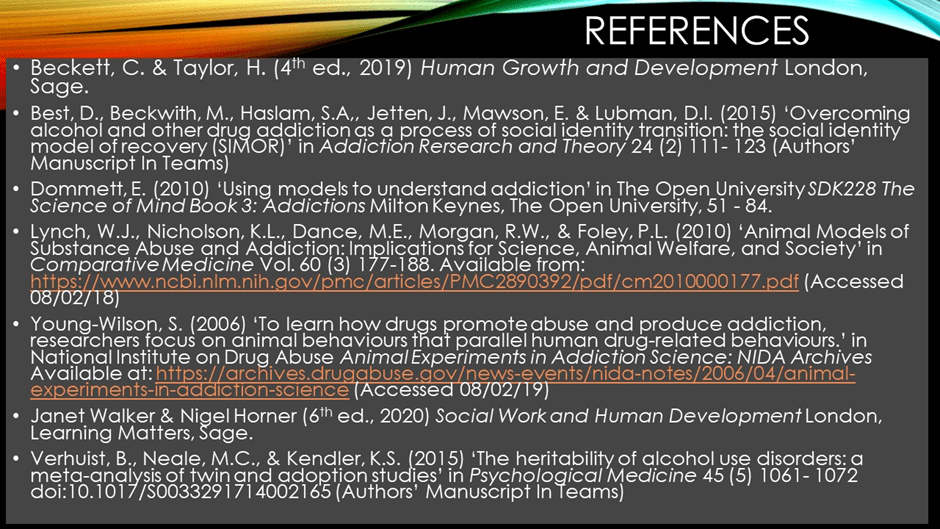
Drawing out briefly but no detail on models of life-course or partial lie-course in ‘addiction’ recovery stories. A paper by Best et.al. is provided in teams for back up after the lecture: Best, D., Beckwith, M., Haslam, S.A,, Jetten, J., Mawson, E. & Lubman, D.I. (2015) ‘Overcoming alcohol and other drug addiction as a process of social identity transition: the social identity model of recovery (SIMOR)’ in Addiction Rersearch and Theory 24 (2) 111- 123 (Authors’ Manuscript In Teams)
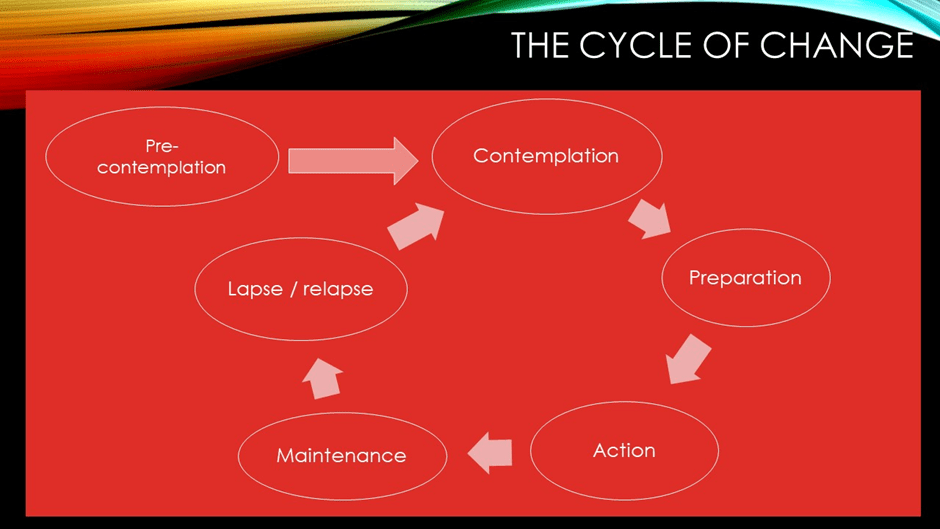
Next few slides show visual ‘models’ of recovery story dynamic – for open discussion.
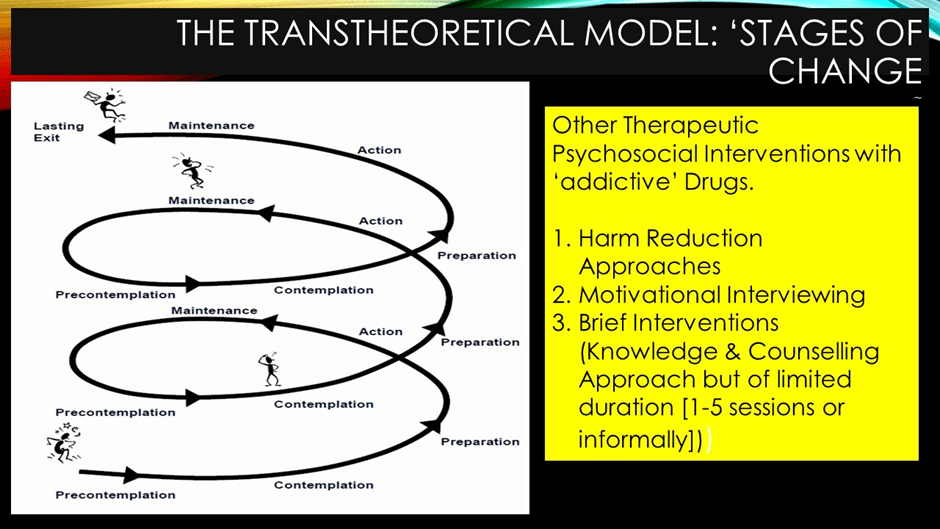

Emd with open discussion of history of social work training pitting medical model against psychosocial models. Is it far/ A question for the whole course. Followed by (select) references. Explain why. Not encouraging further reading yet on addiction treatments.
Love Steve
Feedback always helpful (in blog space or direct to me or on Twitter).
 Steve_Bamlett_blog