‘He erected his easel … and turned it almost perpendicular to the window, angling it to catch the light without casting shadow.’[1] This is a blog on the ownership of figurative Art and the politics of ‘colonisation’. The blog concerns Audrey Magee’s (2022) The Colony London, Faber. Note that it CONTAINS SPOILERS: so do not read if you do not like that: BOOKER REFLECTIONS ON LONGLISTLIST 2022.
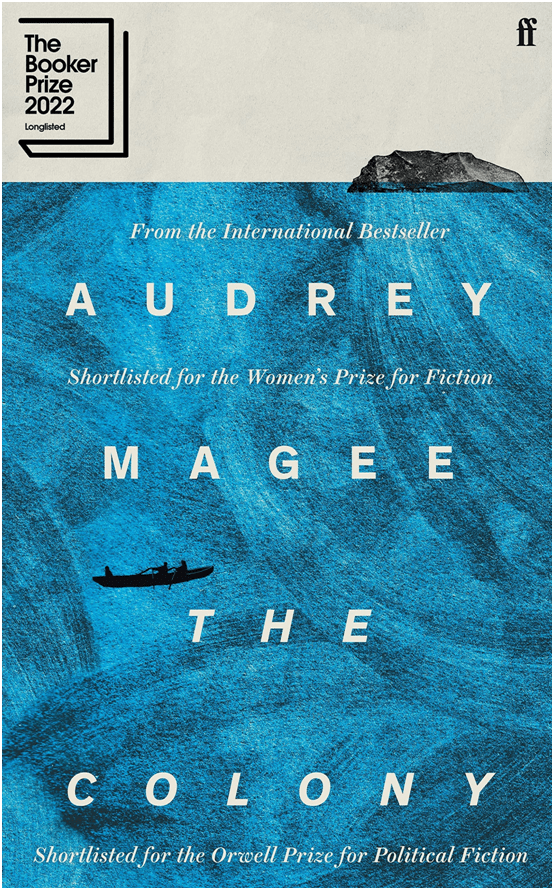
When I blog on books I love to find a quotation in which I see something essential to the book’s major theme or themes. However, on this occasion, I feel unable to do that; instead choosing one partial sentence which I think (but cannot be sure) demonstrates some features of the possible resonances of the book. The sentence comes when the artist known in the novel as Mr. Lloyd has arrived at the tiny island off the Irish coast where the story is set, transformed a former bedroom into a studio and is now completing that metamorphosis of ordinary world into a place of work for an artist: ‘‘He erected his easel … and turned it almost perpendicular to the window, angling it to catch the light without casting shadow.’[2]
The placing of the easel shows the meticulous consideration of the artist in the creation of the conditions of his art – a point made all the more precise by the use of the term ‘perpendicular’ to describe the placing of the easel relative to the window. But is there more involved in this choice of word for an artist working in 1979, the date we learn the events to be set. We learn this because this is the year in which all the atrocities from Northern Irish History and mentioned in the novel are set, as attested by Kevin Power in a review of the novel in The Guardian. He describes Lloyd as:
An Englishman bringing his baggage to an Irish island: the meaning of such an encounter, in fiction as in reality, depends quite heavily on the year in which it occurs. Interleaved with scenes of Lloyd failing to charm the islanders are terse chapters recounting Northern Irish atrocities. All of the atrocities happened in 1979 – the year, it is later confirmed in an aside, when the action of The Colony takes place.[3]
You might think this is political complexity enough in a novel, but my own conviction is that Magee extends the politics of the ‘baggage’ carried out by Englishmen to that embedded too in the ‘history of art’. I pick out the term ‘perpendicular’ from my chosen sentence for this is already a loaded tern in a peculiarly English form of the history of art and carries the burden of English nationalism. In 1979, it was common to use the term ‘perpendicular style’ to name ‘”the quintessential national style”, and a manifestation of the English national character’, to use Richard Marks’ 2012 characterisation of the work of the nationalistic (indeed in the Second World War definitively fascist) architectural historian, John Harvey.[4] Does Lloyd bring with him the prejudices of the English colonist not only as a man, as the IRA supporter, boatman Francis, feels he does, but also as an artist. It certainly might put a slant on the way in which Lloyd steals from the talent of the 15 year old islander, James Gillans, whom he takes as a painter’s apprentice, marginalises (‘painting over’ James in his group portrait of the islanders) and then abandoning him, breaking his promise to take him to be educated as an artist in London. Indeed in more than one way James is correct, when he says to Lloyd that he had “painted over me. Turned me into a fisherman”.[5] Of course, left behind on the island, what else can James ‘become’ but a fisherman, like his drowned grandfather, father and uncle.[6]
In reading that sentence from my title further there is something peculiar about English politics in Ireland that is indicated there too I believe, since it too ‘angled’ its perspective, such that its actions caught ‘the light’ of English self-characterization without making visible the darker ‘shadow’ of its pernicious influence on those it, as a nation, acted upon (and especially, in this context, Ireland). The whole burden of this novel is to capture the ‘shadows’ cast by the English as an example of a colonising European nation. This applies not only to politics per se, or even visual art, but also to verbal art and language. The aim I believe is to enable us to see that the ‘coloniser’ works in multiple ways, some of which are invisible to themselves. Lloyd is correct to say to Masson, the ‘French linguist’ studying the ways in which English presence marginalises the languages and dependent culture of nations it colonises or ‘takes over’, that France did the same to other nations, including Algeria. What Lloyd misses in saying so is that Masson is only a ‘French’ linguist by being the product of colonisation of Algeria – the source of his mother’s language (a mother-language quite literally):
Language is a casualty of colonisation, he said. India. Sri Lanka. The French in Algeria.
There are similarities, said Masson.
French was imposed on Algeria, on Cameroon, English on Ireland, on Nigeria. To progress you learnt the language of the coloniser.
And?
Lloyd shrugged.
It happened. All over the world.
And?
The damage is done, said Lloyd. Move on. Invest in the living.[7]
This conversation is a set piece example of the ways that the Englishman uses his own language and axioms embedded in it (like ‘Move on’ and ‘Invest in the living’) to catch an interpretation of the actions of himself and his nation (past, present and possibly future) that looks as if it is set in ‘the light without casting shadow’. When Lloyd apparently looks as if he is investing in the living: in the life of James as apprentice artist (an artist potentially better than himself) that action will succumb to the ‘shadow’ of his nation’s antagonism and ignorance of Ireland during the late 1970s and early 1980s and of his own jealousy of James’ greater skill and authority on the meaning of life on his ‘own’ island. He allows James to infer that he can be educated in an English art school at the same time as he refers, jokingly, to his and James co-residence (of a kind, though James is more a servant who lives outside) at the ‘Artist’s Hut’ near the island’s cliffs as ‘the artists’ colony on the edge of Europe’. The link to the colonisation theme couldn’t be clearer, even if the intentions of Lloyd are disguised and shadowed.[8]
That this novel is shortlisted for the Orwell Prize for Political Fiction as well as longlisted (thus far at the time of writing only that) for the Booker Prize is no surprise for this is political fiction at its best – demonstrating how power at the structural level globally and nationally is lived in the lives of small groups – small ‘colonies’ we might say in the more innocent sense of the term also used in the novel – and within both families and individuals. But power is not just reflected into personal lives by the politics of colonial appropriation, it operates through other structures such as gender and age, which the novel deals with, as it does much else, refracted through the consciousness of the artist about his own rights as a creator. The artist sometimes feels he owns the beauty he is allowed to create, as if art justified his possession also of its subject. James’ mother, Mairéad, still a young woman in comparison to Lloyd, is appropriated as a model and stripped and positioned by him as if he had rights over her body, in the manner of his artistic hero, Gauguin, taking over the bodies of relatively powerless women in Tahiti.
He opened her hooks on the side and hitched the skirt until it sat under her breasts. He directed her back towards the right side of the chair. … He tilted her onto her left hip and placed her hand flat on the chair.
…
He drew.
island series: woman with feathers, after gauguin.[9]
The language of power and action that subjects the passive other to manipulation shouts at us here, just as a young mother is drawn into the fantasies both of males and the world of revered male art. When Mairéad leaves he continues not only to draw her but to possess her in ways that are intensely sexualised and align her with his past drawing of his wife:
as he drew the curves of her breasts, of her hips, the curls of her hair, eliciting from her, from himself, a beauty that he had not expected, had not felt running through his fingers for many years, ten at least, when he last drew Judith, when she was younger, as young as Mairéad, his fingers and body pulsing as he created her contours, laboured over each piece of her, her hair, eyes, nose and lips, her shoulders, breasts, stomach and buttocks, her pubic hair, …., picking his way along her body, digging his way into her, …[10]
This breathless sentence names the parts of ‘her’ body’ that he fragments so that he is in control of it – creating it and physically appropriating it by working on it; physically ‘digging’ into it. The action of older men is the making of their own object of desire that allows desire to outstrip that object, as the maker praises that which only he could have made. Though this sentence allows the model ‘beauty’ it is only that beauty ‘elicited from her’, a sensation and flow ‘running through his fingers’. The sexuality is masturbatory in nature perhaps, although my best friend, Justin Curley with whom I shared passages says that this is best expressed thus: as a mismatch between a non-sexual event in intention and surface meaning on the one hand and its descriptive observation of the body that cannot help but be sexual on the other, despite the overt intention and meaning of its agents.
Perhaps this is the way older men own the youth of women – and which alone stimulates a jaded desire. Indeed, I would argue that it is the same desire that Lloyd directs at James. He is pushed back only when James shows that his creative powers equal and perhaps will one day challenge those of Lloyd as the teacher is outstripped by the student. The most wonderful passage showing this makes James equivalent to both the youth Lloyd desires from his models and the death their youth is meant to stave off. He asks James whether he can ‘draw’ him, carrying the rabbits he has just freshly killed to eat:
Lloyd flipped to a new page, his pencil scrambling to capture the freshness of youth and death, the boy’s dark hair, his blue eyes, his wrongly-buttoned shirt and his too short trousers, his scuffed shoes and socks that no longer had elastic, his fingers clasping the rabbits’ hind feet, their wyes wide with shock, their bodies still to stiffen, the dribble of blood from each mouth yet to congeal, his pencil feverish, his throat humming until his breath shifted and a bestial groan rose from his chest, a signal that he had achieved. His hand relaxed and he filled out the boy’s face, shading his eyes, his mouth.[11]
The tension here between images of feverish desire and relaxed sensuality, from the innocence of inexperience and the knowingness that can make death out of life, while preserving its signs (in the bodies of the still flexible rabbits) is complicated and no way as easily translated into an emblem of sexual desire as the last passage I looked at. However, I think it touches on a guilty repressed sexuality, which works itself out of the passage in the shifts of breathing until the release of a ‘bestial groan’ like those of the rabbits in death and completion. The variation of pace sings in the sentence rhythms.
I do not know what to make of this except to show that the range of power conflict and its link to colonising appropriation in this novel. James’ appropriation is akin to the surrender of autonomy, symbolised in the loss of one’s own language – like the loss of Irish language so valued by Masson as a substitute for the loss of his Algerian mother-tongue. Into this story of complex conflict, based on notions of appropriation of the other, are placed the various stories of Northern Irish atrocities (I counted twenty-nine).[12] These stories increasingly feed into the main narrative of the novel as the main characters become aware of them and discuss them and the meanings they suggest.
It’s going mad up there, Mam.
It is, Mairéad. Attacking and killing their own.
Mairéad mopped where her mother had swept.
Francis would say our own.
He would, Mairéad.
But you’re not.
I’m not.
…[13]
Mother and daughter here are responding to the death of Catholics at the hands of republicans. Is this a killing of ‘our own’, or ‘their own’ they implicitly ask. The answer depends, of course, on the situation of one’s sense of identity and ownership of impassioned action. It is an index of the complexities that is entering into all lives as they situate beliefs and wishes in the context of present politico-military contexts of struggle, deciding on their meaning thus. I do not think easy conclusions are advised here – for violent struggle is part of the whole continuum of time. Violent struggle even went into the formation of the island on which the novel is set. Here is Lloyd’s view of the island – a moment in which he looks at something whose significance is possibly only offered to us in the language of the third-person narrator, rather than Lloyd’s ‘point of view’ :
He lay on his stomach, on the still dewy grass, and stared at how the sun lit the cliff, illuminating tiny particles of rock and sand pressed into each other millions of years before, highlighting too the ancient structure of the cliff face, planed in some parts, roughly cut in others, the rock hacked, serrated and puckered during that violent separation from the mainland
agony
swirling still
through water and wind[14]
Human beings, and Lloyd is typical in this in the passage above, see the structure and form of things but not necessarily the origins of that structure (and the things themselves) in conflict – for if they did they would escape the partialities that they think fundamental to their identity – nationality, age, gender understood as binary potential and so on – and see the bigger picture in which they might act in ways less determined by these partialities.
This is an amazing novel. I am not confident in my reading but I am in my admiration of the novel-writing and writer. It must reach the shortlist in my view.
All the best
Steve
[1] Audrey Magee (2022:30 ) The Colony London, Faber
[2] ibid:30
[3] Kevin Power (2022) ‘The Colony by Audrey Magee review – an allegory of the Troubles’ in The Guardian online [Fri 25 Feb 2022 07.30 GMT]. Available at: https://www.theguardian.com/books/2022/feb/25/the-colony-by-audrey-magee-review-an-allegory-of-the-troubles
[4] As cited in Wikipedia entry for John Harvey; available at: https://en.wikipedia.org/wiki/John_Harvey_(architectural_historian)
[5] Magee op.cit: 347.
[6] Ibid: 53
[7] Ibid: 181f.
[8] Ibid: 177
[9] Ibid: 246 Magee’s italics and lack of capitalisation of names therein.
[10] Ibid: 247
[11] Ibid: 56
[12] See ibid: 18, 42, 65, 67, 73, 110, 121, 127, 131, 170, 178, 193, 197, 218, 221, 229, 23, 238, 244, 250, 254, 293, 296, 301, 305, 307, 315, 338, and 372.
[13] Ibid: 339
[14] Ibid: 55
 Steve_Bamlett_blog
One thought on “‘He erected his easel … and turned it almost perpendicular to the window, angling it to catch the light without casting shadow.’ The blog concerns Audrey Magee’s (2022) The Colony London, Faber. Note that it CONTAINS SPOILERS: so do not read if you do not like that: BOOKER REFLECTIONS ON LONGLISTLIST 2022.”