BOOKER REFLECTIONS SHORTLIST 2022: ‘“Who? What? Said the man. “Is there a difference?” ’[1] This blog contains my personal views of Alan Garner’s (2021) Treacle Walker London, 4th Estate.
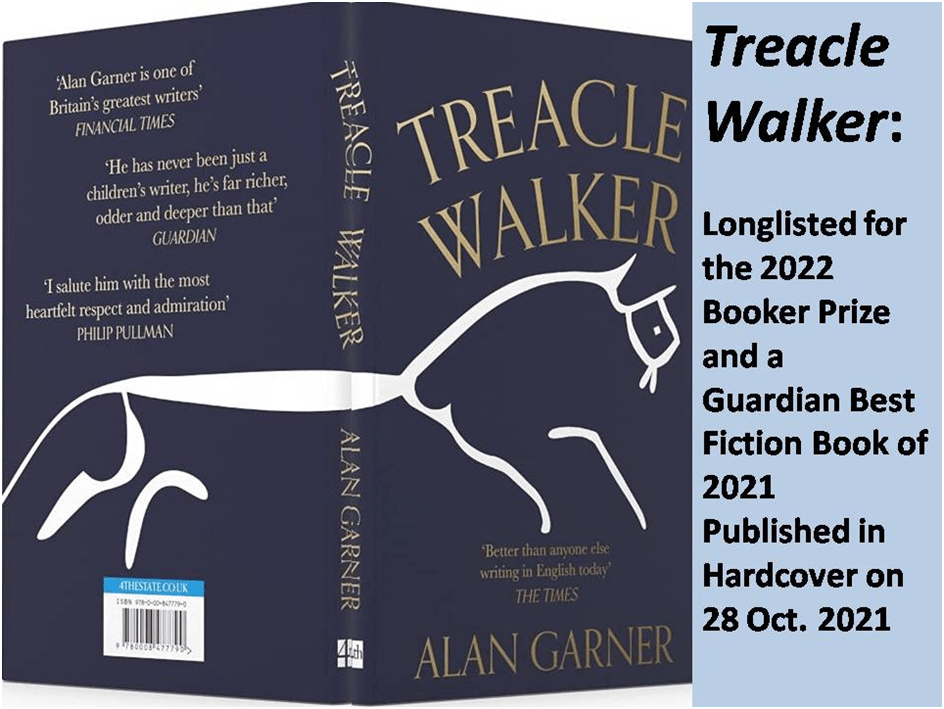
Some readers of Alan Garner seem to be clear about who, or what, this novel is about. Reviewers for The Guardian (Alex Preston) and The Observer (Justine Jordan) agree that’s its subject is as announced by its epigram by Carlo Rovelli: ‘Time is Ignorance’. Jordan elaborates a little on Rovelli’s concept of the non-physical saying: ‘.” Rovelli believes that it’s a mistake to pursue our sense of time in physics alone – that it’s linked to human brain structure. Or as Garner has it here: “What’s out is in. What’s in is out.” Jordan’s source, a review of Rovelli’s short book on time in Physics World, is available at the link she offers in this citation from her. The concepts aren’t necessarily clearer in the answers Rovelli gives to the Physics World reviewer’s questions but they amount to saying time is a construct whose properties are subjective phenomena not physical properties whose existence is verifiable objectively. Here’s Rovelli’s answer to being asked for a definition of time ‘in a nutshell’:
I think that the key to understand time is to realize that our common concept of “time” is multi-layered. Most mistakes about the nature of time, and much of the confusion, come from taking the full package of properties we attribute to time as forming a unique bundle that either is there or not. Now we understand that many properties we attribute to time come from approximations and simplifications.[2]
Amongst the errors humans make in considering time the same reviewer, Martin Durrani, mentions, with some evident incredulity, is his belief that, as Durrani cites it, ‘”references to our fear of death [being] an error of evolution”. Both Treacle and the Amren Man, whom Joe is given the power to see from a product bought from Treacle smell of decay that others notice rather than he, as is this riddling conversation:
“What is wrong?” said the man.
“You smell.”
“Not I, Joseph Coppock,” said the man. “You smell that I stink. Let words be nice.”[3]
Even the archaic use of the word ‘nice’ to mean particular and specific is very much like other parts of Treacle’s discourse, blending words now rarely used with a more modern idiom, as if he was a function of the history of language and has the sniff of the old-fashioned. Thin Amren is a dirtier part of history and absorbed in such a way that he is made of his environment in which ‘the air was heavy with marsh smells’, whose decay is in part suggested by the naked man coloured ‘copper brown’ from the bog in a ‘copse that had long not been worked’. As Thin Amren says: ‘May not a body rest in his bog?’ [4] Treacle by contrast, fastidious always to ask permission to enter a home, is associated with the absence of body. When Joe looks from outside at the door knocker that has banged, he says “There’s nobody there”. To which Treacle answers ‘The no body wishes to come in”.[5] The splitting of the word nobody into ‘no body’, something that like Treacle knocks politely to request admission is telling.

I think though that this idea of the antiquated becoming resurrected is as central to this book as any philosophical approach to the ontological questions raised by time – the ‘who’ or ‘what’ that might be the answer to describing the being and function of Treacle Walker. However, we can start with obviousness that he is a tinker, a tradesperson associated with the sale of objects whose exchange worth is low but which, possibly for that reason, become associated with magic and the prediction of the future of the purchaser. Nevertheless, reviewers often make assumptions en passant in their reviews, ones I would not make at all. Jordan shows that she is not reading but making assumptions when she starts telling the story as one concerning, ‘Joe Coppock, a convalescent boy’.[6]
For the term ‘convalescent’ conveys the suggestion that Joe is ‘getting better’ from his illness, a belief he has in the story been given permission to have it sometimes seems, but which may be far from the truth and does not take into account deeply cherished mores about the care of the convalescent child by significant others. Alex Preston points out that much of the story veers from our most cherished beliefs about the needs of children in these words:
Joe, our hero, is a child living a strange and circumscribed existence. He has been poorly, he says, and wears a patch to correct a lazy eye. His parents are not in evidence, and he measures out the days by watching the passing of Noony, the train, through the valley below.[7]
Indeed I think this fable is possibly a most poignant parable of death, that thing the fear of which Rovelli calls a ‘mistake of evolution’, and too prominent in our human conceptions of the meaning of time as ‘mortality’. That the story may concern the experience of a dying child at a point before he has tasted other than an imaginary adult life, and perhaps not even that, makes it even more poignant and meaningful, especially since we are reconciled to that eventuality. Treacle says to Joe in the final chapter: “It is time to make an end.” Though Joe still asks ‘End of what?’, he learns in quick succession that he must affix Thin Amren back to the bottom of his dirty wet bog (which ‘opened before him further than he could tell’) with sticks, and that this means Thin Amren must resign himself to the loss of ‘Whirligig’ (that endless motion in which life still only eddies) by thrusting him deep and staking him quick.[8] It is at this point that Joe asks Treacle: “Treacle Walker, am I dead?”[9] I think the answer is ‘Yes’, though his destiny is to himself become a new Treacle Walker. And the novel ends with a reordering of very nearly the same phrases which introduced Treacle Walker, at the same time of day and in the same weather and with the same event – the passing of Noony, the midday train. The novel opens thus: ‘Noony rattled past the house and the smoke from her engine blew across the yard. It was midday. The sky shone’. It closes thus: ‘It was midday. The sky shone. Noony rattled past, and her smoke curled along the valley’.[10] They are as I say ‘very nearly’ the same but the difference matters. The smoke which had become locked in the yard of a house holding a sick boy now passes along the valley.
Preston says ‘the novel is essentially a response to [Carlo Rovelli’s] idea, seeking to ask how we would experience the world if we were able to step out of the straitjacket of time’.[11] Nothing could be more telling an example of this than the presence of the train Noony, as the symbol of eternal recurrence that may indicate not several occurrences of a thing but one and only one – a narrative time that is entirely mythical and subjective. This would explain why Joe’s parents or other carers are absent from the tale – for it is he who must face Thin Amren’s cry ‘I am alone’ and become his comforter that life has not abandoned the dying but continues in the survival of other forms of continuing life and death: “You must sleep, … You’ve got to.” Acceptance is all in death it seems: ‘Thin Amren moved, settled, and was still”.[12]
If we look at the landscape of this fable then we see a landscape forever taking on the aspects of mortality, illness and ending but rendering it beautiful and intriguing: when, for instance, ‘The sky was a blare of sick headache’.[13] Treacle knows the ‘sun is not good’ for Joe and that his ‘visage is wan’.[14] His condition gives him ‘a bilious sick headache’ which means he must rest.[15] No wonder, when the novel opens at noon, Joe is still in bed with a comic, living through its reflections. Smoke is often the image of life, a chimney a hole where what is in gets out. Even passing through a mirror is like passing from life: ‘the cold of the passing was none he had ever known’.[16]

The phenomenon at the heart of this novel is that of ‘glamourie’. The term derives I believe from the Scots and is the title of a poem by Kathleen Jamie, which appears to be a defiance of death when it is seen as a mere ending of vibrant life in a ‘ditch’ (but the poem will have other readings of course so follow the link to the original here). At one point the poem’s narrator:
…. duly fell
to wondering if I hadn’t
simply made it all up: you,I mean, everything,
my entire life….either way,
nothing now could touch me
bar my hosts, who appearedas diffuse golden light,
as tiny spiders
examining my hair….
‘Glamourie’ is here a kind of imagination, seeing what ‘is not there’, or at least to the unimaginative. This is very much its function in this fable story. But whether this is right or not I cannot tell and suspect that looking for a ‘right’ meaning for anything here might be hopeless and reductive. The story gleams with sad haunting and magical beauty. I think Felix Taylor, reviewing the book for Literary Review, may have a strong point. He points out sources for many ideas and possible symbols in the novel. He includes one which Garner himself must have suggested – one I love since it references the nearest large town to my birthplace. Treacle Walker was, according to Bob Cywinski, a scientist (at the University of Huddersfield) known to Garner, ‘A Huddersfield tramp who could heal “all things save jealousy”’, like our character in the book. Likewise lots else can be traced to ‘Celtic myths and other motifs familiar to readers of Garner’ but Taylor says of all this, probably correct in its denial of correctness:
Spotting these does not necessarily provide answers to the story’s meaning. Treacle Walker is playful and quick in the telling, yet heavy in implication.[17]
I had not intended to read this novel and it is not the kind of story I like but this is beautiful. You may be surprised to like it as I was. You may however know that you will like its human take on the philosophy of science, for know that ‘quantum physics’ lies behind it is not even necessary. Whether it could win Booker in 2022 I could not dare guess.
All the best
Steve
[1] Alan Garner’s (2021: 11) Treacle Walker London, 4th Estate
[2] Martin Durrani (2018) ‘Carlo Rovelli: the author of The Order of Time discusses ‘perhaps the greatest mystery’’ in Physics World (online) [04 Jul 2018]. Available at: https://physicsworld.com/a/carlo-rovelli-the-author-of-the-order-of-time-discusses-perhaps-the-greatest-mystery/
[3] Alan Garner 2021 op.cit: 5
[4] Ibid: respectively 43, 42, and 45.
[5] Ibid: 11
[6] Justine Jordan (2021) ‘Treacle Walker by Alan Garner review – a phenomenal late fable’ in The Observer [online] (Sat 30 Oct 2021 07.30 BST Available at: https://www.theguardian.com/books/2021/oct/30/treacle-walker-by-alan-garner-review-a-phenomenal-late-fable
[7] Alex Preston (2021) Treacle Walker – the book of a lifetime’ in The Guardian (online) [Mon. 01 November 2021] Available at: https://www.theguardian.com/books/2021/nov/01/treacle-walker-by-alan-garner-review-the-book-of-a-lifetime
[8] Alan Garner 2021 op.cit: respectively 139, 142f., 147
[9] Ibid: 151
[10] Ibid: 3, 152 respectively. The phrases also occur ibid: 23.
[11] Alex Preston, op. cit.
[12] Alan Garner 2021 op.cit: 146f.
[13] Ibid: 142
[14] Ibid: 60
[15] Ibid: 29
[16] Ibid: 114
[17] Felix Taylor (2022: 64) ‘Like A Rolling Stone’ in Literary Review Issue 503, December 2021 / January 2022 , 64.
 Steve_Bamlett_blog
One thought on “BOOKER REFLECTIONS SHORTLIST 2022: ‘”Who? What? Said the man. “Is there a difference?” This blog contains my personal views of Alan Garner’s (2021) ‘Treacle Walker’.”