‘Unrecounted / always it will remain / the story of the averted / faces’. This blog ponders on the need to tell ambiguous stories, neither truth nor lies exactly, of the displaced Jew, the insane, unnameable or queer and other characters written ‘on the edge’. It probes writing fascinated by the theme of the untold and untellable story of the forever more deeply marginalised in the work of W. G. Sebald and the unsettling reflection of that in Carole Angier’s 2021 literary critical biography Speak, Silence, In Search of W. G. Sebald [London, Oxford, New York, New Delhi, Sydney Bloomsbury Circus]. Should untellable stories be told?
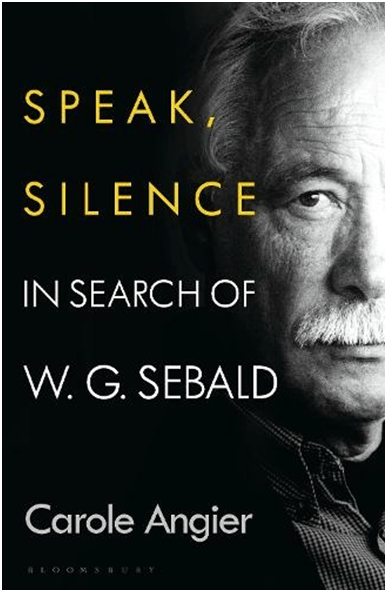
It is impossible to describe the effect of W. G. Sebald in a way that will not alienate even more those who already find him and his writing overly obscure or hard to categorise. Refusing linguistic categorisation of the subjects of one’s anxious memories is, after all, the nature of this writing and writer. It is more than likely that any attempt to tell a clear story about such liminal subjects will only hopelessly confound the value of his work which depends on our need to embrace what is obscure and query the process of how we understand each other as persons.
Often the obscure subjects he deals with are only available to us on the cusp of that which can be articulated directly in language that categorises both its subjects and their behaviour as a single name-label or unequivocal description. In fact such categories can often turn out to be little other than an implied possibility open to error or complication by numerous other possible categorical terms. Think of the word ‘queer’ itself in fact as an illustration – the whole aim of ‘queer theory is to decategorise the application of the term. But even proper names – those we use to identify a person – are potentially problematic.
Angier labels the parts of her book using the connotations and denotation of various names between which Sebald morphed. These are the names he used or adopted when used of him in life but also in the characters who could often partly represent him in his novels and stories. The sections of Angier’s book are named to identify personae between which Sebald transitioned. Each ‘name’ has complex beginnings in terms of its origin located in exact times and places. Winfried (the name his parents gave to the the young boy) is the easiest but where and when the alternative names Sebe (a name given to him initially by the teenage ‘Clique’ he grew up with) is harder to locate and interpret across and between times – since Winfried continued to be his name at home. It seems to connote the places and times of his rebellious adolescence and to have no obvious denotation in meaning.[1] Cocky, again, is the name he takes on generally in the context of his life with peers at Freiburg university and derives initially from being given the role of Cocky the Cockney in Eugene O’Neill’s’ play In the Zone at that place. He played the role with ‘uncompromising fidelity’: the role, that is, of an English working-class rebel cursing his way into prominence alongside close masculine company.[2] From thence the names ‘Max’ and the authorial ‘W.G. Sebald’ play different roles in relation to the characterisation of man, teacher and writer but include elements of Cocky, Sebe and Winfried.
Angier seems to point to the deficiencies in singular categorical labels in naming most often when she deals with Sebald’s treatment of the potentially alienated or depersonalised feelings, behaviour or traits in his characters (even to the point of the fragmentation of any coherent personality through ‘madness’ or suicide), their relationships or the same in those characters that acted out his ‘own’ life like Sebe, Cocky, Max and so on. We need to come to the complex relationship of the writer and man to a validated identity as German that also enacted an imaginative empathic desire to understand what it felt like to be a Jew in his critical writing and fiction. But let’s be clear from the outset, despite his identifications and inventions of Jewish identity for his ideal of writers and characters, Sebald was not himself Jewish. Indeed a problem in his writing is that he is so hard on Jewish people who do not play the role of being a Jew and telling truths which only a Jew might know as well as he wishes them to do. Angier however attempts to explain this, I think, in terms of other ideal identities against which standard Sebald continually measured the behaviour of his characters (and she hints, himself). For me unsurprisingly I first felt this theme impinge on my relationship to his representation of queer feelings, behaviour and markers of complex interpersonal relationship in his writing and now in Angiers representation of his life.
Below, for instance, is an example relating to how we should read the constant references in both Sebald’s writing and Angier’s writing about Sebald. She never (given the limitations put on her sources of evidence about Sebald’s personal life by his acquired family) names his sexuality directly on the basis of hard documentary data. This too needs asserting from the outset. In this example, Angiers is speaking of the central relationship between an older and younger man. The relationship is based, it would seem, on a story taken from his wider past family history, in which the elder man, Ned McLean, died in ‘“in a state of mad exile”, … “shut off from himself”’ that was generated by alcoholism.[3] The narrative of this relationship is taken up in the story named ‘Ambros Adelwarth’ in his great work of exile, The Emigrants. [4] In discussing ‘Ambros Adelwarth’ Angier works out that McLean might be represented by Cosmo Solomon and his possible youthful lover, Ambros, an amalgam of many sources including McLean’s putative lover and ancestor of the Sebald’s, William Schindele.[5] Whilst that historic relationship can only be inferred since there is unsurprisingly (given the homophobic society represented in the story) little hard documentary evidence of a ‘homosexual’ relationship between the two. Indeed Sebald, according to Angier, even deliberately obfuscates any denotative naming of that relationship too in its subtly connotative suggestions in the fictional version:
… – are Ambros and Cosmo lovers? In the published story there are only hints: Kasimir’s remark that Ambros ‘was of the other persuasion, as anyone can see’, and the shared bed at the end. But in one draft Cosmo also takes and presses Ambros’s hand: in several, Ambros, disturbed by his vision of home, holds onto Cosmo. And where in the published story the two just lean against a wall on the mount of olives, in the drafts they lie with their heads together, or with Cosmo’s head on Ambros’s breast or shoulder. In other words, Sebald began by describing quite clearly what the relationship is between the two. But bit by bit he cut and refined it, until – typically – all that is left is implication.[6]
And moreover, the source of feelings of alienated exile and later collapse into madness of the characters are further complicated by the fact that Ambros and Cosmo are described as Jewish and of immigrant stock, which bears no link to real life-identity of their models. Of McLean Angier says: ‘You couldn’t find a more thoroughly non-Jewish establishment Wasp than Ned McLean’.[7] This kind of metamorphosis of Germanic ‘Wasp’ to Jewish identity is used to vaguely indicate then otherness to norms and conventions. According to Angier Sebald often introduces to his characterisations of fictional persons a complex and the oppressed history of a type of the Jewish émigré that was not justified by sources. These sources were sometimes well-known literary ones but there were also many cases where the models for characters were living or recently dead real persons. In both cases offence was caused to the person related to this or other matters, when relevant, or to their surviving families. An good example is the case of the transformation to the case of a suicide in the story (also in The Emigrants) of Dr. Henry Selwyn from its source. Selwyn is based, Angier shows, on the suicide of the non-Jewish Dr. Philip Rhoades Buckton. So persistent was Sebald in these transformations that he even lied to Angier in her role as literary journalist reviewing the book on publication her (and inadvertently Will Self) that the source had been Jewish.[8] About this, and other changes (such as the exaggeration of Buckton’s mental ill-health, according to Buckton’s family) that surviving family were ‘furious’.[9]. This fury was shared in other cases of closely-described obvious models alive and dead for characters. Angier says categorically (or as near to this as she gets) that the transformations of models that were categorically non-Jewish Germans or Austrians into Jewish characters had much to do with his belief, as expressed by her, that ‘by ‘Adelwarth’ homosexuals have become like Jews: victims of the German past, who deserve empathy, not hatred and fear’.[10]
It is as if, I’d argue, Sebald wanted to focus not on categories like ‘racial identity’ or other categories, such as that of the nineteenth century invention of the homosexual or the ages long construction of the ‘mad’ as the obverse of a normative state of mind called normality, but on how their shared otherness to convention revealed the problematic basis of all social norms in all ‘civilizations’. These ‘civilisations’ would include the USA and UK who ordered mass destruction in the German city of Dresden, and other cities, as well as those Nazified nations who engineered the ‘final solution’ to the existence of the Jewish race (constructed as a problem by German Nazis).[11] And this empathetic defence of otherness (of what queer theory calls the ‘queer’ in life) is what makes Sebald a great novelist I’d say, following Angier of course. However, Angier takes this point further into speculation about Sebald’s sexual identity outside the hard evidence, which thus far excludes support that Sebald was at any time homosexual or gay. However, that Sebald understood queerness in feelings, interactions and relationships is without doubt and, in my view, this is all we need establish, without any irritating search for ‘evidence’ of male-to-male sexual contact, however we define ‘sexual’. I think there is moreover in each case more than ’empathy’ involved for otherness but also a rather a demand that people othered by convention stand up for themselves as Jewish and/or queer.
This is particularly important I’d say in Sebald’s treatment of the romantic (to say nothing about the implied ‘sexual’) life of the teachers he writes about, especially in another story from The Emigrants, that of Paul Bereyter. The character is clearly based, as Angier effectively shows from the analogies between them, on his own teacher, and that of the teenage ‘Clique’ before mentioned, Armin Müller.[12] The differences between Paul and Armin however emphasise the queerly ‘a-normal’ (I am refusing here the heavy negative connotations of the term ‘abnormal’ in my word-choice but not the implication of marginality or liminality) in Bereyter’s uncommon use of corrective violence in behaviour and language. Strangely enough Angier shows Sebald admitted taking this trait in part from another German-Jewish emigrant, Ludwig Wittgenstein, who was also a heavily self-denying queer man and teacher.[13] However, this trait is not unlike (especially in critical language used against traits he disliked in others) that which we might name (to use Sartre’s terminology) bad faith (or mauvaise foi in the playing out of given or existentially chosen identities.
Angier uses the term ‘bad conscience’ herself in analysing the way in which Sebald employed venomous language as an academic literary critic especially, and in proportion to writers who ought (in his view) to have embraced their Jewish identity more thoroughly. These writers included the subjects of his academic dissertations Carl Sternheim and the great Alfred Döblin .[14] In contrast he thought Peter Weiss, in The Investigation for instance, did write with the the ‘real insight’ he later told learners at East Anglia that we should expect from ‘Jewish writers’.[15] That he expected this extreme of public self-identification with an existential position even in the face of the most extreme social oppression and marginalisation like the death camps, reflects I think on his over-determined and even neurotically unforgiving attitude to people who turned their back on the love that people generate between themselves. And this unforgiving attitude applied even in extremis, whether the love-match were heterosexual, homosexual or one having no part in these simple binaries.
In the case of Paul Bereyter’s love for Lucy Landau the bad faith is built into their common Jewish identity and the difference of their fates in terms of survival of Fascist oppression. To create both characters, Sebald invented the Jewish background of the real Armin Müller’s real three lost female lovers – the name of the most likely being Ludmilla (shortened to ‘Lu’ and therefore suggestive of Lucy Landau) Moser[16]. However none of these three women were Jewish nor sent to concentration camps. Even Müller’s identity, only a quarter Jewish, was made entirely Jewish for Paul’s character profile. Angier calls the mental source of the traits of severely critical passion for truth in Bereyter – to the point of unreason – ‘survivor guilt’ based on the loss of Lucy to the Holocaust in their joint traumatic past. As well as an emphasis on faith to self then there is driving this story a motivated displacement of the self into a typology that Sebald sees as characteristic of the emigrant and wanderer. In her literary critical discussions, Angier traces this type in Sebald’s Vertigo to literary models of character and motif in the writing of Sebald’s greatest literary love, Franz Kafka. And she shows how Sebald imported too into Vertigo the interactions in Kafka’s work between notions of the brother, doppelgänger and queer themes. Her analysis of this, which must be read in context and in Angier’s original by any interested reader of my piece, ends with the finely flat paragraph (given the excitement of the literary chase it concludes) which alludes to the texts in a way it would be too tedious to further explain for me here:
He is thus the ultimate image of the wanderer with no home in this world, whether in reality or metaphor: … Especially of course, like Sebald: at home but not at home in W., his life already disappearing into his writing. At the same time, Gracchus is Schlag, in whom sex and death meet. And again, in both Kafka and Sebald, Gracchus’s fear may be of homosexual love, as he touches the knee of the mayor of Riva.[17]
In fact I cannot verify the critical doubling and literary allusions here now, given my present distance from Kafka (or Stendhal who is also involved) as a reader at this time in my life. However, of Sebald, the feel of the queered invoked here – of love that means embracing at least social (but sometimes physical) death when it is authenticated in the body and not convention – this all rings clear to me as a devoted reader. I do not myself think this means Sebald was ‘really’ gay, but that he admitted that his desires were not fitted to norms, of any kind and however militant those norms might have been, as they definitely were in Nazi Germany. It fits with the continuing existence within the writer Sebald and the adult ‘Max’ of the adolescent rebellion of Sebe when he began to reject the more pliable role of himself as young Winfried: ‘he started to dissent and criticise, and arguments began … that would last until he left home’.[18] It took the form in the family sometimes of Sebe waggling ‘his finger under his nose, in Charlie Chaplin’s Hitler parody’ when in his father’s presence.[19] In the later Max and Sebald too was the more urbane enactment of existential freedom from self-definition attempted by the student who was Cocky. The latter was photographed with university friends officiating over the ‘corpse of higher education’.[20] And this rebellious attitude to normative educational institutions was a theme in the university teacher Max, where a learner he taught remember he ‘loved to mock pretension’.[21]
Perhaps the most liminal of identities that were to inform Sebald and Max as writer and person were his experiences of mental breakdown, which his characters often rehearse too in their lives. Angier speaks of his teaching at Manchester where his friend ROP reports Max saying that he ‘sometimes feels near the edge’, feeling it ‘break out inside him, like Herzog, and fill him with ideas and images’.[22] The experience of something like madness( based in that conversation on Saul Bellow’s character) can otherwise be also found in Kafka. Angier doubts that this experience of near ‘mania’ was more than an imagined alienation of mind she also reminds us that experiences of ‘deep depression, with moments of panic and anxiety’ are admitted to throughout his life, although in a way covered up by the ability to act ‘normal’. She also shows that he saw these experiences as essential to his creativity and response to life events and art.[23] He loved books where the hero can say as Bellow’s Herzog does that he is ‘out of his mind’ but that ‘it’s all right with me’ (she mentions Holden Caulfield too from J.D. Salinger’s Catcher in the Rye.[24] But the absences of mind that led to his many car accidents (and eventual death in such an accident) shows that some of this alienated character-type was a possible reflection of Sebald’s own personal life. The lives of the ‘mad’ are the least ‘recounted’ of any moreover for they have truly ‘averted their faces’ from wishing to be understood by others or given up avoiding the obscurity of their experience.
Sebald sometimes plays games with identifying even living persons who became the models of his characters as exempla of thinly repressed mania. This is particularly true of the use of Frank Auerbach, a German-Jewish emigrant, as a model for Max Ferber in another story in The Emigrants; a story in which Sebald ‘planted clues all over his text’ that would identify the artist. Auerbach hated publicity and particularly publicity so openly identifying his oddness of character with a mania based on fleeing the Holocaust experience. The evidence that Ferber (originally named Max Aurach) anyway uses Auerbach’s unmistakable thick impasto working methods is unmistakable. Moreover, he included (in the original German edition) ‘one of Auerbach’s drawings’.[25] The truth is, as Angier implies, Sebald felt Auerbach’s story so recalled his own, but with the added liminality of oppressed Jewish emigrant history, that he felt he could own his story with impunity and without asking. And with it went a right to interpret that history as the creation of an emergent living exemplum of an artist transforming personal and family tragedy, and the madness, isolation and potential displacement involved, into the stuff of art. The same interpretation of Auerbach Sebald may have gained from Robert Hughes 1990 biography of the artist, but his possession of it became almost a sign of instability itself in Sebald’s own identity, which Auerbach himself seems to say in a letter to Angier cited in the biography where he deprecates ‘the use of other people’s misunderstood biographies to lend weight to what appeared a narcissistic enterprise’.[26]
The whole process of creation is liminal between what is real and what invented, myth and observed event, past and present in Sebald and thus almost like a kind of mania or psychosis. But the importance of this is that it rescues from ‘silence’ the ‘unrecounted’ (the untold and unnumbered lost) that lay under the world of norms (thus allowing obscenities like the Holocaust to occur as if they were normal). Amongst these is our common humanity with the emigrant, the oppressed, ignored and queer, who speak and enact desires to survive that others dare not. There is something wrong I think with using Jewishness as a symbol of other cultural, social and psychological displacements but it is not something wicked. However, in that it led to Sebald as a critic to abuse Jewish authors who had not been bold enough to speak out against oppression and for an existential Jewish identity is perhaps unforgivable on a personal level. Perhaps this happens because Sebald is in fact loathing his own disguise under normative behaviours. We need to think whether Angier is right about Sebald’s constant reference in art to an implied queer sexuality of his own – a repressed recognition at least in himself of queer desire that led him to experience a similar ‘bad faith’ to that he sees in Sternheim regarding the latter’s Jewish culture and upbringing.
We will not know until, if ever, Sebald’s family releases his personal documentation. In my view there is enough to interpret in Sebald’s manner and frequent use of evasions, even to the point of the lie like that he told Angier about the Jewishness of the model for Dr Henry Selwyn. Is it a core belief of his that the very source of the need to assert truths is not a literal demand nor just metaphor for being entirely true to oneself but somewhere queerly in between where contraries can be true simultaneously and the self is experienced in multiple instantiations.
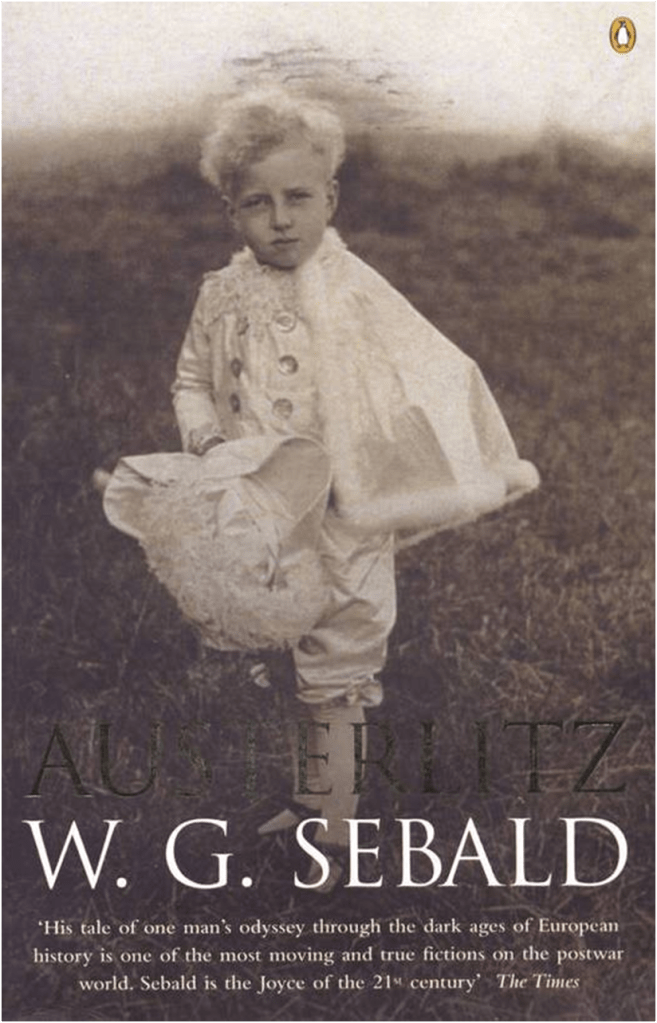
Do read this book. But I know now I must re-read Sebald. I think my eyes will re-open, especially in the case of my favourite novel, and his masterpiece, Austerlitz, which is a novel like no other I know. Join me, please.
All the best
Steve
[1] Carole Angier (2021: 27 – 86, 115 respectively) Speak, Silence, In Search of W. G. Sebald London, Oxford, New York, New Delhi, Sydney Bloomsbury Circus.
[2] Ibid: 178, 182f.
[3] Ibid: 83
[4] W.G. Sebald [translated by Michael Hulse] (1996: 65 – 146) The Emigrants London, The Harvill Press.
[5] Angier op.cit: 78 – 83
[6] Ibid:85
[7] Ibid: 80
[8] Ibid: 25
[9] Ibid: 22 – 24.
[10] Ibid: 73
[11] Ibid: 137
[12] Ibid: 97,
[13] Ibid: 163
[14] Ibid: 213, 257 respectively for each writer.
[15] Ibid: 318
[16] Ibid: 170f.
[17] Ibid: 400
[18] Ibid: 114
[19] Ibid: 138
[20] Ibid; 191
[21] Ibid: 317
[22] Ibid: 235
[23] Ibid: 151f.
[24] Ibid: 244
[25] Ibid: 279 – 282
[26] Cited ibid: 289
 Steve_Bamlett_blog