‘It occurred to me I might be dead and I think it’s possible that I was, that I’d crossed the line or was crossing it, was in some kind of limbo, where the brain is busy trying to make sense of what it doesn’t understand at all, trying to see itself, what’s wrong, then doing what it always does, putting together a story of some kind, however unlikely’.’[1] This blog reflects on Andrew Miller’s (2022) The Slowworm’s Song London, Sceptre. Surely a Booker nominee.
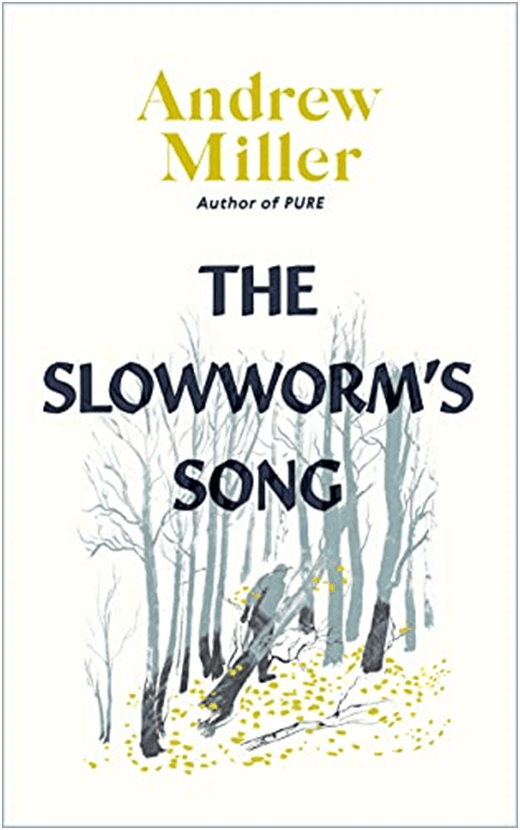
I am often dumbfounded by the fact that some people still believe that a mental health diagnosis explains, or would do so if it were known and introjected by a patient, everything about how the world looks to the person with that diagnosis. Yet in the i newspaper, Peter Carty reviews Andrew Miller’s novel with precisely this objection – that the main character and narrator, Stephen Rose, sounds smart enough to have worked out that he has Post-Traumatic Stress Disorder (PTSD), as Carty clearly indicates that he himself would readily diagnose in Stephen. Carty goes on, in a rather involved argument, to imply that the reason Stephen Rose does not come by such self-illumination is that the author, Miller, really wants Rose as his own avatar and voice-bearer:
There are problems with the depiction of its central character. It seems clear PTSD is at the root of Rose’s troubled mental state, but Miller never spells this out. It is odd that his narrator, so luminously reflective, has not self-diagnosed this for himself. In the same vein, while a squaddie can be as bright and self-aware as anyone, in his refined sensibilities and profound insight, Rose is rather too close to his creator.[2]
This paragraph oozes a judgement that is based entirely on expectations of class: that which marks the unlikelihood, for instance, of reflective capacity and refined sensibility in a ‘squaddie’, whilst making a play of saying the opposite. Yet to equate the sensibility and intelligence of Rose with Miller, in part at least, is surely a mistake for in terms of the novel’s larger narrative drift. Rose’s consciousness reflects that of multiple and sometimes fragmented identities and subjective positions held by Rose from which a complex fully rounded character emerges in a process of ongoing development. Moreover that development has not been completed by the end of the novel which ends with the short final section of the novel labelled ‘Start’, as if: ‘In my end is my beginning’.[3] If this echo of T.S. Eliot is seen as proving Carty’s point about Stephen as a puppet of the authorial voice, we have to remember that the 3 section division of the novel (‘START’; ‘STOP’; & finally ‘START’) which mimes a cycle of repetition in process is actually attributable to a iconic image from a postcard received by Stephen from his daughter Maggie, during her stay in Munich, described within the novel itself. The novel is written in the first person and in the first section (‘START’) is in the form of a long letter to his daughter Maggie:
The picture on your card puzzled me. Two big buttons on the front of an old machine, something industrial. A green button marked START and a red button marked STOP. … it seemed pointed and I began to feel you meant me to choose one – stop or start, the green or the red. Stop what? Start what? More likely, of course, you meant nothing at all and the card was simply one you picked out of a drawer, the first that came to hand. It’s become a bad habit of mine, this constant imagining that the world is signalling to me, every bush a burning bush. Is it self-importance? A sort of vanity? Or just the hope of some guidance? The need of it.[4]
Novels are, at their best highly organised networks of connected meanings which sometimes fire into a unitary form or meeting but sometimes do not. The ‘creator’ of a novel holds responsibility for the network of meaningful connections in the novel but does not have thereby to imply that the network they build already subsists in the consciousness or point of view of their character, even if the latter is also first-person narrator. In my view, we look for clues in this paragraph to authorial intention, as Moses looks into the burning bush for the same in the Old Testament, but may not find them or at least not only one single and coherent meaning. Everything can point to meaning – this is notoriously the symptom of some psychotic disorders – but need not promise fulfilment of that meaning in a more than provisional and perhaps unresolved sense. And that is how this novel ends – with a stop that might be a start or might not; in the flash between choice of a red or green button. But what must stop or start? In a novel about cessation of drinking in the main narrator there is an obvious candidate but of course it could mean anything – the sense of a lived life or indeed a story.
And the novel is about how and why stories get told, especially about life events and how they start and the clues that might make them stop. The circular repetition of the structure of the novel could even be being ‘signalled’ by another story, that meta-narrative of how stories function in the self-consciousness of all people, with or without a psychiatric diagnosis, told by the psychotherapist of the novel, Zoë.
She spoke back to me something of the history I had given her over the month, the succession of collapses, hospitalisations, slow recoveries, the new moments of crisis, of panic, the whole wheel turning again. …
…
Stephen, she said, we have to be careful not to get trapped by our stories. That’s one of the things we can learn. To tell the story differently, even to let go of it completely. To do that for a single minute and see what’s in the space set free.[5]
The wheel-like turn of stories can act as a trap. At the end of our novel, we do not know if Stephen’s new ‘START’ will be the beginning of another STOP, a final entrapment, perhaps, even literally, prison for the murder he acknowledges he committed, in one version of his story. And stories often reflect the interests (in both senses but here largely I am talking about self-interests of different kinds) of their tellers. Thus the novel turns on a moment of revision of history and the large and small stories that make it up in a Commission of Enquiry whose letter to Stephen telling of its start triggers the cycles of narrative in this book. Stephen contemplates how everyone has an interest in retelling stories from ‘our smooth-cheeked prime minister’ (of course Tony Blair but unnamed) to sectarian ‘murderers’ now in power in the Republic of Ireland and Northern Ireland who are ‘sitting in clean rooms’ now: ‘Every day they’re quietly rewriting history’. [6] Thinking of his daughter’s generation and their reception of the story of Northern Ireland Stephen thinks that Maggie’s story source may intrinsically favour the Nationalists in character, because ‘they are more ready to speak up, have a clearer story, one they’re good at telling’. It may also be nearer the truth he admits but it still omits that story once favoured by British troops occupying the North of Ireland at the time whose Unionist prejudices were inbuilt because ‘we saw them as our natural allies, trusted them, felt relatively safe in their neighbourhoods’, even though that story is now ‘a harder sell’.[7]
And this self-consciousness about self-interest and stories feeds too in the ways in which stories conflate sometimes with perceived lies, as Maggie perceives momentarily her father to have lied by omission of events that kicked off his alcoholism.[8] To be debriefed after the murder of the Irish Catholic 16-year-old boy bearing an asthma inhaler rather than a gun that was intuited to be in his hand, Stephen is returned to barracks, in fact a converted disused factory. Stephen feels intensely here people as well as himself attempting the process of ‘getting my story straight’,[9] a story which would start where the army scribes wanted him to start and would omit anything those scribes were perhaps trained to omit, as being irrelevant. In one ‘lance jack’s’ eyes he ‘could feel him taking me in. I was a story he would tell to other lance jacks’.[10] But stories are not only plastic out of self-interest of their tellers (or their employers / governments) but also because they seem to sum up the person by their own and other people’s standards of both accuracy and ethics. They are the main means human beings have, as the quotation cited in my title says; by which their ‘brain is busy trying to make sense of what it doesn’t understand at all, trying to see itself, what’s wrong, then doing what it always does, putting together a story of some kind, however unlikely’ (my italics).’[11] And, human beings live (or indeed die) on the ‘sense’ they make of themselves and their stories, made up out of words with tentacles in very ambiguous meanings. Stephen confronts this precisely as he begins to write and thinks about why he writes: ‘To get in my side of the story before they got in theirs? One more, one last go at making sense of it all?’[12] For stories don’t yield a unified appearance, they proliferate out of the words we use and those they darkly suggest at a subterranean level where comprehensive meanings subsist but are not necessarily conscious: ‘’Words have shadowy roots tangled around the roots of other words’.[13]
Human beings experience their lives without a sense of a coherent plot after all and even if conceived of as a play, ‘every time we play it there’s a small alteration’.[14] And the point is, the stories of our lives are too often inconvenient to our sense of order, structure, meaning or wish fulfilment. Telling them is lifelong and they are not always what we want our audience to hear. Indeed audiences may want something formed by their wish for comfort and safety rather than challenge and danger. One such danger is that we begin to query whether we are in fact the kinds of persons we like to think we are. Stephen says:
I wish I had a different story to tell you. … it cannot be made less and it cannot be made safe and it cannot be hidden and it cannot be forgotten. So there it is. Make what you can of it.[15]
Remember that Unionist communities felt safer to the soldiers and that made their story of the troubles were therefore more palatable to those British soldiers at the time. We like our stories to be safe – to read with a safe unitary and unambiguous identity or moral but they are not thus. And we will not understand each other in looking for safety alone. For life is risk and ambiguity, however carefully we assess its details. These details often slip us by in perception or get forgotten, where they do not fulfil our conscious or unconscious purpose. Think of the soldiers bedding down in their factory, whom, though ‘not stupid’, stop thinking about the stories that make the totality of Ireland and ‘the first time you’re really afraid, then you think differently’.[16]
Amidst all of this one of the stories that get revised and in the process gives away the safe veneer of norms it might have worn is that of queer love, for Maggie is a lesbian partnered with her lover Lorna. Stephen learns to tell his story for Maggie in a way that fundamentally interweaves the role of Lorna because both together make sense of the unsafe parentage of one of them in mutual supported reading. It is as if the novel tells the story of the chosen family in emergence, even finding some of its roots in Quaker traditions. Stephen learns that he must exit his own family to ‘find some version of myself I could live with’.[17] And that learning eases him into seeing the way a queer common identity is structured into domestic practices by his daughter and Lorna as he watches them both in the kitchen:
You with your haircut as short as a boy’s, and Lorna with hair the kind of red that never appeared in nature, each of you sporting a pink triangle tattoo on the underside of your right forearm … in honour of the gay men and women (mostly men?) in the Nazi camps who were marked out by wearing a piece of pink cloth. That surely is a victory of sorts. Old symbols of oppression worn with defiance while those who are oppressed are dust and yellow bones.[18]
With this vision Stephen foresees a possible end to certain micro-oppressions in society, even ‘Irish jokes’, which moulded his and his comrades’ earlier selves. I love this. It is one of the simpler moments in the story that otherwise abandons a simplistic ethical vision and yearns to unpack the circumstantial out of stories. For there is no story that has an ending that is forever only the struggle to foresee a new start, which is why Stephen cannot promise Maggie and Lorna he has given up dependence on alcohol forever. Action in the novel takes place in wide prospects of time and space and a brilliance of this novel is where it shows us events in these temporal and spatial (and perhaps ethical) prospects, especially in the murder of the young man. It is a novel about why we need to write stories and write them with honesty to all perspectives that impinge on the event, even those that have faded from being or not yet come into it.
I think this is an exceptional novel.
All the best
Steve
[1] Andrew Miller (2022: 177) The Slowworm’s Song London, Sceptre
[2] Peter Carty (2022: 44) ‘Grappling with stored-up Troubles: Review’ in the i (Friday 18th March 2022).
[3] The citation is the final line of T.S. Eliot’s East Coker from The Four Quartets (Available at: Four Quartets 2: East Coker poem – T. S. Eliot poems | Best Poems (best-poems.net)) and echoes the supposed death statement of Mary Queen of Scots and Isaiah (46:10). This would seem to prove Carty’s point that the narrator is a man of literary echoes – but the truth is, he credibly is and so, despite the beliefs of the educated elite, were many working men from literate traditions, such as the Quaker one on this novel.
[4] Miller op.cit: 118
[5] Ibid: 232
[6] Ibid: 143
[7] Ibid: 263
[8] Ibid: 186
[9] Ibid: 161
[10] Ibid: 163f.
[11] ibid: 177
[12] Ibid: 35f.
[13] Ibid: 36
[14] Ibid: 170
[15] Ibid: 172
[16] Ibid: 110
[17] Ibid: 78
[18] Ibid; 92
 Steve_Bamlett_blog