Can technology really ‘have you interacting with art in ways you never imagined’?[1] This blog reflects on the Van Gogh Alive Exhibition by Grande Exhibition seen at MediaCity, Manchester on Thursday 9th December 11 am, with reference to the Official Programme.
Van Gogh has been used as appropriate material for exhibitions through reproductions, rather than the originals, of his paintings outside the established network of art galleries before this show started its European tour. Indeed I blogged on one such exhibition in York some time ago (open this link to see the full blog). In that blog I said, somewhat naively:
There is some information to be had about Van Gogh’s ideas about his art … but the experience is not at all like being absorbed by the work of painting. It is rather more an artefact of light projection technology. It is being immersed in the flow of colours where issues of flow and overlap matter more than seeing colours on a static and flat canvas where motion is essentially an illusion of form, line and colour contrast.
I call this a naive statement because it operates at such a point of obviousness. Of course any exhibition will ultimately be of the medium chosen for the exhibition of its content, but then perhaps no image ever is an ‘original’ because we cannot reproduce the conditions in which it was originally seen, or indeed know them sometimes. This is especially perhaps the case with Van Gogh, given the relative neglect of his paintings by the art establishment and art market. For him both functions narrowed down to the interventions of his brother, Theo, who worked with the Goupil Gallery. This show is as much then, as it must be, about the medium and mode of its delivery to an audience using a system the Grande Exhibitions curators name SENSORY4TM. This is a system in the sense that it brings together a number of technologies for transforming the sensory experience of space, as in therapeutic sensory environments. Our friend, Justin, loved how this association of its nature to sensory play and experience rooms made this art the more available to even young children and to a young man with learning disabilities who danced in the coloured light. Hence it is appropriate to invoke the theory of and the market for sensory technology here and to show how its appeal can be extended to seeing ‘art’, whatever we may mean by that, in ‘ways you never imagined’ as claimed by this show. As one dealer and manufacturer of products, Senteq, says of this technology says:
Sensory experiences can be hugely beneficial to children and adults alike. They are great for promoting a range of developmental skills. For example, colour recognition, hand-eye coordination, fine and gross motor skills.[2]
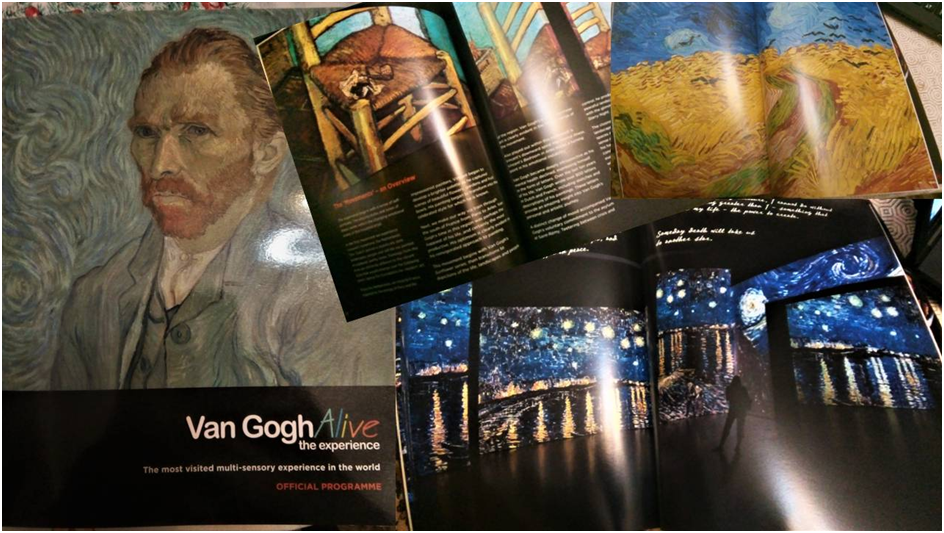
What is to stop then the application of such assistance to education in the practice, theory and history of art? And Grande Exhibitions in their official programme (see picture below) for the event says it is:
… simultaneously enchanting, entertaining and educational. Van Gogh Alive will stretch the definition of the word “exhibition” as it stimulates the sense and opens the mind.[3]
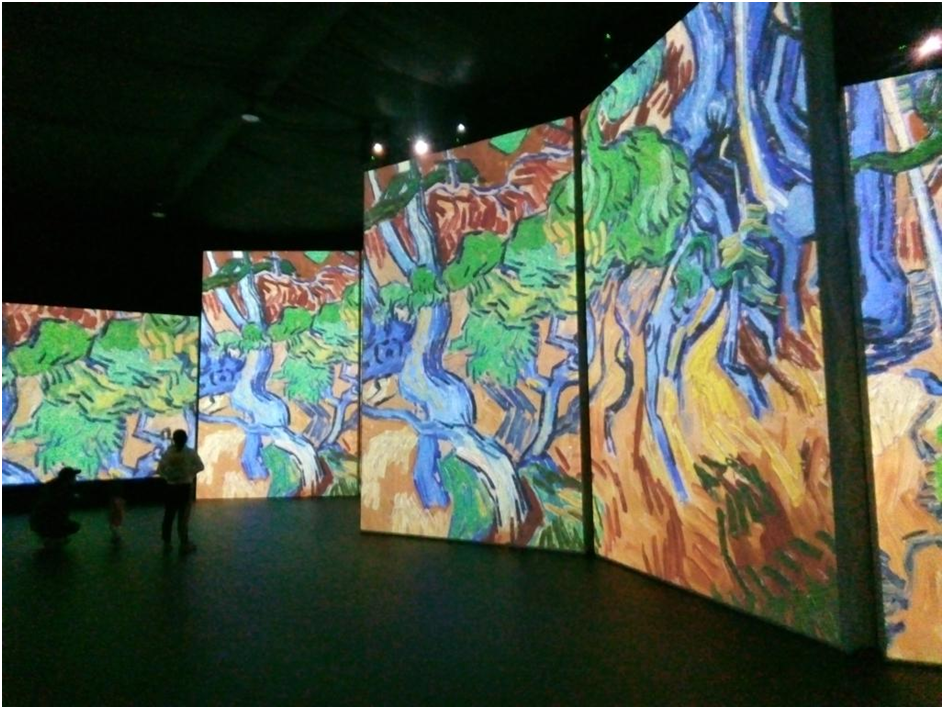
In my view our party was in an interesting position to be a test case for these claims, comprising two of us with a track record of loving Van Gogh with a full library of books, videos and past (and projected) exhibitions to prove it. But though our intelligent and inquiring friend Justin, who we met in Manchester, knew Van Gogh, he was as yet to feel or know any liking for either Van Gogh’s subjects or methods as a painter. Yet it was Justin who emerged from this exhibition thoroughly converted to the painter. This was not just because of the information about the life, work and its methods in the show, but its novel means of allowing access to the cognitive (including the art historical) and sense material that constitutes what we mean when we imagine Van Gogh. Geoff and I learned and enjoyed but maybe our resistance to being educated by these means needed a little more work, To appreciate it fully the experience of light has to be interocepted (and introspected) as one’s body moves freely through the room through its varying lights and shadows all cast from different source directions. Bodily movement, stance, gesture and flexion, establish in this show a fuller relationship with the play of moving light, colour and sound. Because I stood in and/or moved through the exhibition space – as did Justin as if by instinct – perhaps I caught more of this kind of learning than Geoff who took a seat and maintained one unmoving space. Much of the effect comes from the eye being guided to lights and shadows that you sense as being created behind or at the sides of you and following the motion of animated objects and more static surface pictures through those initial ‘sensings’ of the light effects they create.
The curators say of the medium of projection (for both sound and visuals – animated or otherwise):
SENSORY4TM is a unique system … Incredibly detailed images flow through the mass of projectors and merge with digital surround to saturate the space in a breathtaking immersive display.[4]
SENSORY4TM is a system in the sense that it brings together a number of technologies for the projection of material to a range of senses. Calling itself unique is really a recognition that no combination of projection technologies cannot but be unique, defined by their purpose. In the Grande Exhibition system sound projectors create a sound that surrounds the rooms inhabitants – an effect in cinemas called surround sound since it seem ubiquitous and immersive. The sound is of well collated classical music pieces, often from Van Gogh’s own time.[5] Likewise using a large number of high definition projectors and ‘multichannel motion graphics’ means that high resolution images can be varied across screens at different depths and with varying perspectival overlap as visitors move around or be versions of the same image be projected as a total surrounding visual medium, that is sometimes static and sometimes capable of adding elements of motion across the static image – such as the image of the steam train that takes Van Gogh from Paris to Arles.
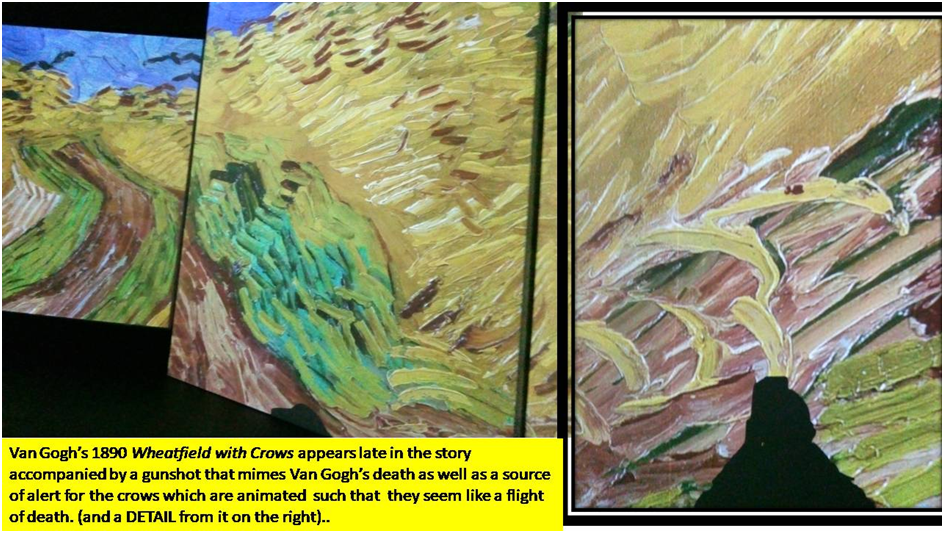
I think the motion of the visitor’s body and its sense receptors ate also important to the experience but one feature of the display is that the quality of resolution of the images shows the volumes of applied paint and thus allows us access to the sense of how brushstrokes were manually applied – an important feature in my Van Gogh. The collage below shows how a painting is distributed across the screens, and therefore spaces at different depths and a detail from the same reproduction, which I think shows the way in which the density of brush strokes can be seen, and, I would say, the feel of Van Gogh’s ‘hand’ at work and in motion.
One feature that again Justin emphasised to me is the nature of Van Gogh’s japonisme, since he has a great and beautiful appreciation of Hiroshige. Indeed his love of the flatter surfaces of these nineteenth-century Japanese masters he contrasted with what seemed the’ gloop’ (a good word I think) of Van Gogh’s impasto effects. Yet the display actually contrasted the most famous (perhaps) of Hiroshige’s works, ‘Rain Over Bridge: Views of Edo’ with Van Gogh’s own version of it, which the display highlighted certain key features silently by animating the slanting fall of the rain in each case.
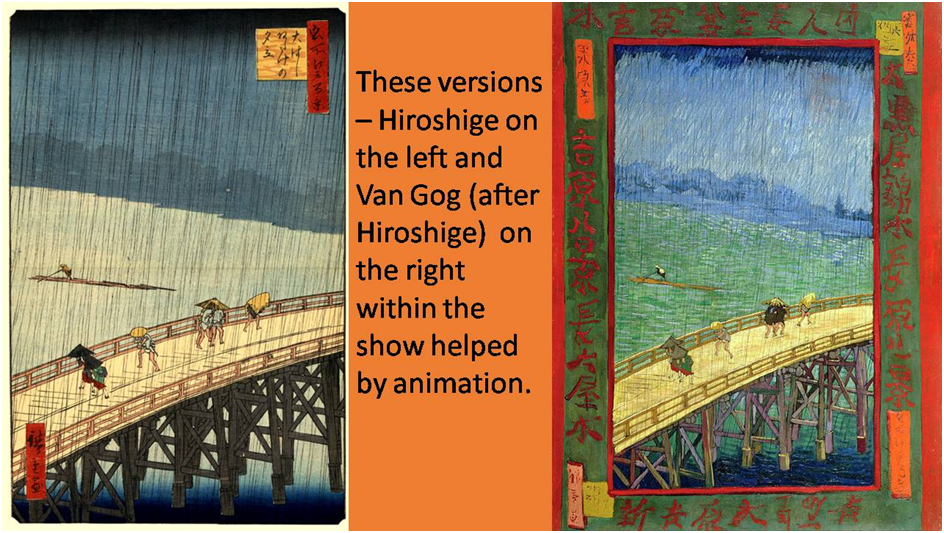
Given Justin’s comment, it was easier to me to see what Van Gogh was doing here. It is as if he tries to marry the artifice in the creation of the natural world with background events that contrast Hiroshige’s background (motionless as if innocent of signs of the lateral and vertical changes of nature as it moves through a scene) with Van Gogh’s gloopy sea and mid-sky. And it is the marriage of these stylistic variations that produces the later Van Gogh, especially in relation to flower pictures, like the beautiful Almond Blossoms. But how exciting it was to sense how Van Gogh taught us to feel a rain shower, in this episode. The term animated nature seems truer in such art than ever in Hiroshige’s wonderful stylization, at least to a Western eye.
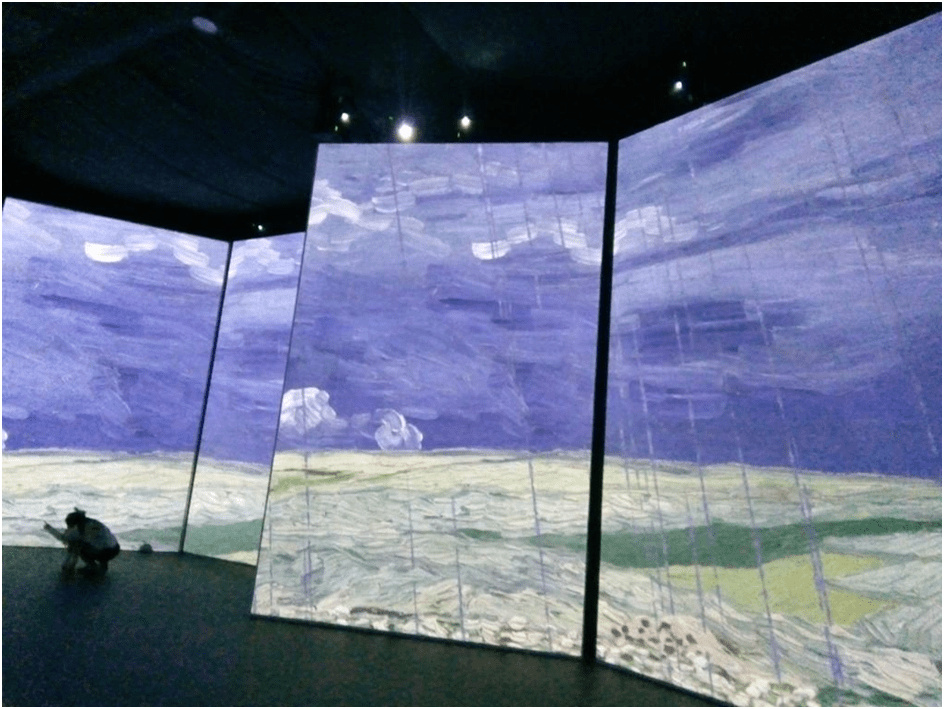
And especially in those paintings that equate creativity with motion that emerges from its subjects – in fact a good working definition of e-motion (emotion). How well that was conveyed below from those spaces surrounding a text from the letters: ‘I would rather die of passion than of boredom’, where passion is passive submission to such e-motion (from the verb in Latin passio).
See too in the photograph below a child entranced by the effects of light, differential distance, repetitions and colour overload. Colour, light, introjected with the sound of music – the sensory world allows the paintings to share the life of the body while stimulating cognition in acts of object recognition. This is what I take it to mean that this show ‘stimulates the sense and opens the mind.[6]
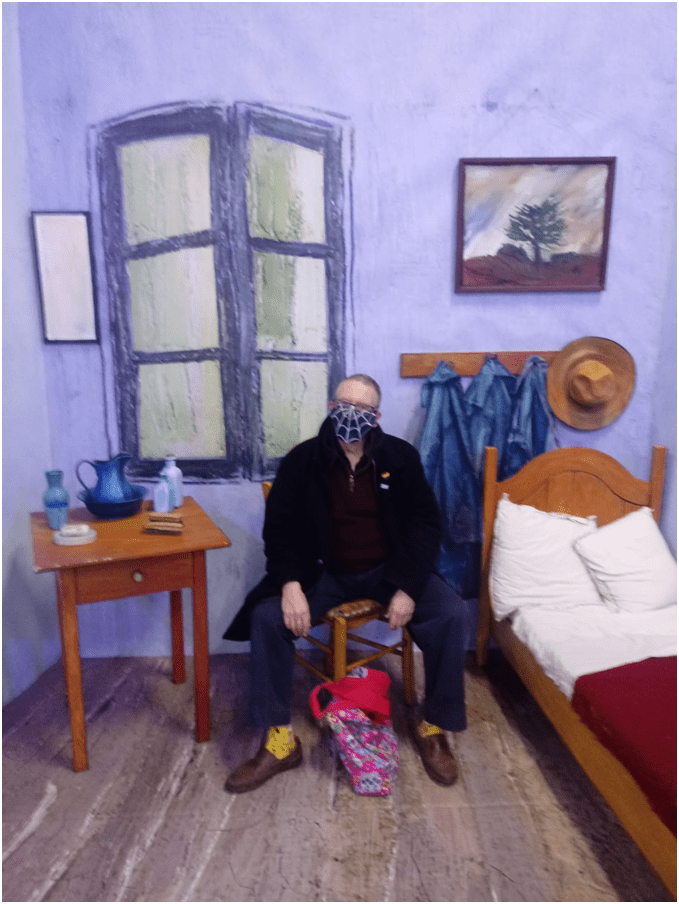
We stay in one room to see these wonders. Other effects look somewhat cheaper, such as Van Gogh’s bedroom in which I sit below – photo by Justin Curley. Although it was interesting to sit within the recreation of the perspective effects – the foreshortening of the bed.
It was stimulating to walk around a small space using mirrors to simulate larger space and the multiplicity of sunflowers across them but the number of photographs and videos in this room seemed out of proportion to the relative significance of the technological innovation, even if a good preface to entering the gift shop.
Rather than sum it up myself I will leave that to some of Justin’s tweets. I could not put it better. He has a good feel for what is needed to make people enthusiastic about your subject – a skill I have always lacked.

Justin. You are right. Again. And what integrity in talking to people. I admire you friend!
All the best,
[1] Grande Exhibitions (Director: Bruce Peterson) [2020: 5] Van Gogh Alive: the experience (Official Programme) Port Melbourne, Victoria, Grande Exhibitions
[2] For the full explanatory page of Senteq’s website, see: Sensory Rooms | Design, Sales and Installation | 15 yrs+ experience (senteq.co.uk).
[3] Grande Exhibitions (Director: Bruce Peterson) op.cit: 5
[4] ibid: 7.
[5] Ibid: 24. Pieces are listed ibid: 12f.
[6] ibid: 5
 Steve_Bamlett_blog
4 thoughts on “Can technology really ‘have you interacting with art in ways you never imagined’? This blog reflects on the Van Gogh Alive Exhibition by Grande Exhibition seen at MediaCity, Manchester on Thursday 9th December 11 am, with reference to the Official Programme.”