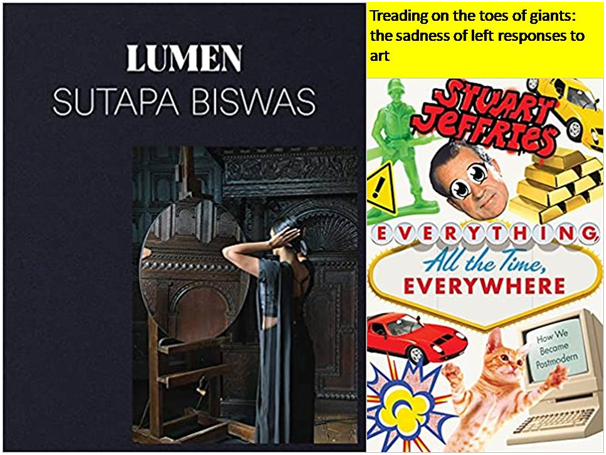
Sutapa Biswas explains the intellectual and pedagogic engagement in her art with Griselda Pollock, the leading UK socialist feminist art historian of her day, as ‘saying to Pollock “Where am I in your narrative of Old Mistresses?”’[1] Francis Fukuyama sees such statements of exclusion from the grand narratives (here Western feminism) as part of the ‘kind of struggle, which he called the struggle for recognition, or what has become better known as identity politics’.[2] This blog reflects upon Biswas latest art work Lumen in relation to a politics of ‘resistance’ to ideologically determinant social structures, wherever they might hide, that have fostered a need for an understanding ‘the dynamics of belonging, dispossession and trauma’ that such structures leave in their wake as they become animated. [3]
This blog was motivated (although perhaps ‘driven’ is a truer description here of my subjective response) by my despair at the left’s continuing refusal to take the politics of diversity seriously as witnessed in this case by Stuart Jeffries new book for the left-wing publisher, Verso, and other attacks, mainly those on ‘queer theory’ as also replicated by Jeffries. In a way there is little need to read this book if you read only Terry Eagleton’s recent (today as I write) review of it in The Guardian magazine, since the case is entirely based on the most oversimplified premise used to describe post-modernism and to discredit it without argument at all: ‘For the past half-century, postmodernist thinkers have been trying to discredit truth, identity and reality’.[4] Put like that, one might say, postmodernism is clearly ridiculous without further commentary. But Eagleton’s words, penned from the entitlement and privilege of white cis academia, are not argument but rhetoric. You will find much of the same in Jeffries, although there is recognition that ‘Eagleton’s critique of post-modernism has created a straw man’.[5] That is an improvement on Eagleton himself and makes my point, although Jeffries pulls in Chomsky, Daniel Dennett, and of course Habermas, to rescue Terry from his own rhetoric.
Of course it is unfair of me to describe Eagleton as a privileged and entitled former white, cis, male and heterosexual Oxbridge professor. Are not the left allowed to succeed I hear the bleating of the Twitter currently hegemonic Labourites? But my point is that such privileged entitlement staffs our universities at all levels and, despite postmodernism, is still the hegemonic ideology, and is based on a notion that such authority means one should never change, because one is merely supporting, even if only in aspiration, ‘truth’ and ‘reality’. Least of all, scholars need not change because ‘students’, those poor necessities of their sinecures, wish them to reconsider their fixed positions and to listen sometimes to their offerings. The sense of an objective truth independent of the conditions that shape the lives of an academic and journalistic intelligentsia has been very convenient for the embourgeoised socialist / feminists who make up for most of the radical critique spent upon thought, society, politics, art and literature. Objective truth need never compel subjective change on individuals who speak it nor validate comparison to those who must live the conditions of actual oppression. Of course bourgeois women are not free of the effects of sexism or heterosexist practice except relatively – but sometimes the relativity is the issue. I became interested in Biswas because it was as a student that she successfully challenged a radical degree programme that failed to recognise the conditions of her oppression. The other hero of this story is Griselda Pollock, who embraced the need to change the paradigms of her thought and pedagogic practice from this pressure rather than reacting against as later did lesbian feminists like Kathleen Stock and Julie Bindel.
Griselda Pollock taught at the course at Leeds studied by Biswas in which art history with theory AND art practice with theory were both necessary components of the course, and, in which Griselda Pollock’s co-authored book Old Mistresses was a fundamental starting point for feminist theory. Sutapa as student dared to use her assessment as a means of breaking Pollock’s supposed role as a neutral observing subject as she attended a film piece based on Biswas, artwork Kali (1983-5), the video of which is now owned by Tate Modern (the link is to their commentary and citations from that video). Here is Pollock’s description of how she was, without warning involved in the artwork; she thought she was coming to offer ‘objective judgement’ upon.

Obliged to sit in the centre of a circle, hooded, though I could just see through the slits at eye level, I was made to function as an icon of imperialism around which Biswas’s enactments of resistance would be performed. Centred, yet made vulnerable by being deprived of the position of protected observer, I could not distance myself from the mythological representation of a historically conditioned struggle … Participant yet target, forced to hear and struggle to see meanings that silenced me, I was made witness to the making of another set of subjectivities, which exploded the oppositions ‘black/white, Indian/English’ in order to demand mutual recognition based on the mutuality or interdependency of subjectivities and meanings.[6]
Such a response to her student’s artwork lacks the kind of emotionally overblown and self-interested reaction that Stock and others have displayed and is the mark, in my view, of something unusual in academics of whether the political right or left. It admits not only that the role of ‘protected observer’ and ‘writer’ of ‘truth’ can be a collusive role but also that it is, and always will be, a ‘defensive’ one, enabling a hiding-place from any mirror of one’s own position vis-à-vis the personal-political struggle of other groups and individuals. I would say that is especially true now of the enemies of queer theory, with whom Jeffries uncomfortably, and a bit on the left-side, sits. Jeffries probably correctly locates the basis of his attack on postmodernism in his attempt to revive the neo-conservative, Francis Fukuyama’s, case against a ‘symptom’ of postmodernism, which has named ‘identity politics’ as a phenomenon that has ‘risked disastrously fragmenting and weakening societies’.[7] A feature of Jeffries book is that he conducts his attack, as I have already suggested, on issues of queer politics rather than the politics of ‘race’ (often put in shock quotes at the time of its emergence as a radical resistance movement). It is the latter domain that has more clearly than any other issue has challenged the grand narratives of the left and the right, for the exclusion of any recognition of colonialism as a structure of racial dominance powered often by binary symbols of ‘black’ and ‘white’.
I think this is because the case for arguing for a biological basis of race having been debunked, those left thinkers have relied solely on what they see as a the ‘unchallengeable’ binary of ‘biological sex’. Of course the latter has been challenged (see the linked blog) but that challenge is debunked in the name of a grand narrative type of political feminism represented by Martha Nussbaum, as a depoliticising quietism before the actual and substantial oppression of women. But Jeffries does not argue the case. He rather instead relies on the confluence of authorities from left and right of the political spectrum to suggest his case for the unchallengeable ‘truth’: that biological sex is binary and trumps any consideration of ‘gender’. There is a total lack of cited authority, for instance, for the following statement, and no reference to the well-known biologist who argues otherwise: Anne Fausto-Sterling. After reductively summarising the position of Judith Butler, his bête noire, to mean that, ‘babies have no tendencies or abilities prior to their experience of gendered society’,[8] which Butler herself NEVER says, he continues: ‘This thought still outrages many scientists and doctors, for whom sex is a biological fact, and whether one is born male or female is a matter of biology …’.[9] Who are these scientists and doctors and how do they actually argue their case. We will never know. In part this is because Jeffries wants to pretend a kind of objectivity outside this case, but the implication is never far from clear that this is the kind of consensus with which Jeffries concurs.
This is not the place either conversely to argue the case for Judith Butler or other queer theorists but such an argument does need to, and will, continue. Rather I want to look at how resistance to power structures that operate at the subjective as well as the wider and more immediately sensible (in the sense of being available to eye, ear, taste, smell and touch) systems of socio-political organisation has necessitated some elements of a postmodern revolution. The entitled academic and journalistic left (those embedded in the status quo) today (or a significant and powerful part of it, especially in the academy) has interpreted in a far too reductive and (let’s face it) binary manner the failings of postmodern as a push against modernisms. It is as if there were an unchallengeable basis (possibly even biological) for the modernist – postmodernist comparison like that they assert (for that it what it amounts to) that for biological sex untouched by social constructions of gender (as people use to argue for biological aetiologies of the distinction between black and white races).
As Griselda Pollock says in her 1998 essay on Biswas (reprinted, as I have already noted in a footnote, in the volume of work on the place of Lumen in that artist’s work) is not disposing of modernist feminist and socialist discourse by emphasising a wide selection of diverse voices and ‘plurality of meanings’. The latter words are those of Gilane Tawadros cited by Pollock and they do represent realities uncovered in postmodernism – often by authors Jeffries dare not cite such as Mikhail Bakhtin – but they are ones that Pollock argues do not invalidate modernist ideologies but build changes into and onto them when understood properly: they enlarge ‘the world by overlaying and thus mutually redefining these oppositions’, amongst which she cites ‘White/Black, self/Other, here/there, man/woman’ but adds another, from Biswas, ‘that of centre/periphery’.[10] And this perception remains the case I don’t formally argue made by radical queer theorists about ‘sexual orientations’.
It is important of course that Pollock speaks from the world of art scholarship alone about an artist that has deepened her understanding of how and why art must take the subjective seriously and is the more political a phenomenon for that reason. And exclusion from that voiced in art is more than damage done to the mental health of individuals and groups, it is political work aimed at defining subjective well-being only in terms of the hegemonic forces sustaining the current ruling class. Now Jeffries championship of Fukuyama, itself requiring some justification given its conservative tendency, sees the complaint of being excluded as rooted in the championship of the mental health of the individual globally. Lest you disagree, here is some of the empty nonsense in support of a ‘therapeutic turn’ in discourses of the social he cites from Fukuyama about those poor souls seeking recognition or balm for their marginalisation that is barely literate (and certainly ignorant) about the relation of both psychology and psychiatry to marginalised identity;
They felt they had those true selves that weren’t being recognised. … Psychology and psychiatry jumped into that breach. … it became legitimate to say the objective of society ought to be improving people’s sense of self-esteem.
Fukuyama conflates the undoubted consumerisation of mental health with the effects of academic postmodernism and such conflation is typical of the elisions in this book. Within a paragraph postmodernism is blamed for President Trump’s form of belligerently individualistic popularism and for, in Perry Anderson’s terms, the ‘phenomenon of cultural coarsening’. As if that weren’t enough postmodernism has induced ‘a kind of Faliraki of the soul’.[11] Nowhere is the elitism of the bourgeois left as pronounced as when they speak of the European holiday resorts of the British working class, especially in those stolen from them in the once elite Greek islands.

I hope this gives enough to show the kind of regressive force of the university and press institutions on which elements of the British left subsist as force standing against recognising diversity in the political voices of the future. There is sanity in Biswas’s alternative, which is to emphasise that the importance of her stance in subjective experiences of the migrant (a subjectivity that knows itself only in the threat of change and responses to it) is the force of political resistance to which it gives her access, and which shuns, in Arabindan-Kesson’s words, ‘myths of identity and essentialism’. There are no essentially ‘Indian’ subjectivities that are not orientated by ‘liminality and its displacements’ caused by enforced movements whether as a product of colonialism, Partition or apparently voluntary economic migration.[12]
Lumen is a complex multimedia artwork that astonishes and pains as it cuts across ‘English’ and the persons ‘English’ (a language, a people and persons) OTHERS. That the work is a kind of chant in English using the acknowledged rhythms of Shakespeare[13] by an accomplished actor (Natasha Patel) further complicates its take on identity and the shifting determinants of that slippery concept – one that for the migrant is always in ‘becoming’ because no other alternative is offered, except as Biswas puts it, being ‘swallowed whole’ by the ambient darkness. She says in her most recent interview, most movingly, when she picks up her interviewer’s term characterising a sense of ‘being unmoored’ within the film’s script, that:
It is exactly right unmooring of the boat, the departure from one place, … and the psychic loss of belonging. … The desire to find one’s self, while fighting against the waves. There is nothing firm, … It is like experiencing vertigo, where you feel like you’re ‘being swallowed whole’. …/…/ I think my mum must have felt like that … somehow in the pit of your stomach, there is the sense of the unknown, and this is the deepest fear really, of not living, and you know the darkest of spaces, like being swallowed whole. …[14]
In the light of reading this and seeing the film I can’t help fearing for the true darkness that is the subjective world of those who see their mission in the dismantling of postmodernism and a return to the Messianic hope of grand modernist narratives, for the fact that the latter require no active commitment is their attraction. One continues to ‘cash the cheques’ for one’s latest radical exposé and nothing is demanded of you. Because postmodernism is, for me, a description of the world we can’t label ‘reality’ because that world pre-supposes no ways in which, as happens, the real in interpenetrated by fantasy or would not be knowable. Some of that is an effect of language, other parts of it an effect of the fact that our symbols are already called upon by a culture that asserts its dominance (one, for instance, that might attempt to read the role of the ‘crow’ in this film through Ted Hughes).[15] It may be impossible not to do so but that is one of the luminal arenas one inhabits. A better example of such backward cultural appropriations, where a migrant cultural identity finds a precursor to that culture in some dark origin of one’s own experience or history of any culture impinging upon one’s becoming is the phrase picked up by Vincentelli, and resonant too to me, but not with knowledge of its origins: ‘Patterns we set – they do not heed’, which addresses the structures hegemonic cultures attempt to impose and which the ruled rightly resist. Biswas tells us:
This comes from an 1813 satirical poem that I found in a book by Richard Drayton called Nature’s Government: Science, imperial Britain and the improvement of the World. The poem is a lament for the Duke of Bedford’s paternalistic attempts to establish agricultural farming methods, and the failures of Whig politics. … the sentiment feels true to the archival footage in the film, which evidences the prevailing and indignant attitude of the British Raj towards Indian subjects. … it was punitive, violent and violating on every level.[16]
Now, I hope one sees that the craven ways in which the left (often the so-called soft left) target trans people in our contemporary is much of the same as this – a swallowing whole of any assertion of difference so that it will not recognise itself. Any remnant of that voice will be explained by psychiatry. It sickens me. Thank goodness for feminists of the sanity of Biswas and Pollock.
All the best
Steve
[1] Biswas cited in ‘Sutapa Biswas in conversation With Courtney J. Martin’ in 2019 from ‘On Housewives with Steak-Knives’ in Amy Tobin (ed.) [2021: 30)] Sutapa Biswas: Lumen London, Ridinghouse, 23 – 32.
[2] Stuart Jeffries (2021: 205) Everything, All the Time, Everywhere: How We Became Postmodern London, New York, Verso
[3] Martin in ‘Lumen: Sutapa Biswas in conversation With Courtney J. Martin’ in Amy Tobin (ed.) op.cit.: 97, 97 – 104.
[4] Terry Eagleton (2021: 69) ‘Giving up on truth: A compelling survey of postmodernism’ in The Guardian (magazine) [13.11.21]
[5] Stuart Jeffries op.cit.: 211.
[6]Griselda Pollock, ‘Tracing Figures of Presence: Naming Ciphers of Absence; Feminism, Imperialism and Postmodernity: The Work of Sutapa Biswas’, in Institute of International Visual Arts 2004, p.26., as cited by Andrew Wilson for the Tate Gallery. Available at: ‘Kali’, Sutapa Biswas, 1983–1985 | Tate. This essay is also reprinted in the Lumen book 49 – 74.
[7] Stuart Jeffries op.cit.: 205
[8] Ibid: 219
[9] Ibid: 220
[10] Griselda Pollock (2021, original publication in 1998) ‘Tracing Figures of Presence, Naming Ciphers of Absence’ in Amy Tobin (ed.) op.cit.: 70, 49 – 74.
[11] Citations and quotation from Jeffries op.cit.: 205- 208
[12] Anna Arabindan-Kesson (2021: 14) ‘Sutapa Biswas and the Space of Diaspora’ in Amy Tobin (ed.) op.cit.: 14, 12 – 22.
[13] Biswas cited in ‘Sutapa Biswas in conversation With Alessandro Vincentelli’ ‘Lumen’ in Amy Tobin (ed.) op.cit.:98f., 97 – 104
[14] ibid.:104.
[15] Ibid: 100
[16] Citing Drayton’s book of 2000 in ibid: 102.
 Steve_Bamlett_blog
