‘This book contains dead people. / …/ Caution: This work contains traces of eulogy. / …. / This book cannot change the ending or your ending or its own ending. … This book will not confirm if there is an afterlife or an alternative universe’.[1] Thoughts about Salena Godden’s book in which symptoms like ‘grief, fear and pain’ projected by her narrator and avatar, the poet Wolf Willeford, could persist until you hear a ‘live reading … where you will find the others’.[2] : The artistic triumph and psychic conversion of the psychological ‘symptom’ in Salena Godden’s Mrs Death Misses Death (2021) Edinburgh, Canongate Books.

Starting this blog I reflect on whether it is a mistake to create a title from what would have seemed to me a confusion of terms like ‘symptoms’, ‘dead’, ‘live’, ‘ending’ and ‘eulogy’. But one person’s ‘confusion’ is another one’s ‘creativity’ and I have decided that accepting this state of affairs is what makes it possible to read this book without thinking of it as a ‘word salad’, the name once given to a ‘known’ symptom of schizophrenia, a ‘disease’ that most now accept as entirely invented to justify the psychiatric institutions which were set up to validate the label, offer a cure for the medical condition it was meant to purport and justify psychiatry’s failure by further stressing the inadequacies that psychiatric ‘patients’ fail to understand properly in themselves. Blaming the victim mechanisms are always thus!
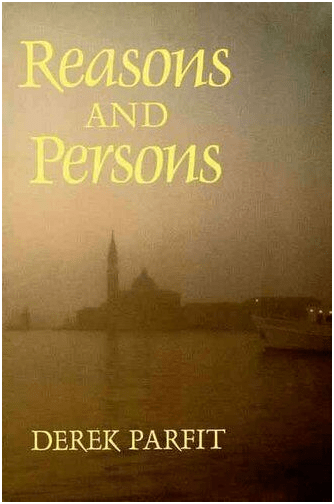
I don’t think my review will help Godden gain readers or please the author or her publishers, but it does seek to make connection to those who read and see their lives being read and validated as signs of hopeful life (or at least continuation in others if not in self) rather than symptoms of possible death (and the inevitability of ending). Although I will not explore it, some who know his work will recognise the philosophy, and the questions it raises, on the role of personal identity in facing the notion of death and the significance of endings in Derek Parfit behind my thinking if not Salena’s. There is a very cogent blog on this at the webpage address connected to this link name: Derek Parfit, Personal Identity, and Death | Reason and Meaning. But I neither know or think it important whether Godden too would feel Parfit was an influence on her, though it makes a great deal of sense in seeing some of the hidden antinomies in her writing: such as that between a dead reading done in one’s own company alone or a ‘live reading … where you will find the others’.[3] In my own view and experience Parfit as a philosopher of identity and the meaning of continuity appeals to people (and I include myself who only came across him a few years ago) most when they have always thought that they will only find meaning in self in relationship to living others.
Salena Godden is a performance artist who believes that otherness is essential in the delivery and reception of a work if it is to be a ‘living’ reading and not a dead one. Black History Month organisers describe her in advertising for an event yet to happen whilst I write this (and I’d validate their views myself after hearing her read from this novel at the Gordon Burns Prize event on Thursday 14th October in Durham) as ‘known for her electrifying live performances everywhere from literary festivals to the Women’s March and Extinction Rebellion protests in Parliament Square, as well as her regular appearances on radio and TV’.[4] Private readings are solitary affairs after all; bound by symbols such as desks at which to sit (alone). But what makes a desk take on the sole identity as a desk (the same question philosophers often ask sometimes of how sure we can be that what we see as a table is what others see as a table).
In Godden’s book a desk thinks to itself that the same wood that forms its material could be used to make a performance instrument, such as a piano. The latter seeks collaborative communion with its audience, since: ‘No one gathers around a desk, but they gather around a piano’.[5] Such are the thoughts of the Desk ‘in the chapter named ‘Oh to be a Piano!’ in which the writing of Wolf and Mrs Death gives voice to the desk that becomes their interconnection. In narrator and authorial avatar Wolf Willeford, who writes what she enchants, she will at least find an over-close, almost closeted, private relationship wherein performance too is privatised:
Lay your head here, Wolf Willeford, rest your curly head. Lay your ear to the desk, play me like a piano, play me, drum your fingers on me and play me, Wolf, and i’ll share with you all I know.[6]
How unlike performance, as it might once have been and herein lies the reason for the attitude to past heroes of performance art, which Wolf predicted in the preface, especially to Prince, and especially in that beautiful poem that is also a chapter (how I want to hear Godden perform it): ‘Wolf: Purple Rain’ (pp. 179 – 181).
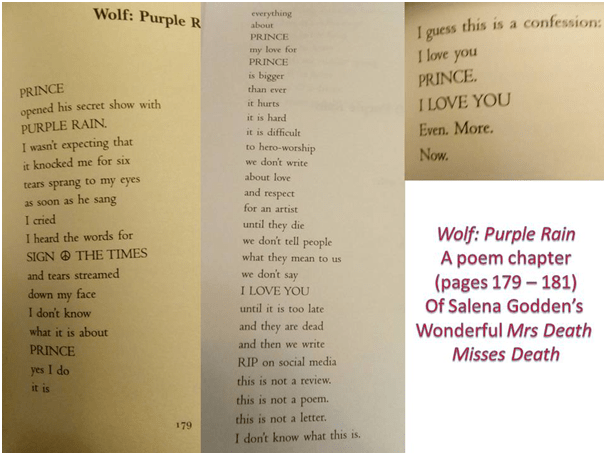
This poem speaks, of course, for itself, but especially when performed. It’s burden is the necessity of ‘love and respect’ as part of the process of art and artistry and a fairly obvious act of making secondary, or less activity such as a ‘review’, ‘poem’ or letter.
Be that as it may my chief aim here is to show how the symptoms of mental illness and disorder are displaced from the language of ‘symptoms’ and made part of a process of healing, just as Mrs Death (though she MAY be a psychotic ‘delusion’, ‘hallucination’ or one many voices in episodes of ‘hearing voices’ associated with the psychotic symptoms of severe mental illness, including the bipolar disorder Wolf feels he is diagnosed with. is able to show Wolf the way to escape the effects of depressive grief and trauma associated with the death by suicide of his mother and abuse by his father. For ‘bipolar disorder’ is an oppressive label in the end for experience outside of norms, as are any over simplifying labelling of the being as simply binary, whereas all of live is made of multiple and contradictory factors which we all share – and would do more if we shared them with each other and celebrated them before they took on the form supposed by the severe judgemental attitude of others.
The doctor has agreed to send me for further evaluation. She thinks I am developing bipolar. I looked it up and I found out that bipolar and hormone imbalance and PMT and menopause and being an empathy and being a human wqho gives a flying shit all hare the same symptoms – mood swings, hypersensitivity, restlessness, insomnia, extreme highs and extreme lows, suicidal thoughts, restlessness, catastrophising and crying alone on buses. … Look at, that’s me, Biracial, Bisexual, bigender and Bipolar. That’s my label and my boxes. …’.[7]
This contains truths, the ironies of which may be lost to those who have escaped the psychiatric system or its allies, such as counselling and that governmental fob-off for the ills of the social system – 6 week therapy by mindfulness in which we learn to be in the ‘here and now’ and deny the shaping power of the stories that make us and deny ourselves the ability to take control of our own complex interwoven / intersecting stories belonging to each bit of our experience, including for some of us the terrible experience of the conflagration of Grenfell Tower by the forces of inequality, denial of true participation in decision-making and injustice: ‘We try and take our time and learn, we read about mindfulness’ whilst forgetting, often with strong help to do so, that you should not ‘put poor people in danger by building shitty cheap housing out of flammable materials: fix the fire alarms, attach sprinklers … Can you smell smoke?’.[8]
The stories of Mrs Death play out the same themes of unequal power (between classes, genders, races, cis and non-cis) and distribution of resources as the root of many unnecessary life-endings: Tilly and Jack the Ripper, Billie Holliday, Marsha and Martha, the Moors murderers and the rape of an Australian female backpacker in Ireland. [9] And in shorter stories still where the issue is being seen as ‘queer’, beyond the norm, and that being seen as necessarily undesirable:
I swig sherry in the car park
I know I’m not normal
But normal people
Drink sherry
At funerals.[10]
Because death and endings are potentially celebrations too and are essential to the embrace of change: just change; ‘all I know for sure is unless humans change the way they are living, they cannot change the way they are dying’.[11] Yet we all face those apparently simple retellings which change the meaning and associations of terrible events without lessening their lack of justice and need to be changed in the future, such as when Wolf sees the desk, becomes a writer and is written by Mrs Death, by Salena Godden, by himself: ‘This is a life-changing moment. It is an odd moment. … But this desk is mine, I just know it, this desk is my doorway, my possibility, my future’.[12] In the end in both Parfit, who Godden may or may not know, and this book are about what books ‘contain’ in both senses of that word – what they have inside them and what they box in and hold back and fail to release such as the connections and webs of connectivity and migration they contain that celebrate change (both travel and migration for economic and political reasons since both are essentially about empowerment). The true joy is given away at the books beginning – it is celebrating immigration, transitioning of all kinds and diversity, strangeness and queerness – being an agent in Time and Space and not just ‘Contained’ by it as a ‘dead person’ (back to the book’s first sentence). After all nothing is truer than this lesson: ‘Human beings still have so much to learn about connection’.[13]
But when you are in transition … you are tuned into this, … In transit you are occupied by Space and Time, by clocks and miles, by separation and reunion, … Humans were built to travel, humans were made to move, to share and to migrate, …
The history and the geography of human migration is nothing less than phenomenal
In a world that is being pulled apart by divisions that typify and and are further caused by issues like Brexit, this is salutary. I love this novel. For it is also about how moving, migrating beings are the product of a fluid and plastic relation to development where the ‘real’ is not a term used to further contain or hold people back. That is why reading, writing and sharing stories together are important: ‘What is real and what are just feelings? And which are real feelings or just hormones or chemicals in your body? And pain and anguish, anxiety and grief, joy and jubilance, are these just imagined? …’ and so on.[14]
Read this book.
All the best
Steve
[1] Godden (2021: viif.).
[2] Ibid: viii
[3] Ibid: viii
[4] Black History Month (online) on events in that month (2021) ‘Salena and Courttia in Conversation: Thursday 21 October 2021. Available at this link name: Salena and Courttia in Conversation – Black History Month 2021
[5] Godden op.cit.: 83f.
[6] Ibid: 87
[7] Ibid: 188
[8] Ibid: 18
[9] Ibid: 57f., 90, 125ff, 147, c. 218 respectively.
[10] Ibid: 208
[11] Ibid: 157
[12] Ibid: 47
[13] Ibid: 1f.
[14] Ibid: 187
 Steve_Bamlett_blog