Reviewing queer content in Pat Barker’s (2021) ‘The Women of Troy’, the second novel of her Briseis trilogy.
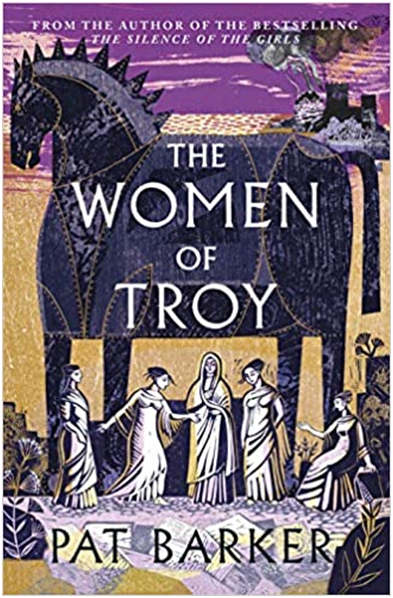
I did a brief blog on the 2018 novel by Pat Barker called The Silence of The Girls (accessible from this link). Since then it has become clear that Barker’s intention is that that novel is the first of an expected trilogy of stories that deal in some way with the story of Briseis, the female slave, but daughter of a king, who was the occasion of Achilles’ anger and conflict with the Greek kings, and Agamemnon in particular, who lead their side of the Trojan War in Homer’s The Iliad. I have now finished the second novel of that trilogy which came out this year. This blog was not so much a review of the novel but a recognition that I delighted in it because of Barker’s ability to ensure that the content of her novels was so queered that its first target was always the gender roles endemic to heteronormative values. I suppose I said this most clearly in this passage about the representation of male queer relationships in the presentation, through the eyes of Briseis (who also has sex with Achilles), of the relationship between Achilles and Patroclus.
I don’t sense ‘repressed homosexuality’, I sense something that neither participant has a name for but which belongs solidly to the intercourse of their whole lives: though nevertheless, to simplistic binary thinkers, disturbing.[1]
This ‘review’ then is not so much of the book itself but of my conclusion about it, in the light of what the second novel offers. Sexual relationships between men remain as potential for any man in the Greek camp in this novel, for that was the notion of the queer capacity central to Greek sexual life that Barker has accepted, but these relationships are nowhere a focal point or in any way explicit. There are exceptions to that generalisation but they relate to relationships that are closed and secreted, from other characters, and to a degree the reader. One example is a man whose sexual life has to remain a secret and for this purpose I’ll look closely at the character, Calchas. For the other, I want to examine the very guarded representation of Pyrrhus (Achilles’ son), whose pathological and misogynistic distaste for women to a large extent makes him the villain of the piece; ripe for queer redemption.
I suspect that Barker always wanted us to see something of especial interest in these men in fact, although I am less able to assert that that interest lies in the variations of male sexuality they represent. Lucy Hughes-Hallett’s review in The Guardian notices that only Calchas and Pyrrhus have their point of view of the narrative recounted, which is otherwise that of the unashamed female consciousness of Briseis. But Hallett does not explain why, having used a female narrator in large, the novel should step back from that narrator to introduce third-person narration with a dominant point of view guiding the selection of events of which one is Calchas, ‘whose point of view’, as she says, ‘we sometimes share’.[2] After all, as Hallett also says, Barker’s innovation to the telling of a fragmented story from classical (and very masculine)‘epics’ by Homer and Virgil (although she only mentions the former) is to give a female cast to that sry. That is true of the selection of events which includes a detailed scene of the pain of childbirth in scene in the women’s slave quarters.[3] It is also true of the manner of their telling, which pieces the story together from one woman’s interviews with witnesses to it, of which many are also women (and not goddesses but human women). Why then choose only these two central male consciousnesses for exploration from all that are available in this story. Let’s look at them separately, starting with The Trojan ‘seer’, Calchas.
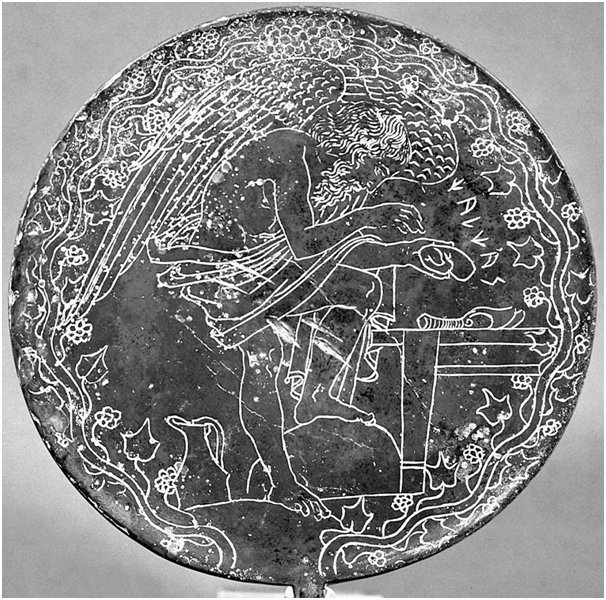
Seeing Through Calchas
Barker could not have made it clearer that Calchas bears quite an important role in this story, not only in the development of the story and its denouement but also in relation to the fate of Pyrrhus, whom I will examine next. His point of view mediates the narration in, at the least according to my notes, chapters 10, 13 and 24, even extending to the narration of a dream about his boyhood including his father’s disappointment in the family trade of blacksmith causing him to fear his father, and the very masculine trade he followed, and favour his mother.[4] It also includes self-reflection on what his appearance might be in the eyes of others, and especially Queen Hecuba: ‘stilted, prissy, constipated’ and fears that she might ‘blackmail’ him regarding a particular event in his past.[5] Whilst the reader occupies his consciousness we never learn what that event was other than an indiscretion that occurred in the past in which his ‘immoderate’ appetites might be guessed and which seem replicated in his taste for sweet cake. Knowing she knows about this event makes him feel ‘as naked as a hermit crab without a shell’.[6]
The very next chapter returns us to Briseis’ first-person narration and it is then that Hecuba reveals to Briseis, and us of course, the nature of that event and its immoderate behaviours. She tells Briseis of a time when Calchas was once really beautiful: ‘not just a bit good looking – absolutely stunning’. So much was this the case that: ‘Everybody was chasing him – men and women. The incident that Calchas refers to without any of the detail that he feels would shame him in the previous chapter is then recounted. King Priam and herself see Calchas, through an open bedroom door:
“and there was Calchas on all fours between two lords …” She giggled. “Plugged at both ends.” / / “… I mean, Calchas was supposed to be celibate.”… [7]
There is no doubt that the shame has a lot more to do with Calchas breaching his celibate status as a priest than with queer male behaviour, though Barker would know that the passive role in sex between men was considered by Greeks if not shameful then ludicrous when it occurred in adult men and spawned the insult, of many used by the comedy writer Aristophanes, ‘gape-arsed’. And here Calchas immoderate appetite is that he is the ‘passive’ (of course a silly word in terms of any actual sexual interaction between) recipient of the male sexual organ at both ends of his body, to wit his mouth and anus.
Calchas is a hypocrite of course, as Barker’s comic play with his consciousness shows. Let’s look at a fine example in Chapter 10. In contrast with other higher-order members of the court of kings (he now waits upon the court of Agamemnon) Calchas sees himself as somewhat ‘worn thin by sacrifice’. The play of his point of view however shows us that Calchas does not succeed in even deceiving himself about the extent of his sacrifice. Indeed even his narcissistic self-concern about the loss of his looks is lost to him somewhat but not entirely. He, like other men (we hear Barker’s laugh of irony suggesting this) project their own sexual narcissism into women of their acquaintance and observation.
He remembers Hecuba’s wrinkled neck, …, and touches his own neck nervously. Men experience their own ageing in the bodies of women, even men like himself who have chosen a celibate life; not that he’d ever actually chosen celibacy – or stuck to it either, come to that. …Dimly, he’s aware of the sky darkening, of his own narrow feet flashing in and out of the shallows, but he’s lost in memories of the past …[8]
Wherein lies the cusp in these complex contradictory sentences between our superior awareness of Calchas’s lack of utter probity and his own. Perhaps it does not exist at all and that he is as capable as we are of recognising that his response to Hecuba’s ageing skin is merely projected from his own, as we nod (as I do at least, to that generalisation about ‘men’. Calchas seems capable of seeing the irony, for instance, that marks the distance between behaviour and words here, of knowing that the ‘darkening sky’ is not just a physically sensed scenario but also a predictive emotion of regret and loss that he can’t pin down but will be played out when he lives on in Troy at the end of the novel, unlike his original in Homer. However, his response is to kick back against the pricks, in the indubitable form of Pyrrhus, another man who acts the man, whatever his truth to himself.
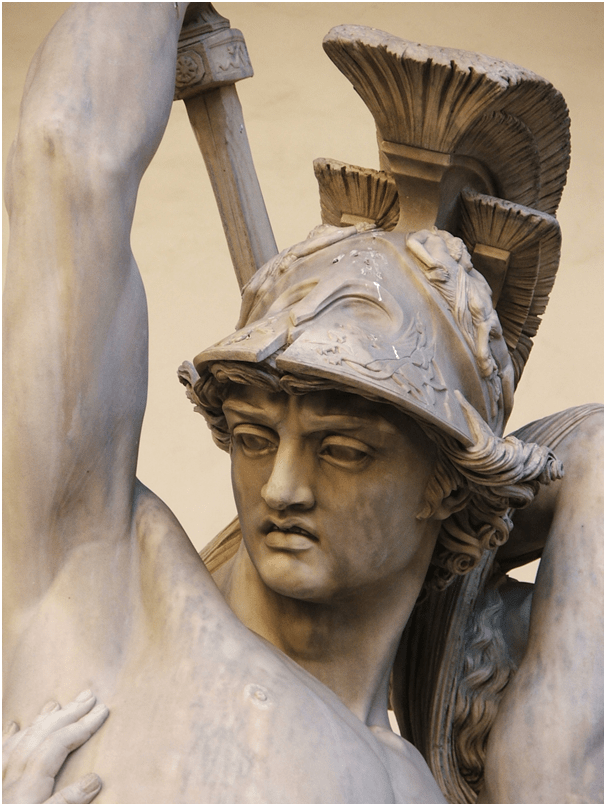
Pyrrhus, the ‘taunting homunculus’.
Pyrrhus years like Calchas to get the better of his father and even when he stands ‘where his father never stood’ in pursuit of Priam in his own palace, he fails to look the part.[9] This is the more pronounce in the ‘goggle-eyed’ witness of Amina, whose name in Arabic means ‘honest’, something Calchas and certainly Pyrrhus never are.[10] What he desires to see in a mirror is himself matched with that ideal of ‘arms and the man’, his father, Achilles:
… he used to dress up in Achilles’ armour and stand in front of this mirror, narrowing his eyes until the image in front of him blurred and it was possible to believe the man standing there was Achilles himself. He’s the model of his father; everybody says he is. Now, though, what he sees is a taunting homunculus.[11]
The device of using his point of view in prose narrated in the third person again here allows us to see a man who attempts to see himself, and uses factitious evidence to do so, as the kind of ‘man’ he only thinks he wants to be. And that man falls short in so many ways to the flawed ideal, which anyway was never what he thought it was. Unable to be as one with Achilles’ Myrmidons he is associated instead with the uncouth, loutish and laddish young men, significantly from his mother’s island, of Skyros.[12] Even sexually his masculinity is constantly in question. Ruth Scurr, in true Times Literary Supplement style, takes Barker to task for a metaphor used by Pyrrhus to describe sex with the middle-aged queen and late wife of Hector, Andromache. Pyrrhus describes the sexual encounter as: ‘being “like sticking your dick in a bag of greasy chicken bones”. This achieves the requisite sense of disgust but doesn’t work as an image’.[13] It always amazes me how confidently academic critics in this paper read the mind of authors, usually to the latter’s disadvantage. We ought not to take as read that Scurr is correct that Barker wants the image to work, as Scurr thinks it should. Indeed the fact that it does not work and fails to register anything approaching the sensation of sex may, and I think does, have more to do with Pyrrhus than Barker and dramatically it is a brilliant use of imagery. For Pyrrhus’ sexual achievements, bruited in from the Syros lads, do not necessarily match any reality of experience for either him or his partners. That is precisely what the dramatically pointed perspective of Pyrrhus in the prose is MEANT to show:
How they’d managed to have sex he didn’t know. But they had, the damp sheet underneath him was proof. He couldn’t remember much, but he’d done it. Had he? Yes, of course he had. He can remember it now, though it’s hardly worth remembering. Like sticking your dick in a bag of greasy chicken bones.[14]
I can only guess Scurr has little or no knowledge of the capacity to confabulate in young men, because this is precisely what is enacted here in syntax and imagery. Very few men could genuinely see a damp sheet as evidence of the task performed (it is a task for Pyrrhus). Barker is very much making this point tongue-in-cheek when she on the next page describes Pyrrhus’ self-talk as characterised by a ‘spurt of confidence’. When Pyrrhus later chooses a female lover, he chooses Helle who is described by Briseis as having the voice and body of a boy rather than a girl. On her return, she tells the women (another revelation for some men is that women do assess male virility) that he had only wanted her to ‘watch him wank’.[15] Even his failure in the sea as a swimmer, in comparison with the capacity of Achilles, is relevant since the sea represents Achilles own mother, Thetis.[16] That Pyrrhus ‘buged’ into rooms is much of the same joke by Barker – his narcicissim has the largest effect on his self-estimation of penis size.[17]
Yet Barker does not punish Pyrrhus forever. His villainy often seems to be symbolic self-torture based on unconscious recognition of his own desire, or at least I see it thus. He is heavily implicated in the torture of Cassandra’s twin brother (she, of the ‘masculine hands’).[18] In Briseis’ estimation Helenus, ‘a really rather beautiful young man’, can only still be alive – royal sons being murdered – because ‘the Greeks just didn’t see him as a man’.[19] Pyrrhus tortures him though, some would say symbolically and for his own pleasure, by pulling ‘out his dagger’ and, seeing anticipatory fear on ‘Helenus’ face, the tension of his muscles’ by pressing this implement into Helenus’ body.[20] And eventually Helenus requests to be as Priam was to Achilles a ‘guest-friend’ and Pyrrhus:
Remembers the emptiness of his living quarters: … really what else is he to do? So he steps on one side, opens the door a little wider – and lets the future in’.[21]
Now Barker’s refusal to speak out what exactly the future of these young men is pasrt of the nature of this novel. The frank queer love of Achilles and Patroclus is replaced by something more closeted in this novel. It is anachronistic I know (but Barker is a self-confessed anachronistic historical writer) but it seems to me that Barker leads us here to the closeted ‘homosexuals’ of others of her novels – in the image of the careful professional Calchas and the young man secretly choosing a buddy in Pyrrhus. When we next see the pair, they are spotted by Briseis standing on the beach – Pyrrhus like a’half-fledged chick’ and Helenus with eyes red ‘from the smoke’. She thinks: ‘They must have done the night watch together’. I bet. But this is the fate of queer relationships in history – not to be open like the beautiful Patroclus but secret and ambiguous like this scene. Yet secrets contain keys to their interpretation. I lingered over the moment when helenus appears ‘red-eyed’ as already cited and remembered this about Pyrrhus love of horses, and particularly his first horse, the one he could not save from ‘redworm’: ‘Even the name had formed a bond: Rufus; Pyrrhus. Both names mean ‘red’ – and there they were, the two of them, spectacularly red-haired, …’

Well, of course, readers differ but I prefer my novel to those in the muted reviews I reference here. I see Barker as eminently wicked with gender play and an ally of new forms of gender experience.
All the best
Steve
[1] From: https://stevebamlett.home.blog/2019/10/31/reviewing-pat-barker-2018-the-silence-of-the-girls/
[2] Lucy Hughes-Hallett (2021:11) ‘REVIEW: The Women of Troy; In this impressive sequel to The Silence of the Girls, Barker moves on from war to its bleak aftermath’ in The Guardian Review booklet (Sat. 21st August 2021) pp. 10f.
[3] Ibid c. 232
[4] Barker (2021: 98f.)
[5] Ibid: 102
[6] Ibid: 104
[7] Ibid: 109
[8] Ibid: 83
[9] Ibid: 10
[10] For the ‘goggle eyes see ibid: 13 & 191 (on the latter page the former one is recalled).
[11] Ibid: 267
[12] Ibid: 144, 150
[13] Ruth Scurr (2021: 18) ‘Pyrrhic victories: Lamentations for a ruined city in pat Barker’s retelling of the Iliad’ in The Times Literary Supplement No. (6177/6178 Aug. 20 & 27 2021), p. 18.
[14] Barker (2021: 65)
[15] Ibid: 92, 94f.
[16] See ibid: 67
[17] Ibid: 125
[18] Ibid: 121
[19] Ibid: 119
[20] Ibid: 268
[21] Ibid: 274
 Steve_Bamlett_blog
One thought on “Reviewing queer content in Pat Barker’s (2021) ‘The Women of Troy’, the second novel of her Briseis trilogy.”