‘She might hope for more but had long ago learned to live with whatever came to pass. Yet sometimes – just sometimes – hope was enough’.[2] Is hope and political liberalism enough in the novel in a world where Black Lives Really Matter? A reflection on Nathan Harris (2021) The Sweetness of Water London, Tinder Press in the light of the urgency to politicise rather than depoliticise the cost of inequity and marginalisation on black lives.
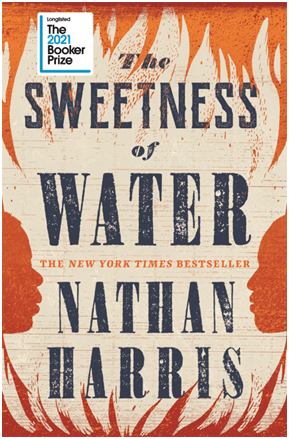
When Louise Ermelino of Publisher’s Weekly introduced the USA publication of this novel she entitled her piece: ‘What Does Freedom Mean? A Debut Novel Is Asking’.[3] This seems an urgent enough question but the novel was published amidst turbulence over the issue of how and why ‘Black Lives Matter’ and the question still needs to be asked whether this novel really addresses whatever needs to be addressed in writing about the ‘meaning of freedom’ to the progeny of a slave population. This novel sets itself at the very cusp of the ‘emancipation’ of black slaves in Georgia but it is not primarily a novel about the experience of white entitlement to the ownership of black lives, though it addresses this matter in the most moving of ways. For surely we need to ask, even of novels written by young black authors of great promise and skill, to what extent this escapes the strictures owing to unacknowledged white entitlement.
I do not refer to the fact that this novel’s sub-plot concerns a white family and their response to other kinds of oppression, internally and externally, for such an intersectional approach is necessary and I was delighted that this novel dealt with queer themes though in the context of white men only. This is not the case with other great novels and essays this year and as a balance to what I have to say here I’d refer any reader still with me to my blogs on Kei Miller, Caleb Azumah Nelson and Robert Jones Jr. The latter novel lays bare the fact that novels have to find ways of exploring the history of black people even without the protection of documentary evidence. For Ermelino the explanation of the reduced focus on the direct experience of black people in Harris’ debut novel (he is only in his twenties and promises to be a very great novelist in the future but he is not that YET) is explained by the fact that records of such lives are too scant, itself a symptom of marginalisation. She writes:
Nathan Harris’s father was obsessed with researching his family history, but when Harris asked what he’d discovered, the answer was almost nothing—a common situation for many Black Americans. In his debut novel, The Sweetness of Water (Little, Brown, July), Harris creates that missing history through the story of two brothers, Prentiss and Landry, who are freed by the Emancipation Proclamation and hired to work on the Georgia farm of George and Isabelle Walker, whose only son died as a soldier in the Civil War. “All Black writers are drawn to filling in their past,” he says.[4]
There you have the bare bones of a plot. George, the central white character who finds common cause with emancipated slaves, Prentiss and brother Landry who are camping without permission on his land in the first chapter. George is a complex rounded character defined neither by just his white skin nor even by other of his potentially defining attributes that single him out as a man. First of all among his ‘eccentricities’,[5] he defies gender conventions and it is he who cooks for his wife, Isabelle, if she will allow him, not the other way round.[6] Indeed it is in Isabelle’s absence, at first until she returns to him and a new appreciation thereof, that we shall see him feeding his own and his reconstituted ‘chosen’ mixed race family, described so beautifully as ‘an assortment of damaged bodies collected together to gain sustenance’.[7] He is also a man who suffers from paranoid delusions about a ‘beast’ that haunts him and his land at night that we are only later to learn was brought into being by his own father purposely to terrify the young George; a subtle but very definite form of child abuse. George is definitively odd – physically and psychologically, if not sexually, ‘queer’ and often compared, to comic effect in both cases, both to a kind of inspired Apollonian poet (in the association of laurel wreaths) and to a woman to further enhance the boundaries this person might seem to be crossing:
His nose was large, his eyes small, and his hair fell in a ring like a well-placed laurel wreath: his belly had the taut rotundity of a pregnant woman and was always safely stowed away in the midsection between his suspenders.[8]
Yet this picture of George, who reads the fiction of Dickens quite tellingly, is both the strength of this novel for readers, especially readers not usually represented by Booker Prize nominated novels – what we used to call ordinary readers with no academic or elitist pretension – and a weakness. I would rather read this novel for its plot and treatment of characters than any of the Booker nominated set of 2021 I have read thus far, some of which I consider very great novels indeed, but I still don’t believe that it would be correct for it to win. In such a good year, even a novel of its skill and talent, should not I think even be on the shortlist. That is because it depends on those staples of the novel as described by E.M. Forster in Aspects of Novel: namely a good and surprising ‘plot’ or story with many twists and turns and complex rounded characters. At a time when black writing is coming to the fore, I think this novel compromises too much with white traditions of the novel, unlike Robert Jones Jr., for instance.
Ermelino is correct in citing Harris’s intersectional political intentions I think. She says: ‘Harris looks at class, identity, and society. A parallel plot follows the fate of two gay Confederate soldiers who return to the town of Old Ox, and the effect on the community when their relationship is revealed’.[9] But I think she undersells the degree to which a concern with an increasing liberal and white family from Georgia as its focus upsets the ability of the novel to focus on the notion of ‘freedom’ for black people. Freedom becomes in this process something given to black people by white people. For instance, everyone in the focal white family escape any tar falling from the consequences of ‘white entitlement’. Thus, they are all committed to pay emancipated slaves a living and equitable wage. Even when restarting the family peanut farm alone, near the end of the novel Isabelle advertises for workers from ‘ALL RACES, CREEDS, AND COLORS. FAIR PAY. EQUAL PAY’. [10]
The two key black characters remain or become impassive tools. Prentiss, for instance, realises from his brother’s experience not something about the reality of unequally distributed power between white and black and Southern and northern citizens of the USA, but definitively human lessons about the nature of the large defining and cross-cultural trans-racial human being. He learns, for instance, ‘from Landry’,that large and beautiful man of a brother who clearly is presented as having a learning difficulty, ‘that the language of grief was often nothing more than silence’.[11] The effect is, in my view to ‘silence’ black resistance to the power of white races and I am sure that, at this point in history, the largely white literary establishment should not be making this its champion of novel writing by black authors.
To illustrate the beauty of its focus on the individual character, we continually have to return not to Prentis and Landry, the ‘freed slaves’, but to George and Isabelle and their wonderful queer son, Caleb. Harris is meticulous in seeing the effects he achieves as the effects of art, and it is a beautiful and subtle art not to be expected from so young a writer. Look at this self-conscious beautiful paragraph of exquisite sentences for instance:
She brought two plates to the table, returned moments later with two cups of coffee. There was a rhythm to their eating. One would take a bite, and then the other, and it was in these slight recognitions – no different from the way they exchanged deep breaths while falling asleep – that the brushstrokes of their marriage coalesced day after day, night after night, the resulting portrait rewarding but infuriatingly difficult to interpret.[12]
No-one but E.M. Forster has ever better expressed how the novel might encapsulate its beauty, meaning and artistic flair in the notion of rounded characters in a well told story – ‘rewarding but infuriatingly difficult to interpret’. The relationship is like a painted portrait and like music both at once. It is ‘composed’ even in the skill of the motion of its sentences and is so beautifully satisfying. Yet it leaves the politics of the novel locked in the mysteroies of personal relationships and characters whose problems are resolvable rather than predicted by a political script, which in fact I think any conscious and conscientious person post the Black Lives Matters movement now believes they were. Such is the finding in the debacle of slavery, as examined by artists like Steve McQueen and, in a lesser way, Alex Wheatle for instance (see my blog at this link for a justification of that assertion).
In Harris’ novel the belief in individuals and the possibility of their redemption is so deep, except perhaps in the case of August Webler (the most evil gay man I have ever come across in literature) is so deep that even the most died-in-the-wool slaveowner (Ted Morton) is presented as a slightly faulty (and definitively non-artistic) individual rather than the force of an oppressive political system:
Ted Morton was a dimwit, a man who if offered a fiddle, would be as liable to smash it against his own head to hear the noise as put a bow to its strings. His parcel of land bordered george’s, and when an issue arose – a runaway most often – the ensuing spectacle rife with armed overseers and large-snouted dogs, lanterns of such illumination that they kept the entire household awake, was so unpleasant that George often deferred all communications with the family to Isabelle just to avoid the ordeal. …[13]
Alex Preston, reviewing the novel for The Observer, argues that the strength of the novel is that it finds a new way to tell the stories of the American Civil War that, for a change, cannot be described as part of an American tradition of the Civil War novel (he includes Margaret Mitchell, and E.L. Doctorow in these) that is:
… a slightly macho, fusty one, with accuracy privileged over narrative, drawn-out battle scenes over emotional complexity, and a focus on the lives of red-blooded, white-skinned men (and the women who love them) drowning out the experience of others.[14]
Who knew that Gone With the Wind was ‘accurate’ by the way? But although Alex is surely correct in saying that the novel is ‘lyrical, impressive at the level of the sentence, and in its complex interweaving of the grand and the intimate, of the personal and political’, it is a truth that black readers like Kei Miller, for instance, may find very uncomfortable if still very beautiful and totally worthy of plaudit.[15] The reaction to George’s ‘indiscretions’ marked by actions favouring liberal employment and housing of black workers is still in this novel attributed to the ‘frustrated men’ by the character, Ezra – a moneylender who unfortunately is clearly also Jewish – because frustrated men, ‘makes for rash men’. In characterising the reaction of white racists this is surely not good enough – not in my eyes anyway, even though the words of a character that is of rather limited human attraction but yet presented as thoroughly decent. George rightly acts in antipathy to Ezra’s words but George too is, we know, rash and sometimes irrational. What the novelist can seem to agree with is a characteristically Forsterian perspective such as in this beautiful axiom to explain what hearing oppressive prejudice feels like (to Isabelle): ‘Sounds of excess, vice not of the religious order but of the human order, the noises of society fending off despair with routine’.[16]
Moreover, although I was delighted to find a queer theme in this lovely novel, its queer men are either defensively defensive of their heterosexual masks (August Webler) or mere dupes. Caleb is however a beautiful dupe and I like this character and hope, like Isabelle, well of his future. His love for August is told in an interesting way. We see the resultant sexual union (an act of anal penetration of Caleb by August) through the eyes of a man with learning disability, Landry, who is, (I think almost incidentally except that his witness is already compromised by that fact) black and ‘had never seen a white man naked’.[17] He sees the sexual act as an act mainly of aggression and perhaps in that, he is totally correct, if not in ‘innocent’ Caleb’s eyes. Only then do we get the story of how this meeting – on a Sunday at a pond frequented by Landry – was set up and the events which preceded it, including an angry fight that is less ambivalent than that Landry sees.[18] There is determined cruelty in the description of the anal sex however:
In the fields, Caleb was a man in his own right, or at least at the cusp f being one, but he appeared now as a boy, emitting childish moans as the other boy choked him, took hold of his hair, and delivered heavy blows to his backside.
I have not really worked out how I feel about this crucial scene, though I find it a long way empathetic to even white queer men: ‘Their bodies were contorted, with Caleb on his stomach and the other boy mounted upon him’.[19]
So I hope this novelist is not rewarded too early to allow his human and political perspectives to grow, especially in the company of other black writers rather than white publishers and their journalistic like. Because here is someone capable of true greatness I think, but who is not there yet. The quotation I cite in my title are the final words of the novel and their tendency is to reduce political forces to human relationships and grand human emotions, as in E.M. Forster. We have moved on though from Forster and he and his lovely liberalism has failed us.
But read this novel. It is TOTALLY ENJOYABLE!

All the best
Steve
[1] Harris (2021: 356).
[2] Ibid: 356.
[3] Louisa Ermelino (2021) ‘What Does Freedom Mean? A Debut Novel Is Asking’ in Publisher’s Weekly (Mar 12, 2021). Available at: https://www.publishersweekly.com/pw/by-topic/columns-and-blogs/openbook/article/85793-what-does-freedom-mean-a-debut-novel-is-asking.html
[4] Ibid.
[5] Harris op.cit.:11
[6] Ibid: 49
[7] Ibid: 110
[8] Ibid: 12
[9] Ermelino, op.cit.
[10] Harris, op.cit.: 317
[11] Ibid: 167
[12] Ibid: 12
[13] Ibid: 3
[14] Alex Preston (2021) ‘The Sweetness of Water by Nathan Harris review – a fine, lyrical debut’ in The Observer online (Sun 27 Jun 2021 13.00 BST). Available at: https://www.theguardian.com/books/2021/jun/27/the-sweetness-of-water-nathan-harris-review-american-civil-war
[15] Ibid.
[16] ibid: 102
[17] Ibid: 142
[18] From ibid: 155ff.
[19] Ibid: 142
 Steve_Bamlett_blog
One thought on “BOOKER LONGLIST: ‘She might hope for more but had long ago learned to live with whatever came to pass’. Is hope and political liberalism enough in the novel in a world where Black Lives Really Matter? A reflection on Nathan Harris (2021) ‘The Sweetness of Water’.”