CONTAINS SPOILERS. Be aware if you like to read your novels unaware.
This great book is on the SHORTLIST
‘She herself has been taken by surprise at how much it matters to her, this buried question from long ago. … that particular stone never seems to find a resting place, no matter how often it’s turned’. [1] A novelist examines the constantly returning inadequately repressed content in the body of individuals, families and nations. A reflection on Damon Galgut (2021) The Promise Chatto & Windus, London
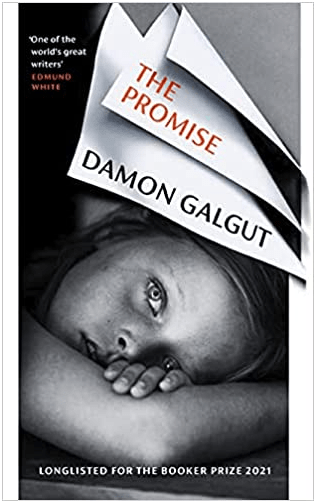
I refer in my title to Freud’s concept of the ‘return of the repressed’ but it isn’t to suggest that Damon Galgut’s novel deals with anything like the ‘unconscious mind’ or events that must be analytically unearthed from the novel. For the repressed in this novel may be ‘buried’ but it is also visible from the outset, if not ever clearly delineated within safe boundaries: ‘Some sign or image, just under the surface. Trouble down below. Fire underground’.[2] After all the quotation in the title refers to one of the most prominent, if difficult to realise, things in the novel itself – the unfulfilled promise made to Salome, the black maidservant of the family that the home in which she and her children live would be made her own.
Of course at one level this novel operates as a ‘continuous allegory or dark conceit’, like Edmund Spenser’s The Faerie Queene, so that her ‘home’ is either or both her ‘tied’ house and the nation of South Africa herself, both of which may be so mired in their dark histories to belong precisely to no-one or to an unnamed ‘community that says they were forcibly removed’. Both constitute for those that inherit them, however lawfully, ‘a poisoned chalice’.[3] And thus we see variously pass through these pages Mandela, Mbeki and Jacob Zuma. Verwoerd is captured in the name of a hospital which, because it now houses multi-racial dying people, is described as ‘spinning in his grave’.[4] These different politicians ought not to be lumped together perhaps but they are for the law that sustains this nation as it changes proves thinner than the soil surfaces of this novel. This is despite the fact that the law is somewhat (like Miss Miss Coutts-Smith) ‘amplified over the years’, and feeling ‘even larger to talk’ about large sums of sequestered monies.[5] The whole subject and tender matter of the novel (‘a promise’) quivers under the now weighty Miss Coutts-Smith: ‘I’m a lawyer. Promises don’t mean a thing’.[6]
And to labour the point about buried depths, let’s just remind ourselves of how commonly they interrupt the narrative with their low but incessant and troubling voices:
Trouble in all the townships, its being muttered everywhere, even with the State of Emergency hanging over the land like a dark cloud and the news under censorship and the mood all over a bit electrified, a bit alarmed, there is no silencing the voices that talk away under everything, like the thin crackle of static.[7]
And again, like Spenser, these buried entities take multiple layered meanings in relation to politics, racial oppression, corruption in financial systems and sexual and other relationships, even amongst those supposedly dead – the novel’ s sections are structured around a death in the family in intervals of ten years. This novel, like Hamlet the play, also has a central gravedigger’s scene.[8] Bob, the homeless itinerant man who witnesses Astrid’s funeral and its haunted members, sees them as not unlike the state officials he’s used to seeing surmounted by ‘evil entities’; although in some cases (‘a couple of minor ectoplasmic entities lying on the floor’), they are ‘fortunately harmless’.[9] We do not know what the content of the consciousness of Pa is, as he lays dying from a bite by a Cobra from his own Scaly City tourist site, because he wishes to expose his faith in God to the test. Nevertheless, the narrator asks us to: ‘ Picture a tunnel underground where no light has ever shone. Something like that, a crack in the bedrock of himself, is where Pa has retreated’.[10]
Sex like political and financial corruption too become underground experience, indeed another ‘underground fire’ that would be like Hell if it were not both so trivial and like the ubiquitous rats that emerge so often in the novel towards its end. As the narrator lends their voice to Anton on meeting him early in the novel, we hear:
Only one thing on my mind since hearing about Ma, … Eros fighting Thanatos, except you don’t think about sex, you suffer it. A scratchy, hungry thing going on in the basement. Torment of the damned, the fire that never goes out.[11]
The play with Freudian categories here is I think just that, as much as the play with images of the infernal is also playful. It is a persistent itch that never becomes fully conscious rather than being of the Unconscious, in the full Freudian sense of that which refuses to be known. And sex and death are, of course, linked by the body in which both are experienced. Hence there is a concentration after each death on the fate and memory of each of the bodies in their process of decay: there may be an urgency to get those bodies buried or cremated but that process nevertheless fails to solve the problems that bodies continues to pose to ‘civilized’ values.
We first see this theme in the treatment of the body of Ma (Rachel). It is ritually prepared by an elderly volunteer of the Jewish community whilst the process is overviewed by a ‘ghost’ of that same body contemplating her double: ‘the spitting image of herself, but grey and cold, like somebody dead. / She is somebody dead. …’.[12] Likewise the body of Pa (Mainie) is prepared by the undertaker Fred Winkler to clear up all that ‘letting go’ and incontinence that accompanies death because you ‘have to make them look peaceful: ‘it’s the family that wants to be at peace’.[13] The truths of the body, including its tendency to leak from its boundaries, form sometimes a kind of, what Norman O. Brown used to call, an ‘excremental vision’ of human and familial civilisation. Anton, for instance, the ‘firstborn’, robbed of all other illusions of the better life that all, but latterly only himself, had expected of him finds himself ‘in a toilet stall, pissing’ a fact explicable to him only because ‘urinating is an inherently truthful activity’: ‘Shitting too. No social graces to disguise you’.[14]

Thus too graves (and indeed mortuary slabs and tables) abound. The most iconic of the former in the novel is that of a pigeon that flies against the transparent, but nevertheless hard, glass of the family house. It is the most inadequately buried of the bodies in the novel, and that is why therefore I call it the most iconic:
The bird lies in its little grave, just under the surface of the earth, for only a few hours before it’s dug up by a jackal, ….
//
The ground has been opened up, in the place that stinks of bone. The earth exhales odours when it’s torn, undetectable to the human nose but to Canis mesomelas, oh, it speaks in tongues. The wound is big and raw, and the smells of the diggers are in their too, … their sweat and saliva and blood’.[15]
A grave that is also a stinking pit reminds me (does it you?) of the worst of King Lear’s imaginings in the scenes on the heath where he loses his reason and every orifice reminds him of his primal fear of women and the misogyny that generates.
Behold yond simpering dame, whose face between her forks presages snow, that minces virtue and does shake the head to hear of pleasure’s name. The fitchew, nor the soiled horse, goes to ’t with a more riotous appetite. Down from the waist they are centaurs, though women all above. But to the girdle do the gods inherit; beneath is all the fiends’. There’s hell, there’s darkness, there’s the sulfurous (sic.) pit— burning, scalding, stench, consumption! Fie, fie, fie, pah, pah!—Give me an ounce of civet, good apothecary, to sweeten my imagination.[16]
The distaste for the sexual gets fully associated with at least some of the layers of the theme of the grave, since these containers too often fail to hold in and hold back the body. The latter therefore bruits its presence. Anton’s wife, Desirée, pursues a modern day yogi who teaches ‘meditation and yoga’ at his ‘Whole Human Centre’ but to Anton that same yogi might have waked in his wife ‘the sleeping Tantric serpent at the base of their spines’. Human’s pursuing ideals like wholeness sometimes only achieve opening up their own reduction to being a living and breathing body valued only for its ‘holes’: ‘Hole human’.[17] Even Fred Winkler, the no-nonsense undertaker, imagines the ‘faint tincture of decay’ emerging from a sealed coffin that reminds him too that his ‘vest and underpants are too tight’. It’s tinctures mingle with ‘the fumes of his own sweat’. Bodies that cross boundaries appear to do so through the most basic of senses.

But bodies matter most to Anton for whom there is little or no gap between the female body as an object of someone’s sexual pleasure and of very primal misogynistic hate. Viewing his sister Astrid’s body in a mortuary on behalf of her wrecked and cuckolded husband he confesses unnecessarily to having once ‘shot a woman when I was in the army’.[18]
Of course this is not the only time in which that body re-emerges into Anton’s consciousness and is used to interpret his feelings for women he desires or those of his family. Indeed the cusp between these women, as with King Lear, is very thin and constantly sundered. Anton killed a woman who throwing stones at him and colleagues in their role in the South African army, yet he knows there is more to this than the sin of the repressive politics of South African apartheid: ‘he hated her, he wiped her away’.[19] Having shot one woman he generalises his guilt and personal responsibility to all women, even his mother: ‘My mother is dead. I killed her. I shot and killed her yesterday morning’.[20] And the sins of South African history are constantly revived for more than he – for his wife, Desirée barely knows how to compute the fact that her own father:
Who everybody used to respect and fear, would have to go in front of the Truth and Reconciliation Commission and admit to doing those horrible, necessary things. The problem with this country, in her opinion, is that some people can’t let go of the past.[21]

The past is dug up as savagely from such shallow graves as the jackals dig up thjat pigeon who ends up as ‘road kill’. In effect, this is what I mean by invoking the novel’s Spenserian allegory or ‘darke conceit’. Characters over-represent values and abstractions, sometimes in their names – especially the two central women, Desirée and Amor, over whom games about the differentiation of desire and love play. Nothing and yet everything in this novel is other than too near the surface to be ignored and forgotten – the tragedy of human failure and partiality keeps manifesting itself – in the political and economic history of South Africa, the flaws in a family ill integrated between the communal faiths that ought to hold it together in the eyes of some characters, in sexual and human relationships and the mixed interests they serve (including those of corruption) and in religion. Faith is experienced by Astrid as if it were a ‘tumour’ for instance. Amor experiences her first menstrual blood as the grave of her grandmother is closed in, and ‘salvation’ is merely ‘ambiguous and unsure’.[22] For people, families and nations:
Every day since he left home has been imprinted on him as a visceral, primal endeavour and he doesn’t dwell on it, nothing to be savoured there. Survival isn’t instructive, just demeaning. The things he does recall with clarity he tries not to, pushing them under the surface. Part of what you do to keep going.[23]
Except you never quite bury these things deep enough so that they don’t, like the pigeon’s carcass, ‘speak in tongues’ to some jackal. And for Anton it speaks in his unfinished novel in its ‘fragments and jottings and cryptic phrases’. And what is lost is any integrity, any wholeness. What remains is post-modern fragmentation, although clearly Anton makes one final effort to reconnect with his mother’s Jewish past by adopting the name of Aaron:
… as Aaron’s life breaks down, the narrative does too, names and details changing from one paragraph to another, febrile scratching-out and rewritings in Anton’s unmistakable old-young hand, could be a child’s or a geriatric’s.[24]
There is so much more to say of this novel but this is perhaps enough. It is a novel of great literary ambition and gets fairly roundly chastised for that by some early critics, like Jon Day in The Guardian, who sees this novel as an ‘inevitably partial’ achievement seeking unlike earlier novels to escape ‘the smaller frame’ in which Galgut is said to excel.[25] But surely Day fails to see that the way Galgut handles the narrative in this book is not just the demonstration of a masterly technical skill as a novelist, but an attempt to find a role for the omniscient narrator that in itself illuminates the uneasy role of the reader as a voyeur of the sexiness of other lives. It is important that this narrator can slide into any character but that they know that their role is compromised by serving the needs of a reader who probably is as little interested in the fate of a woman like the black maid Salome are as the main characters; even perhaps Amor, who still remembers looking down, perhaps in every which way, on Salome’s home, the subject of ‘the Promise’: ‘Not ours, not safe. Dirty and dangerous’.[26]
Entitled white readers too hold off and hold back from such lives as those of Salome and her apparently wayward, but actually oppressed, sons. A narrator who is truly omniscient ought to know that about his readers and this one does and brings us into the frame of the novel’s themes with a jolt: ‘… and if Salome’s home hasn’t been mentioned before it’s because you have not asked, you didn’t care to know’.[27]
For the readers of novels too often avoid knowing that they too are complicit with buried pain and the experience of oppression. In fact, as we read The Guardian literary pages, are we not aware that this is the professional requirement of the literary reader and their prized evaluative objectivity.
For me this novel is very great indeed. It doesn’t fill its frame because that is no longer possible as it was for, say, George Eliot. Instead, it reminds us how uncomfortable we ought to want things tidied up for us in the novels we choose.
All the best
Steve
[1] Galgut (2021: 211f.)
[2] Ibid: 3
[3] Ibid: 281
[4] Ibid: 99
[5] Ibid: 280f.
[6] Ibid: 282. My italics.
[7] Ibid: 9f.
[8] See ibid: 132ff.
[9] Ibid: 202f.
[10] Ibid: 100
[11] Ibid: 54
[12] Ibid: 44
[13] Ibid: 123
[14] Ibid: 237
[15] Ibid: 130f.
[16] Shakespeare King Lear Act IV, Scene VI (lls. 115ff.). Available at: https://www.sparknotes.com/nofear/shakespeare/lear/page_242/
[17] Ibid: 189
[18] Ibid: 181
[19] Ibid: 35
[20] See Ibid: 36, 70
[21] Ibid: 193
[22] Ibid: 69, 71, 94 respectively
[23] Ibid; 94
[24] Ibid: 276
[25] Jon Day (2021: 13) ‘ A formally inventive examination of a national trauma through the story of one white family in South Africa’ in The Guardian (sat. 19 June 2021).
[26] Ibid: 282
[27] Ibid: 285. My italics.
 Steve_Bamlett_blog
2 thoughts on “BOOKER SHORTLIST: ‘She herself has been taken by surprise at how much it matters to her, this buried question from long ago. … that particular stone never seems to find a resting place, no matter how often it’s turned’. A novelist examines the constantly returning inadequately repressed content in the body of individuals, families and nations. A reflection on Damon Galgut (2021) ‘The Promise’”