Task for MOOC:
Write a ca. 500-word text to explore the strategies of those fighting for women’s suffrage in the US between the 1870s-1910s, reflecting specifically on the following questions:
- Was the case for women’s suffrage argued in terms of women’s status as a specific type of citizen (e.g., motherhood), or rather in terms of a universal notion of rights and citizenship?
- To what extent and in what ways did women’s suffrage organisations reach out internationally, and how did this influence their strategies and perspectives?
- Who was excluded from women’s suffrage and citizenship?
- In what ways can the images you have chosen shed light on the above questions?
I have chosen:
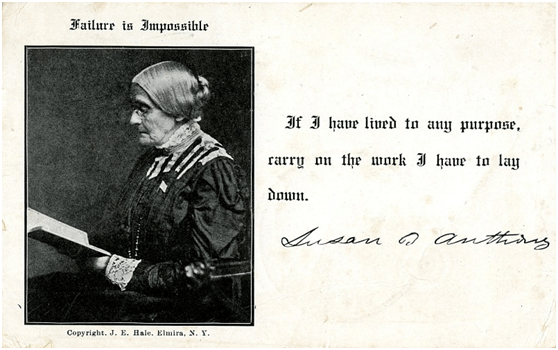
1. The Wome’s suffrage postcard available at: https://www.si.edu/object/woman-suffrage-postcard:nmah_1444284
2. Women’s Suffrage badge available at: https://www.si.edu/object/woman-suffrage-button:nmah_1444303
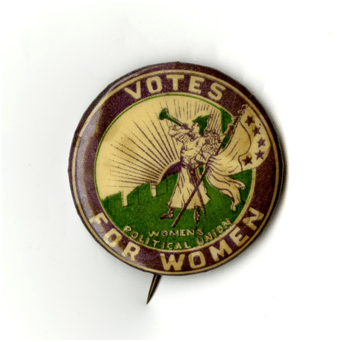
The two resources highlight features of American feminism but to see them correctly we need to see what they do not show as well as what they do. The motif of the ‘clarion call’ is frequently met in trade union calls to action together with the metaphor of the battle, which is emphasised by the fortress walls and the ‘new dawn’ of a rising sun coming up behind it. The clothing, though feminine in a way, apes classical mixed with medieval models of male militia apes the Roman. And most of all, this is a white woman and white is the major colour – so much so that it has the invisibility of background. Likewise the choice of green and purple as foreground colours emphasises alliance internationally but with the cause of white women as a contingency of unspoken racist assumptions thyat woulf have not been seen as such: ‘Despite prompting from Southern Hemisphere members, whose ranks swelled as women’s organisations from South America and South and East Asia were admitted, en masse, during the interwar years, neither the ICW nor IWSA met outside Europe or North America until the 1960s. As a result, international representatives were overwhelmingly white, wealthy and Protestant.
That Susan B. Anthony becomes an icon in the postcard I selected surprised me at first because this is primarily an image, unlike that of the badge, of an older white woman. Not only that but of a highly respectable educated white woman. Nevertheless age is another variable in the intersectionality of identities and it does suggest diversity is addressed in the movement provided that diversity stops at boundaries of race. In fact the older woman becomes an image of the transmission of female wisdom down the generations: but the exclusivity is confined to a particular white middle class culture. The use of Gothic text in the postcard is also interesting – again it suggests the need to suggest reflection on ancient wisdom and tradition, that rhymes with the book Anthony is reading. It is a very different image from the martial themes of the badge and the stress on the defence of a fortified civilization.
 Steve_Bamlett_blog