Optional Assignment 2 on confabulation: Course on What is a Mind? University of Cape Town course on FutureLearn:.

Instructions:
For this assignment we are asking you to produce a short piece of writing (300-500 words) on confabulation. It is a topic of great curiosity likely because a confabulation is not deliberate or conscious. After you have submitted your text, you will receive feedback from another learner.
Describe an example you have experienced of confabulation and explain why you consider this to be an instance of confabulation and not something else. Recall that confabulation is a term I had used for someone giving an involuntary fabricated explanation for something that is not consciously a lie. For example, the question “what happens when you die?”, often provokes confabulatory responses. Understanding this is something I find particularly interesting.
In writing about an experience of confabulation, the following steps may help:
First preparatory draft with given prompts from course materials.
Start by describing an example, this could either be something you have heard someone say or something you yourself have said or thought about, that was likely a confabulation.
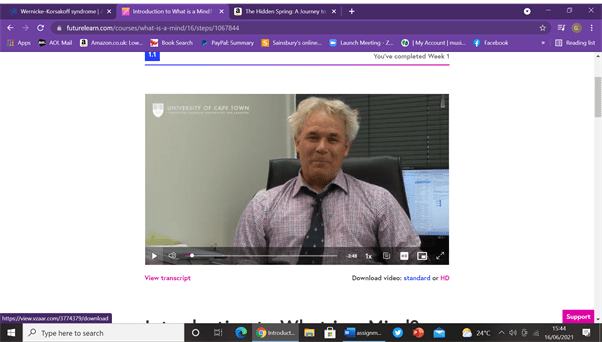
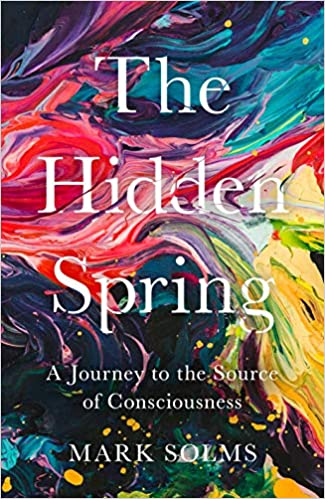
Mark Solms in this course defines confabulation as: ‘filling in gaps in one’s memory with false narratives and memories about the self or the world (a type of misremembering). …’. I have to come clean about two influences on my thinking. First I have worked with people with dementia and their carers where the behaviour is common and expected, and sometimes (wrongly) treated as a symptom. Second, I have begun to read Solm’s book (2021) ‘The Hidden Spring’ and have just reached the section where he reports the confabulation involved in interviewing Mr S, who displays ‘Korsakoff’ (a dementia related to alcohol use) ‘psychosis, the central feature of which is a dream-like called confabulation’.[1] Solms, of course then deconstructs the extent to which this behaviour is merely a symptom of ‘abnormal’ behaviour or of an underlying condition. Hence my analysis is not an ‘innocent’ one which is a pity but was not planned.
I recall that, later in life -in my 60s, I was taking an examination in Philosophy for a MA course in Humanities (in fact I stopped at a Postgraduate Diploma level) because I was retiring and did not want the stress of a thesis. I was extremely concerned about my readiness or capacity for this examination and slept extremely badly the night before it. I had to travel 40 miles to Newcastle to attend and then walk through the city. I did sit the examination, never stopped writing once the paper was dropped on the desk and actually, I was to find out months later, scored very highly. At that time I contacted a friend to whom I said that had he not called me that morning to reassure me of the hard work I had done on the course and how well to him I seemed to know the materials, I could not have succeeded so well or even passed. At this point, the friend told me that not only had he never contacted me that morning but had no idea at all that I was engaging with this course. It became clear as he detailed evidence for this that my story was entirely confabulated.
Next briefly considering what circumstances likely lead to confabulation. Importantly confabulation is not intended to be misleading; rather it is the best explanation given the degraded facts available and given the manner in which the facts could be misconstrued.
The circumstances that might have produced these events concern the high levels of (possibly unnecessary but it did not feel so at the time) stress I felt under, and the consequence of broken sleep. That it seemed that I had no sleep has happened before and yet my husband claimed I did have episodes of deep sleep that night (he must have remembered months after because unusually I kept him awake). He said he had reassured me on leaving home but that I had appeared to take no notice. Meanwhile, I had been thinking about my friend and his wife, who lived at a great distance and who I had not seen for a time and longed to do so. Another factor may well be that though I later recognised I was well prepared I felt rather ashamed of feeling so unconfident and unsafe about this exam.
Finally, consider how you came to conclude that this must be confabulation and rather than something else.
Having gained all this new evidence months after, it became clear to me that I had not received this message, or at least not from the person and in the way that I storied it to myself – and indeed others (fellow learners for instance). The story gave a kind of coherence to a piece of ‘magical thinking’ that, despite setbacks, I had been saved from failing by the necessary reassurance from just the right person AND it proved our connection, about which I was longing for evidence, because he rang when I needed him. It proved me to myself on a number of related fronts: that I could handle challenges and had that agency needed to succeed, that I was liked and respected by someone I desired that from and that things can go right even in adversity (like failing to sleep). This seems like classic Freudian ‘wish fulfilment’. It is likely a dream was involved but was not recognised as a dream but instead collapsed into a confabulation that served the purpose better because I could recognise it as ‘real’. What this convinced me of is that confabulation is not a symptom of abnormality but of the power of seeking behaviours (in the interests of security and self-esteem for instance) to imagine the necessary steps to achieve what I wanted and to believe they actually happened. how much more would someone with a dementia (Korsakoff’s or any other kind) want the same.
Use terms from the course to help explain these circumstances and why you consider this a good example of confabulation. The assignment should be between 350 and 500 words.
Final draft submitted
Mark Solms defines confabulation as: ‘filling in gaps in one’s memory with false narratives and memories about the self or the world …’. He then shows that this behaviour isn’t merely a symptom of an ‘abnormal’ behaviour or condition. In my 60s I took an examination in Philosophy for a MA. I was extremely concerned about my readiness and slept extremely badly the night before it. Once seated at the examination, I never stopped writing. Months later, I discovered I scored very highly. At that time I contacted a friend to whom I said that had he not telephoned me on the morning of the exam to reassure me of how well I knew the materials, I could not have even passed. The friend told me that not only had he never contacted on the exam morning. He, moreover, had no knowledge I was engaging with this course till now. It became clear that my story was entirely confabulated.
The circumstances that might have produced these events concern the high levels of (possibly unnecessary but it did not feel so at the time) stress I felt under, and the consequence of broken sleep. That it seemed that I had no sleep has happened before and yet my husband claimed I did have episodes of deep sleep that night (he must have remembered months after because unusually I kept him awake). He said he had reassured me on leaving home but that I had appeared to take no notice. Meanwhile, I had been thinking about my friend and his wife, who lived at a great distance and who I had not seen for a time and longed to do so. Another factor may well be that though I later recognised I was well prepared I felt rather ashamed of feeling so unconfident and unsafe about this exam.
Having gained all this new evidence months after, it’s clear now I had not received this message, or at least not from the person and in the way I thought. The story gave a kind of coherence to a piece of ‘magical thinking’ I had been seeking that, despite setbacks, I’d been saved from failing by the necessary reassurance from just the right person. It proved me to myself on a number of related fronts: that I could handle challenges and had that agency needed to succeed, that I was liked and respected by someone I desired that from and that things can go right even in adversity (like failing to sleep). This seems like classic Freudian ‘wish fulfilment’. It’s likely a dream was involved but was not recognised as a dream but instead collapsed into a confabulation that served the purpose better because I recognised it as ‘real’. What this convinced me of is that confabulation is not a symptom of abnormality but of the power of seeking behaviours (in the interests of security and self-esteem for instance) to find necessary steps to achieve what I wanted and to believe they actually happened.
500 words precisely
[1] Mark Solms (2021: 38ff.) ‘The Hidden Spring: A Journey to the Source of Consciousness’ London, Profile Books.
 Steve_Bamlett_blog
5 thoughts on “Optional Assignment 2 on confabulation: Course on What is a Mind? University of Cape Town course on FutureLearn:.”