‘Is that how you look at paintings? I asked. Do you take them purely on their own terms, or are you looking for signs of the hand that created them? It’s both and you know it, she said’.[1] The hand of the auteur in art and issues in the control of queered sexuality and life-choice. Reflecting on Niven Govinden’s (2021) Diary of a Film London, Dialogue Books.
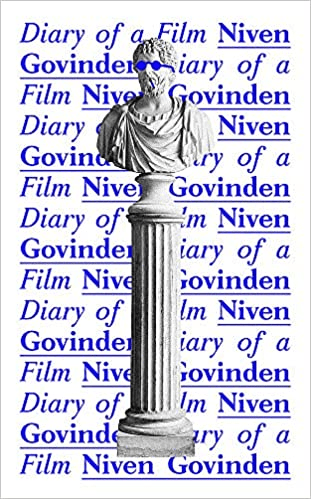
This is a highly intelligent novel but I didn’t always find it an appealing one and I think that may say something about my expectations of writing and my need to feel some little part in readerly control of the material offered by others as theirs. Yet this book is nearer I think to a favourite queer author from the USA, Garth Greenwell, than others I have read in making bold choices about how to make the conventions of written language and our control over them itself an issue. Even in the cited quotation, the absence of conventional forms of punctuation beyond the full stop, since in these writers the ‘sentence’ is sacrosanct and must not be (even if in appearance only) abandoned. It’s a prose that is more like Henry James than James Joyce therefore but what it does abandon is the boundary markers in written language between characters, especially ‘quotation marks’ or ‘inverted commas’. This, of course makes the boundaries of a conversation – who says what to whom and when – the more difficult to follow as the sample in my title again shows. And this has effects in blurring the sense of the distinction between persons and incorporating their debates in one huge head – that of the narrator or of an over-riding and distinct auteur, opening up the head of their narrator to its internal contradictions and how and why thee contradictions drive their behaviour and speech.
The other missing element is the paragraph and as I read I began to realise how much reading can rely on such breaks, pauses and minor endpoints beyond those of the sentence. I found myself checking chapter length more as I read and finding the constant reversals of direction of reading to ensure I was understanding how episodes in story related to each other in ways other than by accident or contingency. It is as if having sensitised his reader to the pure beauty of some of his sentences, Govinden refuses to let up on their onward flow despite the fact that readers need to orientate themselves, or feel they need to transitions, not only between the speech of different characters, but events in the narrative. I kept needing re-orientation, just as the many people guided (or ‘directed’ – and we come back to that word) around the city of B, a city they do not know, in this novel also need such direction and awareness of the presence of conscious turning points. Of course it’s a submission to authority some of us, especially those proud to be author of their own lives in their own mind, will not allow. This point is driven home from the start:
We talked of the lack of street signs in the area and how that was both a curse and a blessing, … . My mother is a very proud woman, she told me. When she came to visit my apartment she walked in circles for over an hour rather than ask a stranger for help with directions (my italics).[2]
Directions on a map or being directed in the art in which one is a participant are aspects of the auteur in theory of auteur film-making. And the narrator is most often addressed as ‘Maestro’ by the young and beautiful men, Tom and Lorien, whose sexuality and mutuality he appears to want to control and direct, in as far as he can, as their roles in his last film. He is a ‘Master’ in much the sense as other novelists’, such as Colm Tóibín, and critics called Henry James the ‘Master’. [3] Being opaque to the direction of others, except lately his husband, characterises our auteur, locked in the absoluteness of his own authority: ‘…I could not acquiesce the power of my eye to submit to the gaze of others’.[4] His eye and his ‘I’ command even that in which they sometimes have to admit is not theirs to control, such as the character Cosima, her memories of her brother and her novel, which he wants as the subject for him to define of his next film.
At its heart is the problem of how true, and if true, how that that truth be continually reinforced that The Maestro records thus:
This was the element of possession that making any art imbibed upon the practitioner. I wished to wipe phone records and memories. It was shocking the lengths I felt I could go to in order to protect my developing thoughts on the film. … Because to be an artist is to carry a sense of being embattled; how work can only be created if you feel you are the only one who can do it … I was known for my kindness on set, but this was where I was the bastard: figuring out the work and nailing it down.[5]
This hungry and all-devouring need to be in control marks him even as a husband to his husband and father to his son, although he feels he makes allowances here and perhaps he does. It does apply however to the sexual lives of his two gorgeous young male actors, however much he professes to ‘love’ them. There is a sense in which having lived his life as a queer man, even ‘coming out’ as such through his art makes him envious of any particularity of young men who are discovering their sexual being in its complexity and diversity and he even wonders if freedom from his kind of controlling demands on life might not be something better than he will ever know. This arises from small signs in his observation of Tom and Lorien’s relationship, such as when he sees Tom wearing Lorien’s sweater:
… for I was of a different tribe, and our path to happiness had been a long-winding one of discovery, setbacks, shame and covert behaviour, before we learned to speak with our art, and from that saw how we must be outspoken about our lives in the world. As he walked ahead of me I could see that it meant both nothing and everything. He walked with a magic unbeknownst to others, and the buttoned-down joy in that made my heart sing.
To speak with your ‘art’ is very different from the greater freedom of doing so, and singing too, with your ‘heart’. I think this is so. Tom is like Shelley’s Skylark which:
Pourest thy full heart
In profuse strains of unpremeditated art.[6]
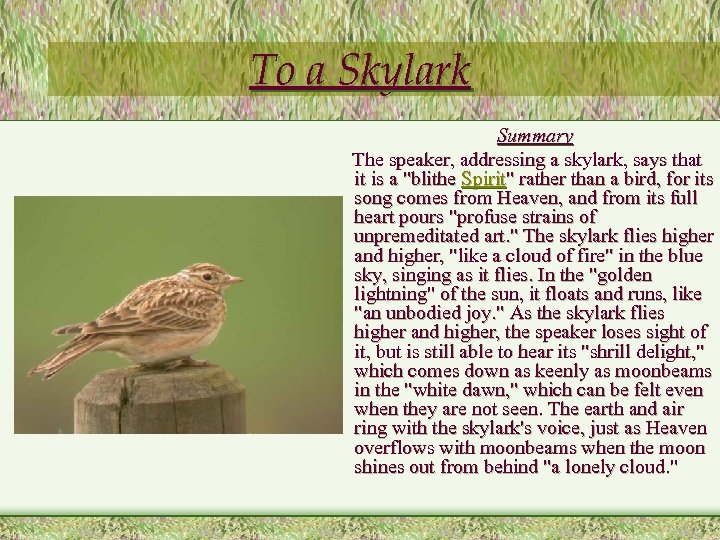
‘Unpremeditated’ is the lynch-pin here. The invocation of a return to a Romantic myth of a world beyond control and truly spontaneous is rare these days. It happens here I think only because the novel knows it is a myth – if a necessary one.
One of the best articulations of this dilemma is the way the novel deals with and articulates through its characters the sense of how things end. When I trained as a social worker I was trained to manage ‘endings’. It is probably a commonplace now of management training in all realms that ‘deal with’ other people. In discussing Giorgio Bassani’s The Garden of the Finzi-Continis (Il giardino dei Finzi-Contini) with Lorien, since the latter has it by his bedside and it now smells of Lorien, the narrator says it is about ‘first love’ rather than ‘death’ as Lorien suggests. Lorien replies: ‘Oh, it is that, he said, but I was mostly struck that it was a book of endings’.[7] This conversation is important because, as we sit at Lorien’s bedside and smell him (‘a mix of sandalwood, leather and musk’) we can share the sense of superiority that both men have, been older and more experienced gay men, over Tom and his fresh and ‘unpremeditated’ ways, since both Lorien and Tom had ‘learned’ from their Maestro, ‘how to kiss another man on camera’.[8] Our knowledge and skills lead us to inevitable conclusions – endings of a cognitive type that direct the lives of men as they age – about the fate of ‘first love’ that Tom is yet again subjected to, as he enters his first love relationship with two men, however different the love in each case. This is already predicted from the beginning where authoritative statements are made that ought to apply to the narrator’s own life but can be enacted by others under your authorial direction:
Filmmaking had taught me much about finality; how the obsession of a shoot, the freedom and pressure, friendships … all ended’. Living was learning to deal with endings in a way that did not hurt you more.[9]

Endings, planned and otherwise, litter both of these novels not least in narrator of Novinden’s knowledge about the two beautiful young men now enacting the same roles he wrote for them in his just-ending film. He is though, as if for his cast, ‘aware now that the joy of spending time in each other’s company had its limit, …’.[10] Or as he says in thought to them earlier;
You two are too young to appreciate how fragile time is. The reason I make films is because I never want the present to be over, pushed by the impossible wish to extend the moment.[11]
Cosima matters in this novel because, whether right or wrong, she refuses to give (or even sell at high price) her authority as an independent writer away to the Maestro: ‘How do I know that half my words won’t be chopped, or that you’ll make drastic changes?’[12] She doesn’t know that of course but should he need to we know he would. He has done it before and, as expected, those people cut from his work agree with him the work is better thus. that is what it is to be a ‘master’. but is it such an admirable thing as we think to be now able to manage relationships – ours or those of other people. Altogether, I think it is not entirely. But, of course, the doubt remains.
This is, let’s face it, an amazing book.
Yours Steve
[1] Govinden (2021:196).
[2] ibid: 7f.
[3] ‘From the 1940s to the 1970s he was steadily enshrined as both the greatest American novelist and the most solid object of academic study. There was something cultish about the way modern American critics talked about “the Master” and his exquisite refinements; it was palpably painful for them to admit that James ever blotted a line.[Leon] Edel’s biography was the breviary of that cult, …’. James Wood (2003) ‘Cult of the Master’ in The Atlantic, April 2003 issue. Available at: https://www.theatlantic.com/magazine/archive/2003/04/cult-of-the-master/302716/
[4] Page number note lost! It happens!
[5] ibid: 122f.
[6] P. B. Shelley ‘To A Skylark’ lls 4f. Available at: https://www.poetryfoundation.org/poems/45146/to-a-skylark
[7] ibid: 106f.
[8] ibid: 33
[9] ibid: 17
[10] ibid: 65
[11] ibid: 58
[12] ibid: 196
 Steve_Bamlett_blog