I say how good this course is on: https://stevebamlett.home.blog/2021/05/10/a-new-course-from-the-university-of-leeds-on-heroism-in-world-war-1-and-the-assessment-participation-methodology-used/
This is my brief review for our course. (WW1 Heroism: Through Film and Art – the exercise comes from https://www.futurelearn.com/courses/ww1-heroism-art-film/52/steps/1098890 ). I decided to go for a BBC program Considering The Poppy featuring Simon Armitage reading his own poetry. See: https://www.bbc.co.uk/mediacentre/latestnews/2014/simon-armitage for a description by the BBC itself.
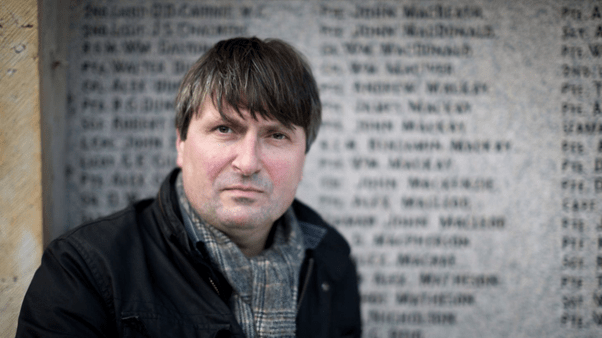
These poems were published in 2014 with wood engravings by Chris Daunt by Andrew Moorhouse, an independent publisher. Armitage in a preface says: ‘Commemoration was the film’s central theme; … I wanted to consider how the fallen might be remembered for the next one hundred years, now the war is lost to living memory’.

The intention to remember the dead of a war whose purpose is longer be part of a living agenda redirects the reader’s attention to the meaning of loss. That loss is primarily of the potentials belonging to youth. The tragedy illuminated is our and their acquiescence to a cause that NEVER belonged to them but only to those with more power and interests in the surviving nation than they would have ever been able to claim as their right. Yes, it’s sad but it is also politically frightening that we reduce our sense of the young so that they are merely resources that do not have autonomous development. That is, after all, what our contemporary ‘civilization’ does by refusing to take young men seriously and value them as portents of a time to come not:
all never was
all might have been.(Remains)

I will finish by looking at the title poem, which you may be able to read by enlatging this copy of the broadside version – the pic is available from: http://www.finepresspoetry.com/considering-the-poppy—simon-armitage–chris-daunt.html .
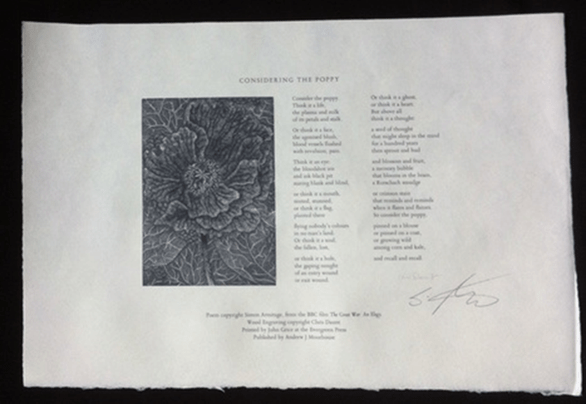
The poem reconstructs the poppy as an image of young life that turns into one of death. If we ‘Think it a life’ the conditions of life get infected by a youthful flush that turns into pain:
Or think it a face,
the agonised blush.
blood vessels flushed
with revulsion, pain.
From then on it takes it’s place as a dying or dead unseeing eye or dead unspeaking mouth. What it might be – an image of patriotism – gets undermined by the fact that life and death no longer relate to any loyalties that have current life:
or think it a flag,
planted there
flying nobody’s colours
in no-man’s land.
That sense of being between the opposed sides a war – ‘no-man’s land’ – is central. The heroism of any youth might come from either side in the was that is no longer part of ‘living memory’. Instead a poppy becomes related through its vacancy (‘a hole / the gaping nought’) into invisible abstractions – spirit or ‘ghost’, emotion or ‘heart’ and eventually as emergent cognition – ‘a seed of thought’. Of course none of these are divorced from blood and that ‘crimson stain’ caused by blood refreshed in memory that repetitively remembers and calls out to the future:
‘and recall and recall’
Here heroism is implied and not denied but is placed in the context not of one-sided victory but of general and widespread loss that crosses boundaries.
All the best
Steve
 Steve_Bamlett_blog
One thought on “‘WW1 Heroism: Through Film and Art’ exercise on ‘Considering The Poppy’ featuring Simon Armitage reading his own poetry.”