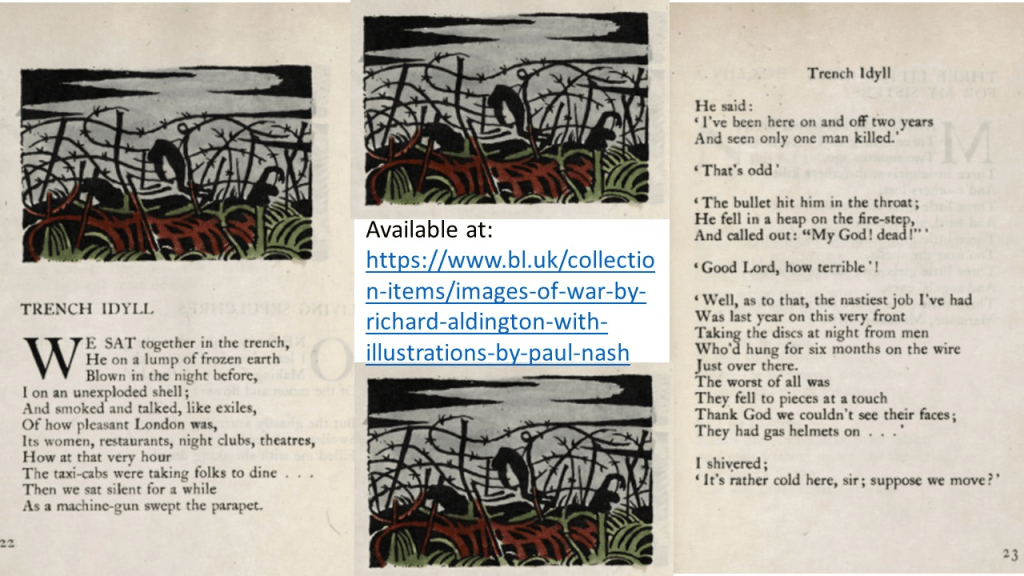
Of course, when asked to go for an image from the art of World War 1 I go for one that is anti-war and undermines heroism, without being Wilfred Owen (who is well enough known). This is an image from Paul Nash illustrating a Richard Aldington poem.
My comment from course board:
Undermining the heroic
Paul Nash’s illustrations to Richard Aldinton’s poems force us to see how images of the herioc were harder to sustain in a mechanised war like WW1 became. Aldington emphasises how uncomfortable men become when they reflect on the ‘nastiest job they’ve ever done’ – taking the discs from dead soldiers at night to create a death record and allow army to inform relatives of the death. Nash usually doesn’t picture men but here he does – as a kind of debris hanging on barbed wire. There is a kind of modern Crucifixion scene in this wonderful and very dark illustration. you understand why people want to forget.
The exercises – though intended I believe for a school level engagement with World War 1 history really are great for anyone. After doing one I wrote:
What an excellent distance learning tool. Anyone can engage – at their own level and time availability without fear of being ‘shamed’ in class. Good. Thanks.
My first contribution as an example: The loss of ‘individuality’ and distinct social role in war service
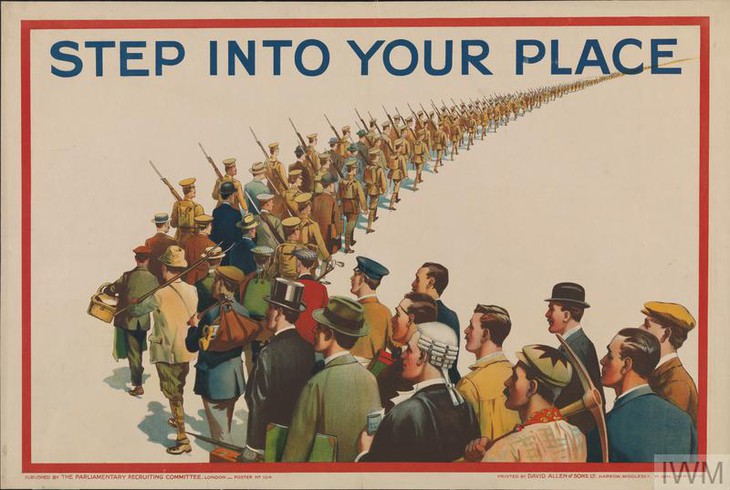
This poster (from Imperial War Musuem – https://www.iwm.org.uk/learning/resources/first-world-war-recruitment-posters) uses a complex understanding of social class differentiation and democratic duty in a nation. The phrase ‘know your place’ easily associates with quiescent acceptance of a given role in society to which the working classes were well accustomed in class-based discourse. But here everyone – includiung ‘stereotypes’ of middle class and other men to become just one of the men by marching ‘to step’ with the rest in the army. This would be gratifying from a number of perspectives – especially since it was based on the fiction that war recruitment equalised men as just one more man. Note how any identifying traits of individuality disappear as the men march out to their future role – that this might be death could even be signified here (your place is to be a ‘sacrifice’ to the idea of nation and manhood. Herosm has no content here except as a function of belonging to a larger unit and fulfilling the role of ALL men – of whatever class or status in civilian life.
The location of the analysis used in the course is : https://padlet.com/steveandgeoff/s3keqyn67uaw2o5z
Asked to do a review I offered a shortened form of this:
‘WW1 Heroism: Through Film and Art’ exercise on ‘Considering The Poppy’ featuring Simon Armitage reading his own poetry.
 Steve_Bamlett_blog
One thought on “A new course from the University of Leeds on heroism in World War 1 and the assessment/participation methodology used.”