‘”… . There is one good thing we learn in Rocky mountain life; there is no high or low, knowledge or ignorance, except what applies to the needs of men who come together. So there are needs which most men have, and go all their lives hungering for, because they expect them to be supplied in a particular form. There is something,” Philip concluded, “deeper than that in human nature”’ .[1] Enlightenment Heteronormativity and Classical Humanism tie themselves in knots in service to the moulding of the American dream in the ‘close, rough, naked contact’ between men on the Western frontiers of venture capitalism: ‘Even your speculator, whom I have met in every form, is by no means the purely mercenary and dangerous man I had supposed’.[2] Is Bayard Taylor’s Joseph and His Friend: A Story of Pennsylvania of 1870 really the first gay American novel or a misogynist’s celebration of patriarchal values? Reflecting on a modern reprint Bayard Taylor (2019) Prince Classics (www.princeclassics.com).
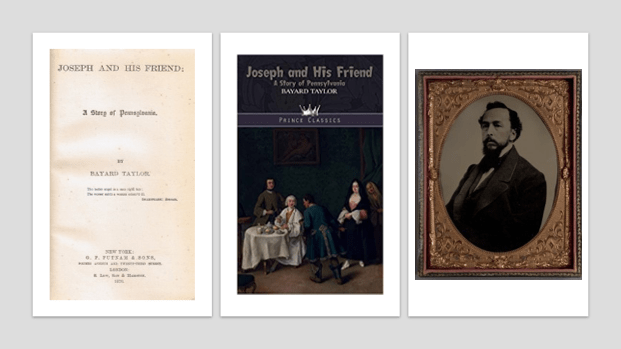
The better angel is a man right fair,
The epigram of the original 1870 novel by Bayard Taylor from Shakespeare’s s Sonnet number 144 is a fair taste of the entitled white racism and male misogyny of the whole novel I look at today. That purpose is masked of course, as it is in European versions of Enlightenment aspiration to human growth and plasticity. Bayard Taylor, after all, is best known for his verse translation of Goethe’s Faust. After reading the novel I was reminded of a gutsy feminist and Jungian blog on Faust and the doctrine of ‘The Eternal Feminine’ within it that puts my case about the novel very succinctly and perhaps more directly.
“Das ewig-weibliche zieht uns hinan”— the Eternal Feminine draws us ever onward—is the eerie last line that’s haunted me, and countless others before. And trust me on this, as someone who’s read this two volume, 12,479-line, 21 hour long play two and a half times, it’s an extremely odd ending. Because the play has nothing to do with the “feminine”. It’s about a selfish dude who only cares about his own progress, who thinks he’s entitled to too much. And yet somehow he’s not drawn down into the bowels of the earth to be dismembered for eternity, but drawn up into heaven to sit in the lap of the “Eternal Feminine”, whoever she is.[3]
Likewise Taylor’s novel ends with its most masculine stereotype Philip still being drawn onward and upward by his own version of the Eternal Feminine (‘I will wait: but I will find her’). This happens despite his feeling ‘a little sting of pain’ in the loss of the proximity of his male friend to marriage to a woman (though it is marriage his sister, Madeline who will look after the domestic needs of both he and Jacob). The novel also has powerful exempla, less abstract than that eternal feminine that Philip awaits, of fair, intelligent and noble women, who nevertheless leave politics and economics on the macro or non-domestic scale to their husbands or male dependents. The novel ends, moreover, having created often surprising reversals of our expectations of the women in it, especially the hapless and hopeless Julia Blessing who will stand in for the ‘worser spirit a woman coloured ill’ in Shakespeare’s sonnet 144.
Julia will be condemned in the novel though not because she is the monster her husband begins to think her to be but because she is what her wayward father will eventually reveal in a court case, vain, foolish and narcissistic: obsessed with how she appears. Good women in the novel marry, guide their husbands, produce children or teach them, at least before they marry a good man on the way up socially, like Ellwood Withers, and thus age gracefully. Similarly other reversals of perception in the novel produce eventually images of a just system of class-based American meritocracy, just (if wordy) political governance led by Congress and wise jurisprudence. These redeem the America of the Constitution in the shape of men (of whom the previously ‘unmanly’ Jacob is our example) ‘taken out of civilization’, driven by the blind hope of ‘winning a great deal’ rather than worked-out ‘principles’. They are led into ‘making ventures without any certainty of the consequences’ (the dreams that underlie venture capitalism and, even contemporary American neoliberalism).[4]
This novel is as much a pastiche in themes of Goethe’s project as was the philosophy of Thomas Carlyle in England; whose work Taylor also knew well. It is committed like Goethe and Carlyle to the cautious abandonment of old forms and conventions and it is in this respect that we shall see a certain contained radicalism in its treatment of love between men. Its energies are directed against old social roles that have lack authenticity in lived life and have become ‘masks’, or mere appearances. It’s favourite adjective is the ‘plastic’ and this it celebrates development in persons, social groupings and the economy (even the rural economy). Hence new growth and the capacity to be moulded in changed forms are the ways out of imprisoning conformity just as they are for Goethe’s Faust in his Wittenberg cell, which is the very image of a world of decaying ‘old forms’.[5] Likewise Philip is ever aware of ‘the old, mechanical routine’ of his life ever ready to return. Against this Philip, Joseph’s Mephistopheles and equally of future yearning change analyse the ‘arrested development’ of old worlds, wherein ‘form becomes fixed’:
…, as soon as they passively begin, to accept what is, all that was fluent or plastic in them soon hardens into the old moulds. … Your stationary men may be necessary, and even serviceable; but to me – and to you, Joseph – there is neither joy nor piece except in some kind of growth.[6]
Of course before I go on to show how this argues the necessity of freeing love between men from the conventions surrounding it in the novel as its, almost philosophical, project, there are simpler grounds for seeing this as the first celebration of male gay love in the American novel. There are hints of Jacob’s baseline gay identity: on the death of his wife he suddenly feels like ‘a stranger in a strange house’ and amongst memories of his own life, in waking dreams that haunt him including a scenario in which: ‘a boy whom he had loved in his school-days floated with fair, pale features …’.[7] But Jacob has to learn to own his unmanliness.[8] He must not only marry but learn, just as Philip has already done, what real manly life is from ‘real men’ in the Rocky Mountains. Hence the novel will not and cannot celebrate fulfilled gay love as an alternative to heterosexual love and a ‘new code of ethics’.[9] However, it edges close to describing gay romance and domestic intimacy wherein, as Philip looks after Jacob after his trial at his home, ‘the fire made a cheery accompaniment to the deepest and sweetest confidences of their hears, now pausing as if to listen, now rapidly murmuring some happy inarticulate secret of its own’.[10] That this love is fulfilled only in metaphor though full of sensual experience of whisperings at the ear of the men is probably inevitable. At this very point Philip makes it clear that Jacob needs to leave for some distant training in how men deal with intimacy in a less domestic and less safe setting. In his first letter home in the next chapter Jacob praises ‘this rough school’ but it isn’t without a form of the homoerotic, posing as it does in macho comradeship: ‘we cannot get away from the close, rough, naked contact’.[11]
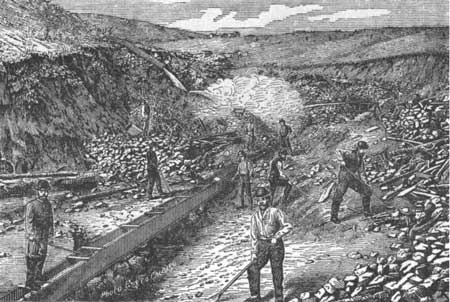
If male love has to exist in nineteenth century America it had better live in wild and remote companies of men and feed not male passivity but male sexual, aggressive economic fortune hunting and mastery over circumstances forced to yield to the superior power sitting with the male sex (in the value system of ths novel). In this sense this is for me not the first gay novel but a means of harnessing male libido in the service of economic capitalism and the economically liberal state. However, there is in it some brilliant exploration of how heteronomativity works to limit any sexual and love relationship between men. In the following passage for instance, Jacob’s first meeting with many eligible young women triggers reflections about the repression of the body by religion and sexual ethics: ‘Shall not the hungering senses all be fed? … All around me, everywhere, are the means of gratification, – I have but to reach my hand and grasp, but a narrow cell, built ages ago, encloses me wherever I go!’.[12] Freeing desire from the prohibition of its gratification is one thing but what matters about this statement is the need to guarantee the feeding of all the senses, and ALL kinds of desires not just exclusive ones that happen to be socially validated in this moment of history. Of course this is the clarion cry of appetitive capitalism based on the growth of ever new means and commodities to feed an ever-growing range of new desires but it is applied in this context, as Jacob’s reflections themselves develop to new forms of companionship and bodily contact that might just as easily have come from Forster’s Maurice, written just after the First World War:
Love is hidden as if it were a reproach; friendship watched, lest it express its warmth too frankly; joy and grief and doubt and anxiety repressed as much as possible. … I am lonely, but I know not how to cry for companionship; my words would not be understood, or, if they were, would not be answered. Only one gate is free to me, – that leading to the love of woman. …[13]

This stops this passage being merely about sexual repression. It is also about selective choices of object choice in love relationships – there are no gates it would appear except the one that enforces heteronormativity in that respect at least. This point is echoed in a later reflection of Philip’s (used in my title) after he rescues Jacob from a train accident and Jacob, presumably because he is injured, hurt and fatigued: ‘suffered his head to be drawn upon Philip Held’s shoulder, and slept …’. Some suffering we might say. Indeed it is more like longing wherein Joseph, ‘longed to open his heart to this man, every one of whose words struck home to something in himself’. [14] What strikes home I believe is Philip’s deep belief in the fact that some needs felt by men, in particular, go unsatisfied because the only gate to their fulfilment is in women: ‘… there are needs which most men have, and go all their lives hungering for, because they expect them to be supplied in a particular form’.
Yet again we confront the fact of the preselection of how a man’s ‘needs’ can be met. The echo of our earlier passage of Jacob’s reflections earlier in the novel is partly what must be striking home to ‘something in’ Joseph. Even on first meeting Jacob sees Philip as if he were but in an early life-stage, in which ‘live was only beginning its plastic task’. Even before the rail accident liberates touch as a means of communion between him and Philip, looking at Philip’s face he becomes ‘conscious of its attraction’ and the two exchange a glance in which Jacob catches the ‘full, warm, intense expression’ of a ‘momentary flash’ in those stranger’s eyes that meant that ‘he dropped his eyes in some confusion’.[15] Apart from this there is but one kiss between the men.
They took each other’s hands. … Each gave way to the impulse of his manly love. rarer, alas! but as tender and true as the love of woman, and they drew nearer and kissed each other.[16]
The only other element of the potential of male amativeness, in Whitman’s term, is Jacob’s relation to Ellwood Withers; the relationship between whom is queered only by a secret common bond to their friend Lucy Henderson. This love triangle seems to make for complications in their discourse when Ellwood spends the night with Jacob following his first party for the girls with whom they are both now newly acquainted: ‘There was a subtle chill in the heart of his happiness, which all the remembered glow of that tender scene in the garden could not thaw’.[17] And both men learn that they will only gain love primarily as a factor secondary to the development of their economic role in a new society of capitalistic adventures.
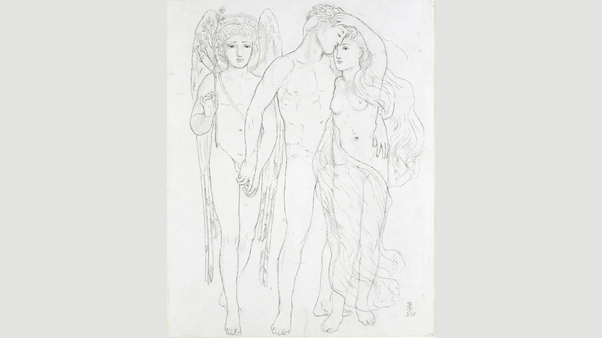
Thus, apart from these necessarily contingent factors (I’d exclude the kiss from description as ‘contingent’) there is little more to qualify this novel as the first American gay novel, except those abstractions I’ve outlined above. These work anyway only at the level of a future potential; once the lid is lifted on what sexual or amative object choices men might make. And the possibility of these choices does, I think, in this novel, apply only to men, since the role of women remains at the end of the novel is to remain, even for men who like other men, to draw men ever on and upward as the poor relation to the abstraction we call the ‘Eternal Feminine’.
If we were in any doubt about this we would need only consider the treatment of Julia Blessing, a woman who passes as younger than she is producing youth ought of a very dubious use for arsenic, which will be her downfall. Even from the first her attractions and ability to capture Jacob’s affections are pitted against Philip Held: If Jacob, ‘had not been quite as unconscious of his inner nature as he was over-conscious of his external self – he would have perceived that his thoughts dwelt much more on Philip Held than on Julia Blessing’.[18] Even immediately after their Julia and Jacob’s wedding: ‘… Philip’s earnest, dark gray (sic.) eyes, warm with more than brotherly love, haunted his memory …’.[19] Similarly Philip’s affiliation to Jacob is at one point, where it can be confused as Philip’s adulterous attraction to Mrs Hopeton, compared to that of the ‘unsevering embrace’ of Paolo and Franscesca in Canto V of Dante’s Inferno.[20]
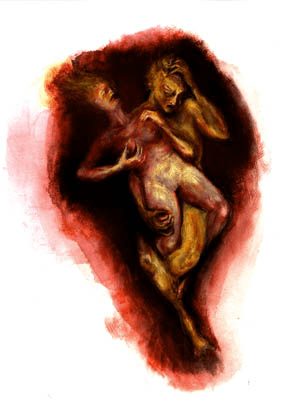
In contrast Julia’s ‘transition’ to a married woman exposes her to both Jacob and us as both empty automaton: inappropriately, as the novel inevitably sees it, wanting power, riches and access to superiority over men.
He saw, with a deadly chill of the heart, the change in her manner, – a change so complete that another face confronted him at the table, even as another heart beat beside his on the dishallowed marriage-bed. He saw the gentle droop vanish from the eyelids, leaving the cold, flinty pupils unshaded; the soft appeal of the half-opened lips was lost in the rigid, almost cruel compression which now seemed habitual to them; all the slight dependent gestures, the tender airs of reference to his will or pleasure, had rapidly transformed themselves into expressions of command or obstinate resistance.[21]
Misogyny sees something evil, mechanical and unnatural in women who seek the same power (and indeed pleasure) as men. These women are presented as a kind of monster. It seems to me that a passage like this is meant to cover an all too frequent experience of men who marry for the supposed tender softness provided by women to find something hard and resisting and too like themselves. By the time of her upcoming death, Julia is literally a monster – a machine, zombie or an animal that denies the sense of soft relief hungered by men: ‘The face that so suddenly glared upon them was that of a Gorgon. … and the narrowness of the brow was entirely revealed; her eyes were full of cold, steely light; …’ and so on.[22]
Compare this with the fusion of Jacob and Philip for the short time before their destinies have to be forced apart by their separate destined roles in the politico-economic world in a kind of ideal marriage of minds and hearts wherein: ‘each gradually acquired full possession of the other’s past, … . One gave his courage and experience, the other his pure instinct, his faith and aspiration; and a new harmony came from the closer interfusion of sweetness and strength’.[23] This homonormative arrangement may ape the supposed virtues of a union of opposites that is meant to ‘natural’ in heteronormativity but it is preferable the novel defiantly shows to the clash of wills inevitable when women seek powers equal to men, a gynarchy in opposition to patriarchy.
The novel imagines a future I believe where men remain men but may satisfy the needs of love, and perhaps even sex (though that is not imagined in the novel) provided men challenge the norms that have been the only way presented heretofore of meeting their needs. This resolution is why I say Enlightenment Heteronormativity and Classical Humanism tie themselves in knots in order to justify the rule of men as the source of the drives that justify capitalism. It is one of those eminently ideological resolutions that resolves the contradictions of capitalism in some kind of utopia that that is impossible to realise. Gay men can take no comfort from this world I believe unless they confine themselves to the stereotype of the sexual chancer – turning the economy into the best means of not only satisfying their human needs but creating ever-new needs as well: the perfect society of consumer purchasing power. The current state of the right-wing neoliberal dream.

[1] Taylor (2019: 88f.)
[2] ibid: 298
[3] Mariana. Available at: https://www.persephonessister.com/blog/the-eternal-feminine-patriarchy-and-your-reclaimed-power
[4] Taylor op.cit.: 297
[5] In Bayard Taylor’s translation and in the first scene proper. For full text see: https://www.gutenberg.org/files/14591/14591-h/14591-h.htm :
Ah, me! this dungeon still I see.
This drear, accursed masonry,
Where even the welcome daylight strains
But duskly through the painted panes.
Hemmed in by many a toppling heap
Of books worm-eaten, gray with dust,
Which to the vaulted ceiling creep,
Against the smoky paper thrust,—
With glasses, boxes, round me stacked,
And instruments together hurled,
Ancestral lumber, stuffed and packed—
Such is my world: and what a world!
[6] Taylor op.cit: 291
[7] ibid: 234
[8] ibid: 297
[9] ibid: 292
[10] ibid: 294
[11] ibid: 297
[12] ibid: 52
[13] ibid: 53
[14] ibid: 89 my italics
[15] ibid: 85
[16] ibid: 187
[17] ibid: 62-64.
[18] ibid: 89
[19] ibid: 111
[20] ibid: 196
[21] ibid: 138
[22] ibid: 220
[23] Ibid: 294f.
 Steve_Bamlett_blog


One thought on “‘”… . So there are needs which most men have, and go all their lives hungering for, because they expect them to be supplied in a particular form.”‘ Enlightenment Heteronormativity and Classical Humanism tie themselves in knots in service to the moulding of the American dream in the ‘close, rough, naked contact’ between men on the Western frontiers of venture capitalism. Is Bayard Taylor’s ‘Joseph and His Friend: A Story of Pennsylvania’ of 1870 really the first gay American novel or a misogynist’s celebration of patriarchal values?”