‘… exposing themselves and their writing to being thought of as symptomatic cases, not poets’.[1] ‘And Elizabeth herself? She has undergone the transformation from living, breathing woman – fluent, motivated, sometimes self-absorbed but always pushing herself onwards, fighting for breath, determined to stay alive and to speak – into a figure in the stories other people tell about her’.[2] Reflecting Fiona Sampson’s (2021) Two-Way Mirror: The Life of Elizabeth Barrett Browning, London, Profile Books.

King James Bible
And further, by these, my son, be admonished: of making many books there is no end; and much study is a weariness of the flesh.
Ecclesiastes 12, 12. Available in many translations in: https://biblehub.com/ecclesiastes/12-12.htm
OF writing many books there is no end;
And I who have written much in prose and verse
For others’ uses, will write now for mine,–
Will write my story for my better self,
As when you paint your portrait for a friend,
Who keeps it in a drawer and looks at it
Long after he has ceased to love you, just
To hold together what he was and is.
Elizabeth Barrett Browning Aurora Leigh (1856) Book First, ll. 1ff. Available: https://digital.library.upenn.edu/women/barrett/aurora/aurora.html
For though mine ancient early dropped the pen,
Yet others picked it up and wrote it dry,
Since of the making books there is no end.
Robert Browning The Ring and the Book, (1868- 1869) Book X, ‘The Pope’ ll. 7ff. Available: http://www.telelib.com/authors/B/BrowningRobert/verse/ringandbook/ringbook10.html
There is a vanity implied in attempting to continually add to the number of books that one has written, we might imagine the eponymous fictional poet hero of Aurora Leigh to say by quoting Ecclesiastes as she does. Similarly, the Pope in Robert Browning’s The Ring and the Book might use the same to say that it is equally vain to seek guidance in your specific role in life through old books alone. Ecclesiastes is the most appropriate book of the Old Testament to remind us of this, since it urges us to steer clear of a constant return and interpretation of what, being the words of wise reverence and AUTHORITY cannot be improved upon or further glossed into other meanings. Verse 10 of chapter 12 of Ecclesiastes (in the New International Version) puts it thus: ‘The Teacher searched to find just the right words, and what he wrote was upright and true’.
And yet here is another interpretation of the life of Elizabeth Barrett Browning long after she ‘dropped the pen’. Has the pen of her life been ‘written dry’? I wonder. Clearly the author has consulted new unpublished material.[3] Fiona Sampson has taken ‘distorted ideas’ and ‘myths’ about the Browning’s ‘private life’ that ‘obscure’ ‘first her work, and eventually even her identity’as the windmills at which she’ll tilt. One giant culprits is Rudolf Bessier in The Barretts of Wimpole Street and the many succeeding romantic Hollywood film versions of the film based on his play.
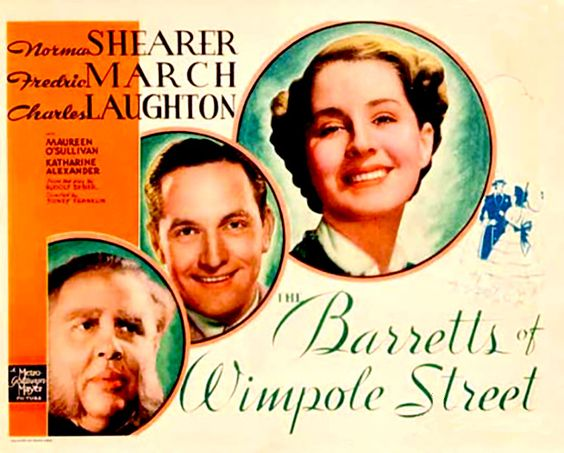
More shockingly I was reminded that in the 1970s, when I was first reading Robert Browning, it was considered clever rather than merely misogynistic to write as Lionel Trilling and Harold Bloom (considerable contemporary authorities) wrote in The Oxford Book of English Literature. They say Aurora Leigh is ‘very bad’, whilst her Sonnets from the Portugese escape as only ‘quite bad’. Her major contribution they suggest was to be a millstone around the neck of the ‘best poet of the age’, with whom ‘she eloped’, both as an invalid and a carrier of unreasonable ‘enthusiasms’ which ‘gave her husband much grief’.[4] Even Virginia Woolf, Sampson argued, turned the Victorian poet’s life into ‘a famous costume drama’ (she refers to Flush: A Biography, a book about Elizabeth written from the point of view of Elizabeth’s pet spaniel).[5]
Elizabeth’s father or ‘Papa’, Edward Barret Moulton-Barrett, is somewhat reinterpreted in the book as a beneficent influence on the ‘emergence as a poet’.[6] However, about Robert Browning’s influence there is the presence of doubt that his influence was always as benign as it is usual to paint it, not least by Robert himself. She did not in their early life in Italy, unlike Robert, have a room of her own in which to wite we are told. Robert was also capable of reacting against her beliefs, in either spiritualism or the role of Napoleon III in Italy ‘with some harshness’.[7]
Sampson also speculates rather bizarrely, and certainly not very appropriately to the context she is addressing in Elizabeth’s life-story in my view, about the possible bisexuality of Robert. It was not necessary to establish this in order to illustrate that Browning sometimes socially colluded with other literary men who were frankly misogynistic, like the Revd Fr. Francis Sylvester Mahoney (known to literature as ‘Father Prout’). Of course Sampson is nuanced about the evidence: which is first that Mary Russell Mitford saw the younger man as ‘a girl drest in boy’s clothes’ (as ‘Femelette’), second, the language he used to address Alfred Dommett (his ‘Waring’), and the reception of a kiss full on the lips from Father Prout in a public place. She also assures us (rightly I think) that male critics have got it very wrong about his disagreement with Wordsworth on Shakespeare. It was not, she says, based on distaste for bisexuality per se. But if ‘bisexuality isn’t disproved by a great love affair with an individual of either sex’, neither does Sampson’s specific ‘evidence’ carry much weight in either direction. The point seems to be that the romantic life of the Brownings was not as clear an examplele pf heteronormative romance as Bessier and some others present it, and that Robert Browning was not a simple character. Of course we have to remember that even Henry James in A Private Life was prepared to countenance that possibility, ‘nonsense’ though it still might be in his own view).
I am not in a position to judge whether this book contains significant discoveries . It may indeed use material that allows for significant reinterpretation of Barret Browning’s significance but, even if this so, I do not think that the books assertions really add up to such a significant reinterpretation. We already knew that she was a vitally important poet to and for professional and non-professional women writers and readers on both sides of the Atlantic, that she took this role seriously and that this was an important issue for women. Yet where does in this book does anything said by Sampson lead to readings of Barrett Browning’s work (her poems) that surprise us and open out what she has to offer as poet and thinker. There is too little close work on text. I think, for instance, the dismissal of the Psyche Apocalypté of 1841is painfully thin given the interest in identity ‘doubles’ in Horne’s work The Fetches that stimulated the project. Likewise, the significance of her relationship to Richard Hengist Horne is not considered at all in naming the latter ‘a typical rackety literary male’ and leaving it at that, given the importance of his New Spirit of the Age.[8]
The focus on Aurora Leigh as a fictional autobiography with analogues to Barrett’s own life is hardly new. You yearn to learn for instance why the opening of that great poem plays games with a ‘double’ self, of which one part is male and the other female. The male aims to use his the femininity of his other self in the convoluted analogy used to ‘hold together what he was and is (my italics).’ This reminds us that the Teacher-narrator of Ecclesiastes address his sayings to ‘my son’ and not to a woman and that authority and authoring are very male matters therein. However we cannot honour a poet whose poems of which we are apparently unable to demonstrate their value.
Interpretation in Sampson’s book is guided by a ‘frame’ based on the structure of Aurora Leigh. The purpose of this narrative and interpretive framing is to draw out ‘the story of someone who becomes herself through becoming a poet’.[9] That is precisely why the value of the poems themselves ought to be at the forefront. I taught this verse novel, when I taught Literaturein the 1980s, alongside male fictional autobiography focusing on developing writers, such as David Copperfield and Pendennis. The aim was precisely to enforce equivalences regarding how identity is written for and by writers in and across gender distinctions. In Sampson’s hands, the interpretive ‘frame’ consumes quite a lot of this thin book. When I first came across the rationale for the book’s title, Two Way Mirror, I was thrilled that a poet and academic should use her experience from working in mental health hospitals to illustrate her method. In the framing diversion attached to chapter 5, entitled ‘Tain’, Sampson explains how two-way mirrors are constructed and how they are used in such workplaces to allow patients to be observed by clinicians without the former knowing they were being watched. She sees this as ethically problematic, as indeed it is, but more so because her own role was to ask patients in the hospital ‘to write poetry, that intimate gesture of self-disclosure and trust’.[10] If this betrays patients as I agree it does, using their self-disclosure in a way the discloser would not want, is doubly a betrayal. I cite this in my title wherein these patients expose: ‘… themselves and their writing to being thought of as symptomatic cases, not poets’. [11]

It seemed interesting to me for Sampson to make this analogy when I first read it. Now, on reflection, I feel it is intrusive and a kind of tertiary betrayal of those hospital patients by calling them in to illustrate a problem in biography writing that isn’t really stated, or at least not clearly or unambiguously, here. Whilst it is true that Elizabeth Barrett Browning had more to say about herself than the stories other people tell about her say, I don’t think Sampson really does much more than add to the stories told by other people. Perhaps that is Sampson’s point and the books interpretive frame is yet another way of exposing Barrett Browning to other people’s use of her. It certainly is not new to see her as a fervent abolitionist in the slavery debate and a great supporter of the Italian Risorgimento, nor as a feminist but yet – why not investigate how that feminism fitted into the feminist intellectual networks supported by Barrett Browning – in Anna Brownell Jameson, for instance who does not appear in either an intellectual or feminist light in this biography, or her support of American feministMargaret Fuller, the writer of of Woman in the Nineteenth-Century,. She and Robert knew Fuller personally bother before and after she married an Italian count but this does not get mentioned here. There is a truth in the writer of Ecclesiastes and the first line of Aurora Leigh that ‘OF writing many books there is no end’: If there is no end, there is no purpose and all that is left is vanity. It is a pity because there is so much to love and quite frankly admire in Elizabeth Barrett Browning. I find here too much of Fiona Sampson, too little of the person behind the two-way mirror.
Steve
[1] Sampson (2021: 125)
[2] ibid: 256
[3] See ibid: xi
[4] Cited ibid: 5
[5] Cited ibid: 6
[6] ibid: 104
[7] Ibid: 250
[8] ibid: 119f.
[9] ibid: 37
[10] ibid: 125
[11] ibid
 Steve_Bamlett_blog