‘As you make your way through his twisting narratives, it becomes ever more difficult to escape the impression that the circling merely exhausts us while never bring us any closer to the subject’.[2] Reflecting on why it’s possibly better never to know the subject of the turns and twists in one’s own life adventure. Helped by Daniel Mendelsohn’s (2020) Three Rings: A Tale of Exile, Narrative, and Fate, Charlottesville & London, University of Virginia Press.
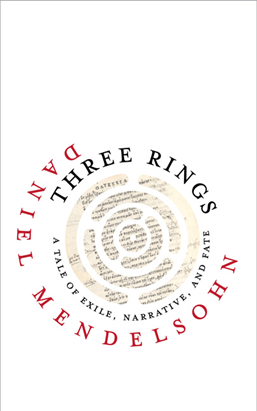
The quotation cited in my title is ostensibly a description of what it feels like to be a reader of the many ‘twisted narratives’ that make up the complete life work of W.G. Sebald. As an avid reader of this writer, I love the many turns down obscure pathways that his books take – even in Austerlitz, Sebald’s last novel (in 2001) before his untimely death in a car accident (which is the book that even people who don’t like the circuitous feel of Sebald’s books tend to like). It also describes Mendelsohn’s text, which is also a work that never quite approaches a subject other than in being about the way it and many other great works from Homer’s Odyssey onwards are told: they are told using ‘many turns’. The concept πολύτροπος is used by Homer to describe something shifty, both politically and personally ambivalent, in Odysseus, his hero. However this concept also characterises, particularly as applied by the great critic Eric Auerbach, the multiplying apparent endlessness of many shifts of focus, direction and topic in Homer’s wandering narrative as a whole.
This book is Mendelsohn’s great later-life reflection on his own life work and experience of depression. Both of these phenomena are linked so closely to a sense of exile from the destiny of his Jewish forebears and heroes. It is ostensibly about how the major narrative works of three writers are structured in circles. It’s worth noting in digression that though many reviews say this is about three figures, it is actually about four: since Marcel Proust is also fundamental to the books concern with how journeys and long (apparently lifelong long) circling journies. Each of the three (Eric Auerbach, François Fénelon and W.G. Sebald) was forced to chose exile and displacement from their former lives. Each also shared overlapping topics and methods based in the need to explore digression as a means, paradoxically, of reaching the destination for which their life seemed destined and which may have been none other than digression itself.[3] Each explored experience from a position of exile in a foreign place and each was unable or unwilling or both to embrace settled lives.
They turn in and reflect and comment on each other these life-stories, just as they appear to Mendelsohn to comment on what drives him to seek solace in lost and wandering figures in history. One such figure was C.P. Cavafy though he does not mention this poet here, of whom he is the greatest contemporary translator. The latter is there however – in the many references to Η Πόλη. For Auerbach, in an irony not lost to current politicised Turkish writers like Elif Shafak who reviewed this work for the Times Literary Supplement, that he chose Constantinople as his first place of exile from Nazi Germany. There, in that city of many losses he writes with limited resources and access points to the scholarship he was about to change, his great literary critical masterpiece, Mimesis: The Representation of Reality in Western Literature (German: Mimesis: Dargestellte Wirklichkeit in der abendländischen Literatur).
Mimesis starts by contrasting Homer’s narrative technique to that of the stories of the Jewish Covenant. At once this implicates Mendelsohn who has veered between a commitment to the complex narratives of the former, on the one hand, and a longing for the under-written mysteries of a tradition from which he has felt painfully but permanently alienated on the other. The last being the type of a lost ‘Great’ synagogue and the fateful family histories it occulted and kept silent:
… a decaying but still handsome structure that still dominates the market square of a small sub-Carpathia town called Bolekhív, currently located within the borders of the Ukraine although it was part of Poland when my relatives, who called it Bolechów, lived there, as their relatives before them had done for many centuries until 1943, when the last of them perished.[4]
I quote above a typical digressive complexly structured sentence, geography and family story that never quite touches directly on the subject of the dislocations that it involves. If Auerbach suggests this to him, it does so only by making it further necessary to show how Fénelon needed to inscribe his aims in a new digressive addition to Homer’s narrative. Likewise, Sebald is driven to perfect Homer’s over-comprehensive but necessarily convoluted narrative method, in which direct approach to the subject is occluded in a self-conscious post-modernist formal experiment made out of his own life and its difficult-to-specify goals.
And as I read I felt bits of my own life called forth and begin to speak out about why Sebald has, despite the specificity of his own particular and complex history, sometimes made me feel I am like him, if in a lesser way. This mainly because he knows why our lives sometimes feel so lost in the processes through which we felt we were finding things out. Auerbach’s great book engineered out of an old discipline known as ‘philological analysis’ a new meaning for the purpose of literary exegesis. I first became conscious of this book and this project when it appeared on a reading list sent out to people who had a place in the Department of English Language and Literature at University College London. That must have been 1970 I think but, at this distance, I get these dates wrong. I was later to find out that this list was prepared by Frank Kermode, the Northcliffe Professor of the Department and its head, of Literature at the least.
I could not know at that time that Kermode’s fascination with Auerbach’s scholarly example, and his sense of radical alienation, was to lead to his greatest book The Genesis of Secrecy. That latter book focused on Biblical narrative as the origin of a taste for a ‘opaque style of narration and the elusive deity … recognizable products of the Hebrews’ distinctive mentality, their Geist: precisely what philological analysis is meant to reveal’.[5] Nor could I know that I would be mentored by Kermode 5 years later and that I would sit in the seminar he did in this in his Kings College Rooms at Cambridge. Yet, without ever being a success in the world of literary criticism and having dropped out of my Ph.D out of a sense of mental and ontological failure, I have certainly internalised the view of the world that these accidents and contingencies brought together. It is a pre-divided inheritance like the narrative options set out in Auerbach’s first chapter and so well explained by Mendelsohn:
- The topic we seek to understand in the world will only ever be the centre of concentric rings of explanation that never truly touch upon it, but that are constantly ‘whirl’d’ around it (the aural pun is intended) in the ‘ring composition’ of that world. Mendelsohn describes this condition as aporia, after the Greek: ‘a “lack of path,” or “no way”’. And with Mendelsohn I think I recognize, as one does in Kermode under the urbanity of the latter’s prose, ‘the terrifying blank nothingness from which Odysseus must extricate himself, literally and figuratively, in order to reclaim his identity and find his way home’.[6]
- That there is an answer to our life questions that has the quality of “having only one turn” (monotropos not polytropos in narrative terms). It may be an answer of a kind but it is not findable in the sequential terms of a logical search or narrative end-point. It is as secret as the ‘elusive God’ of the Old Covenant.[7] Unlike Mendelsohn’s case this was not for me a displaced identity with the home left behind by the spiritual and material diaspora of the Jews, but was as equally elusive a truth about class and educational displacement – a secret embedded in unreadable codes that occasionally promised to make sense for a limited time. For these elusive truths one attempts searches in metaphysics or politics – sometimes both as in my time in the now defunct Communist Party of Great Britain. That is the kind of answer that might have urged François Fénelon to think the world definitely would be a better place if only Louis XIV had realised there was a better ways of governing a country than resting on ‘susceptibility to flattery, his vanity, and his penchant for expensive wars and costly luxuries’.[8]
So Mendelsohn’s book is a haunted reflection for any reader who has at any time in their lives realised that to put hope for amelioration of our personal or sociocultural position into our reading is an exile from some kind of responsibility for a communal answer to our politics and alienated despair. Hence it is as likely to be felt by the people who are the supposed successes of meritocracy as by people who long to identify with a tradition like that of the Jewish ideal. We are left with a culture wherein we most easily identify, as does this Page-Barbour lecturer Mendelsohn, engaged in, ‘dream-like (…) travelogues narrated by a neurotically unhappy figure who could or could not be the author himself … plagued … by anxieties about how we represent the past …’.[9]
I cannot imagine what it must have been like to be in the audience for such lectures. Because the academic world is cushioned by as much ignorance and ability to deny that there are issues that matter in the world as the rest of the crumbling superstructure of capitalist and its continuing worship of Mammon and selfish gain. What I regret is that I didn’t make better political choices when the die was not cast but instead may have colluded with ones that compromise so uncomfortably, but still as effectively, with the status quo. It now seems a ‘winter’s tale’: “A sad tale’s best for winter. I have one / Of sprites and goblins“.[10] And here is Mendelsohn’s Wagnerian motif of a ‘goblin’ upon which these haunting lectures circle It is full enough to encompass everything we know about life retrospect before death or indeed at any juncture of change. I have added the final phrase in that sentence in honour of a young man, JC, I admire immensely as he faces such changes with strength:
A stranger arrives in an unknown city after a long voyage. he has been separated from his family for some time: …. The journey has been a troubled one, and the stranger is tired. … he moves with difficulty, his shoulders hunched by the weight of the bags he is carrying. their contents are everything he owns, now. He has had to pack quickly. What do they contain? Why has he come?[11]
Steve
[1] Mendelsohn (2020: 99)
[2] ibid: 99
[3] For the treatment of this theme see ibid: 26ff.
[4] ibid: 6
[5] ibid: 41
[6] ibid; 13
[7] ibid: 26
[8] See ibid: 64f. A lesson still to be learned by Donald Trump perhaps.
[9] ibid: 95.
[10] Mamillius in Act 2, Scene 1 ll. 629f. of Shakespeare’s The Winter’s Tale.
[11] ibid: 3. But see also ibid: 83 and other echoes.
 Steve_Bamlett_blog