Two poets go ‘hybrid’ in response to the art of Francis Bacon: Yves Peyré [& English translation by David Watson] (2020) Francis Bacon or The Measure of Excess Woodbridge, Suffolk, ACC Art Books & Max Porter (2021a.) The Death of Francis Bacon London, Faber & Faber.
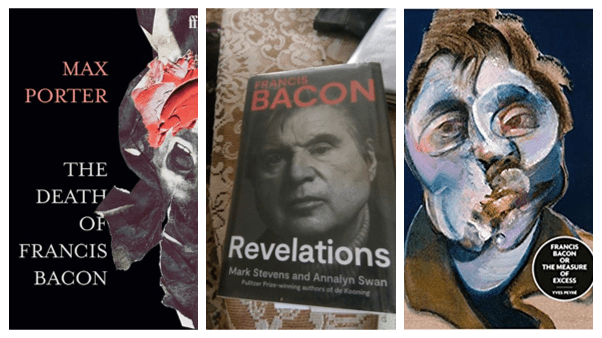
In a chapter that bears the same title as an earlier work on Bacon (in French, L’espace de l’immediat – ‘The Space of The Immediate’), Yves Peyré writes:
Interiority focused on itself seems suspect; but exteriority is not sufficient. The outside has to be established in the enclosed space of the interior of a theatre. However, this outside is an impossibility, close to inaccessible. This is why the painter comes to privilege these in-between worlds: the stage, the ring, the room. Neither outside nor inside.[1]
How any person writes about and explicates art (be it poetry or painting) must always confront questions of how we access that art in the first place. Art works only when someone lives in it. Yet our right to live in it is highly contestable – it is not our space. We did not plan its dimensions nor organise its contents nor have we a right to validate the meaning, and perhaps even the name of those objects that for us have perhaps come together accidentally and without intention. If we do not ask ourselves how ‘I’ in viewing art relate to the thing that contains it – a canvas (or board) and frame, a series of page leaves and certain markings upon that space (we keep trying to say within that space), then we certainly do not in any significant way see art at all. It is not meaning necessarily we seek since that predisposes that we already know something about the intent of the object and the claims it makes upon us. Hence the same essay I quote starts:
Begin walking, slowly. It is right there in front of your eyes, a call sounds from deep within yourself which you cannot shirk. It is as if you are summoned to explain yourself. What takes place is both an internal dialogue and a dialogue with the painting by Francis Bacon.[2]
Hence the feeling we have that art has an inside and an outside, an exterior and exterior, a variation of accessibility wherein some parts are less accessible than others because they are deeper or more private, or at least less public. Anyone to whom these thoughts are mere nonsense must feel that they already own art, as a collector or member of the visiting public at a communal gallery or library, or have disowned art and that, after all, has no meaning for them personally – none at all!!! But to value art is to ensure some kind of ritualisation of the space in which it endures.
It strikes me that Peyré’s words explain to us so much about why art and its maintenance as a phenomenon is so problematic and contested. Owned and controlled spaces like temples, churches and galleries do not only create space around artworks but already interpret and contextualise them in ways that make their being justifiable – in the name of the God(s), communities of the faithful or nations. That is why so many people who have no relationship themselves with art suffer its maintenance. It is not so easy for anyone who must justify, to us or themselves, why they are ‘into Bacon’. Indeed this is precisely the problem Max Porter identifies in a reflection on his poem The Death of Francis Bacon in the Guardian Weekend Review.
I remember a snooty someone saying, “Of course you’re into Bacon”, as if it was an excruciatingly basic position, to be into Bacon. I flinched …. The comment also nudged me even further into Bacon, into the loneliness of being misunderstood, the uncoolness of being into one of the most famous painters working in England (author’s italics).[3]
And this interior space, so far only a dead metaphor contained in the slang of incomprehension of another’s interests comes to be written by Porter, as he relates artist to artist, with Bacon as a space much like those described by Peyré. If we let our eye slip back to the beginning of his article, we see that the space was already imagined but perhaps the depth of its relevance to Porter not yet understood by us:
If I were to visit a floor plan of my artist obsessions and wander from room to room, there would be artists I will always have deep feelings for, the ones who provoke or engage especially, … Deep in this imaginary place is a bloody chamber, a dimensionless room full of bodies. A place I want to escape from, and a place I yearn to be back in. This room is my long and uneasy obsession with the paintings of Francis Bacon (my italics).3
The metaphor is common enough and it isn’t my intention to imply that Peyré’s usage has much to do with Porter’s other than they both know that their readings are almost as private to themselves as Bacon’s paintings are to him – when they meant anything at all to him because, if they did not, he ritually destroyed them or got a trusted person so to do. Meanwhile the sense that to be ‘into’ an artist is to make claims about oneself as special in relation to art in general or this artist in particular. You will find reviews of Max Porter’s new poem that repeat this critique of the poet as he appears in this poem (if it is a poem), one that cannot fail to be personal as Porter would readily acknowledge. Witness, for instance, Tim Adams in The Guardian:
As a result, the book reads like brilliant notes towards a very private communion with the painter, which sometimes forgets that there might also be a reader listening in. (my italics)[4]
I want to end this blog by considering how Max Porter negotiates between the sense of private communion and a public statement. However, for a moment, it is worth considering how strange in reality is the distinction Adams makes between Porter and other consumers of art. Porter’s ‘reading’ of Bacon (and presumably therefore ‘viewing’) has become artwork in itself. That artwork is described as a kind of intended joint production of a ‘very private communion’ with the artist. Adams doesn’t really spell the point out but it seems to me that he relies on a belief that the artist’s main concern and at all times is to remember the demands of an only partially engaged audience constituting a much more general ‘public’ space for art. It’s an audience that ‘listens in’ rather than either communes with the art itself or even just actively and urgently listens. The artist needs to remember, that is, first and foremost their role as a public communicator, not only making an utterance but making that utterance accessible to even those who aren’t even asking to be actively involved in the art, who want just to listen in from the shadows.
But are artists really the slaves of such passive engagement and consumption of artworks, whether written, composed or graphically designed? Yves Peyré makes it clear I think that such very partial involvement is evoked only unsuccessful art. Of the variable success of Bacon’s artworks he says:
Whether or not this work has attained its goal (having assigned itself no other than itself, painting as act) is confirmed by our agitation. Outside of ourselves, in the deepest part of ourselves, something is palpitating.[5]
Peyré’s beautiful book, with large high-quality reproductions of highlights from Bacon’s work, contains (if that is ever the right word when speaking of Bacon’s excesses) a series of prose essays, including an interpretation of the stages of development within his art, and a poem in French (even in the British publication) accompanied by an adjacent English literal translation. The title of the poem is not translated but, like Porter, invokes a room as its setting (La Chambre En Haut Du Cri). The translation could be, as Google translates it, ‘the room at the top of the scream’. This title seems to offer a spatial exterior (of course it is also an interior (to some other kind of superstructural housing of itself ) in which to stand is also at the same time dissolved in auditory and perhaps visceral interiority, where we strain the receptive and transmitting parts of the nervous system of our bodies to catch a high note and a kind of completion of sound’s swelling before it begins to subside.
In effect a moment of extreme agitation is amplified through space. Agitation and oscillation (although these too are kinds of exteriorising metaphors) are the means in which neurons live and function. They do not rest, since even a stable state is in fact a balance between positive pulses that either excite or inhibit. There is no state of inhibition that is strictly a form of rest except death and that is the origin too of Freud’s Thanatos or Death Instinct – the wish for a state of non-agitation is a wish to cease. Bacon knew Freud but I don’t want to argue this in terms of influence. It was commonplace for Bacon to speak oft as a phenomena that, when it is good art, addressed the nervous system directly and viscerally, a view that Stevens and Swan, his latest biographers, cite Bacon advancing as the correct way to view his art throughout his life. One of their finest of many discoveries, for instance, is their interpretation of Bacon’s use of a book in his own library named The Wonder Book of Electricity:
that contained modern images of electrical patterns that could almost be an arterial map or an excited nervous system. The patterns suggested a lit-up agitation, a crackling in which every nerve fires at once. Bacon was always dreaming of passing through the body’s surface in order to reach its essential wiring.[6]
Amongst its many functions the nervous system is a physical means through which interiority and exteriority, as well as stasis and change, can be seen as the same thing, as all based on living agitation as opposed to the stillness only death, and never just rest, affords. And it is this system which Peyré invokes in poetry about Bacon, as if the nervous system addressed initially through the eyes in Bacon’s art must also be shared by the poem and the reader of that poem in an agitation sufficient to evoke a scream at the mouth, that spatial orifice at which external and internal meet:
Rien que bouche ouverte sur le hurlement,
les murs
se reculent, la marée intérieure
épuise
son ressac, l’ombre qui tangue.
la crise
de lumière. l’étincellement du sens,
les nerfs
pincés jusqu’à l’à-vif, la tension,
la pulsion,
les dents se referment sur un grincement,
le silence recouvre.
La vibration, ……[7]
The Watson translation (see note 7) shows how inadequate such verse is when it relates to the reader mainly only through concepts – though the constant repetition of pulsation, vibration and agitation is there connecting the senses, the mouths, our proprioceptive sense of the inner walls and relative positionality of outer surfaces of the body (sensitive at orifices including scars and wounds) link up just as they do in the French. In the French though the rhythm of flow and resistance to flow is more insistent in the sound of the poem – in its assonantal and stop/start broken form. Sometimes grave accents on the e sounds resonate as do the acute accent on the ‘a’ sound in the wonderful line: ‘pincés jusqu’à l’à-vif’ which mimes both the held up sounds of the tension as well as the re-established flows in ‘la tension, / la pulsion’, where even end-rhyme helps that is not present in the English translation which chooses ‘drive’ for ‘pulsion’ because of its proximity to the common English translation of Freud’s terms.
The use of alliteration also shows how sound is marshalled into combining the ways in which sensation travelling through the nervous system unites body to cognition and emotion, in the extreme condition where violence is done by one person to another. Wound is linked to knowing in the French, as it is not in the English translation other than conceptually, by the common hard ‘c’ and by the fact that French but not English allows the adjectival sign of the damaged head (dented or cabossée) to follow the noun for that body part rather than precede it such that it alliterates in the opening of the words ‘connait’ (which implicates knowledge to the wound’s being), ‘comme’ (implicating simile or analogy) and the basic unit in which nerves operate (‘le corps’). Just to be clear relations of heard or sensed sound bring together body and knowledge through proprioception of the wounded body in the flow and breaks of rough sex with which this stanza ends by celebrating an artist’s use of strong ‘colours, slashes and twistings’ (‘de couleurs, des balafres et des torsions’).[8]
la tête
cabossée ne connaît pas la plainte,
comme le corps
malmené avant la fougue de la fusion,
…[9]
It is a long time since I said it but remember that Tim Adams concern, ‘that there might also be a reader listening in’ is hardly pertinent to poets who need, in communing with Bacon’s imagery and twisted composition, to ensure that their own readers feel the writer’s own agitation in their language. So it is only now that I feel that we can begin to do justice to Max Porter’s work of uneasy generic type on Francis Bacon. Yet again Peyré’s words help in defining a purpose for poetry that leads directly to Porter’s analogous discovery of Bacon as a means of sharing his own interior agitation of mind, sense and body with his own readers, by making the latter as uneasy in their own bodies as both he and Bacon inevitably are by their attempts to make apparent that there has been, as far as is possible in a post-religious world, ‘revelation of the absolute, the transcription of the hitherto unseen’.10
This is why the viewer is gripped, sent back to their most intrepid dreams by the attention they devote to that which requires consecration (my italics).[10]
If a reader is being asked to reveal ‘their most intrepid dreams’, it follows that they need to respect the fact that the writer responding to Bacon’s agitation of body will dip into their own most private iconography (such as Edward the ‘Martyred’ boy king), where meaning is often occulted even from its originator. For me this explains much of the switching and twisting together of the personalities and voices of Porter and Bacon which has worried many readers (particularly those keen to rescue the academic discipline of the history of art from Porter’s strictures on its limitations as a means of access to painting). Of the latter, the gentlest and most understanding critical voice appears from Ben Eastham reviewing, paradoxically, for a journal intended for artists and art historians, who says that his suspicion that Porter’s:
… plea to ‘let the paintings speak’ … should be treated as authorial diversion or self-deprecation is buttressed by the book’s own asides to art history: … . My guess is that these hints reveal more of the author than the artist. … The author is here with his notebook, intruding on the scene, along with the reader. Who is the subject of these portraits, and who is their author? / Porter’s failure to convincingly capture Bacon’s voice is, by this measure, not a failing. The Death of Francis Bacon is less about ventriloquising a canonical painter than exploring the ways in which consciousness gives shape, and by extension meaning, to life’s chaos.[11]
Having cut some of the art-historian’s finessing from this quotation helps us to see a better argument about the literary text than you will find in most literary reviews of the same book, which rather than see the absorption into and reinvention of Porter as doubled or shadowed within Bacon as an iconic maker of images on the cusp between privacy and publicity.[12]

Here is an example of that uneasy edge in the poem between private experience and public show (since the voice that speaks seems conscious of a film being shot of an intensely private moment) from the poem, whose hybridity of voice, upsets many supposedly literary reviewers:
Take a seat why don’t you?
Are we rolling?
Will you take out any really daft bits?
It’s an attempt to get the sense of what is looming up behind the person being hurt.
It’s an attempt to keep the breast meat of the bird moist while the skin is crispy.
It’s an attempt to express my feelings about a painter I have had a long unfashionable fixation with.
It’s an attempt to get art history out of the way and let the paintings speak.
It’s an attempt to hold catastrophe still so you can get a proper sniff at it.
The repetitions with which each proposition about the artwork here is a means of varying the register of and context for each statement, as if each could be written by a different person in a different setting, one of which is Porter’s own voice and expressive intention with regard to the written work before us. Each register changes and adds to the multiplicity oy of Bacon personae available (all findable in Bacon’s life development) – the renowned chef. the expresser of feelings about old painters (Velasquez, Picasso), the enemy of conventional art discourses and the sadist’s dependence on the masochist. And the changes of register ensure that even images we might have felt comfortable about – such as how best to cook a chicken share some of the disgust involved in wanting to know how someone you want to hurt might feel about it: ‘to get the sense of what is looming up behind the person being hurt’. In his Guardian piece Porter calls these elements an ‘ecstatic democracy of ingredients’ and predicts the fact that the repeated attempt to ‘slip in and out of different registers’ is ‘likely to enrage some readers’, whilst it disturbs the fiction that an artist’s images appeal to just one meaning or perspective, whether in visual or literary art.[13]
Porter, like both Bacon and Peyré, does not mind agitating or upsetting his readers. Indeed it is better to do so if we are to capture with any legitimacy the embodied nervous system at work as it reads.
What is the squirming unpicked body doing while the background is being filled in? What is the chat, the image-pulse; the residue of a Bacon painting’s inner energy? … Who is in there with him? Or is it terribly lonely? …[14]
It is not only though multiplicity of registers and voices that may have been in Bacon or are definitely not, such as that chicken chef, but also the divergence from known interests of Bacon to those which are more likely to be Porter’s (or indeed any other persons) private interests in narratives of pain, hurt and death. Only one review I found (and that was in a newspaper from Eire and behind a paywall so remained unread by me) dealt with the puzzling inclusion in the early section of the work of a life of Edward the ‘Martyred’ boy king. This may be because the reviewer had nothing to say in explanation of this prominent feature but it seems to me that the inclusion of such strangely private associations of the Poet Porter with the artist Bacon, is of a piece with the work’s readiness to agitate the reader by not offering fully comprehensible reasons for the fragments of its contents.
In Section Two of the work (Oil on canvas, 651/2 x 56 in.) the voice of the poem imagines, likely to be Bacon since he refers to Bacon’s lover at the time of his death in a Spanish clinic, José Capelo, that being in Spain is an alternative to being murdered in Frith Street in London. Whose voice though allows this bifurcation of potential fated deaths in time to become magnified into a possible set of alternative subjects: ‘Edward the Martyr or Francis the painter?’ I do not know of any association between Bacon or Edward, though it is likely both visited Corfe Castle near Bournemouth (Edward was murdered there supposedly in front of and at the order of his mother), but it does not mean such association does not exist and can be proved in a document. I just do not know it myself? Nor, on the other hand, do I know why Porter might himself be obsessed with Edward.
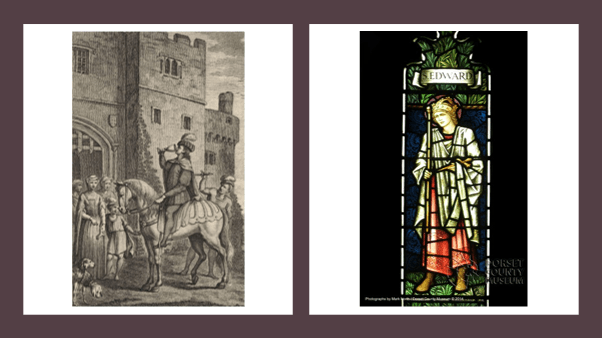
Edward is a strange figure in British ecclesiastical figure because he is claimed as an icon of true religion by warring Christian sects from the Orthodox Church in Russia to the Catholic Church and to the Anglican establishment. Foxe’s Book of Martyrs includes King or Saint Edward as an example of true English Christianity before the soiling of the same by the Bishop of Rome, in the view of the Anglican Reformers. The story is told, in prose, between two moments in which Sister Mercedes comforts the dying Bacon and settles his body, but by and for whom? This Edward is caught at the moment where his senses tell of his horse-wearied and worn body and nausea. The emphasis on the autonomic and sensory-motor nervous systems is constant in references throughout and is parked by consciousness of both body and queered and oneiric desire from response to body pain, awareness of the genitalia, stomach and bladder discomfort and hunger. Most telling is Edward’s desire to be both comforted (mothered) and to have sex with his mother. take a taste of the description:
Edward was chafing, … barely a hair on his bollocks, none on his chin and his arms ached, … cross and anxious hot young king, sweat in his eye stinging, unease in his belly. … starving hungry but shite like gruel loose and feverish cramping a bit, nervous to eat, … here she is, the woman he fears in his future and fucks in his dreams … and he feels a surge of hold me, bathe me, dry my hair, wipe my arse, drain me, empty my balls into your downturned mouth and let me sleep in your bed.[15]
Describing this description as Oedipal seems tame to say the least. It is Baconian in its themes of course : ‘meat and temporality, but also the well-made cup, perched body ripe and crucial on the road’.[16] It splits desire – for and in Edward so many ways and complicates it by the complex ways the viscera deal not only with sex but the bare gristle of living: eating, digesting (or not) and excreting. At one point Bacon mistakes the told story as if it ‘was Peter’ (Lacy) ‘reading to me’ but it certainly could not have been Sister Mercedes telling the story of the Spanish Catholic version of the Saint.
Again, as in Peyré’s vision of art, it all irritates and agitates the body and its senses from outside and within. Everything that gets included in the work refuses to tie itself down or to have comfortable and comforting meanings as if the movement of the nerves in excitation and inhibition were all and generated all kinds of genres in art – even the narratives Bacon so hated to admit to art’s function. The end of each section is a pleat to rest (in Spanish) but this work is restless – will never sleep until it dies, a bit in this respect like Edward the Martyr. I love this work, and there is more to say in response to the ways it has been reviewed to rescue it from those who praise as well as detract but I want to stay with one feature that all of the reviews I read mention, which is its inclusion of a quoted critique of Bacon. Although the reviewers all notice that these are from an essay by John Berger, few say much more than this (since Porter does not identify Berger himself although he has them printed in italics) as if Jack Horner plucking a plum from a pie was all there is to literary critique.[17] Here is the piece which punctuates a kind of hallucinatory vision of Bacon’s supposed by Porter to have come to him on his deathbed in the presence of Sister Mercedes. Into that vision some of Berger’s words (‘desperately private’) are later woven.
Bacon is a very remarkable but not finally important painter.
BORING. I know this. I know what you’re doing. She’s up on the ceiling, in some kind of trapeze swing seat or harness, matte batwings, couldn’t reach her if I tried.
These paintings are haunting because Bacon is a brilliant stage manager rather than an original artist; and because their emotion is concentratedly and desperately private.
Oh naff off you skag. Rien de tel que privé.
…[18]
In Bacon’s time ‘skag’ or ‘scag’ was a term of abuse (it now often refers to the drug heroin) especially for a girl who is considered unattractive and is likely to be directed at the girl on the trapeze swing on the ceiling in the hallucinatory vision cited. But no figure is stable in this work and although Berger (or the unnamed art critic) is meant to enter the poem as a policeman (the art police perhaps), we are given much help to distinguish figures cited here one from another.

The important issue served by Berger’s words is to distinguish the public from the private and to insist (if but in French thus irritating at least some monolingual readers) that art criticism (even in Berger – an important figure for Porter apparently) the private world – of visions, hallucination and free image-creation – is ‘Not at all private’ because nothing is private. It is the creation of a real nervous system operating upon sensation, cognition and emotion and blending these things. This does not only happen in dreams but in neurotic symptoms or day-dreams or art as Freud often asserted.
This is a good place for me to stop, having argued that the case against Bacon as a manipulator of private imagery in very painterly or artificial (stage managed) ways (or the same argument applied to other artists including those who write rather than paint) is a non-case. Likewise those who want art to comfort and stay owned by stable institutions of the private capitalist world or the modern nation-state are thoroughly mistaken. Such an argument has long exercised me. Although democratic in politics, it feels to me that cultural conservatives like Bacon (and his heroes Joseph Conrad and T.S. Eliot) have a point about good art perhaps being inaccessible except to the few who allow themselves to be agitated by its take on reality. For as Milton knew great art may seek the good of a democratic commonwealth but yet be understood in its purpose, at least till change arrives, by ‘fit audience though few’. This apparently elitist argument still seems to me to hold truths for even democratic radicals and socialists, even though Bacon was not one of us (if Milton was).
Steve
[1] Peyré (2020: 65)
[2] ibid: 61
[3] Max Porter (2021b: 24) ‘Under the skin’ in The Guardian Weekend Review (23rd Jan. 2021) booklet. Also available (with different title) https://www.theguardian.com/books/2021/jan/22/francis-bacon-was-my-guy-max-porter-on-his-life-long-obsession-with-the-artist
[4] Tim Adams (2020) ‘The Death of Francis Bacon by Max Porter review – last rites for a great artist’ in The Guardian Online (29th Dec. 2020) Available at: https://www.theguardian.com/books/2020/dec/29/the-death-of-francis-bacon-by-max-porter-review-last-rites-for-a-great-artist
[5] Peyré (2020:71)
[6] Mark Stevens and Annalyn Swan (2021: 149f.) Francis Bacon: Revelations London, William Collins
[7] Peyré op.cit: 287 with Watson translation: ‘Nothing but mouth open in a howl, / the walls / retreat, the internal tide / exhausts / its surf, the shadow that pitches, / the crisis /’ of light, the sparkle of sense, / the nerves / pinched, on edge, tension / drive, / teeth closing, gnashing, / the silence recovers. // The vibration ….’
[8] ibid: 287 Watson translation of stanza 2 with original French in brackets.
[9] ibid: 287 with Watson translation: ‘the dented head / knows nothing of complaint, / like the maltreated body / before the ardour of fusion,’
[11] Ben Eastham (2021) ‘What Does It Mean To Write a Painting? On Max Porter’s The Death of Francis Bacon: Book Review’ in artreview.com for 21 January 2021. Available at: https://artreview.com/what-does-it-mean-to-write-a-painting-on-max-porter-the-death-of-francis-bacon-review/
[12] This cusp is characterised by Peyré as a combination of guilty exhibitionism, on the part of the artist and his figures, and the voyeurism of a shamed and agitated audience. For a fuller quotation read Peyré op.cit.: 69.
[13] Porter (2021b: 24f.)
[14] ibid: 25
[15] Porter (2021a: 18f.)
[16] ibid: 20
[17] The essay is reproduced as ‘Francis Bacon 1909-92’ in John Berger (Ed. Overton, T.) [2015] in Portraits: John Berger on Artists London & New York, Verso Press. pp. 341- 352. The quoted sections in Porter are on p. 342. Berger first published his half-antagonistic critique in The New Statesman and Nation in 1952 and is described in Stevens and Swan (op.cit.: 344ff.).
[18] Porter (2021a.: 10f.) The French can be translated as ‘Nothing like private’ or ‘Not at all private’.
 Steve_Bamlett_blog

9 thoughts on “Two poets go ‘hybrid’ in response to the art of Francis Bacon: Yves Peyré (2020) ‘Francis Bacon or The Measure of Excess’ & Max Porter (2021a.) ‘The Death of Francis Bacon’.”