‘Me, Lovely, in full hair and makeup, … . / The country is not knowing her yet, this new superstar. but me, I am knowing her’.[1] ‘He wonders whether they know who he is or whether they salute anybody who turns up in a government-issue white Ambassador’.[2] ‘I might have studied literature and I might have spoken English so well that, if you had met me on the street, Ma, you would not have known me! Ma, you would have thought I was a rich girl’.[3] The price of being known as you might wish to be known in Megha Majumdar (2021) A Burning, London, New York, Sydney, Toronto, New Delhi, Scribner.
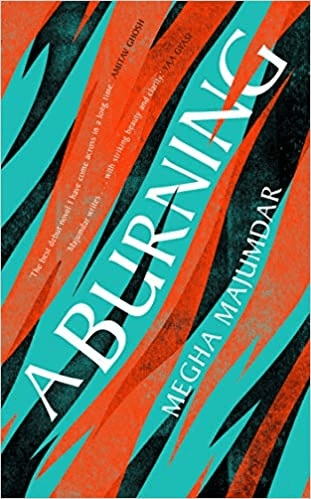
Above is the title of a brief review of this novel I had wanted to write. I very much admire this novel. In my view it creates a descriptive narrative account of how and why ethical decisions are often made either impossible or unrecognisable in a society in which collusion with pragmatic half-truths is the ultimate aspiration of people who wish to be recognized or ‘known’ within the established values of any current society.
I gave three quotations in the title because they demonstrate to me that all three of the narrators of this novel know that their ultimate aspiration is to be seen as someone which they are not yet. The price of such recognition for each of them is to identify with the half-truths which mask social corruption or lack of personal integrity. Such half-truths are ideologies of what society and individuals within it would like to think it is, and they are, rather than know themselves as ethically driven beings.
Jivan is sacrificed in the novel to save a social lie that claims that government, police, education and civil society primarily exist to protect and refine. She would have preferred, and who would not when the alternative is to be hanged, a middle-class academic lifestyle that lifts her beyond her mother’s current knowledge of the world to speaking truths of any kind or with any nuance. What one must not do is point out that most people live life constantly colluding with the existence of inadequacy of attention and carelessness to the suffering and unnecessary pain of social victims. And one must never make middle class academics in English ever feel uncomfortable or morally compromised.
In such a society there can be no moral life. In my view Jivan becomes an icon of the ‘shame’ of a society that refuses to see itself as it is as corrupt and exploitative, choosing instead inaccurate and flattering self-images that do not challenge falsehood or seek to change the corrupt or inadequate expression of social beliefs. Jivan’s role becomes allegoric of this shame, just as she allows us to see exist, unrecognised by its actors, in both PT Sir, her ex-teacher, and Lovely, her once mentee in the learning of the English language. Once taken to a deep dark cell under the prison she has been kept in, she sees herself as, ‘… in this posture of shame, until the posture is all I am’.[4]
I would have liked arguing a case for this. However, when I blog, I usually read around some of the reviews and one such, by the brilliant James Wood in The New Yorker, actually says everything I would want to say and much more clearly than I could. Hence follow the link in the sentence above to read a review that implies, where it does not say directly, all that is needed to conduct the argument I would have followed. It is an excellent review.
The only other remaining impression I had was that some reviewers illustrate the same collusive attempt in our culture to pretend that the political truths in this novel are merely a matter of opinion rather than documentable facts. Such reviewers parade their professionalism. Say a lot of things that are perceptive but deny in the end any function of literature other than of being a means of making a living for themselves in the cultural media or universities. This is precisely the non-story Jivan would have liked for herself had she not fallen prey to social ideology by testing its limits.
I might have studied literature and I might have spoken English so well that, if you had met me on the street, Ma, you would not have known me! Ma, you would have thought I was a rich girl.[5]
Whilst literature is a means to personal social comfort, what hope remains for seeing it as a means of challenging ideologies and promoting social change through new unvarnished voices, such as the Hijra Lovely’s might have been without Jivan’s intervention as a teacher.
Thus, for instance, when Madeleine Tew writes the following for Harvard Review Online, is she not herself also blazoning her safe social status or wish for such status by undermining the novel’s political power. Since Tew is a Staff Writer for the Student Online Magazine Harvard Crimson, she may be still aspirant to social status but it is a useful strategy to accuse critique from the left as ‘a bit one note’, with ‘scant room for disagreement with its message’. In fact I don’t find it as on ‘one note’ at all. I find no master message moreover as, for Tew, there obviously is. What A Burning represents is an undeniably corrupt racist society but it would be difficult not to see Modi’s openly Islamophobic and right-wing India as precisely and undeniably that.
In fact, after a while the novel begins to feel a bit one note. Every moment seems designed to serve the same end: to show how corrupt the system is. The story leaves scant room for disagreement with its message, and the ending doesn’t inspire hope. PT Sir and Lovely stop fighting to free Jivan in order to hold onto their own unbelievable power and success. Both characters get the happy ending of their wildest dreams, whereas Jivan is put to death as a terrorist.[6]
Please read this novel. Put up with any difficulties of access because it becomes a read that you ‘can’t put down’ and which leaves many images in the mind, whilst it questions the innocence of image-making in social and individual psychology.
All the best
Steve
[1] Majumdar, M. (2021: 266)
[2] ibid:267
[3] ibid: 278
[4] ibid: 189 (my italics)
[5] ibid: 278
[6] Tew, M. (2021) ‘A BURNING by Megha Majumdar reviewed by Caroline Tew’ in Harvard Review Online (Oct. 6th, 2021) Available at: https://harvardreview.org/book-review/a-burning/
 Steve_Bamlett_blog