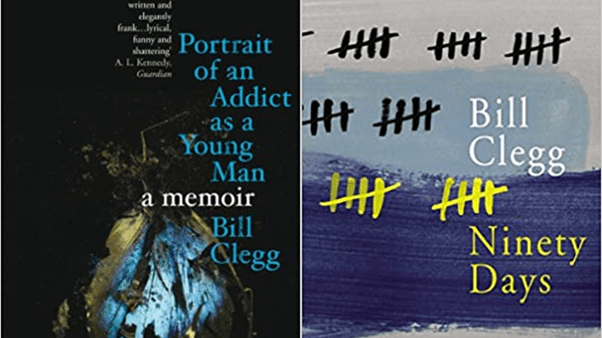
Moral vision and autobiography: Seeing selves differently for the first time. @TheCleggAgency. Reflecting again on the nature of complex moral empathy in Bill Clegg’s (2020) The End of the Day London, Jonathan Cape. What do we learn from examining the author’s two volumes of memoirs: Bill Clegg (2012a.,b.) Portrait of an Addict as a Young Man, & Ninety Days. London, Jonathan Cape? [Published in USA in 2010]
‘Suddenly, for the first time, feel as ifI might look and act and sound in a way that I am not able to see. …, it dawns on me like a great shock that I might actually look like a junkie’.[1]
‘I remember all the cabdrivers and hotel employees, dealers, and addicts. The ones who prickled with disgust, fear, or ecstasy, and the ones who said in a gentle tone that everything would work out, that it would all be okay. I wonder who they thought they were talking to, who it was they saw, who they were. There are things that will always puzzle me – … that I will never be able to see clearly enough to distinguish truth from delusion. ….
I wonder what it was like for my father. How the hours I remember from my childhood were for him. What worry he knew. … Did he worry that he’d taken the wrong tack. Been too tough? Too harsh?… Wasn’t that how men were with boys?’[2]
This is a further reflection on some thoughts on a novelist’s technique and the notion of a ‘moral imagination’. For earlier blog on Clegg’s latest novel (which can be treated as preliminary to this one on an autobiographical theme) click here.

If ‘moral imagination’ exists and can be shown to grow in the ethical development of a character like the Mexican taxi driver Lupita in Bill Clegg’s novel The End of the Day, as I have tried to show in my earlier blog, then you would expect it to be evident in the same prescient author’s autobiographical work. And I found that to be the case in Bill Clegg’s two volumes of memoirs, focused mainly on the genesis of his addiction to drugs and his subsequent narratives defining the processes of what he calls ‘recovery’. That process will be in itself a form of discovery of what in narrative leads to the recovery of agentive personhood in a narrator. I will state that such a form of personhood in the ‘I’ of a memoir restructures the narrative world it deals with rather than merely reproducing endlessly repeated cycles of events. However it must show both of these alternatives in narrative in order to contradistinguish them. In an autobiography the dialectical contest between personal development or regression into what merely happened before is clear in both of Clegg’s stories of addiction and recovery. That this has a moral dimension is entirely based on the fact that a recovered self is a relational self, a self that cannot be organised apart from in simultaneous reorganisation of the relationships between self and many, many others.
There is an easy way of thinking about what is meant by the ‘relational self’ in the theories of addiction recovery that the stories deal with, because these are versions of the notion that addiction lives in the human bias to the concept of self-containment and self-reliance and rejection of any higher value system. Jack, Bill’s sponsor for the abstinence meetings he attends states it simply, as if out of a manual for such treatments.
When I tell Jack about trying to get sober a year ago, he says, It sounds like ME versus THEM and never WE, and the only way to get and stay sober is when it becomes WE. He also tells me that getting and staying sober – even after ninety days – needs to remain my first priority; that whatever I put in front of it I will eventually lose. Career, family, boyfriend, – all of it – you’ll lose it. Lose again, in your case (author’s own italics).[3]
The fact that this quotes without conventional punctuation to indicate speech, substituting instead the author’s italicisation of Jack’s remarks gives them an importance that is not merely that awarded by Jack’s authority as a reported character. The point becomes that identity is understood as shared in relation to others (not ME and THEM but WE and US) and that understanding of one’s own identity cannot be divorced from those ever-expansive relationships.
This may read to anyone who knows anything about the psychology of abstinence treatments, rooted as they often are in a Jungian analytical or Kohutian self-psychological rejection of infantile or regressive narcissism, rather ably but sometimes mystically explained by different versions of spiritually-oriented psychodynamic, such as the Diamond Approach, whose infographic is a good explanatory tool for pre-critically analytic learning about this approach (see the infographic below).
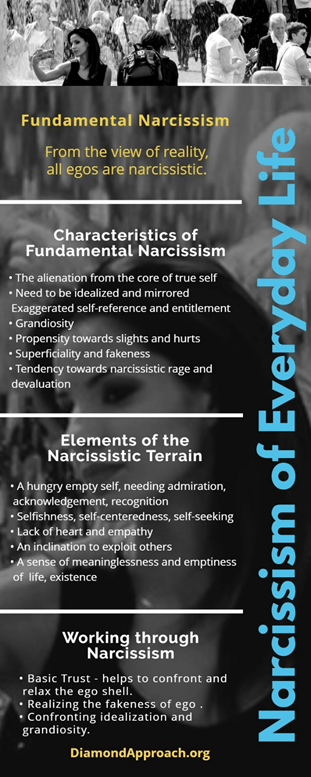
But, although it is important to understand the theoretical underpinnings of this approach in understanding how abstinence treatment approaches to both substance addiction, and addictive behaviour such as sexual addictions, I later query whether it takes Clegg far enough in his journey as a moral writer rater than just an addiction diarist. Sexual addictions are also repetitively and cyclically demonstrated in Clegg’s life journey, often in association and experienced simultaneously with both methods of illegal substance acquisition, nominal ‘sharing’ of bodies and substances rather sharing of more holistic selves and time-limited repetitive journeys in taxi cabs between temporary stops at hotels. But we can approach all of these facets of the education of moral imagination through the consideration of Clegg’s autobiographical narrative technique alone.
For stories of addiction are stories of greedy and empty selves who begin to understand both that the people they use to serve the telling their stories are themselves people with an ‘equivalent centre of self’. That last term is from George Eliot and I referred to it in my first blog on Clegg. But let’s see it again:
We are all of us born in moral stupidity, taking the world as an udder to feed our supreme selves: Dorothea had early begun to emerge from that stupidity, but yet it had been easier to her to imagine how she would devote herself to Mr Casaubon, and become wise and strong in his strength and wisdom, than to conceive with that distinctness which is no longer reflection but feeling–an idea wrought back to the directness of sense, like the solidity of objects–that he had an equivalent centre of self, whence the lights and shadows must always fall with a certain difference.
Chapters 21 George Eliot (1871) ‘Middlemarch’
The important aspect of Dorothea’s moral education here is that even a sensitivity and sensibility like Dorothea’s can be described as morally stupid. She can tell herself stories about a character like her husband, Casaubon, to feed her own sense of destiny (another kind of narcissism) without seeing in that character as ‘an equivalent centre of self’, and thus essentially fail to treat him with anything like moral integrity. This is the same situation that Clegg illustrates.
He will show us that people in his narrative not only serve in the telling of Bill’s story but also have an interpretation of him and of themselves that introduce not only interpretive but perceptual difference to both their own ignored life stories and their equally ignored perspective of Bill’s own life story. For the journey from addiction and ‘narcissism’, if that is implied, although I dislike the word and its over-simple associations, is a journey into multiple narrative perspectives on the self, such that the ‘lights and shadows’ of which reality is found are deeper.
I remember all the cabdrivers and hotel employees, dealers, and addicts. The ones who prickled with disgust, fear, or ecstasy, and the ones who said in a gentle tone that everything would work out, that it would all be okay. I wonder who they thought they were talking to, who it was they saw, who they were. There are things that will always puzzle me – … that I will never be able to see clearly enough to distinguish truth from delusion. …. [4]
There is a level of treatment of the world in which first-person narration lacks any moral depth because of its freedom to embrace solipsism and even paranoia, in order to privilege its own rights to see the world in any which way it chooses. Clegg plays really wonderful daring games with this fact, such that the passage above manages to re-interpret swathes of story-telling in the rest of his book. For the ‘characters’ in it only begin to access a perspective on themselves and their story in the light of this key passage of moral growth in the ‘first person’ as it gives way to perspective on events and the nature of the selves involved in those events, after this point. Most reader will have felt that queasiness in Clegg’s narrative in its most charged passages in which the other is transformed into the stuff of the espionage thriller with the narrative pace and sense of imminent danger involved to the storyteller himself. The text sometimes offers shifts of insight into the possibility that the narrator’s vision is tinged with psychosis and does admit sometimes of its potential to paranoia. In the turning point I have already quoted the narrator speaks of the fact that he may, ‘never be able to see clearly enough to distinguish truth from delusion’. However the point is that when first-person is our only perspective on events that readers too must find such distinctions difficult.
Illegal substances do, of course, attract the attention of the agents of social control and, as Clegg constantly reminds us, arrest and punishment is always a potential treat to the committed user, but at times Clegg allows his narrator to take control of the narrative so much that every character, just because they are identified with social norms of appearance and behaviour, becomes an agent of an unbelievably omnipresent surveillance state. Ordinariness is equated with what Clegg described as JCPenneys, referring to the massive department store chains and producers of uniform style of clothing that once dominated US consumer culture. To call someone a JCPenney is, of course, to point to a lesser form of life – an individuated characteristic of normal people on limited budgets that the narcissistic self that people who believe themselves special reject as beneath them, however grotesque, unseemly and odorous one’s own self-presentation might be. We will see this in the narrative constantly. Sometimes we are allowed to see the potential to delusion in this narrative vision, where ‘bland’ and ordinary becomes threatening to ‘my specialness’, because the fact that this is only person’s vision is made overt:
There are vans parked along Gansevoort Street with metal boxes on their roofs that I’m convinced are surveillance vehicles. There are bland American sedans everywhere, and each one, I’, sure of it, is driven by a DEA agent or an undercover cop.
But at other times the paranoid psychosis becomes the potential reality as when the narrator identifies a very ordinary cabdriver as an example of such a secret agent not ‘drug-induced delusions hatched from my paranoia’.[5] The narrator here allows the reader to share the difficulty of distinguishing reality from fantasy. Look at this more interesting example, a page later than the last quotation, where a kind taxi driver makes the narrator feel ‘calm and blessed’. Furthermore, ‘JCPenneys’, appearing now as the emblem of ‘bland Americanness’, also have their narrative function has flipped from being unrealistic persecutors to unrealistic saviours but nevertheless defined not in their individuality but in group terms by ‘some particular choreography of urban surveillance’:
I am overcome with a wave of relief, and as I stand there, two people walk by – they are wearing the shoes, the coats, the earpieces, the complete JCPeneey outfit – and they smile as if I have finally been let in on some great secret. … Their footfalls and movements all seem timed to some particular choreography of urban surveillance. They’ve been protecting me! I say out loud. This is why I have not been arrested. I look around the street, … and see several people looking my way as they walk at that deliberately and performatively normal gait.[6] .
This lacks as much contact with reality as when the same cast of characters, perceived as homogeneous and as ‘them’, are seen to be persecutory. The issue is that Clegg’s narrator is here unable to distinguish people from stereotypical types that fulfil narrative roles. His people aren’t what they look. They are inevitably more core complex with that ‘equivalent centre of self’ as named by George Eliot to mark how and why moral imagination must mature.

Amongst the list of people that Clegg’s narrative voice begins to see more complexly and in that way honours them with a perspective in the quotation about ‘all the cabdrivers and hotel employees, dealers, and addicts’ above is his father. This is significant to me in that it mirrors the development of Lupita I looked at in my early blog. Like Lupita, Clegg stops seeing his father solely in relation to perspectives he had previously favoured, like his mother and, more importantly, himself and instead as a man who, though he has erred in important ways as husband and father, also had a life from which perspective those errors can be understood, if not fully mitigated.
I wonder what it was like for my father. How the hours I remember from my childhood were for him. What worry he knew. … Did he worry that he’d taken the wrong tack. Been too tough? Too harsh?… Wasn’t that how men were with boys?’[7]
Here memory begins to serve a less self-interested narrative function that serves not only the narrator’s self-appraisal but that of other minor and major characters in his story. And fathers are in this seen again and seen in a way where the ethical ‘lights and shadows fall with a difference’.
From my point of view one of the finest ways in which this moral deepening occurs is when Clegg as a narrator stops seeing his male characters who have sex with men, and gay male characters from the The Library meetings who act outside a purely sexual role as being JCPenney’s with a merely different dress norm and instead as people with a moral perspective not defined by sexual function or function in relation to Bill Clegg alone.
I’m gay but in this place I feel as if there’s a manual for gays that covers everything from clothes, hairstyle, and slang to eating, drinking, and using habits, and everyone in the room owns it but me. I tell Jack [his sponsor] this one night on the phone and he asks me if there have been other experiences, other times, when I felt as if I never got the manual.[8]
Of course the ‘manual’ is a product of a narcissistic imagination unable to differentiate the lives of others from a homogeneous group, a kind of J.C. Penney catalogue but this time for gay rather than of standard heteronormatively understood USA stock. For Jack this is merely, “right down to the word manual – is one of the bedrock feeling of most alcoholics and addicts’.[9] And he might as well have said there too ‘narcissists’.
Now I have personally many doubts about the psychiatric and medically defined notion of addiction at the base of this thinking. I am unsure, for instance, whether the mental health terminology of ‘paranoia’ or ‘delusions’ are as useful in understanding Clegg’s moral growth in these books as much as their proponents, people like Jack for instance, but they are certainly useful to me in as much as they make available a way of talking about the moral nature of developmental growth that is prepared to learn that others are much more than the groups and typologies in which, at the service of ego and complex self-interest, we classify them until we learn that they can and must be seen as seeing things differently from the ways we assume from the roles, in relation to us alone, we place them in. And this is true especially of characters who are the most stereotyped by function of all – transient persons classified as one type like cabdrivers and hotel workers and even addicts.
But I really believe that we can overclassify and over-type ‘addicts’ too and that the royal road to doing so is the version of Jung and Kohut absorbed by Jack, Clegg’s sponsor in Ninety Days and the whole machinery of mental health work in addiction that operates on a one-type treatment fits all basis. I would be interested how Clegg might answer this. That is not though to say I am confident of this view of the matter. Even more so then, would I value Clegg’s response in this particular.
Though I leave the matter here then, much remains to think about. But, isn’t that life in general!
Steve
[1] Clegg (2012a: 151f.)
[2] ibid:213-215.
[3] Clegg (2012b- 75)
[4] Clegg (2012a: 151)
[5] ibid: 67
[6] ibid: 68
[7] ibid:213-215.
[8] Clegg (2012b: 83)
[9] ibid.
 Steve_Bamlett_blog
2 thoughts on “Moral vision and autobiography: Seeing selves differently for the first time. @TheCleggAgency”