‘… he saw, trailing behind him, the great mistake that had been his belief in himself … ’.[1] Islands of Mercy by Rose Tremain (2020) London, Chatto & Windus.
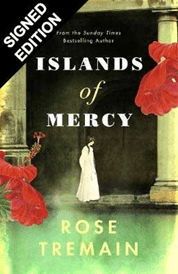
Let’s start with the personal context of a reflexive reader. There are some facts that matter in determining to yourself how you read novels. I am an obsessive reader and have firm favourites amongst novelists. The favourites I read as they publish a new novel. That novel is stored its respective first edition set, to commemorate my reading pleasure and my sense of the ways that novelist’s production changes shape through their publication history. When I lose interest in a novelist, which is not always because I no longer find them good and compelling writers, I clear the entire works (sold on Ebay if they have selling power with few, even the best, have these days, or donate to friends or charity). I have never felt I wanted to lose my sense nor the physical presence of Rose Tremain as a novelist, though I often wonder why – for my tastes tend to be for writers that are, or seem to me, to be for writers who challenge the world and normative perceptions of it.
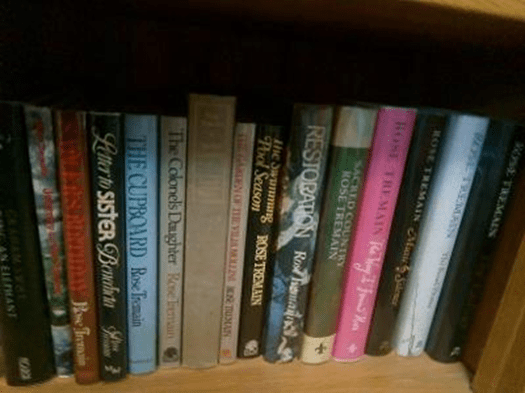
That isn’t how Tremain is treated in the literary press much these days. Thus Alex Peake-Tomkinson in The Spectator Magazine review says something that seems to summarise the flavour of reviews. I get that flavour from the fact that they often merely tell the basic story (without spoilers) of the novel and deny it any larger significance. Thus Peake-Tomkinson:
Tremain has said that she chose two contrasting locations for this book, ‘the genteel city of Bath and the harsh island of Borneo’, but wanted to show that in both settings her characters are involved in ‘the desperate and unending search for places of consolation and solace’. It is a shame, however, that all this searching is never entirely easy to take seriously or to wholly engage with.[2]
That is an exceptionally fine put-down of a novelist’s pretensions, regardless that it leaves a rather nasty taste in the mouth regarding the imagined character of its articulation (a feeling I often get about the literary world). Other reviews take her more seriously but still manage to convey a sense of the second rate. Thus, Stephanie Merritt in The Guardian:
In a novel with a large cast it is perhaps inevitable that some characters engage more than others, and the Borneo episodes never quite come to life in the way that Jane’s story does. But in her portrayal of the ways in which individual longing and frustration unfold against the constraints of forces beyond our control, Tremain has long been one of our most accomplished novelists, and here is further confirmation.[3]
Taken together, these reviews express dissatisfaction and both locate that feeling in the over-expansion of the novel from what it is known to what is sought, some ‘place’ sought by the characters. Is it that the Borneo chapters are so artificial and without life or engagement to the reader, or is it that these chapters more than any other attempt to explore, within the constraints of 1865, a place in which queer love finds much fuller social exploration in a near fictive place.
I think Tremain remains a novelist I love because her characters continually search and do not find ‘consolation and solace’ because the paths or. in her metaphor, ‘roads’ to that solace either do not exist or are end-stopped by the loss of the most famous norms which define a road, a starting-point and a destination. Tremain is the social novelist of the queer, which she possibly conceptualises as the imagination of some impossible fulfilment. Starving and unfulfilled people seek such roads, across land and water, in many of her novels. Even Mrs Morrisey who seeks and finds an imaginatively recreated solace in small capital and large marriage prospects, remember that the non-émigré were set to ‘work on new roads that led to no destination’. That part of the story in Borneo is also set amidst the building of such roads too, for similar reasons and with symbolic resonance in the lives of many characters.
It takes supposition too far but it does not surprise me that various institutional representatives of literary judgement fail to find the Borneo sections less engaging, in Merritt’s case, or both that and unserious in Peake-Tomkinson’s. These sources of consolation and solace are all queered ones that relate particularly to metamorphoses of masculinity. In contrast, the story set in Bath (and London of course) is also one where queerness enters the heroine, Jane Adeane’s, life as well as her consolations and solace. Queerness includes coming to terms with issues of monogamous and non-monogamous partner choices, childbearing and childless love outcomes, and a whole range of LGBTQ+ sexual identity-choices. That this part satisfies literary judgement though tells us a lot about the dominance of a certain kind of feminist literary criticism in the current literary and academic establishment that tends to focus on women from a rather old-fashioned biological perspective.
Borneo in Islands of Mercy is the locus in which masculinity is queered and is less favoured by literary establishment positions I think. Hence Borneo does not engage or interest our critics. But in Borneo we meet queerness which takes forms that only exist in the imagination. I find that in even in the grotesque figure of the self-made Rajah, Sir Ralph. In a world where masculinity is associated with a:
world of hungry, clamouring people which the rajah had fled, when he decided to build his palace in the forest. if he knew that only his money and the authority bestowed upon him by a distant Sultan had made him master of his little kingdom, he had also sincerely believed that he would rule over a peaceable, thriving community, united in quietness and in love of their rajah.[4]
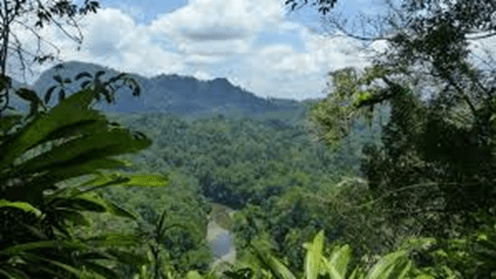
This pre-capitalist world of unselfish love is a world in which gay men are not merely a variation of gender characteristics such as disregard for the lovely and the graceful, ‘sniggering as a Ming vase was used as a pissoir’.[5] It is a world where men find themselves to be something other than men, as so callously constructed out of the self-image of capitalist appropriation or where he dies (as does the invariably heterosexual Ross brother – Valentine), having found, ‘trailing behind him, the great mistake that had been his belief in himself … ’.[6]
If I love Tremain, then, it is because she has never studied the variation and queering of the female without also doing the same for the male, finding therein the stories men tell themselves about each other in order to force identification with the heroes of these stories.
I love particularly the story of Leon in this novel. This small and selfish man longs to be, and have the ordinary normalised goals of, a man. In some ways he could be externally described as ‘only’ a catamite with a most ‘silky arse’, as Sir Ralph describes him. But in others he constantly leans out of his littleness to learn love in different ways than these models suggest, as in this escape of love, so soon turned into penetrative hate, for men within the very privacy of his mind as he surveys the knife which should enact his vengeance:’ Leon stared at the beautiful blue of the lapis. He knew only one man whose eyes were of this other-worldly colour’.[7]
One of the strengths of this novel is that male dreams of love are still based on violence, as in the Rajah’s appropriation of the world of the native Land Dyaks.[8] But its dreams are taken seriously. They are attempts to lay new roads for men that will ‘improve upon what the Creator has given us’.[9]
Leon advised him to begin by building a road.
“A road to where?” Sir Ralph had asked.
“Sir Raff,” said Leon. “There is no ‘where’ in Sarawak. …”
“The point of the road is to try to be.”
Therein lies the contradiction. We need a road without a prewritten destination. If not we will be only according to pre-written roles. Perhaps in those conditions we will never be. For me, then, the Borneo of the novel is an imaginative necessity, where contradictions co-exist. Where they do not, as in Valentine Ross, there is only one end to a masculinity over-determined by its written histories: ‘of the man he wished there to be no trace’ (my emphasis).[10]
Steve
[1] Tremain (2020: 145)
[2] Peake, Tomkinson (2020). Accessible at hyperlink in: Alex Peake-Tomkinson in The Spectator Magazine review
[3] Merritt, S. (2020) ‘Islands of Mercy by Rose Tremain review – a rich, world-straddling saga’ in The Guardian 21st September 2020 Available at: https://www.theguardian.com/books/2020/sep/21/islands-of-mercy-by-rose-tremain-review-a-rich-world-straddling-saga?ref=hvper.com
[4] Tremain op.cit.: 262
[5] ibid.
[6] ibid: 145
[7] ibid: 265
[8] ibid: 35
[9] ibid: 36
[10] ibid: 350
 Steve_Bamlett_blog