‘On borrowed time always, …. but every moment ae it pure electricity’.[1] A ‘heavy gay’ look at redeeming time in Graeme Armstrong’s (2020) The Young Team London, Picador.
This is a difficult novel to talk about appropriately. My own training, which I often regret, in the reading and teaching of the tradition of the novel wants to leap upon its highly plotted symbolic structures, and its tentacles in literary English or literary Scots. However, from the first acquaintance this novel is clearly doing different things from the tradition, in that it seeks to reproduce the voice of those rarely represented as having a voice, young contemporary Scottish working class heterosexual males living life only with the help of the stimulus of drugs. Even Trainspotting fails the test for this subject, its protagonists being much older.
I have my own concern that this widening embrace of the working class male youths virtually eradicates a knowledge of real non-stereotypical queer males as an element of that population, in a way for instance that for instance James Kelman’s The Dirt Road or Alan Bissett’s Pack Men, rather neglected these days, does not.[2] As a gay man born in the working class I find this a problem, though perhaps only for me. That is because the novel tends in my view to render all the goals validated within it for mature male development as those that are represented by a concomitant heterosexual relationship. It is implicit in the novel that for these boys literature outside the contemporary realist is ‘heavy gay’.[3] And its narrative authority seems to differentiate quite starkly between the emotions appropriate within one sex (male or female) and from those between the sexes in ways that naturalise the heteronormative. Azzy tells us that the heightened feeling from ‘uppers’, drugs which give to sentient bodies an emotional and physiological rise, make the young men:
… light, manoeuvrable, irritable, sexual, sensual. Yi huv overwhelmin feelins ae brotherhood wae yir own sex n absolute love n affection fur members ae the opposite sex. It turns no bad tae fuckin stunnin.[4]
Now this is just Azzy’s generalisation but the general sense that gay masculinity that is not encompassed by brotherhood also exists is never established otherwise in the novel. I feel I have to say to this – that it is impossible that the ‘teams’ of Glasgow never contained queer members but the novel never exposes the boys, and Azzy in particular, to that likelihood, apart from their suspicions that imprisonment might mean men ‘takin it up the shitter’. So I’m not calling for a change in Azzy’s subjective perspective but for the working class novel to be as open to the reality of gay experience as different from the perspectives used to save the concept of working-class masculinity from that option. But let’s leave that alone. Because I would not use it to rob this novel of its monumental achievement. Moreover, there is a need, the novel insists, to:
account fur the alienation fae the normal that our lifestyle created. The sufferin of young Scottish males largely untold, behind bravado n the expectation that yi hud tae fulfil the role ae hardman n no even huv the feelings yir meant tae talk aboot.[5]

This locates the group of males in which it takes an interest. But having said this, its innovative choices, at least as seen from the English tradition, of class for its subject-matter do not obviate other structural and literary ambitions although it may disguise them. What we read as a realist take on these young men’s dialect may yet disguise a kind of poetry in the structure and linguistic register of the novel. In this respect what looks like a rejection of the ‘heavy gay’ thing that is a literary culture is merely a way of smuggling into a prose knowable to the men it talks ‘aboot’ a set of ways that have described the arc of human experience for other classes.
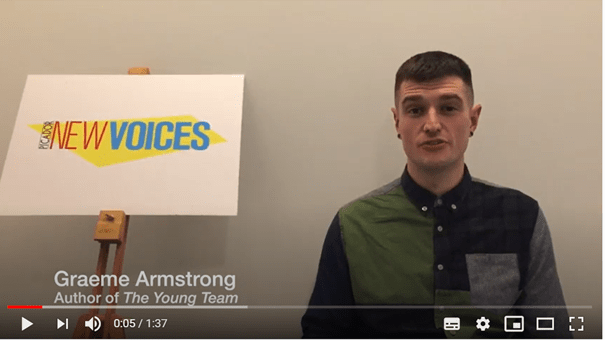
In a brief introduction to his novel, Armstrong offers three keywords in description of his novel: rise, fall and redemption. These words offer us a means of meta-description of the emotional patterns experienced by its characters, its structure or narrative ‘course’ in Armstrong’s term or even the ‘feel’ of its language. Although they are never precise or totally distinct from each other, they create mood indicators for the novel’s treatment of its subjects. For instance, the passage quoted above on the experience of ‘uppers’ intends to make us feel as well as ‘talk aboot’ the rise which the drugs give us. There are passages in the early points of the novel that expressly attempt to transform through language an experience that’s ‘no bad’ to one that’s ‘fuckin stunnin’. Another sentence illustrates how a sentence that it would be appropriate as describing the high point of the rise allowed by youth and new experience, including that of drugs a boy getting his ‘hole’, also is tainted by falling rhythms and the prospect of decline. This needs illustrating from the text and I use it in shorter form for my title. Azzy is describing a particular long instance of the ‘Friday feeling’ that is the school holidays and pondering how he has attracted Monica, despite the attractions of lads:
… who’ve git motors n money n aw the shite that comes along growin up. Ah’m still YTP, tracksuit n bottle ae wine doft, livin life n the edge. Maybe that’s part ae the appeal, even fur a lassie like hur. We’re on borrowed time always, wae every second stolen and destined fur inevitable n painful failure but every moment ae it pure electricity’.[6]
If growing up is an experience of rising into relative riches and what is sometimes called ‘pulling power’ for young men, there is a sense already that the rising mood that might accompany such a process is balanced on ambivalence with its opposite. The positivity that sings from the final beautiful positive phrase (’every moment ae it pure electricity’) comes in part from the licence given to drop the verb from the phrase. It also steals effect from the longevity of sound in the term ‘ae’, compared to the English equivalent ‘of’. But that positivity is preceded by darker reflection. If the moment is electric, each second is stolen or borrowed. Time in this secondary perspective is almost already lost to our positive appreciation and coming to resemble a debt, as it does so often in Shakespeare’s sonnets. Equally the dull sounds of ‘fur inevitable and painful failure’ are already promising that the electricity that is going to give us a rise at the end of the sentence masks a more certain fall.
Moreover, rise, fall and redemption are not words that escape their mythical or legendary origin and often, when used to describe the emotional nature (‘the feel’ if you like) of our reading, show us that all events can contain each with one only in momentary predominance. We would do well to remember their use in mythologies to show different versions of rise, fall and varied limitations of redemption available. This novel casts its eye on myths like these:
- The Christian story of the emergence of humanity into the paradisal garden of Eden, followed by the Fall of ‘Man’ into consciousness of wasteful, mortality of, or as Milton calls it ‘eating Death’.[7] Death here is potentially final, so redemption is not the renewal of an old state but the promise of delayed redemption to come that takes the form of the memory of a lost innocence to be regained, or;
- Non-Christian myths related to the cyclical temporality implied by the day, such as the rising and falling sun and the experience of night, and the cycle of the seasons as the stages of life from birth to death. Redemptive renewals that underlie green man myths as well as the stuff of Frazer’s The Golden Bough, so overworked in modernist literature, are also important.
Despite the postmodernity of the apparent form, I feel Armstrong is a very literary writer. He sets the prompts that show us Azzy’s (Alan the narrator) progress as a learner of past literatures. You will find these myths then hidden in his treatment of the cycles and course of external nature, the seasons and weather, the build and ruin of a ‘mansion’ (“in our Father’s house are many mansions”), the care of a grandparent’s Edenic garden, and in the supernatural brooking of the divide between death and life in so many apparently innocent ‘ghost’ references. It’s also there as well in the central role of Christmas in the narrative and its sparking motive in the writer’s life (Armstrong mentions that he gave up drugs on Christmas Day 2012 in his online introduction to the book).
The novel also uses, but in such an offhand way they remain almost subliminal, notions of journey, pathways and rites of passage, alongside constant references to the emotional, practical and cognitive effects of living in passing time both literally and in its symbolic extensions. The latter time-durations feel different in terms of whether they are experienced when your star is rising in ecstatic youth, declining with even the earliest signs of age or redeemed (satisfactorily or otherwise) in memory or imagination.
Time often passes in the visual evidence or ‘feeling’ of some kind of disorder; whether that be either unwanted rise in the growth unregulated and disordered and pre-human nature or the unwanted fall of an order and human organisation that once was. We see this in two of the important symbols in the novel, Agnes’ Edenic garden, about which more later, and the barn-building the boys called the ‘Mansion’ and which represents to them a kind of children’s shelter from adult life and its laws.
Time moved on. Agnes hud grown eld n hur garden hus begun tae take the look ae a jungle. We still promised tae go but it never happened.[8]
The barn n the stables n the arch wae the room wae nae window ir aw still standin. The rain is pishin doon the eld slate tiles on the stable’s roof. … A kin hear a gentle sobbin. … A’m looking about tryin tae see where it’s comin fae, …. .Nuhin. Just ma name, painted in red n flaking aff the while-emulsioned wall wae damp n time.[9]
These contrasting quotations show that, even in the rising arc of the early novel, the security of feeling that a grandmother’s garden represents to a young boy will itself grow rampant and wild if time is left to act for itself. And time’s effect can be mitigated if human agency ensures the promises of the young are kept to the ‘eld’. I don’t think such lessons in the novel are proposed as moral axioms. They rather show that human agency reflects on time to redeem the worse excesses of ageing, but only if that human agency is responsible to its duty.
In the latter quotation too from nearer the end of the novel, Azzy realises his own potential as a redemptive agency, responding to human misery of Stephen Finnegan (after a failed suicide) and allowing the law, in the form of the ‘polis’, into the illusory space of a youth’s rising pride (which the YTP called the ‘Mansion’). In this space Azzy had painted his name in infernal red, only for it to succumb to ‘damp n time’. That phrase is recalled from Azzy thinking of his own ‘eld school bag’ on which the ‘AZZY W 2K4 YTP written on it’, is also ‘aw faded away wae rain n time’.[10]

Time and rain are persistent companions in the novel, a kind of symphonic motif arises from their repeated persistence, from their introduction in the very first sentence of the novel where they symbolically represent something like the infernal threat to dreams of the young men who stand in the shelter provided by the Mansion in its first few paragraphs: ‘The rain n wind ir fuckin howlin. …/ The building we’re in is a beauty’.[11] My own feeling about the novel is that the rising arc in the first section dealing with youthful pride in self is marked as already illusory by the presence of the markers of time to come. These include the kind of ageing and responsibility of boys, often mediated in this novel by wiser girls and women (who act somewhat like Dante’s Beatrice). The latter show boys that they live on ‘borrowed’ or stolen’ time rather than being in enduring control of their early juvenile freedom. The novel builds not only contrasts – in people, buildings and natural phenomena – that are either young or ‘eld’, or in the process of ‘getting eld’, a process Azzy first notices aged 18.[12] Such feelings of transition are all the stronger in the presence of ‘eld’ Scottish traditions, such as the ‘eld grey kirk’ seen in the snow on the eve of ‘A Shite Christmas’.[13]
That sense of a youthful time is paced and felt as if charged, ‘ae electricity’, as we’ve seen. However, it’s ultimately doomed to inevitable fall. This is best shown in the care with which Azzy looks at the fated Toffey and tries to apply to him his own growing wisdom (that which will help try to redeem him at the end), in the short time before his early death of ‘the bad that’s inevitably comin’:
‘Mate, it needs to stop somewhere. It’s gittin oot ae fuckin control.’
Toffey doesnae understand yit. At sixteen, yir still a Young Team wan through and through. … He husnae started tae endure the bad that’s inevitably comin. …[14]
We should note that word ‘inevitably’. The Young will lose what is good and encounter bad. The novel does show us that either by luck, character or agency, or the words of a woman you might be saved or redeemed. An early differentiation is made between those young men who seek stimulation in nothing stronger than fighting, drink and ‘rave’ parties and those who, ‘headed doon a significantly darker route n wan n aw faded away tae nuhin’, of which Toffey’s short life is an early harbinger.[15] The same metaphor though of fading with time, and the slightly rhetorically lifted effect of ‘n wan n aw’, marks that the novel is compounded of myths and symbols of how persons use the time allotted to it to mitigate circumstances that are admittedly awful and for which the very young may not be equipped.
I think it’s valuable to look at some of the mythic and legendary elements I’ve already mentioned. It’s difficult not to like the treatment of Danny’s gran’s garden, which we first see around the section dealing with ‘fitbaw’ associated Orange and Green sectarianism. I see this Garden as in part the Garden of Eden. Cue here, of course Granny, Agnes Stevenson, who over her Superking menthol cigarettes says: ‘That, boys, is our wee paradise, fae away fae the big bad city where A grew up’.[16]

This Edenic symbol also contains a tool shed, that highlights not only that it is a ‘shrine’ to memory of the ‘eld’ but also a symbol of purposive work, such as that deemed necessary by Voltaire in Candide: ‘Il faut cultiver notre jardin’, as our young men eventually spectacularly fail to do.[17] That this purposive work is also the necessary work of revolution is also hinted at in the picture of the garden in the mind of Azzy, surrounded as it and he is by the pipes of the Orangemen:
A imagine it wild n untamed but still wae aw the intended plants rather than the weeds which huv most likely begun their coup d’etat, insurrection n revolution. … Aw the rot and decomposition is replaced wae a perfected vision.[18]
I sense a complex mix of progressive revolution and reaction in that image, akin to the themes of the marching season, confused on both sides of these religious or social sects.

The garden is a node of the book’s treatment of memory and redemption, since its memory brings back to life a version of the values of the past, in the form of either nostalgia or the eld values themselves that held sway before the Fall. In brief, let’s accept that the Fall, with its varied effects including time, wounds to the body and spirit, imprisonment and suicide, is that caused by drugs for the teams of young men in this novel. At its best the garden is internalised in all but will only for some be an aid to life-change: ‘the garden ae our childhood, a final n untainted place buried away deep inside us’.[20] For most, the unredeemed life is a continual fall, like that of Macbeth, which like this novel is replete with ‘ghosts’ of wasted life. The boys see the play as ‘heavy gay’ and as a ‘pure downer’ like school itself.[21] Otherwise their own lives are, ‘(t)ragedy, but absolutely run ae the mill’.[22]
Yet the Garden is also, ‘un undiminished space ae childhood’; a memory of early innocence and positive feeling that grown men, like the fallen, look back on: ‘broodin, a last time, on forgotten n lost youth’.[19]
In my view redemption in this novel, as I’ve hinted above, is made to spin around the women of this novel quite often from eld Agnes to Azzy’s maw and to women who offer him sensible escape. For me, these Madonna and Beatrice figures are symbolically problematic in their reflection in the sexual politics of this novel as I’ve hinted but there is no doubt that Azzy is also on his own in seeking either escape or redemption at the end of the novel. Redemption for him lies not in a marriage or a partner (there is no certainty anyone would now definitely take him back though he heads for such a chance in Paris) but in fighting the old lies of capitalism:
Our conditionin, two hundred years ae hard labour, made us believe this shite is aw there is fur us – our lot, the drink n drugs, anaesthetic n elixir tae this social nightmare. … We wur aw deceived by the lure ae the Friday Feelin n aw the rest ae the great deception.[23]
I defy any reader not to react with awe to the treatment of the theme of the ‘Friday feelin’ as the symbol of male illusions of freedom and illusory power but I’ll leave you with some page numbers to follow through for yourself.[24] It’s a novel that will not allow you to get easily to the structures and motifs I’ve dealt with mainly here. The style allows such references to occur as if they were not planned. It reads as a fine novel about young men and the waste of their lives facilitated by an unjust society. Read it.
Steve
[1] Armstrong (2020: 105)
[2] Dirt Road give reference to wider range of narrator’s consciousness
[3] ibid: 90
[4] ibid: 79
[5] ibid: 326
[6] ibid: 105. it is explained ibid p. 4 that YTP ‘stood fur Young Team Posse’.
[7] Milton Paradis Lost Book IX ‘ll 271f.: “Greedily she ingorg’d without restraint,/ And knew not eating Death. Available: https://www.dartmouth.edu/~milton/reading_room/pl/book_9/text.shtml
[8] ibid: 96
[9] ibid: 290f.
[10] ibid: 254
[11] ibid: 3
[12] ibid: 18
[13] ibid: 74, 75 chapter title
[14] ibid: 198
[15] ibid: 209
[16] ibid: 96
[17] ‘We must care for our garden’
[18] ibid: 188
[19] ibid: 191
[20] ibid: 188
[21] ibid: 88
[22] ibid: 247
[23] ibid: 373
[24] ibid: 23, 354f., 378.
 Steve_Bamlett_blog
2 thoughts on “‘On borrowed time always, …. but every moment ae it pure electricity’. A ‘heavy gay’ look at redeeming time in Graeme Armstrong’s (2020) ‘The Young Team’”