Six (in(secure)) Poems: ‘from the knotweed sonnets’ by Andrew McMillan (2020) in Granta: The Magazine of New Writing Issue 151 (Spring 2020) 123 – 126.
Some poems speak of those things in our life of which there is no resolution. These poems need not even speak of resolution, since they are presented to us as only part of a larger project in poetry, and perhaps in life. Andrew McMillan has been working for some time on a project that involved gardens and the lives of people in the houses these gardens represent, and which he has described on Twitter as current but unfinished.[1] Queried about the poems in these same tweets, he has identified some earlier sonnets published online (click here) by Wild Court as from The Garden Sonnets.
These sonnets too use the extended symbol of the care of a garden as ‘something needed / to be tended’ in a love relationship. That relationship is under some pressure, perhaps, because of some consuming intrapersonal event, such as sickness or bereavement – we aren’t told specifically – in the life of one partner in a gay male marriage or partnership, formal or informal.[2] In both sets of poems only one of the men speak but the ‘Garden’ poems speak about and sometimes address the loved one who does not speak. Those poems query hidden conflicts or symptoms of such conflict that expose the ‘I’ who speaks in the poems and some other interpersonal conflict:
…. I was gone
too much and didn’t know whether it was best
to let you sleep or take you for a walk or let
you sit in silence or encourage you to talk
…
These poems remind me much of George Meredith’s Modern Love sonnets, the story of a relationship in its terminal stages. McMillan’s poems are not about termination other than a possibility or a danger past, rather they seem to me to show how relationships repair. Their balance of conflict outside and inside both persons, some unresolved ambivalence or ambiguity in the defining affects and cognitions of a relationship is a topic queer poetry has not explored yet in any depth.
Perhaps queer poetry has lacked the maturity to do so in circumstances when it had to promote itself entirely through positive images, feelings, and images. This is why these poems seem to me so important and the latest to be seen, those in Granta issue 151, most important of all. These poems reach depths of imagery of the fear of the dead or dying that they are sometimes positively Gothic in tone, as we shall see. There is still here a man addressing his male partner on the cusp of intrapersonal and interpersonal conflicts but many of the poems do not have the directness of address of the sixth and final sonnet here:
and each time I think we’ve reached the edge of us
together – like that time in the middle
of the Hope Valley when I made up my mind
to leave you when the lit windows of each house
the train passed broke my heart
…
That record of a lone decision and its emotional sequelae represented only by the images of guessed and living domesticity passed by in a train, makes this poem so much about the experience of the experience of duration so intrinsic to how relationships are seen, even when they flicker like fireflies in their multiplicity. The train is complex because it is an experience selected from so many when the lovers are apart, physically or emotionally. Even the almost pedestrian situation of this image in a holiday in the Hope Valley is the more moving because of its everydayness. That ‘time in the middle’, a phrase in which ‘middle’ seems to speak of the middle of the time mentioned not the place to be mentioned before the enjambement of the line dissolves that former meaning.
There’s a true ‘in media res’ here where the things (‘res’) are commonplace rather than epic in their narrative tensions. In a poem in which the interrelation of ‘edges’ and ‘middle’ is central these abstracts take physicality from embodied relationship – the feeling of the edges of time and space at which lovers still are aware primarily of each other. And, after all, this is also about an ambiguous attitude to narrative time, a kind of hopelessness in hope. No male gay poetry has ever sung like this. Moreover, the Hope Valley in Derbyshire does invite tourists but famously as a very visible factory in its middle.
But we jump ahead. These sonnets take their name, unlike the earlier drafted versions of perhaps another part of the same poems not from the garden but of the actual problem in the garden of a house bought by McMillan and his partner, that of Japanese knotweed.
Knotweed is often thought to endanger property resale values since it is thought to attack the structure of the houses within the gardens in which it appears. McMillan tells us of its potential to be an enduring problem in this prose introduction. It is a fine symbol of a plant that makes one afraid for one’s future. He mentions there two true problems that other gardeners cite. It’s growth is unpredictable given the fact that its roots are more properly called a rhizome, they allow new growth to propagate from the lateral extension of the rhizome’s underground tendrils, without further planting.
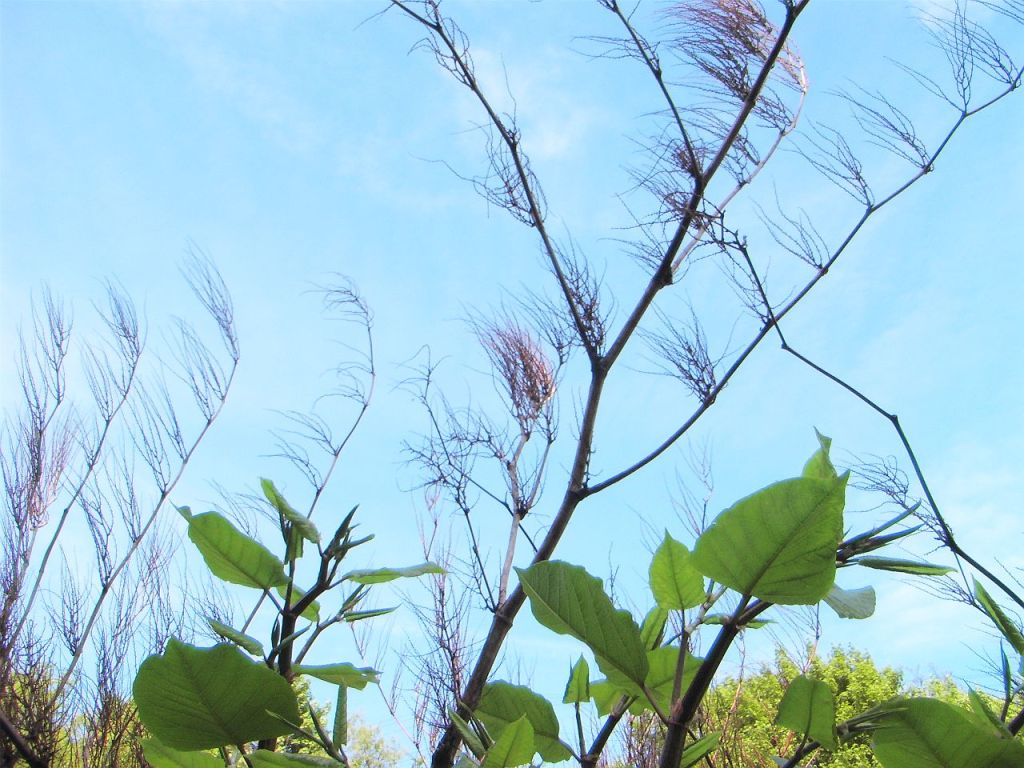
Thus old growth remains like hard bamboo canes, though the plant is not related to bamboo at all, whilst the new springs from places that cannot be predicted over the potential 7 metres of their lateral length from any point from its vertical penetration (of down to three metres) into the earth. Knotweed removal sites often show why both depth and lateral extension are important to knotweed as below.
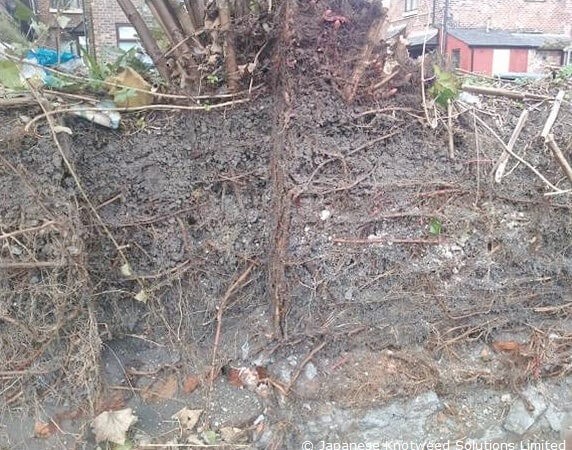
Some of this information is in McMillan’s introduction together with an attitude to it that is strategic, even military (‘scorches the earth’), killing. However, what matters more is that he characterises the problem as about much more than the activity of the plant itself. Seeing it as ‘growing through everything’ includes the time and activities which the partners invest in their future financial security: ‘growing through …, every document, every solicitors’ meeting’.[3]
The machinery of possession we see here is how the capital ownership of the home is tied to a partnership in a capitalist housing economy, involving solicitors and documents to assure an enduring status in the power of ownership often shared by married or unmarried partners. It means something about an attitude to time that is being tied to a relationship – owning a house is secured on the promise of our assurance about the relationships, with conditions of ownership often when that security is less than 100%, which latter we must consider the norm.
The hard ‘bamboo canes’ of the old knotweed then represent an idea of a threat not just to finances but the endurance of the lovers of each other. The final paragraph of the introduction is worth quoting in full:
Sometimes at night, both of us bound tight in our bed, I think I can hear it stretching, threatening to wake up, to grow through the walls.
The language here typifies the slow organic growth of knotweed, and its threat to the fabric of the house and apparently secure walls but also to something secret, dark, deep, and monstrous. It is a kind of organic unknown posed against the rigid symbols of the secure humanly built structure – not just walls but also ‘us bound tight in our bed’. I see the possessive ‘our’ here as important.
What the organic threatens is legalised forms of co-ownership even of each other. There is an answering fear though of the insecurity posed by knotweed and the security of being imprisoned in co-bondage (‘bound tight’). Of course the ambivalence is a matter of tone. I can only insist on the view that if the knotweed is a Gothic monster, it is so because it appears to attack conventionalities which bind us in relationships about which we also have some potential of negative feeling. After all to be bound tight is to be like a corpse, something unlike the knotweed in that it never will ‘wake up’.[4]
This ambivalence I’ve already spoken about. It is explored in the imagery of the six poems to follow. The violence of the gardener (‘put my boot to the soft belly’) in the first poem is described as a violence to a body. Whilst this is a metaphor for the knotweed, it also seeps into the difficulties of the relationship that constrains and civilises but also, perhaps, restricts and contains anything of the natural ‘urge’. These urges distort to violence. This particular gardener is murderous of anything new or young threatening the old. The lines in which I see disordered appearance of the knotweed’s ‘shrubs’ as ‘unkempt’, having their desire lopped. To ‘cut down the ambitions of the shrubs’ feels as violent as Blake’s axiom from the Proverbs of Hell:
Sooner murder an infant in its cradle than nurse unacted desires. Where man is not nature is barren.
Blake, W. Relevant section available at: https://poets.org/poem/proverbs-hell
And like Blake, McMillan’s gardener contrasts the effortful maintenance of control with the imminence within it of violence, of which the controlled near punch used in child’s play, but also with his ‘Mum’, is the perfect symbol of its ambivalence.
The next poem looks at a neighbouring house under the metaphor of a long ‘decomposed’ corpse, guarded and policed, that looks otherwise like an open but starved mouth. The little of nature left in that ‘old man’s’ home are cockerels whom the neighbours scheme to kill or, at least, ensure they do not ‘wake up’. This is like the knotweed whose waking up is feared by the ‘bound tight’. Yet again, the poem looks at houses and homes as containers of that which perhaps ought to wake and live.
In the light of this I sense the sensuousness of the third sonnet as a kind of sensual wish restrained by the ‘netting’ of contained nature. A mouth remains ‘parched’ here like the grass from which the fruit is held back. The sensual imagination comes in a repressed wish:
reach through the netting to handle each one
in their swelling ripe as the noses of drunks
I take them between my fingers
…
Whether this is or not a Dionysian image of revel, it is a yearning one. Even the delay of naming ‘I’ as the subject of the sentence contains a kind of yearning, beautifully juxtaposed to the ‘swelling’ of those fruits to the body reaching for them. The suburban house-owning economy of couples may repress much of this longing, which is so beautifully conveyed in the narrative of the neighbour’s ‘new trophy’: ‘a live-in lad to share the house with his mother’, that owned body ‘topless and smiling’ like a dog on too much restraint on lead – such that his ‘dancing’ and ‘next moment mute’ are entangled as are all contradictions that cannot be reconciled are.[5]
The fourth poem creates a mysterious set f threats to the possession of couples in houses, even the threat of rumour that marginalises and lives on myths, perhaps particularly about gay male couples:
… another
neighbour asks if we’ve been growing weed
or if the neighbours have
where is that smell coming from? …
And, of course, though that is not tended, the couple is in fact growing ‘weed’ – not cannabis though but knotweed. In each case an infringement of bourgeois conventionality. [6]
The fifth poem exposes the ‘path’ followed to owned houses to find secrets – of fearful colonies of ants acting to protect their offspring, and:
a family of translucent slugs
slowly rousing themselves from being curled in
on one another they seem weary
These groups of over allegorised creatures, metamorphosised in the form of human social groupings, do represent I think a kind of rejection of the mores of over-conventional fearful groups. Groups including bourgeois housed couples and their decent middle-class neighbours, who police behaviour like the growing of weed, fear theft of their property and public intrusion are almost laughed at in these images. Moreover, the poem must ‘close the lid’ rather than further expose them – so secreted is what we call our ‘personal life’.
The final poem returns to the gay couple. Concerning ‘the year of no touch’, they seem to recall the Garden sonnets and have chilling resonance for us in lockdown. After the poems which have exposed the fear behind the lives of setting up house by a gay male couple in conventional largely heteronormative settings, the poem suddenly – at its end at the least – revels in enduring monogamous love. Speaking of renewal of love even in forms of relationship that have been tested and found wanting in many ways because based on fear, it finds something new in the old and repetitive in love.
Those last lines are about renewal and are posited on a love that renews on each return of the man who leaves the home. I find them hauntingly beautiful. They are the hope not only of modern gay love but of a mature queer poetry. Finding in insecurity a deeper, if not ever necessarily enduring, security.
we feel our way back and coming home late
you greet me as though newly arrived.
These poems excel and mark a new phase in McMillan’s work as a queer artist, indeed as an artist. We can only wait with bated breath for what will become of them in later published form. I only hope he continues to believe in them. On that belief lovers of great poetry are dependent.
Steve
[1] Downloaded 10/05/20
[2] Available at: https://wildcourt.co.uk/new-work/2646/
[3] McMillan, A. (2020: p. 123)
[4] ibid.
[5] ibid: 125
[6] ibid.
 Steve_Bamlett_blog

2 thoughts on “Six (in(secure)) Poems: ‘from the knotweed sonnets’ by Andrew McMillan (2020) in Granta issue 151”