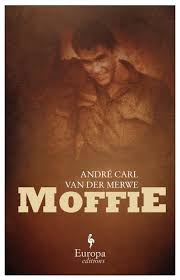
Book into film: André Carl Van Der Merwe (2006) Moffie New York, Europa Editions & film (2020) by Oliver Hermanus Starring: Kai Luke Brummer, Matthew Vey & Ryan de Villiers available at: https://www.curzonhomecinema.com/film/watch-moffie-film-online
Usually we compare films to books to the favour of the book. In this case the comparison shouldn’t perhaps be laden with any preference because they tell a rather different story and perhaps for a different purpose. The book contains much more early biography of its hero Nick, many in flashbacks from the boot camp at which he is trained for the South African Defence Force, telling us much about his early history of experiences with other boys and knowledge of what it means to be a young man growing into a gay identity.
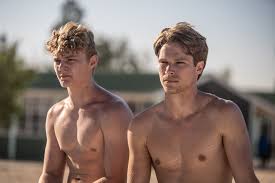
The film, in contrast, has one major flashback that I didn’t find in the book and that resonates with the many shower scenes in the boot camp. It’s a scene where the young Nick glances a boy in a shower in a leisure park but is accused by an onlooker of being a pervert. We are meant to hate the onlooker and to find him obsessive in his homophobia, but it is also the only moment when we know that Nick guiltily enjoys seeing the bodies of men.
Another major difference is the truly short Part 5 of the novel (one and a half pages long in a 362-page novel. This part tells the story of an older gay man seducing a younger boy, contrasting the hardened predatory nature of the former in contrast with the ‘exquisitely defined and youthful, almost tender under the stroke of the older man’s hand moving over taut, elongated muscles.’ That contrast of hard and tender (or gentle) is of prime importance in this book, since it tells how masculinity loses tenderness in order to replace it with power, where the older man, ‘realise his hold and starts abusing love’. And that story runs alongside how a brutal competitive system in which power is absolute places youths and their tender loves in a straitjacket of discipline and authority.
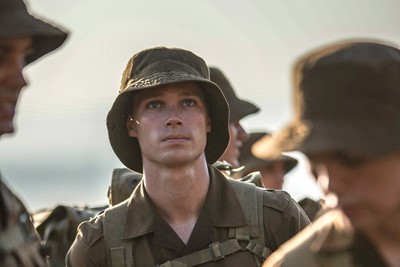
But this isn’t just a coming out story, though it is that too but an elegiac story about the loss in boys of the ability to express tender love. Nick holds onto it in the book however and is repaid with a romantic love-story with Ethan. In the film, Ethan is not a character and his longer love for Dylan (who dies by the middle of the book), though it survives the army has become hopeless, as a result perhaps of the homophobic behavioural treatments meted out to him in the army’s psychiatric Ward 22. Ethan appears to survive Ward 22 in the book and Dylan shoots himself rather than go there.
In the book there is much more evidence of gay men surviving in the army and Nick is tested against relationships against three men. Two tender stories with Dylan, scarred by his predation by an older uncle – that in Part 5 I think but that isn’t made clear – and who commits suicide and Ethan, the true love. These roles are elided in the film into Dylan alone who survives boot camp in body but not Ward 22 in spirit. The third is a more rough-and-ready boyish attraction to Malcolm, made up of interest in teenage songs and eventually of shared stories of their separate gay encounters once they have come out to each other. Malcolm is in the film a lot but doesn’t have the important afterlife that he has in the film.

The function of that relationship is to illustrate in both I think a medium between tenderness and hardness in mutual male relationships, gay or straight. The relationship starts in singing with, rather than to each other, the song Sugar Man by Rebecca Thomson. In the film Malcolm asks Nick, ‘Are you OK?’. ‘Aren’t I always?’, is the ironic reply.
The film’s determination to stay with the brutalising effects of army life means that the analogy of the hyper-masculinisation of South African white men against the black enemy, who are typed as ‘moffies’ (a term like the American ‘faggot’) with and forced and trained heteronormative homophobia. The film starts with the train journey. When the train full of white boys stops at a station where sits a late middle-aged black man, they humiliate and infantilise him. In the book Nick’s nanny, Sophia, is black and from her, unlike his mother he leas tenderness but I don’t otherwise sense any great engagement in the novel of the oppression of black people, other than as a hard fact of life emerging from its background elements.

The film too is filmic in that it recalls other films. The scene in which Dylan successfully invites Nick to share his sleeping bag – Nick’s being soaked in rain – is almost calling out to be compared with the camping scene in Brokeback Mountain. Films have their own intertextual play to deal with. The scene in both media is asexual but tender.
Nick in the film has to overcome his own introjected homophobia: ‘I’m not like you’, he shouts to a gay man who tries to warn him to be discrete. The film like the book is art that treats of the lives of gay men for gay men. Whilst I think the book only plays to a heavily sexualised take on young male bodies in Part 5, it is constant in the film. Not that the film is to be disliked for this. It has its function. However, the casting plays a lot to the importance of the appearance of naked and semi-naked young men, especially the ubiquitous shower scenes.
 Steve_Bamlett_blog