1st draft to be reviewed when I have energy. May be lots of errors.
“Still … something to resolve”: Unending incompletion in Temple Drake (aka Rupert Thomson) [2020] ‘NVK’ London, Titan Books.
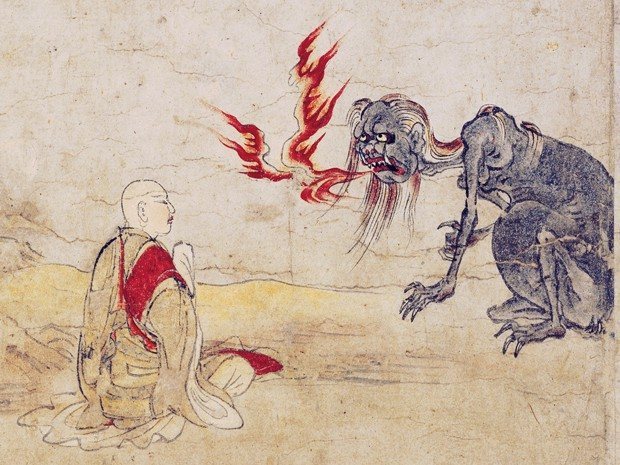
They have the best stories too – … In a typical zhiguai, a mode of expression now viewed as giving a voice to the voiceless, one finds countless instances of female ghosts.
…
…, ghosts are manifestations of something that is incomplete. That’s what a ghost is: someone who still has something to resolve.
Drake (2020: 138f.)
Rupert Thomson is a writer who constantly blurs the boundaries of attempts to say what a story is and what a story does. This applies even the self-evident clichés such as that they have a ‘beginning, a middle and an end’ or that it is possible to distinguish their content, form and meaning. Because these are the very things that queer or strange ghost stories often challenge, and this seems particularly so in the little I know about Chinese ghost stories.
Stories in this book come from re-told myth, gossip, espionage, financial speculation, dreams, imagination, fantasy, semi-conscious interpretations of sexual and other sensations and emotions – they arise in lyrics to songs as well as appear on ancient ceramics in museums. People feed off them but, in doing so, transform them by layering the stories in their lives in a continuous present rather than linear sequence. The character Mad Dog who plays in the narrator Zhang’s band is, after his suspicious death is found unexpectedly to have written a book in his youth published in a ‘matte-black cover, and red characters on the front and down the spine. Its title was A Handbook of Ghost Culture in China, from Ancient Times to the Present Day’.[1]
I see the stereotypical Gothicising of this tradition as a specifically male interest in this novel. Mad Dog’s wife is pleased to give it to Zhang, another male haunted by a fear of women who return and somehow come back into their lives, even if these men feel they have moved on, found something new, leaving any woman that begins to trouble them dead in a completed past:
“… For a ghost, time is nonlinear. The present isn’t a development of the past, but a palimpsest through which the past continues to assert itself. That’s why the woman in the story I told you could be standing in a shop, buying groceries, and also lying dead in her grave. ..”
ibid: 186
The story is largely mediated by Zhang but it is possible to see that these Gothic story-like manipulations (made to explain women) by men are not shared by the putative view of the women themselves. Even in the first chapter, set in Finland in 1579, as NVK escapes the house of her family murdered by the Russians, she resists responding to being asked by a man to tell her story and is aided in not doing so by the man’s wife:
He was only asking what anyone might ask, … A story was a passport, after all. Something that allowed people to place you.
ibid: 11
NVK are always the initials of the name of the central female character thereafter but the name she uses, the stories she inhabits and the ‘passports’ she uses change with every new phase of her life. In this story of Chinese Shanghai she is Naemi. In another story accidentally entering into this story she is Nina, as seen by another sexually interested young man of another generation, Professor Torben Gulsvig. Zhang and Gulsvig, now in his late 60s, even work each other up to see any story in which NVK appears as one in which men appear to ‘be in danger’, even unto death or insignificance.[2]
After the story in this novel ends we know her passport and name will also change, as will her story since her story may never be her story, only a tale told by a man who wants to ‘place’ her in space, time and meaning as a possession that he interprets.
We can easily miss the fact for instance, even in this novel, that Naemi never hurts others intentionally except to save herself from male over-possessive violence or claim. It is their perspective on her that makes her dangerous, that sees her as a thing that feeds off men unless controlled by surveillance and self-justifying (for the man) storytelling. She goes to see Mad Dog, who sees her as a Chinese ‘hungry ghost’, much like that in the illustration above and which has filled his ghost-book of women who feed on male life. When she visits him she hopes ‘they might reach some kind of accommodation’, or ‘truce’ (a hope proving to be ‘naïve’).[3] The actual interaction is a more ordinary confrontation of a man and a woman fuelled by alcohol and male fearful fantasy:
She took hold of his sleeve. “Why are you being so difficult?”
“Let go.” He shook her off. “You’re not real,” he said. “You’re a ghost. You don’t exist.”
“A ghost? What does that even mean?”
Once again, he pushed past her.
ibid: 202
We need to understand the force of NVK’s: “What does that even mean?” She knows, as he does not, that she is not a mere invention of male myth, reflecting male sexual fantasies back onto heterosexual men. It is them who see her as embodying a malevolent hunger they entirely invent to explain their own fear of being ‘drained’ by this external power. To stop this happening she must be controlled, succumb to their social, economic, or physical power, like the prostitutes who make up another domain of male fantasy in the novel.
Men fear being finished off by women. In myth, according to Mad Dog, they return because they, their task, and their raison d’etre is unfinished until the men that claim to give women meaning are finished off. In fact female incompletion is always an attempt to avoid being absorbed into male fantasy and the male stories which embody those fantasies of the ‘siren’, ‘femme fatale’, ‘hungry ghost’ or female vampire. Those mythical women differ, of course, for differing time-spaces, according to the stories offered up to explain those fears by specific cultures.
That is why NVK is a set of mainly untold short stories. It is the only way NVK will maintain autonomy except for ensuring that she feed only off herself and not others, and certainly not men who offer both money and food in exchange for more than just sex. At the end of the novel, her employer in the art-trade says:
“she had been here for long enough. There comes a time, she said, when you just know. But she didn’t say where she was going, or what she might be doing in the future.”…
ibid: 293
The use of indirect speech here is clever. Women talking together in this novel share understandings of why there may be a time in which they should relinquish male possessive desire, a time when they become absorbed entirely in male stories of possession, over-surveillance, and fear. In social terms these themes are the stuff that, in short, justifies domestic violence and sometimes violence between men who control nations). The latter kind of violence did for North Karelia in sixteenth century national wars as will the financial machinations of the twenty-first century capitalist powers amongst whom Zhang is one.
The beauty of this ambiguity in possible interpretations of Naemi is that even Mad Dog can name, when he is not drunk, that ghost stories feature women because women’s lives were, and might be, he admits, ‘even today’, ‘harder than men’s.’ These stories are, “a mode of expression now viewed as giving a voice to the voiceless”.[4] Because as O’Donnell says in his Guardian review of the novel, ‘it is the world of men, insistent and voracious, that has never really changed,’ and which, I would continue, has robbed women of a voice.[5]
Of the putatively ‘voiced’ issues in women’s lives is the importance in Naemi’s life not only of quotidian male threat and violence, but also the prevalence of self-harm, addiction, invisibility, or passivity to changeable male perceptions of them in a world dominated by patriarchal men. Mad Dog knows, but he has no empathy for, female ghosts’ tendency to ‘protest’ or ‘rebellion’: “They’re challenging all the old patriarchal notions of logic and law”.[6]
The one means ghosts use for this protest, and by extension women are accused of using, is ease of self-transformation. Now whilst men demand of women, and art it seems, that they embody mystery and that which is unknown, they also fear its ability to absorb their prized logical rigidity. Thus, he muses in the first full sexual experience:
What was so different? It was her elusiveness, perhaps. Her unapproachability. He had though that if they made love she would become less a mystery, but he was touching her, and then inside her, and she still escaped him. … He felt drawn into a void, swallowed up by it. He felt he might cease to exist.
ibid: 47f.
I think you just have to know that if the elusiveness and lack of objective form these men associate with women, and with sex with women, is not only desirable (is desire itself) it is also fearful as entrapment in shapeless interiors always is. It will need to be controlled and shaped and made more stable by those men in time, made to release its metamorphic hold on reality where male power lies, lest, as you sense that you do not have ‘everything under control’ any more, fear ‘rushes through you, like a gust of wind’.[7]
In my view Thomson is an artist who takes queer theory seriously and I do not think he means his novel to fetishize sexual relations in ways that include only the heterosexual, even if they privilege it, quantitatively at least, except in the case of Never Anyone But You. The men in this novel only ever think of themselves as heterosexual but the uncomfortable encounters with the man in blue suit raise ‘otherness’ as a potential in all and every sexual identity. For Zhang these are encounters in a bathroom and thus charged with other spaces, periods of time and meanings. After sex with Naemi they both talk of encountering the man unable to place him in any story. Then there is a very queer passage indeed where the normative is dissolved in obscurity and Gothic darkness:
… Zhang remembered how the man appeared beside him as he was washing is hands. He remembered the darkness in the men’s room, the kind of darkness out of which almost anything might feasibly emerge.
ibid: 49
Lots of interpretations are possible, and even feasible, but none are certain or to be expected or felt to be the norm in the situation. That is what is ‘queer’ about this writing. Not that it engages with gay sex and sexuality but that it potentiates it out of uncertainty about the norms of this specific situation. No light is shed. Moreover when Naemi sees him at the end of the novel with the same blue suit and blue case just as she had at the beginning, she realizes ‘what he was carrying in his luggage’.[8] She knows what he carries but her knowledge is not shared. We almost certainly will be guessing or even have strong belief (is it for instance syringes, cannula, and piping such as she carries with her in order to feed off her own blood) but there are no clues that could confirm this or any other guess.
We get just a sense of the queer entering into lives in these moments; in the absence of certainties, either of logic or law. And I would say that this is how, if you allow yourself to think about it, the whole novel operates. It throws into a world of apparent reason dreams, myths and hard to apply moments that Johnny throws into the story from barely known Chinese writers such as Hsiang Kao. The latter’s poem has a metaphor of the self as a ‘double’. Zhang suddenly feels these lines of the enigmatic and slightly silly Johnny: ‘For once … had spoken to him directly’.[9] It speaks to us or it does not. We hear what it is saying and what it might be saying to us or we DON’T. It is a queer world.
What I want to end this exploration, done mainly for myself, then is with the thought that it is Thomson’s art which goes on speaking strange and queered stories, this time taking him across a boundary into the name of another writer, Temple Drake, because in any one of these stories there is something ‘still … to resolve’. Professor Gulsvig says at one point: “There were borders and limits, and I knew I couldn’t step over them”.[10] In his book, as it is read by Zhang, Mad Dog says ghosts have reality precisely because ‘the border between the two worlds’ (of life and death, present and past) ‘was porous’.[11] The writer Thomson approaches being, getting there but with things still to resolve, is a queer transformative one, like ghosts according to Mad Dog:
“… It is believed that they gain strength from such mutations. They don’t observe the usual boundaries, you see. Time, space –identity …. The skin is not as big a barrier as people think it is. …”
ibid: 141
If this is what writers do, they do so either from drinking the blood of others (people and writers already in the world) or, as the vampires in this novel do by drinking by stopping the circulation of their own blood and drinking that. The imagination is, after all, a charnel house of dying and dead persons on which to feed but writers only strengthen themselves when they drink their own blood like Naemi. Then they allow a world that wants to seem straightforward emerge as strange in their own imagination before they digest it.
I cannot know how much reading Thomson did in the Chinese ghost stories he studied but it’s likely that he will have come across the work of Pu Songling, an eighteenth century Chinese writer, who aimed to revise and renew the tradition of Chinese strange stories. His work was translated in the nineteenth century by Herbert Giles. In the latter’s introduction he translates words from Pu Songling about why writers write. Here they are:
At the cross-roads[18] men will not listen to me, and yet I have some knowledge of the three states of existence[19] spoken of beneath the cliff;[20] neither should the words I utter be set aside because of him that utters them.[21] … Our home was chill and desolate as a monastery; and working there for my livelihood with my pen,[24] I was as poor as a priest with his alms-bowl.[25] … I stimulate my pen, yet I only succeed thereby in ‘venting my excited feelings,’[31] and as I thus commit my thoughts to writing, truly I am an object worthy of commiseration. Alas! I am but the bird that, dreading the winter frost, finds no shelter in the tree: the autumn insect that chirps to the moon, and hugs the door for warmth. For where are they who know me?[32] They are ‘in the bosky grove, and at the frontier pass’[33]—wrapped in an impenetrable gloom!”
Citing Pu Songling (2013) from the nineteenth-century translator’s (Herbert A. Giles) ‘Introduction’ to The Project Gutenberg EBook of Strange Stories from a Chinese Studio(Volumes I and II), by Songling Pu Available at: http://www.gutenberg.org/files/43629/43629-h/43629-h.htm
These words rehearse the story of a writer who knows that their stories may not find an audience except one as obscure as their own interior imaginings, which may, after all, not exist. Writing remains a thing where an audience is needed in order for imaginings to be released from the ‘impenetrable gloom’ of that imagination. Otherwise their books remain as unread as Mad Dog’s book. Even his wife, Ling Ling, doesn’t want it.
Sometimes that audience can only be imagined across barriers of time, space, and identities as something enduring and resilient. And that is not a vampire who like human beings find that ‘life can change, in unexpected ways.’ On the other hand an artwork can capture experience into an otherness that is not time but stillness. As the two central characters observe a T’ang dynasty vase they see that:
The vase was almost defiant in its plainness and simplicity, and yet it carried with it a sense of all the years that it had lived through. All the centuries. He glanced at Naemi, and saw a new stillness in her face. …
ibid: 277
No artist who is an artist, as Thomson certainly is, writes outside the desire to produce something that stands and stays with the stillness of art. This is not about transcendence at all – about being outside periods of time, space, and identity – but about capturing something that can cross the barriers and boundaries between these things. This is how the most post-modern of writers can aspire to resilience – the resilience of boundary crossing, where like Pu Songling he finds the people who ‘know me’.
Steve
[1] Drake (2020: 241f.) The book is obviously fictional but some of its contents could be summarised in https://en.wikipedia.org/wiki/Ghosts_in_Chinese_culture
[2] The key conversation is in ibid: 246f.
[3] ibid: 204
[4] ibid: 138
[5] O’Donnell, P. (2020) ‘NVK by Temple Drake review – dark obsession in Shanghai’ Guardian online Wed 8 April 09.00 BST Available from: https://www.theguardian.com/books/2020/apr/08/nvk-by-temple-drake-review-dark-obsession-in-shanghai
[6] ibid: 141
[7] This phrase orchestrates the novel but appears first enigmatically said by a ‘queer’ man in a blue suit and with a blue case in ibid: 16.
[8] Ibid: 330
[9] ibid: 228
[10] ibid: 251
[11] ibid: 274
 Steve_Bamlett_blog
2 thoughts on ““Still … something to resolve”: Unending incompletion in Temple Drake (aka Rupert Thomson) [2020] ‘NVK’ London, Titan Books.”