What is the point of art history? Saving the world in T. J. Clark’s (2018) Heaven on Earth: Painting and the Life to Come London, Thames and Hudson.
Questioning the point of art history is often a naïve exercise. After reading this book it may become a more urgent one and demand more than a brief defence of tradition or the art of visual reading. But yet one asks: ‘who does read this book’? Where is its intended audience? To none of those questions do we have answers but we can explore why we so much want them.
The book is declared as a collection of self-edited and presumably revised seminal works by the very eminent art historian and academic, T.J. Clark. Yet it also insists that there is an integrity to its themes as a complete volume. This claim is more than a defence of the book, it is the rationale of a whole discourse.
The form of the book seems important and to signify a significance beyond any paintings on which we get, as we do, major illumination. It contains a series moving us through very brilliant readings of visual effects in landmark cultural paintings in the wider history of European art. Historical and socio-cultural context always plays a part, indeed often, as in the Picasso reading a very large one, in these readings. But beginnings and ends are important. The introduction claims that it is limiting its claims about whether it speaks to its own historical time (Clark 2018:21), but within pages raises a very large question based on many silent assumptions about what it means to live in this, our, historical moment:
…: Could there ever be a thinking and acting directed at changing the world – at truly transforming or revolutionizing it – that did not result in ‘paradise for a sect’ (meaning hell for everyone else)?
ibid:23
For most of us the leap here from what the book undeniably does (reading visual material brilliantly in order to draw out historical and socio-cultural meaning) to what it wishes to do is a very large one indeed. We have to just accept I think that the author feels his past analyses of the role of artists in interpreting their social moment (Courbet for instance) qualifies him to write a conclusion – he names it a coda – named ‘For a Left with No Future’.
A coda does not commit since, though it is a ‘conclusion’, it can add new elements to its purpose of illustrating the main ‘argument’ of a piece of music or writing. There is a sense that a coda is separate from the main structure to which it is the tail if it is inevitably, as tails are, connected to that body. Hence it can allow a wider latitude than merely being merely a summary of what is already fully argued.
For me, that latitude speaks to the oddness of art history as a discipline. Its commitment in left-leaning scholars in the past was to a commentary on the contribution of its subject matter to a praxis based on changing the world, somewhat reminiscent of Marx’s: “Philosophers have hitherto only interpreted the world in various ways; the point is to change it”.
Without this assumption the coda seems merely a rather audacious leap from what we expect a scholar of visual art to know and what remains a rather speculative area, however well peppered with bits of political and aesthetic philosophy from different sources, times and places.[1]
The most puzzling contribution indeed is the long discussion, and eccentric usage, of A.C. Bradley’s Shakespearean Tragedy: Lectures on Hamlet, Othello, King Lear, Macbeth. The reason for this – to illustrate a turn in the left from a millennial to a ‘tragic’ and ‘mortal’ reading of history. This is too little upon which to hang too much – not a coda but a rather eclectically sourced worldview in an appendage. For people still on the Left the naming of this tragic vision as a reason for an entirely different politics, which sounds not unlike global Blair-ism, is on the verge of offensive. As is, of course too, the notion that any other political position on the Left is more or less infected with dangerous utopianism:
… the wish for escape from mortal existence, the dream of immortality, their idea of the Life to Come. … What Bruegel says back to the Book of Revelations …. is that all visions of escape and perfectibility are haunted by worldly realities they pretend to transfigure.
ibid:255
The basic assumption here is that the struggle for political change is a mere emotionally based millenarianism, untainted by anything but false thought. This has been the position of ‘third way’ socialism in the West some length of time. For me Clark represents an academy standing outside any world of political conflict (with a nod to the differing perceptions of landowners and peasants in Bruegel’s time) other than that between competing professors for chairs in major American universities. Each utterance is a paraphrase of the academic’s plaint: ‘my world is everyone’s world and hence I need neither be in nor look too closely at that sad reality – disturb my cosy world, except in very slow-moving and uncertain ways, at your own peril not mine’. Reform we are told is revolution.
That over, the book is otherwise brilliant at what it does if not even worthwhile on what it ought not to try to be doing, not at least from the subject-position taken by its author well outside of any specific historical struggles.
There is a bow to the fact that art history is part of the struggle to understand the rhetoric – including a purely visual one – of historically-based social desire, but no real desire to make contribution, as Simon Schama always does, from an interdisciplinary subject-position, that of history rather than art-history. We know Schama supports art-history as a discipline but he does, as a historian, something quite larger, where the fact that text and image, exegesis and appearance, logos and vision operate together in historical constructions of subject-positions is duly acknowledge, as in the great Landscape and Memory for instance.
Of course Clarke’s book does things that only a great master of visual analysis can do, although I suspect that its exegesis merely ignores the fact that icons, such as feet, or visual structures like bi-pedal humanity are not ever only visual effects. Effects of slant and imbalance, of dimensional stasis threatened by illusion of falls in the visual ground are rooted after all in proprioception . The point about bi-pedal humanity is brilliantly illustrated, together with a brilliant evaluation of how and why the visual relationship between feet and ground, upright posture and the prostration after a fall is forever being painted. He makes us see the Veronese allegories of virtues and vices brilliantly. I re-saw these paintings. All four can be viewed in excellent detail on the National Gallery website.
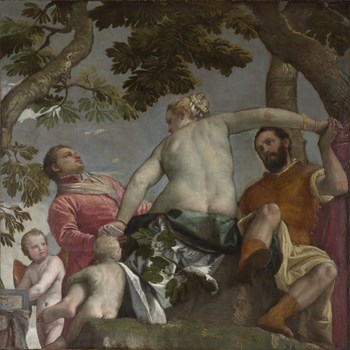
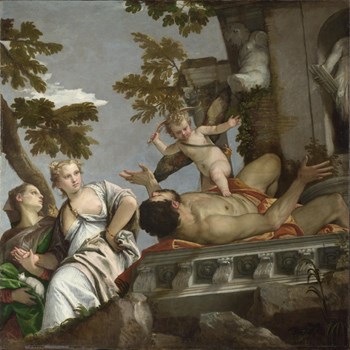
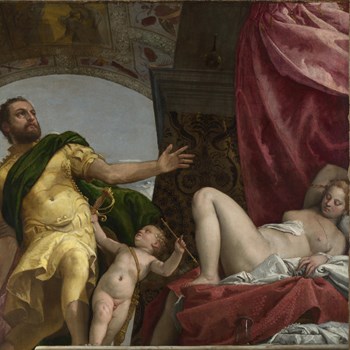
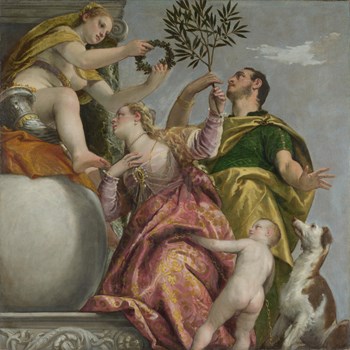
And in dealing with Veronese how beautiful and rich the perception of detail, especial of the role of shadow, in which visual presences not seen in the painting are prefigured so delicately and uncertainly.
Of course at the centre of his argument is the ‘peasant’ reality of the vision of fallen grace in the ‘Land of Cockaigne’. That vision equates fall from upright with the waste of scholarship, control of the land and martial defence of the nation from which all virtue in the ‘real world’ might be thought to flow. You couldn’t pretend to summarise the argument here thought which, in as far as it speaks of the painting alone is subtle, nuanced and rhetorically balanced, unlike Bruegel’s giddy painted world.
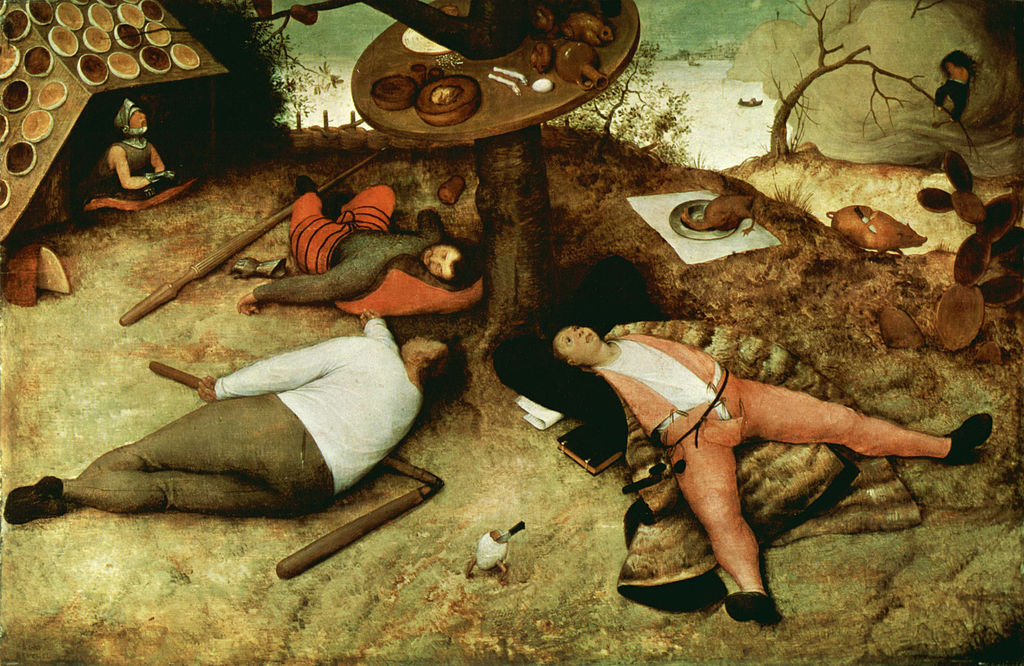
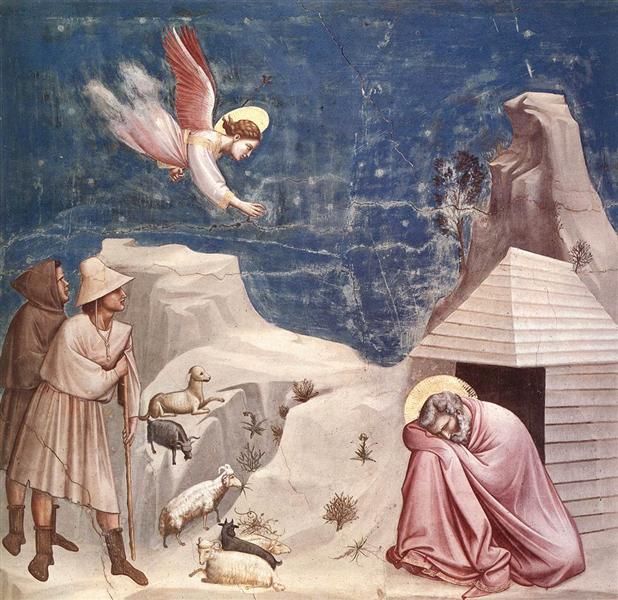
There is less that speaks to me of anything but a beautiful painting well researched and beautifully interpreted – as picture becomes word: whatever the art historian says of the wordlessness of the historical document in the piece on Giotto Joachim’s Dream (1303-5).What strikes you here in particular is the strong way in which the art criticism of Ruskin is rescued and brilliantly used to truly illuminate the painting and not just its context. The main gain for Clark’s overall argument is the painting’s contrast of the dream and the ‘down-to-earth’ facts of that for which a sterile man dreams, but the gain for me is purely in allowing me to see structure discussed in relation to volume and weight. There is great beauty in this perception:
The hut and the hillside as Giotto presents them give Joachim the standing he lacks they set him upright, lend him a grey solidity. The man we see next in Golden Gate has only recently, we sense – and tentatively – regained his footing.
ibid:66
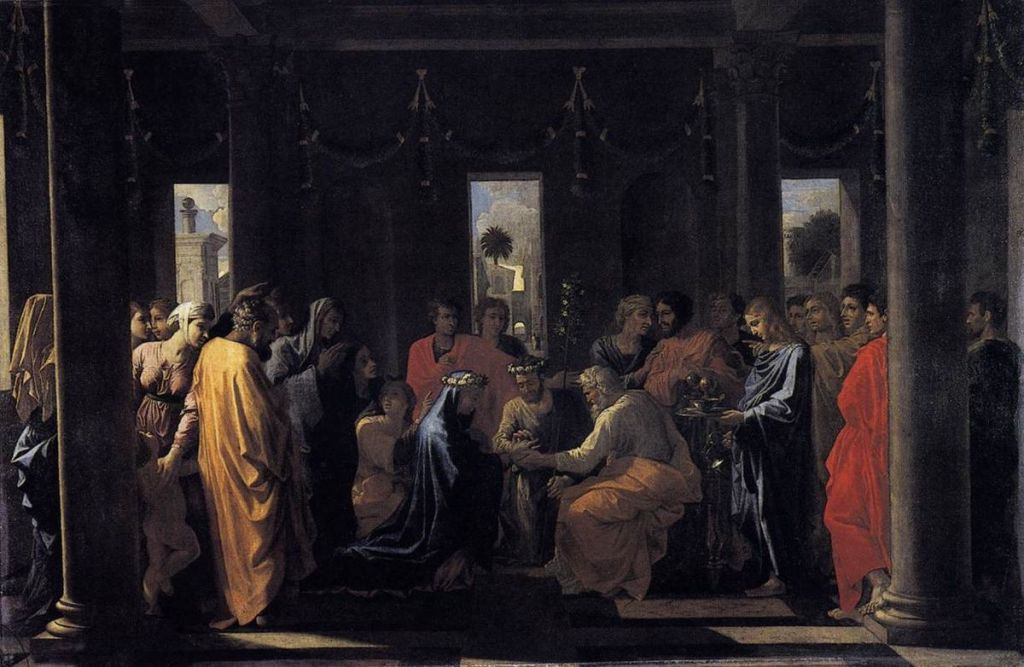
This play on the appearances of bi-pedal stance and the threat of fall ring the changes across other painting, such as Poussin’s The Sacrament of Marriage (1647-8), where the agency of the uncertain fall of light amongst standing figures and vertical architectures is all important.
And finally the account of Picasso’s The Fall of Icarus (1958), which might not portray a passive fall but an active dive, and perhaps not Icarus at all.
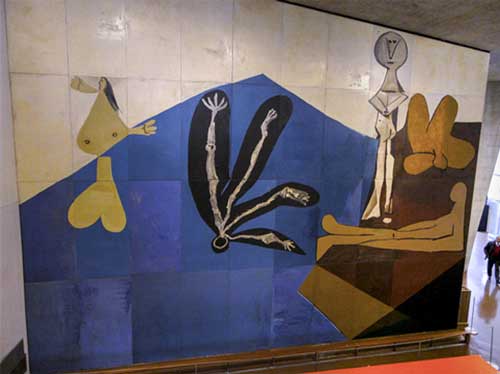
Does this painting deserve the weight of responsibility for illustrating the fall into the millenarian in twentieth century discourses, and the belittling of Picasso’s choice of Communism. I think not. Here the discussion is outweighed by the desire to make a point that seems to have overtaken Clark.
In a sense Clark illustrates in this broken but brilliant book that art history that is not a training into skills that then give themselves up to the interdisciplinary is not viable. All sub-histories are histories – each is only fuzzily connected to another history. Making sense of the overlaps is history constantly re-historized. The book made me certain that art history fails currently to answer to any need but an elite’s.
Of course it’s merely a personal opinion.
Steve
[1] The eclectic list from the References gives a taste of the ‘variety’ so subjectively selected here Carlo Levi (1945), A.C. Bradley (1904), Vernant & Vidal-Naquet on Greek ritual (1988), Mazower (1998), Walter Benjamin, Moses Wall from Christopher Hill, Flood on Aboriginal society (2007), William Hazlitt, Nietzsche.
 Steve_Bamlett_blog
_Nicolas_Poussin.jpg)